Key Stats for DoorDash Stock
- Current Price: $177.73
- Target Price (Mid): ~$931
- Street Target (Mean): ~$245
- Potential Total Return: ~424%
- Annualized IRR: ~45% / year
Now Live: Discover how much upside your favorite stocks could have using TIKR’s new Valuation Model (It’s free) >>>
What Happened?
DoorDash (DASH) pays to operate three separate technology stacks while building a fourth that will replace all of them. Management has been open about the cost, and on the May 6 first-quarter call, CFO Ravi Inukonda gave the overlap a termination date.
He described the structure directly: “there is a portion of the spend, which is redundant in the sense that we are going to run all 3 tech stacks in parallel while we’re working on the global new tech stack.” Then the timing: “My expectation is majority of that will run through ’26. Maybe some portion will bleed into early 2027, but that will bleed out.”
Shares closed at $177.73 on July 22 after falling 5.48% in a session with no confirmed catalyst. Quiver Quantitative found no material filing or company announcement tied to that date and attributed the move to pre-earnings positioning, while other commentary pointed to broader consumer-spending concerns. No single explanation has been established. With second-quarter results due August 5, the near-term print draws attention. The 2027 expiry decides more, because it is the mechanical basis for the operating margin expansion sitting in forward estimates.
A Cost Line That Terminates, and the Offset Management Already Flagged
The three live platforms are DoorDash’s own, Wolt (the Finnish operator acquired in 2022), and Deliveroo (the UK platform acquired for £2.9 billion in 2025). Inukonda has previously described the investment as “several hundred million dollars back into the platform.”
Co-Founder and CEO Tony Xu explained the logic: shipping one feature today requires shipping it “3 separate times across DoorDash, Wolt, and Deliveroo.” Under one stack, once.
Inukonda said design work is complete. “That part is done. Now we are focused on execution. We’re starting to see production traffic go through.” He also held the budget flat, saying his view on total dollars “has stayed the same” and remains “largely in line with what I had expected 2 quarters ago.” That stability matters as much as the end date, because a cost estimate that has not moved in two quarters is a cost estimate management believes it controls.
Most operating expenses scale with the business. This one is scheduled to stop, and when it does the cost disappears while the revenue it supported stays. TIKR’s estimates show EBITDA margins moving from 20.5% in 2026 toward around 30% by 2030 while revenue growth cools from 28.2% to 14.5%, a trade the consolidation is meant to fund.
Management flagged an offset in the same call. Inukonda said the company would “push out some investments into the first half, into the second half,” making room for other costs earlier in the year. Deferred spending returns. The second half of 2026 carries expenses the first half avoided, which means the margin path is not a clean line down.
The larger risk is the word “expectation.” A consolidation spanning three brands and dozens of countries slipping twelve months pushes the inflection past what today’s valuation assumes.
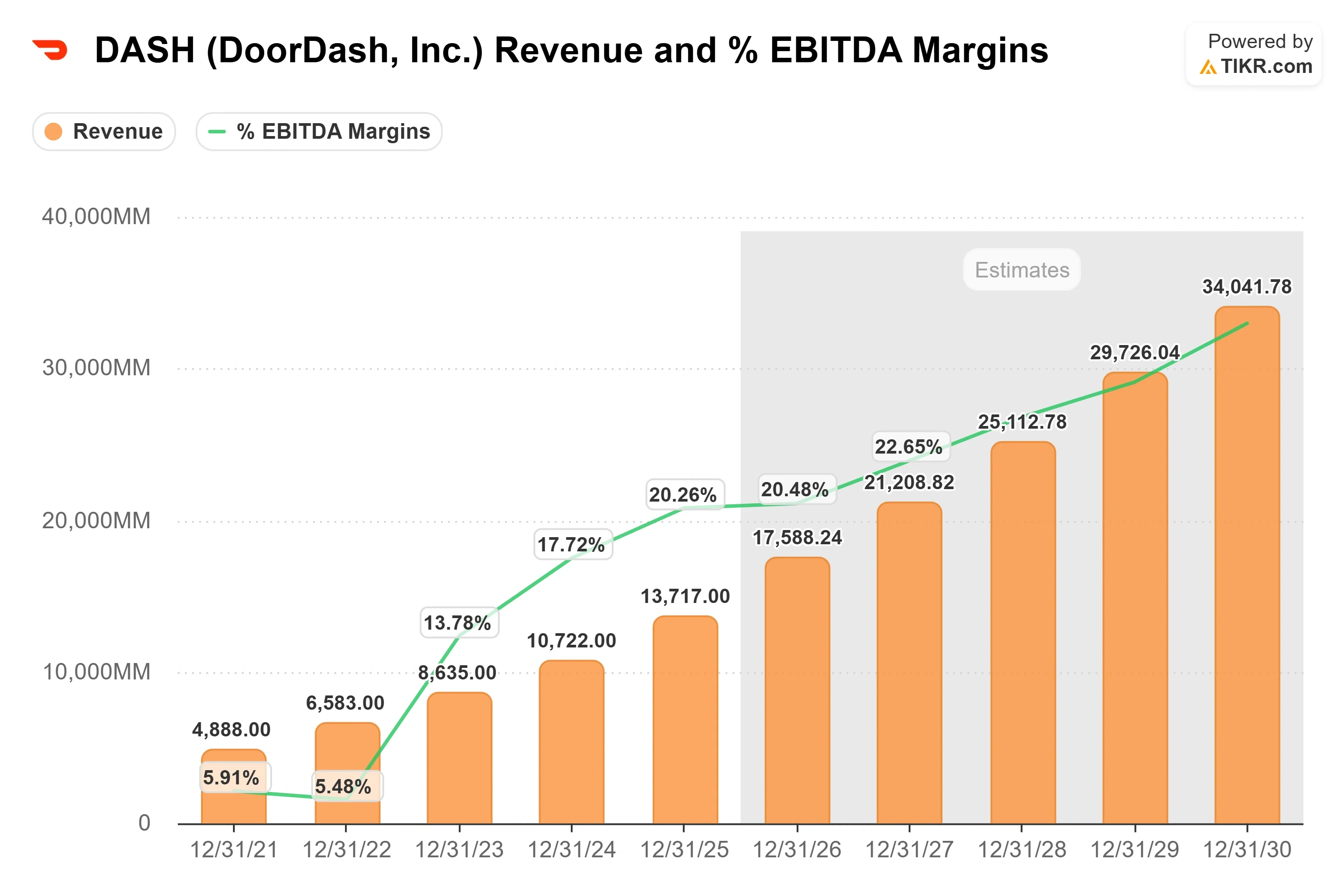
See historical and forward estimates for DoorDash stock (It’s free!) >>>
Xu’s Answer on Whether AI Agents Can Get Between DoorDash and Its Customers
Analysts pressed Xu twice on whether AI assistants could wedge themselves between the platform and the consumer, reducing DoorDash to commodity logistics. He answered with history.
Google ran food ordering through Maps and Search starting in the mid-2010s and shut it down after roughly eight years, Xu said. Google could drive far more traffic than anyone, “yet the retention of that traffic was a fraction of what platforms like DoorDash saw.” His conclusion: customers do not stay loyal to whoever surfaces the order, only to whoever fulfills it.
The asset he named as the defense is a catalog of physical-world inventory, “collecting where every banana sits or every ripe or unripe avocado to every size shoe in whatever color and style.” He claimed that data “does not exist in any digital repository” and “cannot be scraped.” That is a moat argument, and it is unverified from outside the company.
AI is already changing the internal cost base. Xu said “probably closer to 2/3 of our code” is written by AI, then declined to claim a customer benefit yet: “right now, we’re delivering features faster. We’re delivering, like, projects faster, components faster. But I think the customer holds us to a higher bar than that, which is can you actually deliver outcomes much faster.” Inukonda guided near-term operating expense growth to “roughly be in the 2% range.”
A chief executive reporting that two-thirds of his code is machine-written, then saying it has not yet proven it improves outcomes, is a more useful disclosure than most productivity claims investors receive.
The Category Management Calls Unfinished
Xu said DoorDash gained “about 1 in every 2 new customers that come into the industry for grocery delivery for the first time,” and Inukonda said the new-verticals portfolio should turn gross profit positive in the second half of 2026, adding “we’re trending well towards that.”
Xu still described the grocery as incomplete. It has “miles to go on building an experience that I think can outcompete you going into a grocery store and buying the items yourself.” The obstacle he named is inventory visibility: because shoppers move items and store systems do not reconcile, “it’s really hard for them to know where things are.”
His answer is DashMart Fulfillment Services, an inventory and fulfillment layer run with partners. It is deliberately small, live with “a handful of grocery and retail partners today,” because Xu wants to “nail the experience before we scale it.” That is a cost carried now against revenue that arrives later, and it sits alongside the platform rebuild rather than after it.
The international footprint that the single stack must unify has grown fast. Geographic segment revenue outside the United States went from $11 million in 2021 to $2,257 million in 2025, while US revenue grew from $4,877 million to $11,460 million over the same period. On July 14 DoorDash also became a native sales channel inside Shopify’s App Store, letting US merchants with physical stores list inventory without separate onboarding, which adds catalog breadth without adding a platform to consolidate.

See how DoorDash performs against its peers in TIKR (It’s free!) >>>
TIKR Advanced Model Analysis
- Current Price: $177.73
- Target Price (Mid): ~$931
- Potential Total Return: ~424%
- Annualized IRR: ~45% / year

See analysts’ growth forecasts and price targets for DoorDash stock (It’s free!) >>>
Model entry price is $177.73, matching the July 22 close.
- Revenue driver 1: category expansion beyond restaurants, where Xu said DoorDash gained roughly half of all first-time grocery delivery customers entering the industry.
- Revenue driver 2: international scale, with non-US segment revenue at $2,257 million in 2025 against $11 million in 2021.
- Margin driver: the redundant platform spending ending, which Inukonda expects to bleed out in early 2027.
- Primary risk: that timeline slipping, delaying the margin inflection past what the current valuation assumes.
- Upside: new verticals turn gross profit positive as guided, redundant spending rolls off, margins expand while revenue still grows above 20%.
- Downside: grocery stays as unfinished as Xu describes, fulfillment investment keeps consuming cash, and the rebuild runs long.
One caveat on the target. A ~424% return implies a rerating beyond any covering analyst’s forecast: TIKR shows a Street mean of $245.20 and a high of $350.00, against 26 Buys, 9 Outperforms, and 9 Holds as of July 22. Treat the mid case as a long-horizon scenario, not a price forecast.
Conclusion
The August 5 report covers a quarter. It will not settle whether the rebuild is on schedule, and that is the larger question.
Listen for whether Inukonda restates “early 2027” or lets it drift. If he repeats the timeline and confirms redundant costs are declining, the margin expansion in forward estimates has a mechanical foundation. If the language shifts toward “through 2027,” or the total cost estimate rises from a level he has held steady for two quarters, the inflection is being deferred, and a stock at 19.49x forward EV/EBITDA is paying for something further out than it thought.
See what stocks billionaire investors are buying so you can follow the smart money with TIKR.
Should You Invest in DoorDash?
The only way to really know is to look at the numbers yourself. TIKR gives you free access to the same institutional-quality financial data that professional analysts use to answer exactly that question.
Pull up DoorDash, and you’ll see years of historical financials, what Wall Street analysts expect for revenue and earnings in the quarters ahead, how valuation multiples have moved over time, and whether price targets are trending up or down.
You can build a free watchlist to track DoorDash alongside every other stock on your radar. No credit card required. Just the data you need to decide for yourself.
Analyze DoorDash on TIKR Free →
Looking for New Opportunities?
- See what stocks billionaire investors are buying so you can follow the smart money.
- Analyze stocks in as little as 5 minutes with TIKR’s all-in-one, easy-to-use platform.
- The more rocks you overturn… the more opportunities you’ll uncover. Search 100K+ global stocks, global top investor holdings, and more with TIKR.
Disclaimer:
Please note that the articles on TIKR are not intended to serve as investment or financial advice from TIKR or our content team, nor are they recommendations to buy or sell any stocks. We create our content based on TIKR Terminal’s investment data and analysts’ estimates. Our analysis might not include recent company news or important updates. TIKR has no position in any stocks mentioned. Thank you for reading, and happy investing!