Key Stats for IBM Stock
- Current Price: $205.77
- Target Price (Mid): ~$300
- Street Target: ~$263
- Potential Total Return: ~46%
- Annualized IRR: ~9% / year
- Max Drawdown: 37.50% on 7/22/26
Now Live: Discover how much upside your favorite stocks could have using TIKR’s new Valuation Model (It’s free) >>>
What Happened?
International Business Machines Corporation (IBM) said two different things about the same number on July 22.
The company cut full-year constant currency revenue growth to a range of 4% to 5%, down from a prior outlook above 5%. CFO Jim Kavanaugh described the bottom of that range as a deliberate construction rather than a forecast. He also said, in prepared remarks, that the bottom of the range is what the company actually expects. Shares closed at $205.77, down 2.25%, having already absorbed a 25.21% single-day decline on July 14 when IBM pre-announced preliminary results.
Reconciling those two statements is most of the work of reading this quarter.
The Anchor and the Base Case Are the Same Number
Kavanaugh’s framing to Evercore ISI’s Amit Daryanani was that the floor exists to prove something: “That low end of the range we put in as an anchor,” he said, “an anchor so that we can show the investment community the level of productivity and operating leverage we have in this company that allows us to maintain earnings and maintain free cash flow at that low level.” Pressed later by Jefferies’ Brent Thill on whether current conditions persist, he said flatly: “That’s not what we’re seeing here.”
In prepared remarks earlier on the same call, he had said the opposite: “We believe the low end of the revenue range appropriately reflects the current environment and is our base case.”
Both readings carry evidence. IBM held its commitment to grow free cash flow by about $1 billion this year and raised expected operating pretax margin expansion to 100 basis points, an unusual pairing with a revenue cut. First-half free cash flow was $4.8 billion, flat year over year, with adjusted EBITDA up roughly $700 million offset by inventory, cash taxes, and net interest, per the company’s Q2 release.
Against that, margin expansion driven by cost actions during a demand shortfall is also what a company does when defending earnings through a genuine slowdown. The same facts fit both stories, which is why the guidance language matters more than usual.

See historical and forward estimates for IBM stock (It’s free!) >>>
The Mainframe Fell 42%, and a Third of the Slipped Deals Have Closed
The damage was concentrated. IBM Z revenue fell 42%, lapping a 70% growth quarter during the z17 launch, and Infrastructure declined 7% to $3.84 billion. On a constant currency basis, the measurement IBM uses for all revenue commentary, Transaction Processing fell 9%, while Data grew 18%, and Automation grew 3%.
Before the July 14 warning, the Street sat near $17.86 billion per FactSet and LSEG, and reported revenue of $17,162 million fell roughly $700 million short of it. That is the gap the market repriced on July 14. Analysts then cut their estimates to reflect what IBM had already disclosed, and against that reset consensus of $17,263.69 million, the shortfall was 0.59%. The smaller number does not evidence that the quarter was fine. It mostly reflects that the market had already been told.
Against that, Krishna offered the closest thing to evidence for deferral. The shortfall sat in large capital expenditure transactions, in the low tens by count, and about a third had already closed. “Normally, we would not expect all of them to close, but we would expect maybe 2/3 to 3/4 of them to close over the next 6 months,” he said. “So the fact that 1/3 have already closed in the first 3 weeks gives us an indication, not yet full evidence, but a good indication that this was deferral and not destruction.” Kavanaugh put it at “1/3, 40%” and said IBM had lost perhaps one or two outright.
Why they slipped is the more useful detail. Krishna said clients found mid-quarter that competing hardware purchases were rising roughly 30% in dollar value quarter to quarter, and moved the budget toward the prices running away from them. IBM had not raised prices through July and is, in his words, “nowhere near as aggressive as some of the alternate infrastructure providers.”
Two figures support management’s claim that nobody is leaving the platform. Kavanaugh said clients see a 2 to 15 times total cost of ownership advantage running workloads on the mainframe versus moving them off, depending on size and complexity, and that clients representing 85% of installed MIPS are maintaining or growing capacity. The mainframe also carries software with it: every dollar of hardware revenue landed brings roughly three dollars of software on long-term commitments. That multiplier is why Kavanaugh guided Transaction Processing down low to mid single digits for the second half and called it “a 2027 growth vector opportunity for us.”

See how IBM performs against its peers in TIKR (It’s free!) >>>
The Recurring 80% Grew While the Transactional 20% Broke
Software grew 5% overall, but organic growth was flat, with reported growth carrying contributions from recent acquisitions.
The recurring base performed. Annual recurring revenue, meaning the annualized value of subscription contracts in force, reached $24.6 billion, up 8%. Red Hat accelerated a point sequentially to 11%. Krishna said OpenShift ARR now sits at $2.2 billion, while the 10-Q states it is over $2 billion. Distributed Infrastructure grew 37% and exited with about $500 million of backlog. Consulting signings grew 6%, with generative AI at roughly half of signings.
Krishna would not soften the long-term software target when Melius Research’s Ben Reitzes pressed him: “We and I have complete conviction in the double-digit long-term software growth.” He noted the recurring-to-transactional mix, now 80/20, was 60/40 years ago and continues shifting.
One newer risk sits outside the numbers. Plaintiffs’ law firms, including Bleichmar Fonti & Auld and Pomerantz, have announced investigations into whether IBM’s earlier statements about its deal pipeline were accurate. Those are client solicitations by firms that bring securities class actions, not regulatory actions or filed charges, and no allegation has been tested.
The newest revenue line remains unquantified. IBM and Red Hat commercially launched Lightwell on July 8, an open source vulnerability remediation service built on a $5 billion commitment announced in May and staffed by more than 20,000 engineers. It ships as two offerings: Lightwell Network, generally available with a launch catalog of more than 6,500 remediated dependencies, and Lightwell Clearinghouse Premier, in limited availability and initially restricted to financial services. On the call, Krishna cited a $1 million per year subscription and said IBM had made more than 7,500 package versions available, though he used both two-week and three-week framings for that figure. He put the opportunity in the billions without committing to a number. That is a stated price and an ambition, not booked revenue.
TIKR Advanced Model Analysis
- Current Price: $205.77
- Target Price (Mid): ~$300
- Potential Total Return: ~46%
- Annualized IRR: ~9% / year
See analysts’ growth forecasts and price targets for IBM stock (It’s free!) >>>
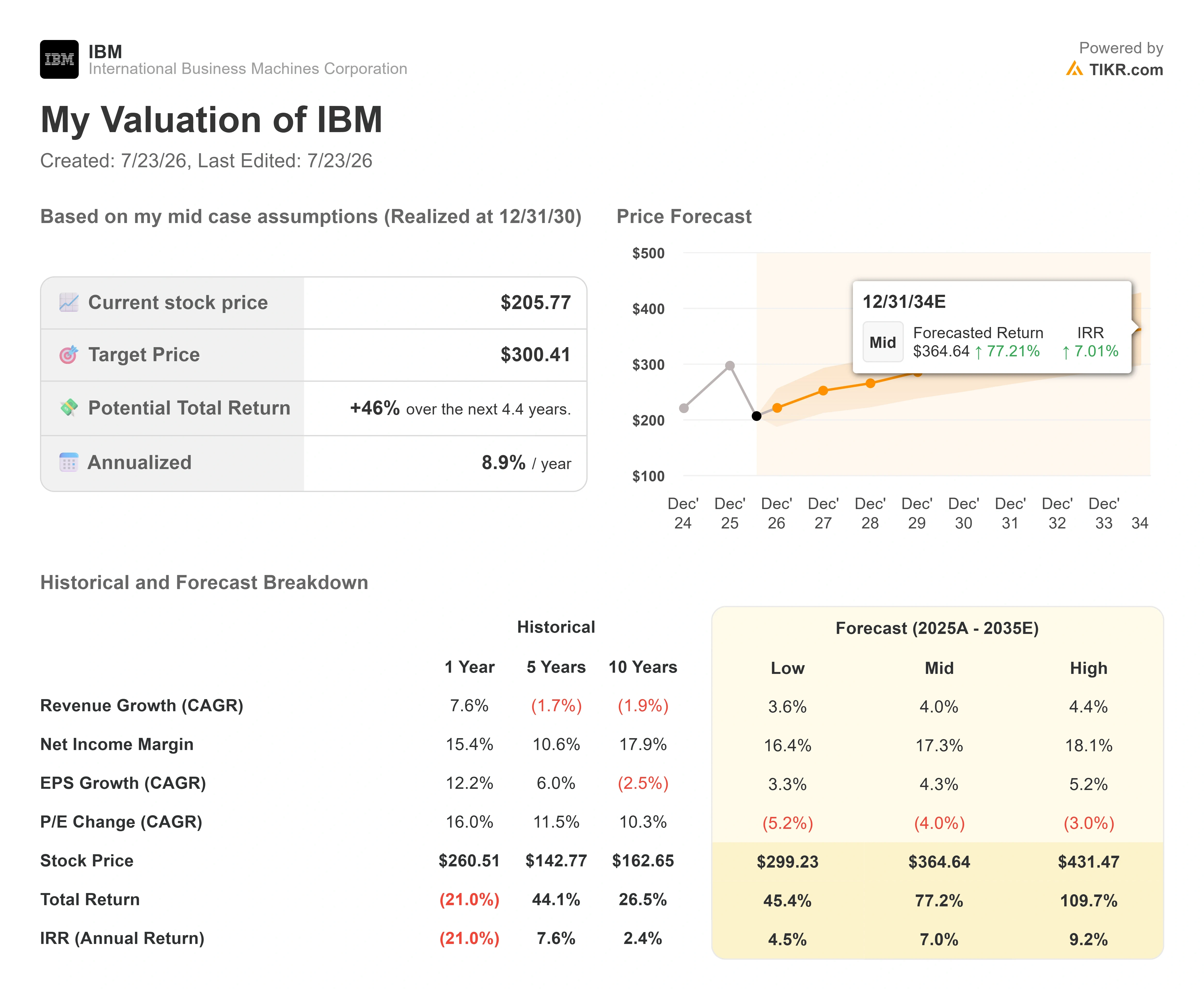
Using the mid case, the model reaches roughly $300 by December 2030, about 46% total return from $205.77, or around 9% annualized. The Street’s ~$263 mean measures something different: twelve months against the model’s four-year view.
Two drivers carry the revenue CAGR. The first is the recurring software base, where ARR of $24.6 billion is growing 8%, and Red Hat at 11% compound, independently of the transactional business that missed. The second is Distributed Infrastructure, growing 37% off a record $500 million backlog.
The margin driver is productivity: 160 basis points of segment margin expansion in Consulting and 110 in Software this quarter, with full-year operating pretax margin guidance raised to 100 basis points despite lower revenue. The primary risk is that the Transaction Processing weakness proves structural rather than timing, since management has already pushed its recovery to 2027, idling the mainframe software multiplier for roughly eighteen months.
Upside: the remaining slipped deals close, z17 holds above 120% program to program, and software reaches the top of its 6% to 8% range against an expanding margin base. Downside: enterprise budgets stay redirected toward AI infrastructure through 2027, Transaction Processing stays negative, and a business growing 1% gets valued like one.
On valuation, TIKR’s competitor screen puts IBM at around 16x forward earnings against Cognizant at around 7x and Tata Consultancy Services at around 14x, the two closest IT services comparables by business mix. IBM’s own forward multiple was around 25x at the end of December 2025 on a business generating similar cash flow, which is the more useful comparison: the re-rating has happened against IBM’s recent history, not against its peer group.
Conclusion
Kavanaugh named the two numbers he wants to be judged on.
The first is z17 program-to-program performance, which exited Q2 at nearly 130% of the z16 cycle at the same point. Holding “high 120%-plus” is what he said carries IBM to the top of its range.
The second is software. The 6% to 8% full-year range resolves on whether the recurring 80% accelerates from 8% toward 10% in the second half. At or above 8% for the year means the pipeline converted. Near 6% means June’s buying behavior became the norm.
Third-quarter results are scheduled for October 21, 2026. By then, Krishna’s one-third will have had a full quarter to become two-thirds, or to stop where it is.
See what stocks billionaire investors are buying so you can follow the smart money with TIKR.
Should You Invest in IBM?
The only way to really know is to look at the numbers yourself. TIKR gives you free access to the same institutional-quality financial data that professional analysts use to answer exactly that question.
Pull up IBM, and you’ll see years of historical financials, what Wall Street analysts expect for revenue and earnings in the quarters ahead, how valuation multiples have moved over time, and whether price targets are trending up or down.
You can build a free watchlist to track IBM alongside every other stock on your radar. No credit card required. Just the data you need to decide for yourself.
Looking for New Opportunities?
- See what stocks billionaire investors are buying so you can follow the smart money.
- Analyze stocks in as little as 5 minutes with TIKR’s all-in-one, easy-to-use platform.
- The more rocks you overturn… the more opportunities you’ll uncover. Search 100K+ global stocks, global top investor holdings, and more with TIKR.
Disclaimer:
Please note that the articles on TIKR are not intended to serve as investment or financial advice from TIKR or our content team, nor are they recommendations to buy or sell any stocks. We create our content based on TIKR Terminal’s investment data and analysts’ estimates. Our analysis might not include recent company news or important updates. TIKR has no position in any stocks mentioned. Thank you for reading, and happy investing!