


Key Stats for Palantir Stock
- Current Price: $124.57
- Target Price (Mid): ~$819
- Street Target: ~$183
- Potential Total Return: ~558%
- Annualized IRR: ~53% / year
- Max Drawdown: 48.22% on 6/25/26
Now Live: Discover how much upside your favorite stocks could have using TIKR’s new Valuation Model (It’s free) >>>
What Happened?
Palantir Technologies (PLTR) closed July 22 at $124.57, down $8.09 or 6.10%, with two unrelated headlines in circulation. Traders discussed a free open-source tool called World Monitor, posted to GitHub, described as performing real-time global event monitoring. That claim originated in a single social-media post and was relayed by financial wires; no source has independently assessed what the tool does or confirmed it moved the stock, and the reporting describes it as a possible contributor rather than an established cause. Separately, the UK’s Office for Statistics Regulation addressed public concerns about how NHS England communicated performance metrics for its Federated Data Platform, a Palantir-built system. That is regulatory attention to a live international healthcare contract, which is a real company-specific matter rather than background noise.
What the session did expose is how thin the conviction is under a stock trading at around 78x NTM P/E, meaning price divided by expected earnings over the next twelve months. Shares sit 39.87% below their 52-week high of $207.52 as of July 22, and the maximum drawdown over the past year reached 48.22% on June 25, 2026.
Palantir’s CTO Already Argued That Cheap, Abundant AI Helps Him
Nothing in the May 4 earnings call anticipated the July 22 headlines. But CTO Shyam Sankar spent his prepared remarks on the exact economics a free competing tool implies, and his conclusion ran opposite to that day’s tape.
Sankar’s argument was that model capability is commoditizing quickly and that this favors Palantir. He noted that GPT-4 equivalent performance costing $20 per million tokens in early 2023 is now roughly 1,000 times cheaper, and framed the consequence as Jevons paradox, the observation that falling unit cost raises total consumption rather than lowering it. In his words, “Tokens are the new coal, AIP is the train.” AIP is Palantir’s Artificial Intelligence Platform, the layer connecting language models to a company’s data and operations.
The corollary he drew bears directly on cheap alternatives: “More tokens means more slop.” His position is that as capability gets cheaper and more abundant, the scarce resource becomes the system that makes the agent’s output trustworthy enough to run a business on. He laid out three questions he says customers must answer for every agent action: “Who authorized this? What did it cost? Can I trust what it did?”
Palantir’s answer is a governance layer rather than a capability layer: cost attribution per agent, and per workflow, provenance tracing every data change back to the reasoning chain that produced it, and security marking carrying classification from input through to output. Sankar’s stated bar for that work was blunt: “That’s how you get a CISO, a CFO and a combatant commander to say yes.”

That is management’s framing, made on May 4, and investors are entitled to discount it. It is also the specific claim a free monitoring tool would need to disprove.
See historical and forward estimates for Palantir stock (It’s free!) >>>
What 200 Hours to 15 Seconds Says About Switching Costs
Describing ShipOS, Palantir’s work with the Department of the Navy on shipbuilding, Chief Revenue Officer and Chief Legal Officer Ryan Taylor cited results at industrial-base suppliers: manufacturing bill of materials approval time falling from 200 hours to 15 seconds, contract review cycles speeding up by 57% to 73%, and monthly material planning time dropping 94%.
Sankar separately pointed to Thomas Cavanagh Construction, where he said 97% of employees use Foundry every day. Foundry is Palantir’s enterprise operating platform, which unifies a company’s data, workflows, and models in one environment. He added that Palantir replaced its own customer relationship management system during the quarter with an AIP-built alternative.
These are management’s characterizations of customer outcomes, not audited metrics, and they should be read as such. What they describe is software embedded in daily operations across thousands of users, a different competitive category from a tool that watches world events. Sankar said Maven usage doubled in the four months through the end of March and stands at four times its year-ago level across the services, the combatant commands, the joint staff, and the intelligence community.
The financials behind that embedding are already public: first-quarter revenue of $1.633 billion beat the $1,541.67 million consensus by 5.90%, and net dollar retention, which measures revenue growth from existing customers, reached 150%. In each of the five quarters shown in TIKR’s data, Palantir beat consensus on both revenue and adjusted earnings per share.
The Small Business Administration announced on July 14 a new phase of its pandemic-relief anti-fraud initiative using Palantir software, formalizing a pilot that began with a $300,000 contract in January. No new contract value was disclosed, so this is a scope announcement rather than a confirmed revenue event.

See how Palantir performs against its peers in TIKR (It’s free!) >>>
The Multiple and the Budget Are the Real Risks
Palantir trades at around 34x NTM enterprise value to revenue and around 78x NTM P/E. Microsoft, the most expensive named peer on TIKR’s Competitors page, trades at 8.00x forward revenue and 21.08x forward earnings. Oracle sits at 5.64x and 15.63x, ServiceNow at 5.68x and 21.16x. Palantir carries roughly four times Microsoft’s forward revenue multiple.
An 84.1% gross margin over the last twelve months and a 38.1% EBIT margin, meaning earnings before interest and taxes, justify part of that, and no named peer is growing 85%. But a multiple that far above the group means the stock reprices on sentiment as readily as on results, which a 6.10% single-session move on two non-financial headlines demonstrated.
Government exposure is the risk that the multiple debates tend to crowd out. Sankar acknowledged on the May 4 call that a continuing resolution is the historical norm rather than the exception, saying that for most of Palantir’s existence, there has always been one, and that certain outcomes sit outside the company’s control. With US government revenue at $687 million in the quarter, appropriations timing is a live variable.
TIKR Advanced Model Analysis
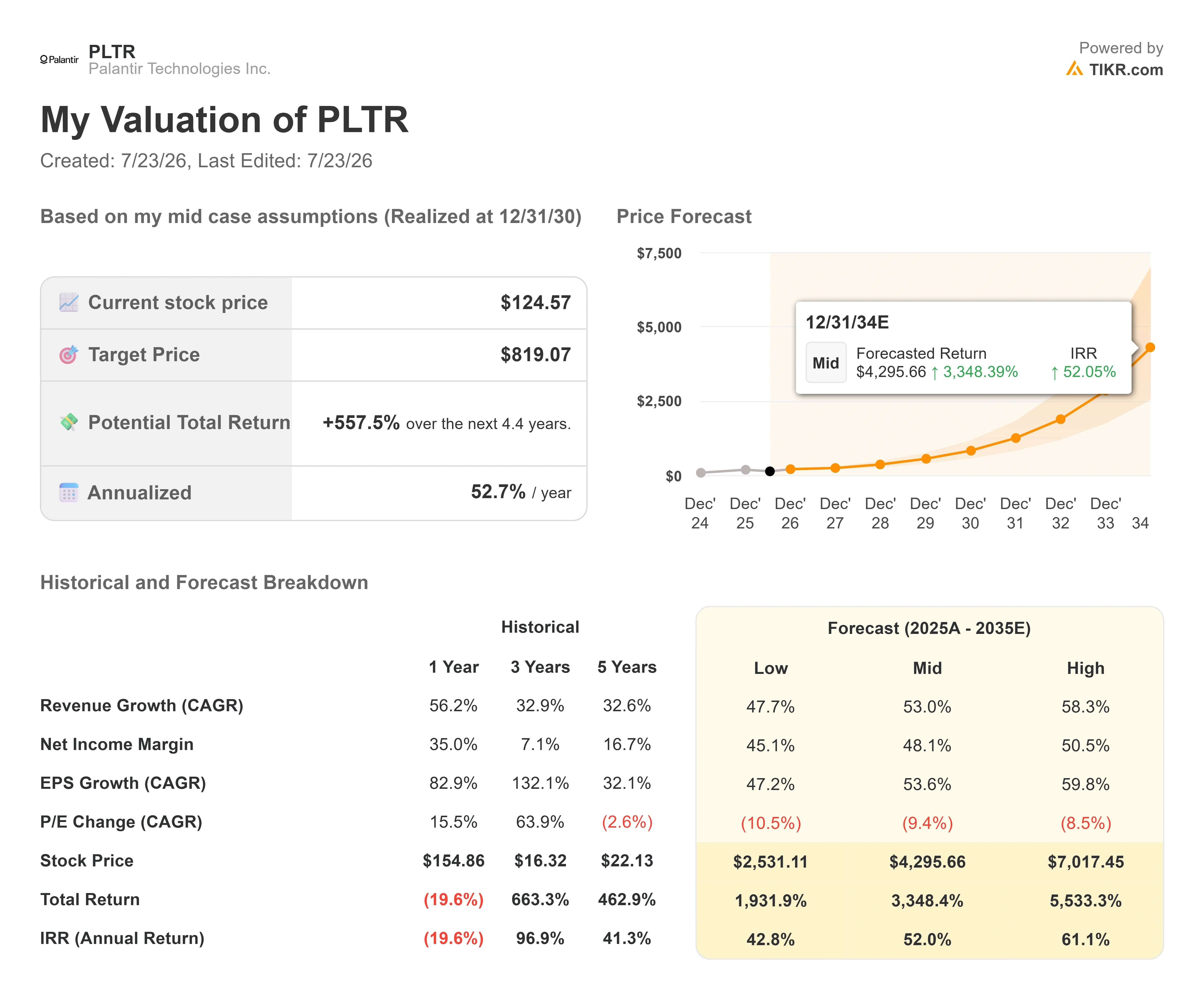
- Current Price: $124.57
- Target Price (Mid): ~$819
- Street Target: ~$183
- Potential Total Return: ~558%
- Annualized IRR: ~53% / year
See analysts’ growth forecasts and price targets for Palantir stock (It’s free!) >>>
Using the mid-case scenario, TIKR’s model produces a target of around $819 realized at the end of 2030, implying roughly 558% total return and about 53% annualized over 4.4 years. That sits far above the Street’s ~$183 mean, and the two measure different things: sell-side targets conventionally run twelve months out, while this model runs to 2030. The gap is a difference in horizon, not a hidden upside.
Two revenue drivers carry the mid case. The first is US commercial, which grew 133% year over year in the first quarter and which management guides to at least 120% growth for full-year 2026. The second is the US government, where Sankar described Maven usage quadrupling over twelve months. The model assumes a 53% revenue CAGR, above the 32.9% delivered over the past three years but below the 56.2% of the past year.
The margin driver is operating leverage on that 84.1% gross margin, with the model assuming net income margins reaching around 48% against 35% today. The primary risk is multiple compression: the model already assumes a 9.4% annual decline in the P/E, and any deceleration would compress the multiple faster than earnings growth could offset.
Upside: if US commercial growth holds above 120% while margins expand toward 48%, the compounding produces returns no peer multiple anchors. Downside: at around 78x forward earnings, one quarter of decelerating US commercial growth could retest the June low regardless of whether any competitive threat proves real.
Conclusion
Palantir reports second-quarter results on August 3 after the close. Management guided revenue to between $1.797 billion and $1.801 billion and US commercial to at least 120% growth for the full year.
US commercial is the line that settles this. At or above 120%, the growth streak holds and July 22 reads as positioning noise ahead of a print. Below roughly 110%, the streak breaks, and at around 78x forward earnings there is no cushion underneath it. On August 3, the argument stops being about a GitHub repository.
See what stocks billionaire investors are buying so you can follow the smart money with TIKR.
Should You Invest in Palantir?
The only way to really know is to look at the numbers yourself. TIKR gives you free access to the same institutional-quality financial data that professional analysts use to answer exactly that question.
Pull up Palantir, and you’ll see years of historical financials, what Wall Street analysts expect for revenue and earnings in the quarters ahead, how valuation multiples have moved over time, and whether price targets are trending up or down.
You can build a free watchlist to track Palantir alongside every other stock on your radar. No credit card required. Just the data you need to decide for yourself.
Analyze Palantir on TIKR Free →
Looking for New Opportunities?
- See what stocks billionaire investors are buying so you can follow the smart money.
- Analyze stocks in as little as 5 minutes with TIKR’s all-in-one, easy-to-use platform.
- The more rocks you overturn… the more opportunities you’ll uncover. Search 100K+ global stocks, global top investor holdings, and more with TIKR.
Disclaimer:
Please note that the articles on TIKR are not intended to serve as investment or financial advice from TIKR or our content team, nor are they recommendations to buy or sell any stocks. We create our content based on TIKR Terminal’s investment data and analysts’ estimates. Our analysis might not include recent company news or important updates. TIKR has no position in any stocks mentioned. Thank you for reading, and happy investing!


-via-Canva-@Joshua-Woroniecki-from-Pexels-via-Canva/@Aflo-Images-from-アフロ(Aflo)-via-Canva-@Joshua-Woroniecki-from-Pexels-via-Canva)

