Key Takeaways
- Jason Calacanis says robotaxis would need 20 million vehicles doing 20-plus rides a day to reach 3% to 4% of global rides, as a Reuters columnist floats the idea of Alphabet buying Uber to strengthen Waymo.
- That math gives Uber years of ride volume, so its global network is worth more to Alphabet or Tesla as a purchase than as something to beat.
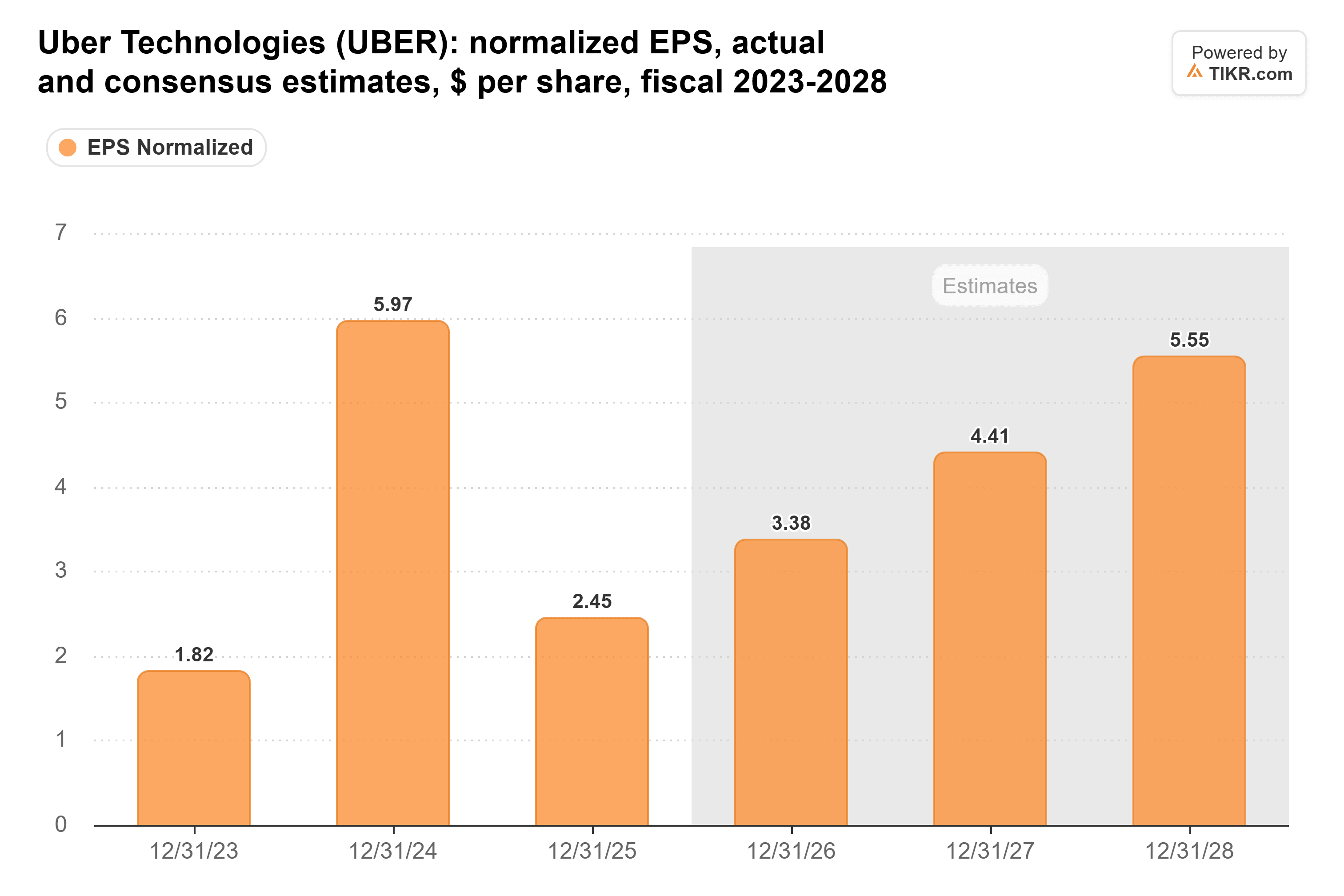
- Uber produced $9.76 billion of free cash flow in 2025, and analysts expect its earnings per share to more than double from 2025 to 2028.
- At 17x forward earnings, Uber trades well below its three-year average of 25x, and Elon Musk’s push for Tesla’s Cybercab to run its own rides is the main risk.
Takeover talk is building around Uber Technologies (UBER).
On Nov. 10, Reuters Breakingviews columnist Jennifer Saba argued that Alphabet (GOOG) could buy Uber and pair its ride network with Waymo’s driverless cars. Jason Calacanis, an early Uber investor who still owns the stock, replied on X on Nov. 13 that “Consolidation is coming to the autonomy space,” and listed Tesla (TSLA) among the companies that could do the buying. Uber closed at $69.69 that day, up 0.82%.
Then he did the math: “It’ll take 20M AVs doing 20+ rides a day to reach 3-4% of global rides.”
That’s a lot of robots.
TIKR tracks 50 analysts on Uber. How many say “Buy”?
See the full breakdown of Buy, Hold, and Sell ratings on Uber, along with Wall Street’s revenue and earnings estimates, all in one place. More than 500,000 investors use TIKR to research stocks like this one. See Uber’s Analyst Ratings
Twenty million robotaxis is a long way off
Twenty million cars doing 20 rides each comes to 400 million rides a day. Uber handled 13.6 billion trips in 2025, counting rides and deliveries, which is about 37 million a day. So Calacanis’s 3% to 4% would take more than 10 times Uber’s entire daily volume.
The fleets aren’t close to that. Calacanis guesses Tesla gets to 250,000 robotaxis in 2027, 500,000 in 2028 and 1 million in 2029. Even 1 million cars doing 20 rides a day only gets about a twentieth of the way to his 3% to 4%. Waymo plans to have 20,000 cars by the end of 2027, Semafor reported. And on Uber’s own platform, autonomous rides are still under 0.5% of trips, management said on its second-quarter call.
Wall Street isn’t expecting robotaxis to eat into Uber’s earnings soon either. Analysts expect normalized EPS to more than double, from $2.45 in 2025 to $5.55 in 2028:
The network is the scarce part
Calacanis also argues that the driving software itself is getting easy. He counts about a dozen companies that have already solved it, Tesla and Waymo among them, and predicts autonomy will be commoditized within two years. If he’s right, the car’s software stops being the edge, and whoever already has the riders holds the advantage. In his words, “no one has them globally in food, grocery and ride-sharing like Uber.”
Uber had 215 million monthly active platform consumers in the third quarter. And 60% of its Mobility gross bookings come from outside the US, management said in February.
That network also brings in a lot of cash. Uber’s free cash flow went from negative in 2021 to $9.76 billion in 2025:
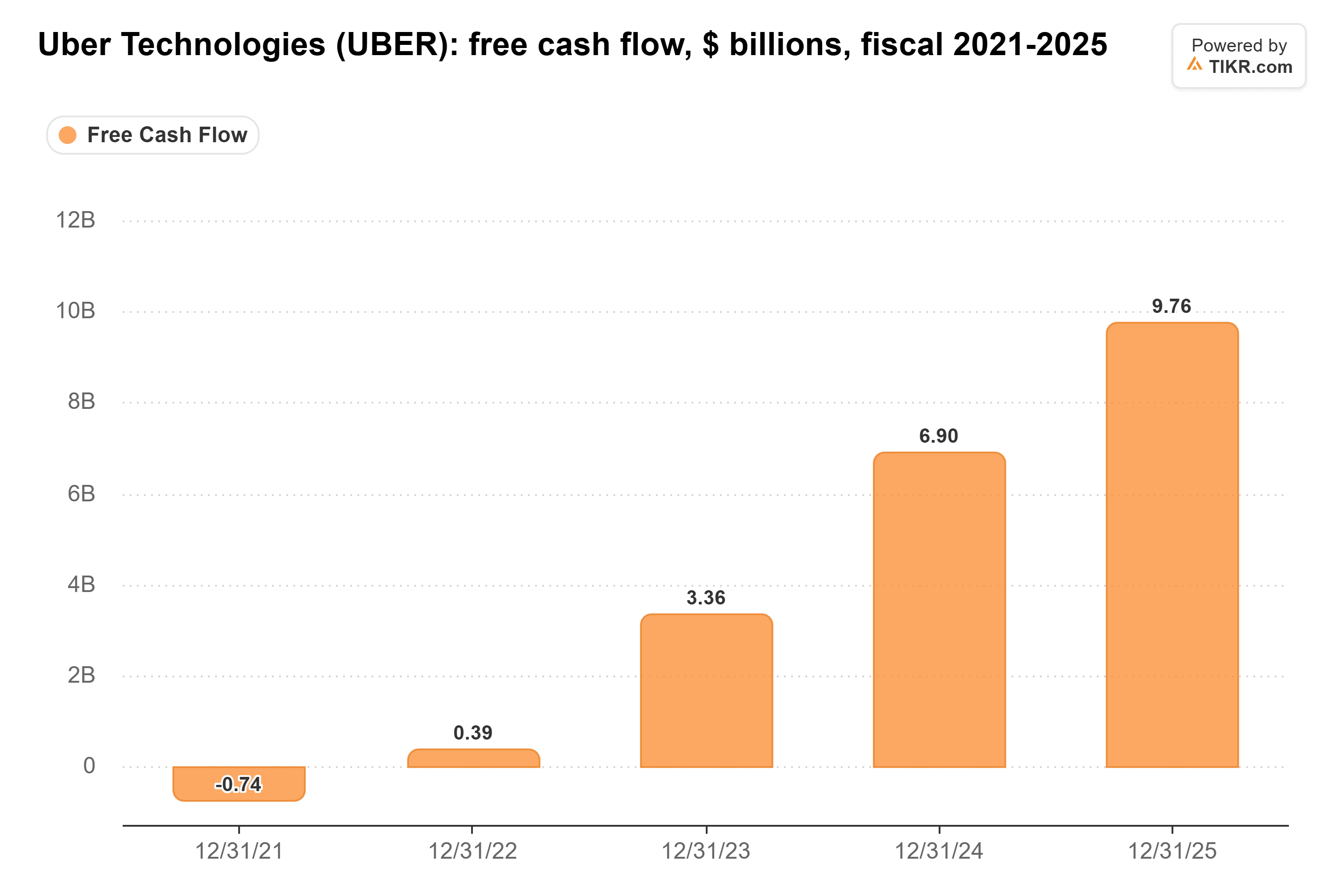
Over the 12 months to September, it reached a record $10.4 billion. A buyer gets all of that. For Alphabet, Uber’s riders could keep Waymo’s cars busy across Uber’s global footprint. Calacanis says Tesla would want it for the “massive free cash and 200m+ users,” and to block competitors.
Cybercab is the real threat
Calacanis owns Uber shares, so he has a stake in that math. Elon Musk thinks robotaxis will move much faster. On Nov. 10, he wrote on X that “Cybercab will do a majority of all passenger miles in any jurisdiction where it is not prohibited by law.”
If Tesla runs its own app in the biggest cities, it could squeeze Uber’s thin margin on each ride long before there are 20 million robotaxis on the road. Waymo also plans to run its own service in Austin and Atlanta from January 2028. But those early robotaxi cities are a smaller part of Uber than they look. Management says the top 20 US cities bring in 25% of Uber’s US profit, and most of its ride bookings come from outside the US.
Priced like the robots already won
Uber’s forward P/E is 17x, just above its three-year low and well below its three-year average of 25x:
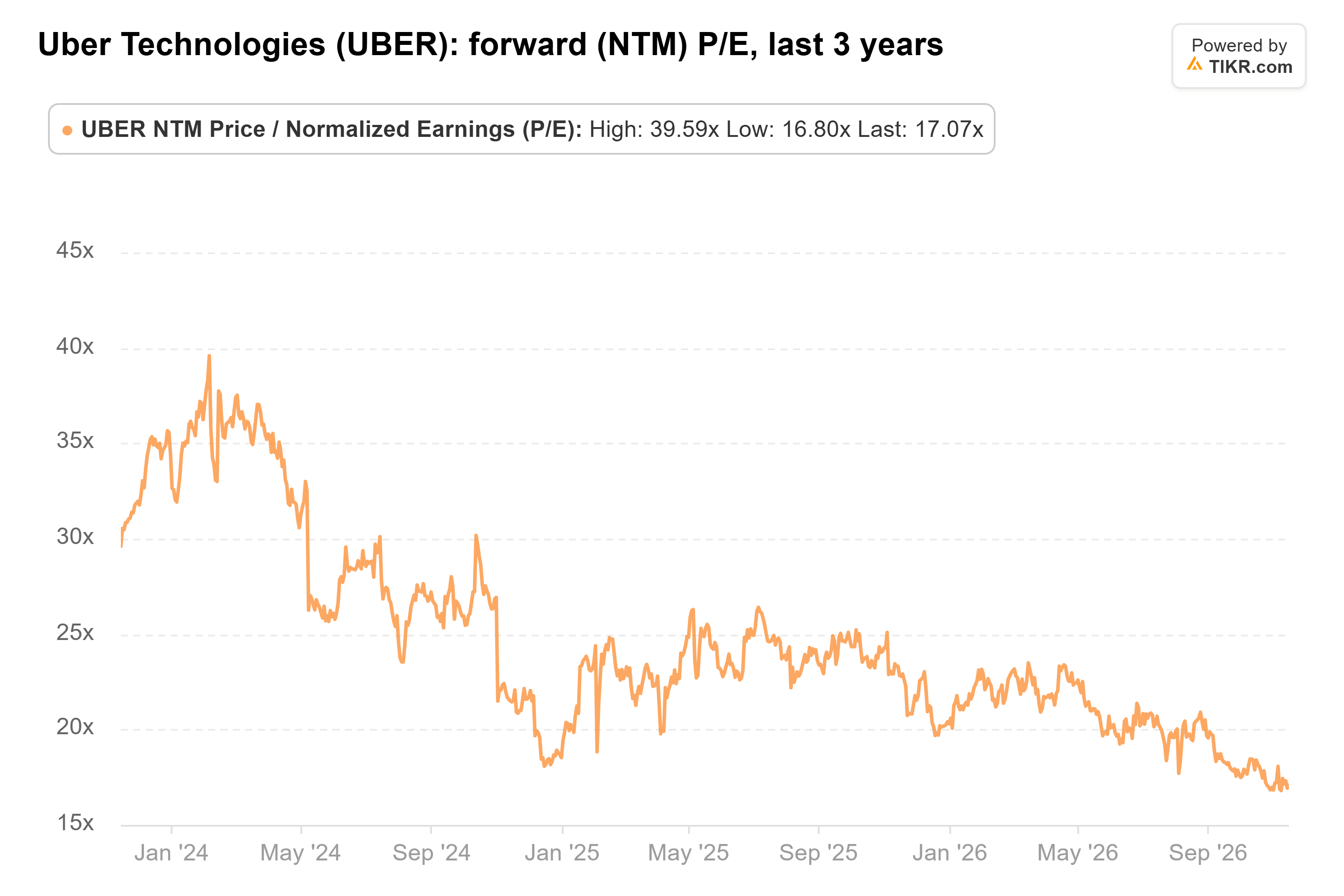
(It was close to 40x in early 2024.) The Nov. 4 outlook didn’t help: Uber guided fourth-quarter non-GAAP EPS to $0.95 to $0.99, below what analysts expected.
Calacanis calls Uber “an absolute steal at this price.” On his math, Uber has years before robotaxis make a real dent in its rides, and at 17x earnings the stock looks cheap whether or not anyone bids. A Reuters column and an X thread aren’t an offer, though, and a deal this size could face a long antitrust review. The nearer test is Uber’s own robotaxi push. It expects about 700 fully driverless vehicles on its platform by year-end, and two of its top autonomy executives, Sarfraz Maredia and Danny Guo, leave on Nov. 16, Bloomberg reported.
So what is Uber stock actually worth?
TIKR lets you forecast the future price of any stock in less than a minute. Just enter a few assumptions into TIKR’s valuation model and see what Uber could be worth. Start from Wall Street consensus estimates, or adjust the inputs to reflect your own view of the business. It’s free to use.
Disclaimer:
Please note that the articles on TIKR are not intended to serve as investment or financial advice from TIKR or our content team, nor are they recommendations to buy or sell any stocks. We create our content based on TIKR Terminal’s investment data and analysts’ estimates. Our analysis might not include recent company news or important updates. TIKR has no position in any of the stocks mentioned. Thank you for reading, and happy investing!