Key Takeaways
- Elon Musk says Tesla’s Cybercab will do most passenger miles wherever the law allows, six days after Uber posted 20% bookings growth.
- A robotaxi price fight would hit Uber’s thin profit on each ride first.
- Mobility kept 8.1% of bookings as adjusted EBITDA in fiscal 2025, yet analysts expect normalized EPS to more than double by fiscal 2028.
- At about 17x forward earnings, against a three-year average of 25x, the stock prices in some of that risk.
Palmer Luckey, the founder of Anduril, put the robotaxi case against Uber Technologies (UBER) in two sentences on X: “Take that ridesharing revenue ($150B+) and subtract the cost of paying 16,000,000 drivers. That is the bet.”
Tesla (TSLA) built the Cybercab for that job, and Musk replied on Nov. 10: “Cybercab will do a majority of all passenger miles in any jurisdiction where it is not prohibited by law.” It’s “obvious to anyone with eyes and a brain,” he added.
Mobility, Musk’s target, made 69.1% of Uber’s segment adjusted EBITDA in fiscal 2025, and Uber’s robotaxi team keeps losing leaders. Danny Guo, the engineering vice president behind its robotaxi partnerships, leaves on Nov. 16, Bloomberg reported. That’s the same day as Sarfraz Maredia, its global head of autonomous mobility and delivery.
Ride-Hailing Has Fought a Price War Before
Jon McNeill, a former Tesla president who later ran operations at Uber’s biggest US rival, lived through the last one. He said on a Nov. 10 episode of The Knowledge Project that “any business that competes on price ultimately is called a commodity.”
On how it played out: “At that point, neither company was making money on a gross margin basis because they were underpricing the product to compete. That’s just insanity.”
Robotaxis could restart that fight, this time with one side paying no drivers.
TIKR Tracks 51 Analysts on Uber. How Many Say “Buy”?
See the full breakdown of Buy, Hold, and Sell ratings on Uber, along with Wall Street’s revenue and earnings estimates, all in one place. More than 500,000 investors use TIKR to research stocks like this one. See Uber’s Analyst Ratings
Uber Clears About 8 Cents on Every Ride Dollar
In fiscal 2025, Mobility’s adjusted EBITDA came to 8.1% of Mobility bookings: about 8 cents of every rider dollar after drivers, incentives and insurance, and before Uber’s corporate overhead and R&D. A robotaxi still pays for the car, the fleet crew and idle hours, but one that gets its cost per ride below Uber’s can fight over those 8 cents.
Consensus has Uber’s normalized EPS more than doubling, from $2.45 in fiscal 2025 to $5.50 in fiscal 2028:
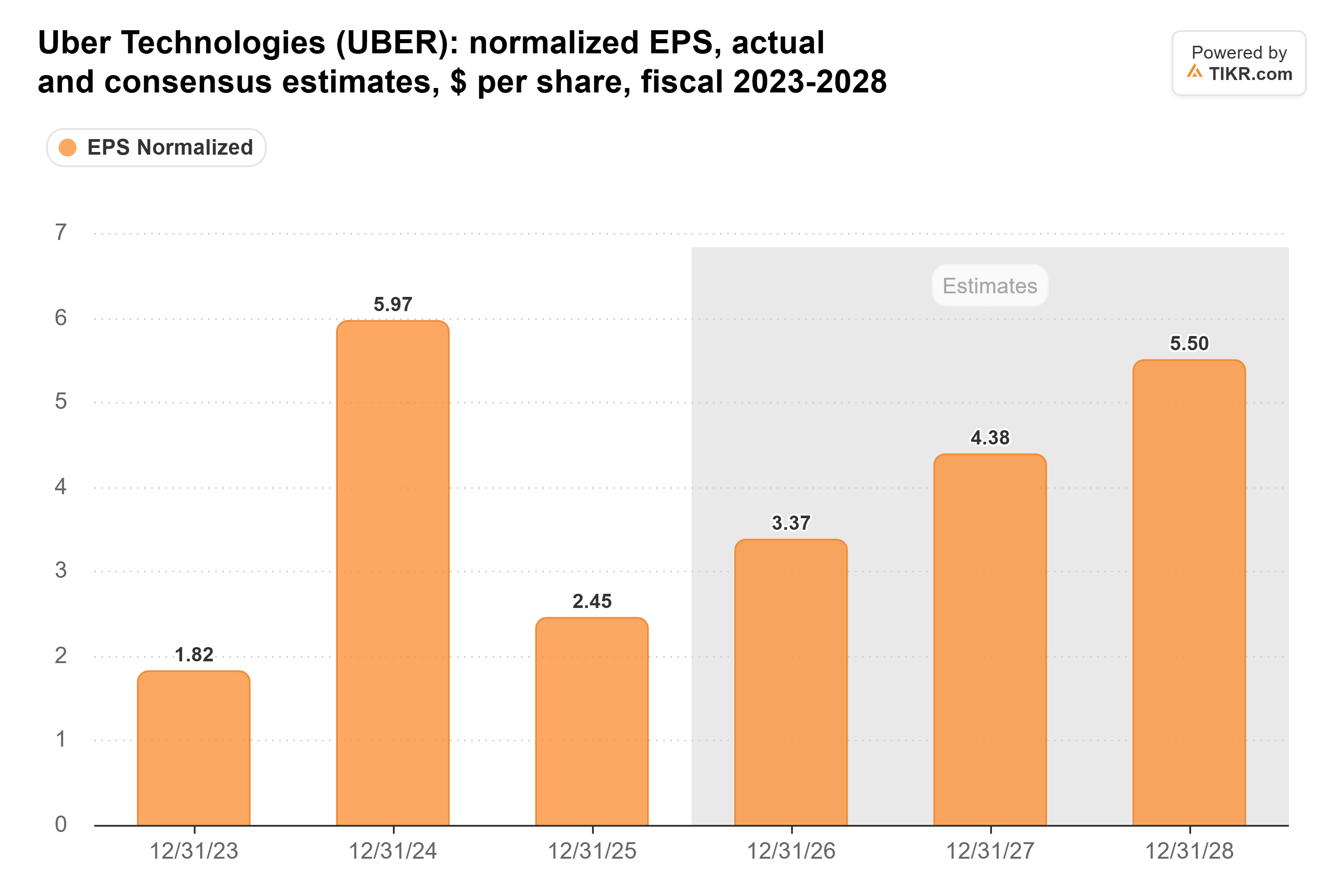
From fiscal 2026 to 2028, analysts see EPS rising 63% on 32% revenue growth. That takes wider margins, fewer shares, or both, and a price war would squeeze the margins.
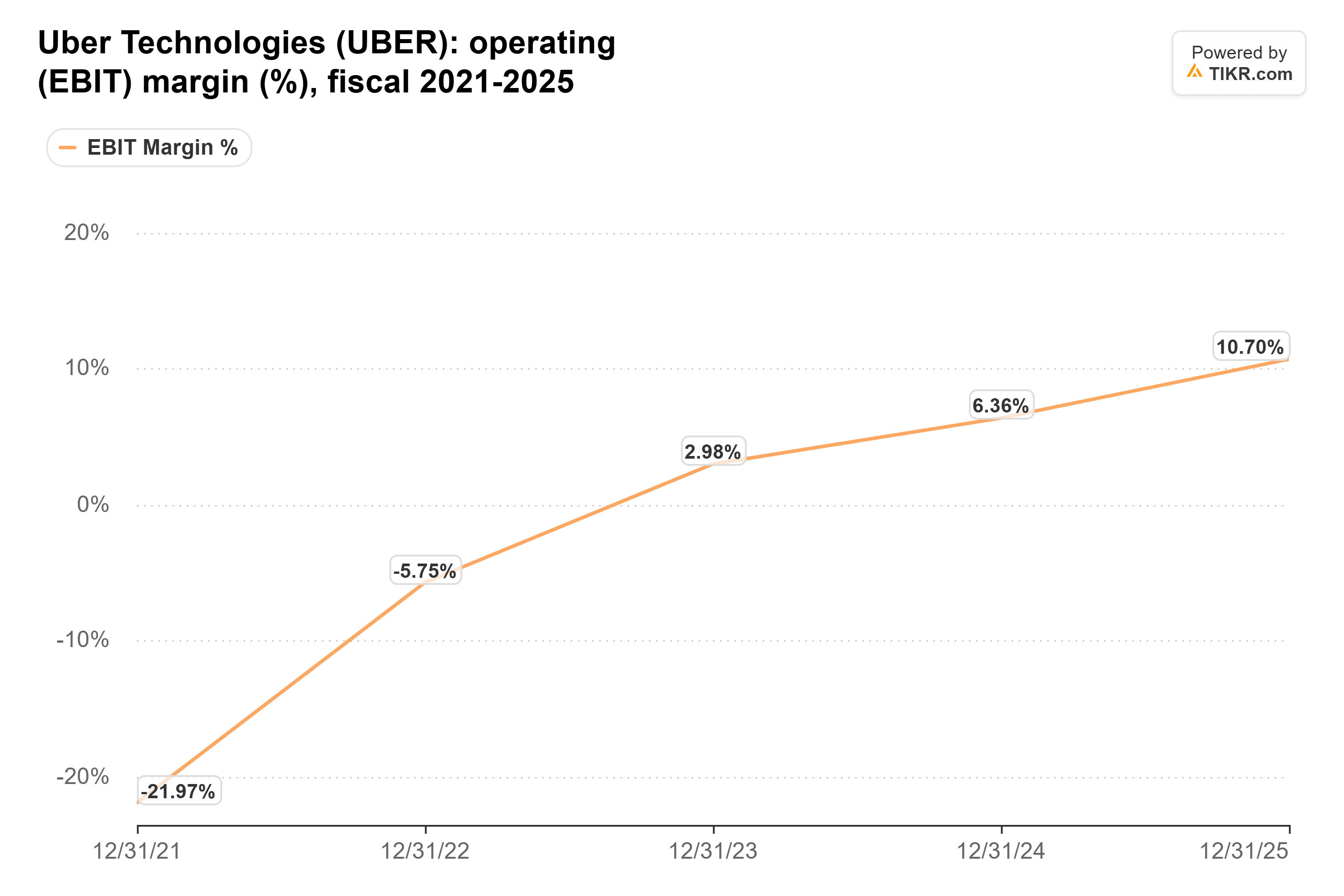
Those margins are new, too. Uber’s operating margin went from -22.0% in fiscal 2021 to 10.7% in fiscal 2025:
Robotaxis Could Still Run on Uber’s Network
Uber has more than 30 autonomous-vehicle partners, and AVs on its network complete about 30% more trips per vehicle per day than on standalone platforms. It expects more than 2,000 driverless vehicles on its platform in 2027.
But the biggest fleet is pulling back. Waymo, with about 4,000 US vehicles, plans to take rides on its own app in Austin and Atlanta from January 2028, ending Uber’s exclusivity there. A fleet that size can demand a far smaller cut than human drivers give Uber. I expect Uber’s network to survive robotaxis, with more supply at a thinner take rate.
Uber Stock Is Cheap for a Reason
Uber trades at about 17x forward earnings, near its lowest in three years and well below its three-year average of 25x. It was nearly 40x in February 2024:
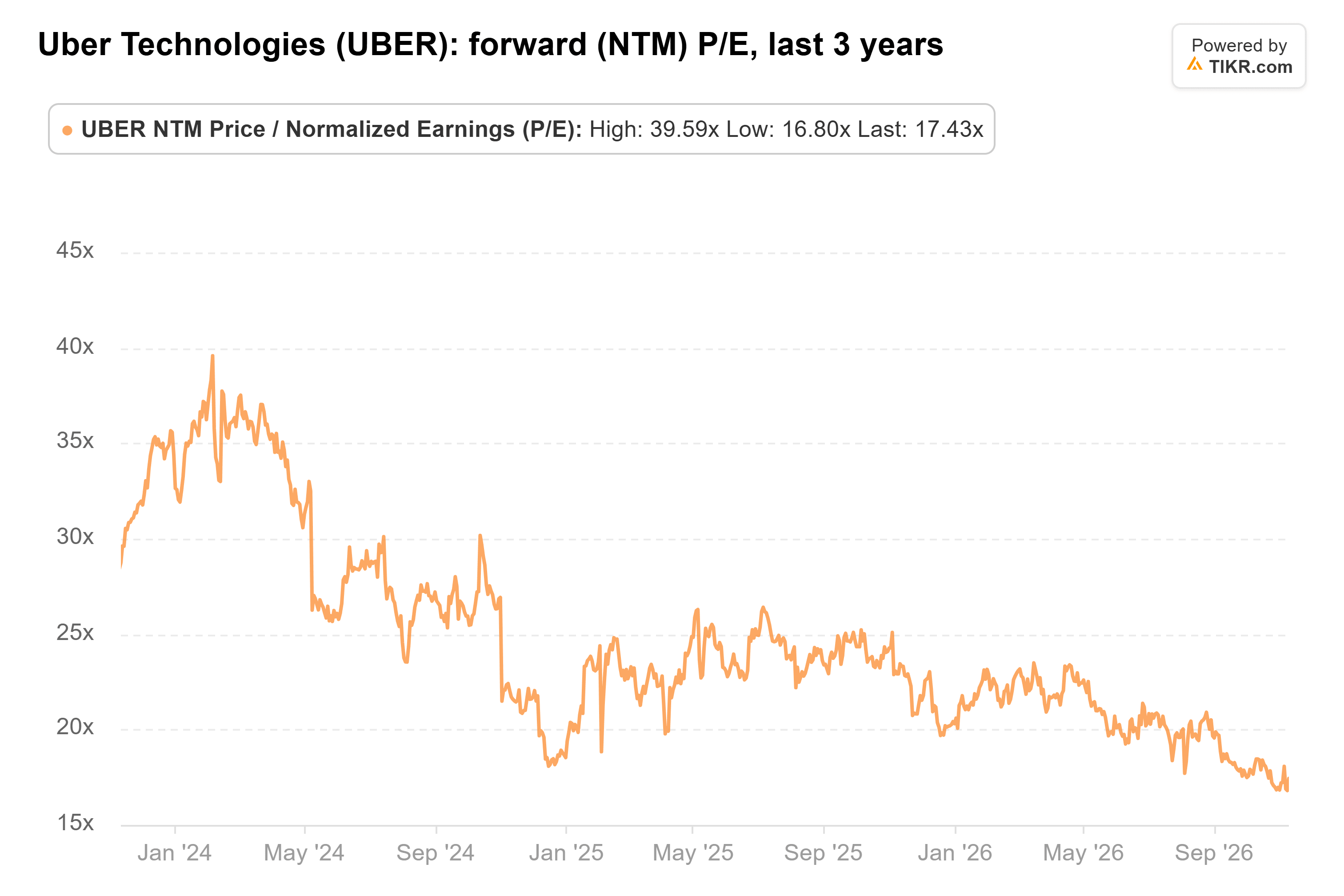
Investors are marking the stock down for robotaxi risk, even as consensus still has EPS growing about twice as fast as revenue.
What Uber Has to Prove Before It’s Cheap
Musk is coming for Uber’s 8 cents more than its riders, and 17x covers some of that. I’d want that Mobility margin to hold through the first big robotaxi rollouts before calling the stock cheap.
Watch Mobility adjusted EBITDA against bookings, not revenue. Third-quarter Mobility revenue fell 2% to $7.5 billion on 18% bookings growth because a UK business model change books driver pay as lower revenue; without it, revenue would have grown about 12%. Uber’s target of AVs in 15 cities by Dec. 31 is the next test of how many fleets still want its riders.
So What Is Uber Stock Actually Worth?
TIKR lets you forecast the future price of any stock in less than a minute. Just enter a few assumptions into TIKR’s valuation model and see what Uber could be worth. Start from Wall Street consensus estimates, or adjust the inputs to reflect your own view of the business. It’s free to use.
Disclaimer:
Please note that the articles on TIKR are not intended to serve as investment or financial advice from TIKR or our content team, nor are they recommendations to buy or sell any stocks. We create our content based on TIKR Terminal’s investment data and analysts’ estimates. Our analysis might not include recent company news or important updates. TIKR has no position in any of the stocks mentioned. Thank you for reading, and happy investing!