Key Takeaways
- Microsoft briefly passed NVIDIA in market value on November 10, and both ended November 13 near $3.9 trillion.
- Ad veteran Joe Marchese says Microsoft is the only one of Alphabet, Meta, Amazon and Microsoft that isn’t highly reliant on advertising. That’s a safer place to be while AI changes how search works.
- Search advertising brought Microsoft $15.2 billion in fiscal 2026, less than 5% of its revenue.
- Microsoft trades at 25x forward earnings, about 4 points above Alphabet but below its own three-year average. That premium looks earned.
Microsoft (MSFT) briefly passed NVIDIA in market value on November 10, and the two ended November 13 about $35 billion apart, both near $3.9 trillion. NVIDIA’s slide did most of that work. But Joe Marchese has a reason to like Microsoft’s position that has nothing to do with data centers.
Marchese is co-founder and general partner at Human Ventures. Before that, he founded the ad-tech company true[X] and ran advertising revenue at Fox Networks Group. On the November 13 episode of the RiskReversal Pod, he went through Alphabet (GOOG), Meta Platforms (META), Amazon (AMZN) and Microsoft, and said:
“Of Google, Meta, Amazon, Microsoft of those four, Microsoft’s the only one that isn’t highly reliant on advertising for the product.”
Asked whether, as an ad guy, he liked that better, he said “it is a better position to be in, in a world where we don’t know what the ad model is going to be.”
Coming from someone who built a career in ads, that’s quite the admission.
TIKR tracks 58 analysts on Microsoft. How many say “Buy”?
See the full breakdown of Buy, Hold, and Sell ratings on Microsoft, along with Wall Street’s revenue and earnings estimates, all in one place. More than 500,000 investors use TIKR to research stocks like this one. See Microsoft’s Analyst Ratings
Microsoft’s ads are a sliver of the business
Microsoft does sell ads. Search advertising brought in $15.2 billion in fiscal 2026 (the year ended June 2026), up 9% from the year before. But that’s less than 5% of Microsoft’s $331.8 billion in revenue. Even the broader Search and advertising line Microsoft began reporting this fiscal year, which adds LinkedIn’s ads and Premium subscriptions, came to $6.55 billion in the September quarter, about 7% of revenue. Most of the rest comes from businesses paying per seat for Microsoft 365, paying for Azure as they use it and buying software licenses. Microsoft also had $677 billion of contracted revenue still to recognize at the end of September, according to its fiscal first-quarter report.
Analysts expect normalized EPS to rise from $17.28 in fiscal 2026 to $24.20 in fiscal 2028, about 40% higher:
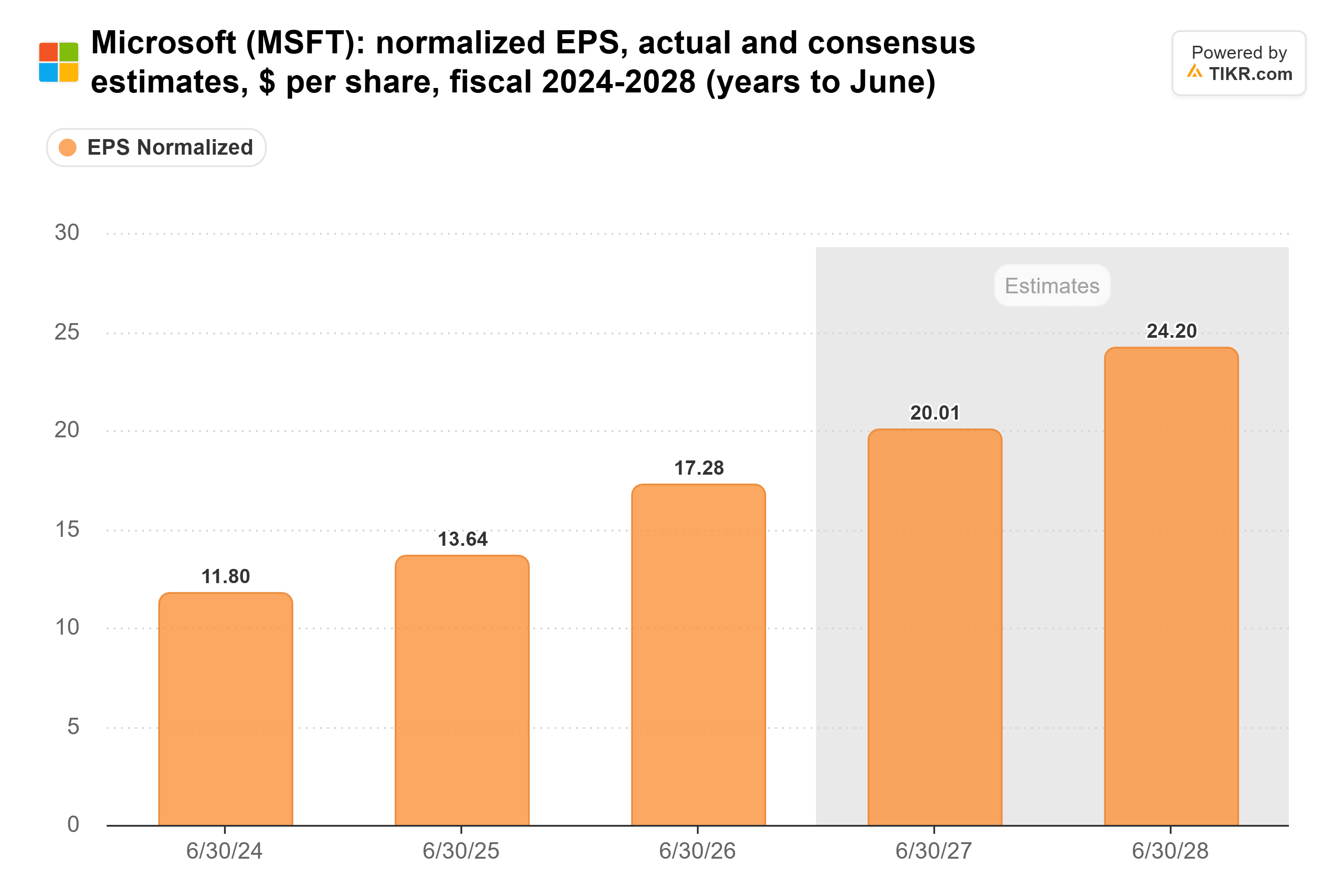
Analysts have raised both years’ estimates since late October, and nothing in the AI search fight so far gives them a reason to cut.
Investors are paying for the difference
Microsoft’s forward P/E has climbed to 25x, up from a three-year low of 19x in late June:
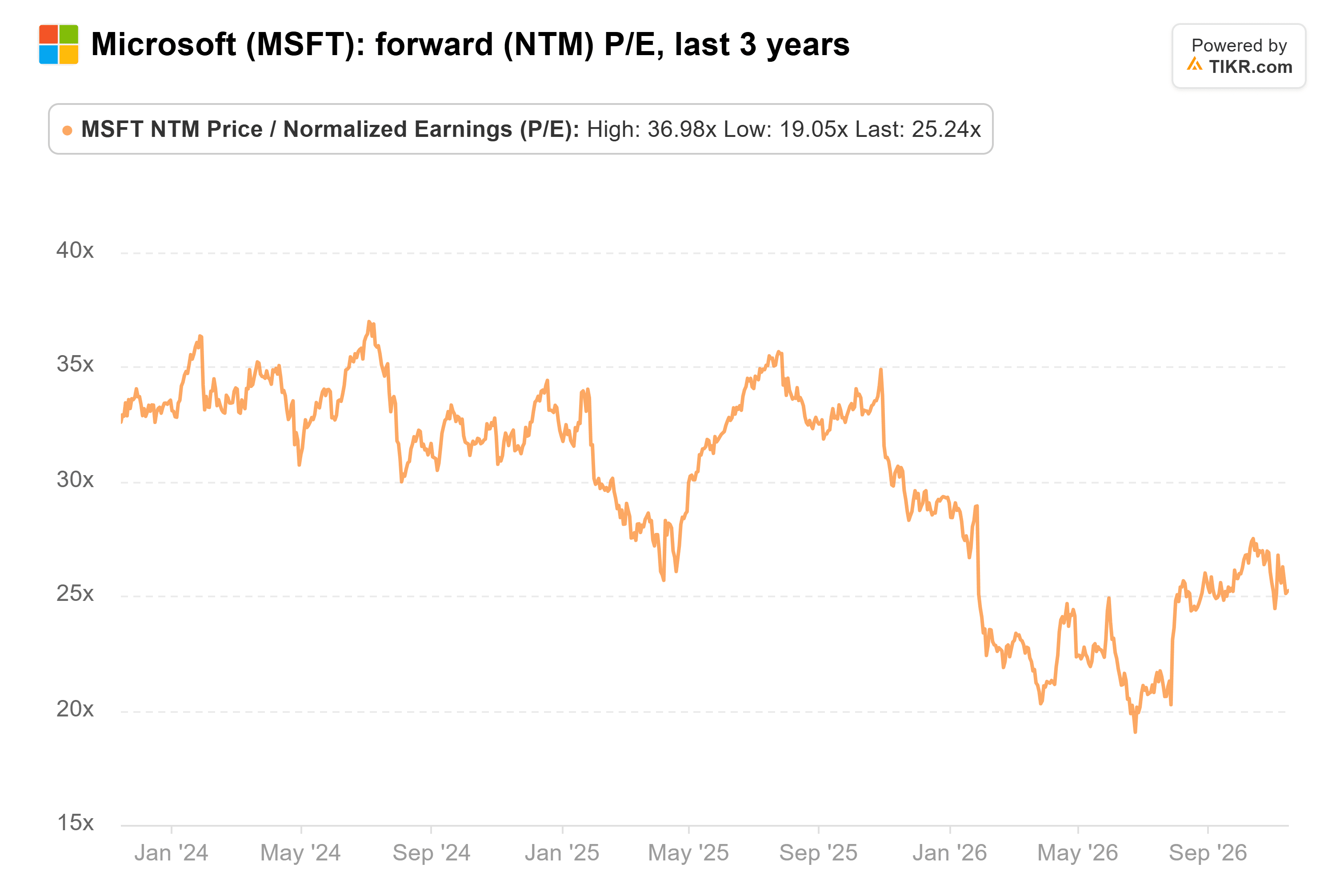
That’s still below its three-year average of 30x, so investors aren’t pricing Microsoft for perfection.
Alphabet has gone the other way. Its forward P/E hit 33x on April 30, its highest in three years, and has since dropped to 21x:
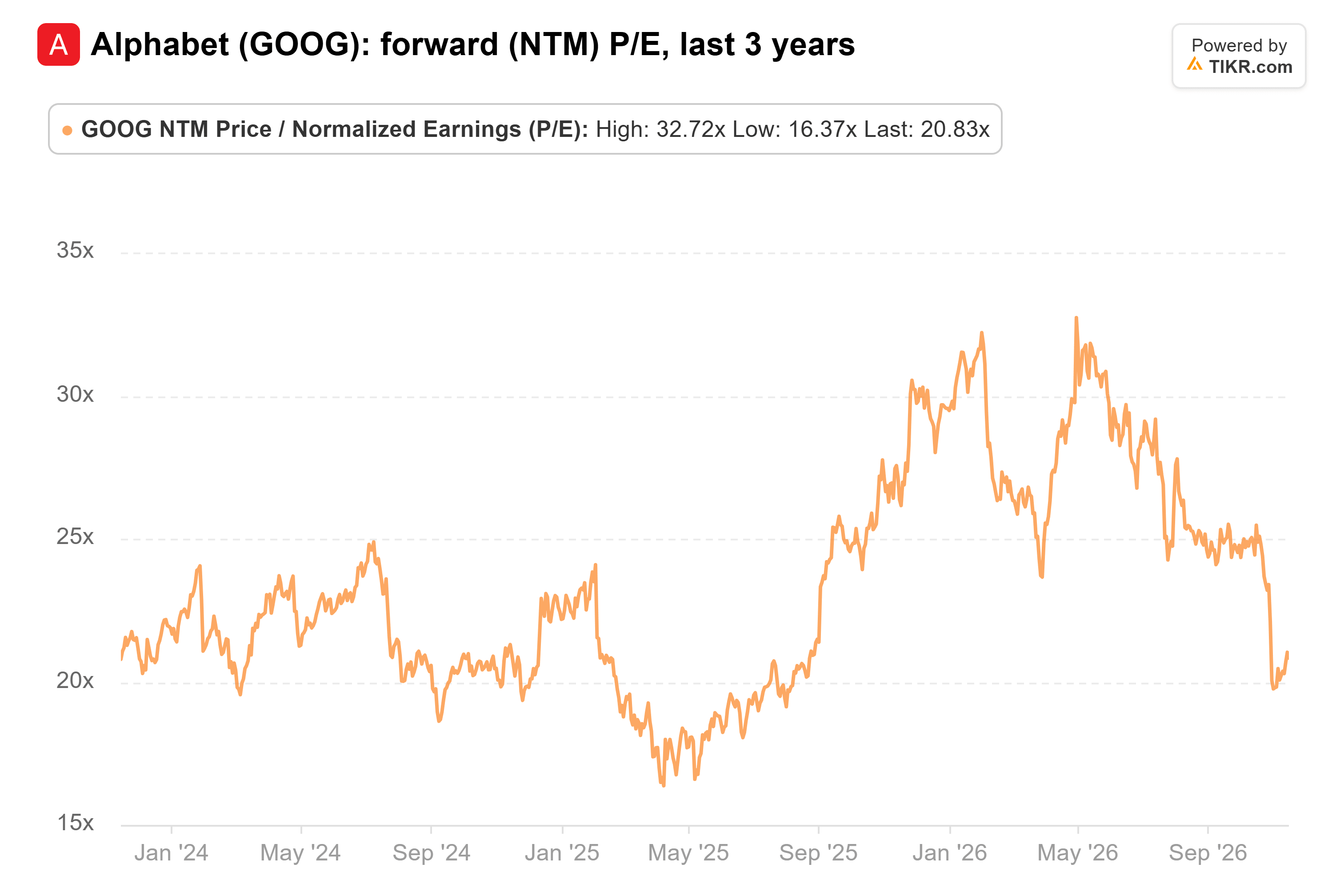
So, Microsoft’s multiple is up 6 points since June, Alphabet’s is down 12 since April, and Microsoft now sits about 4 points ahead. The likeliest explanation: investors are pricing how much of each company’s profit depends on an ad model that AI could rewrite.
Change search, and everything downstream changes
Marchese’s worry goes well past Google. He counts the search boxes on Amazon and YouTube as search too. He sees Meta’s feeds as the other main way the internet puts information in front of people, and he thinks AI does both jobs better. “But if you change search, everything downstream of search, it changes everything.”
His bigger point is about trust. He argued that an AI agent shopping for you won’t stop at the sponsored results the way people do. And if Anthropic keeps its agent free of ads, rivals whose agents might steer you toward the best-paying ad will struggle to earn the same trust. “That’s a multi-trillion dollar problem in the markets.”
He isn’t writing Alphabet off. Marchese thinks Google can work out how to make money from Gemini’s answers. But he pointed out it took 25 years to build the marketplace of clicks behind the ten blue links, and he doesn’t think the next one shows up overnight. That leaves Alphabet, Meta and Amazon defending ad businesses for years in a market nobody can price yet, and Microsoft doesn’t have that problem.
Office has its own AI fight
Microsoft does have an AI threat of its own. Anthropic now includes Claude Sheets, Claude Whiteboards and Claude Data in its paid Claude plans at no extra charge, a direct shot at Office. That matters because Productivity and Business Processes, the segment that housed Office in fiscal 2026, earned 54% of Microsoft’s operating income that year. Microsoft’s own answer, Copilot, passed 30 million paid seats by June, still a small slice of the more than 450 million paid Microsoft 365 commercial seats it had in December 2025. That said, these are early products, and Anthropic agreed in November 2025 to buy $30 billion of Azure compute, so some of Anthropic’s growth comes back to Microsoft anyway.
Microsoft’s premium looks earned
Marchese has it right. Of the four, Microsoft’s earnings depend the least on how anyone sells ads next to an AI answer. At 25x forward earnings, below its own three-year average, a 4-point premium to Alphabet looks worth paying. Of course, if Google figures out ads inside Gemini faster than Marchese expects, that gap could close quickly. Microsoft’s next report, expected in late January, will show whether Copilot is moving Office revenue as Anthropic’s apps spread.
So what is Microsoft stock actually worth?
TIKR lets you forecast the future price of any stock in less than a minute. Just enter a few assumptions into TIKR’s valuation model and see what Microsoft could be worth. Start from Wall Street consensus estimates, or adjust the inputs to reflect your own view of the business. It’s free to use.
Disclaimer:
Please note that the articles on TIKR are not intended to serve as investment or financial advice from TIKR or our content team, nor are they recommendations to buy or sell any stocks. We create our content based on TIKR Terminal’s investment data and analysts’ estimates. Our analysis might not include recent company news or important updates. TIKR has no position in any of the stocks mentioned. Thank you for reading, and happy investing!