Key Takeaways
- Politico reports that a federal regulator has warned Kalshi of possible charges, and InGame estimated this summer that Robinhood sends about 60% of its prediction-market volume to Kalshi.
- Robinhood has more riding on Kalshi than any other listed company, while DraftKings runs its own exchange and competes with Kalshi.
- Event contracts brought Robinhood $173 million of revenue in the third quarter, 12% of the total, but Robinhood keeps only the broker’s half of the fee on trades it sends to Kalshi.
- Kalshi says the problem is procedural, Robinhood plans to move most of its volume off Kalshi by early 2027, and state regulators are still the bigger risk to the business.
A federal regulator has reportedly warned Kalshi that charges could come soon, and the listed company with the most riding on it is Robinhood Markets (HOOD). By InGame’s estimate this summer, about 60% of Robinhood’s prediction-market volume goes to Kalshi.
DraftKings (DKNG) is on the other side of this one. It launched its own CFTC-regulated exchange, DKeX, in June, and Kalshi competes with it for sports bettors.
Kalshi calls it a “procedural error”
Politico, citing a person with direct knowledge of the probe, reported on Nov. 10 that the Commodity Futures Trading Commission has warned Kalshi it could face charges soon. The agency is looking into whether Kalshi failed to properly notify it about dozens of new products.
Kalshi spokesperson Elisabeth Diana said the warning “is about a procedural error involving the submission of a handful of contracts, many of which weren’t live.” “We are already addressing the issue,” she added.
The same source said the matter could still end in a settlement, and nothing reported so far suggests the agency wants Kalshi’s contracts pulled. The stock hasn’t priced in much damage either: Robinhood closed down 2.39% at $81.33 on Nov. 10 and finished Nov. 12 at $81.35.
TIKR tracks 32 analysts on Robinhood. How many say “Buy”?
See the full breakdown of Buy, Hold, and Sell ratings on Robinhood, along with Wall Street’s revenue and earnings estimates, all in one place. More than 500,000 investors use TIKR to research stocks like this one. See Robinhood’s Analyst Ratings
Why Robinhood is the one exposed
Event contracts are Robinhood’s fastest-growing line. They brought in $173 million of revenue in the third quarter, more than six times the year-earlier figure, and made up 12% of the total. Analysts expect the whole business to keep growing quickly, too:
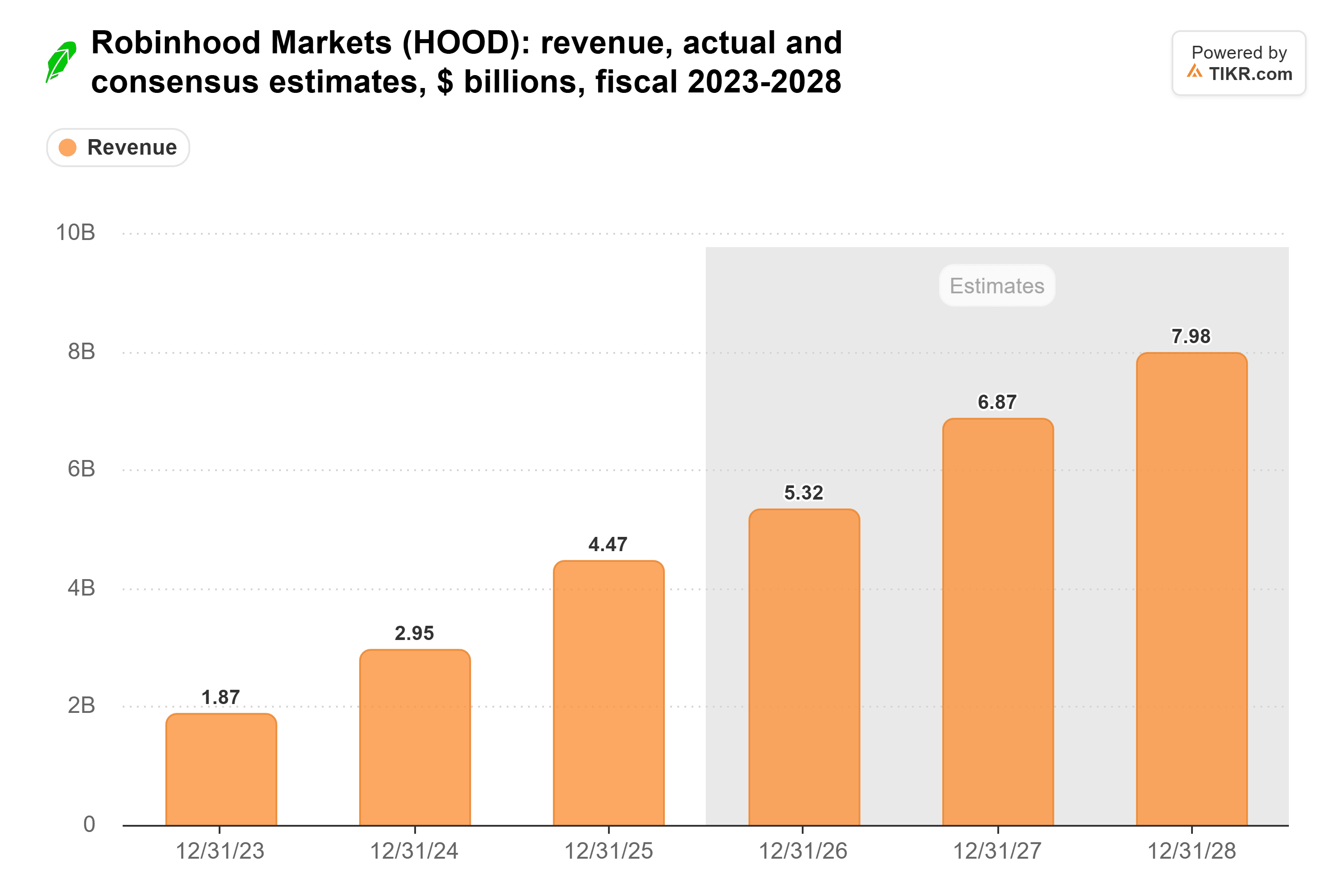
Analysts have revenue climbing from $4.47 billion in 2025 to $6.87 billion in 2027, and event contracts are one of the lines carrying that growth. A procedural charge against Kalshi shouldn’t move those estimates unless it takes Kalshi’s contracts offline.
Robinhood also makes less on the trades it sends to Kalshi than on trades it keeps in-house. The two split a 2-cent fee per contract evenly, so Robinhood keeps 1 cent as the broker while the other cent goes to the exchange. Robinhood controls Rothera, the exchange it runs with Susquehanna, so on trades sent there the exchange’s cent stays inside the group, too. That makes Kalshi’s share of Robinhood’s event-contract revenue smaller than its share of the volume.
Robinhood already has one foot out the door
Robinhood has been moving business away from Kalshi for months. Rothera passed $100 million of annualized revenue in its first full quarter. Since September, Robinhood has also sent some football contracts to OG.com, the prediction-market exchange spun off from Crypto.com, and agreed to take small stakes in both. CFO Shiv Verma said on the Oct. 27 earnings call that Rothera will be the primary exchange and Crypto.com/OG.com the second, with “the vast majority” of Robinhood’s flow going through the two by early 2027.
After the third-quarter report, though, InGame said Robinhood still sends the majority of its prediction-market volume to Kalshi, though parlays may inflate Kalshi’s share. So if the charges disrupted Kalshi in the next few months, they would still hit most of Robinhood’s trading in these contracts.
The bigger risk is still the states
The states have always been a bigger threat to this business than the CFTC. Robinhood stopped offering new sports contracts in Nevada from Dec. 1, 2025, and on Aug. 28 the Ninth Circuit ruled against Robinhood, Kalshi and Crypto.com, letting Nevada apply its gambling laws to their sports contracts. Robinhood has also sued regulators in New Jersey, Massachusetts and Washington to keep offering these contracts. If anything, a Kalshi tied up with its regulator helps DraftKings.
That ruling split with an April Third Circuit decision for Kalshi in New Jersey, and Robinhood asked the Supreme Court in September to settle the question. Whether the justices take it up matters more for the stock than a filing case, since investors are still paying for fast growth. Robinhood trades at 26x forward earnings, far below the 76x it hit in October 2025:
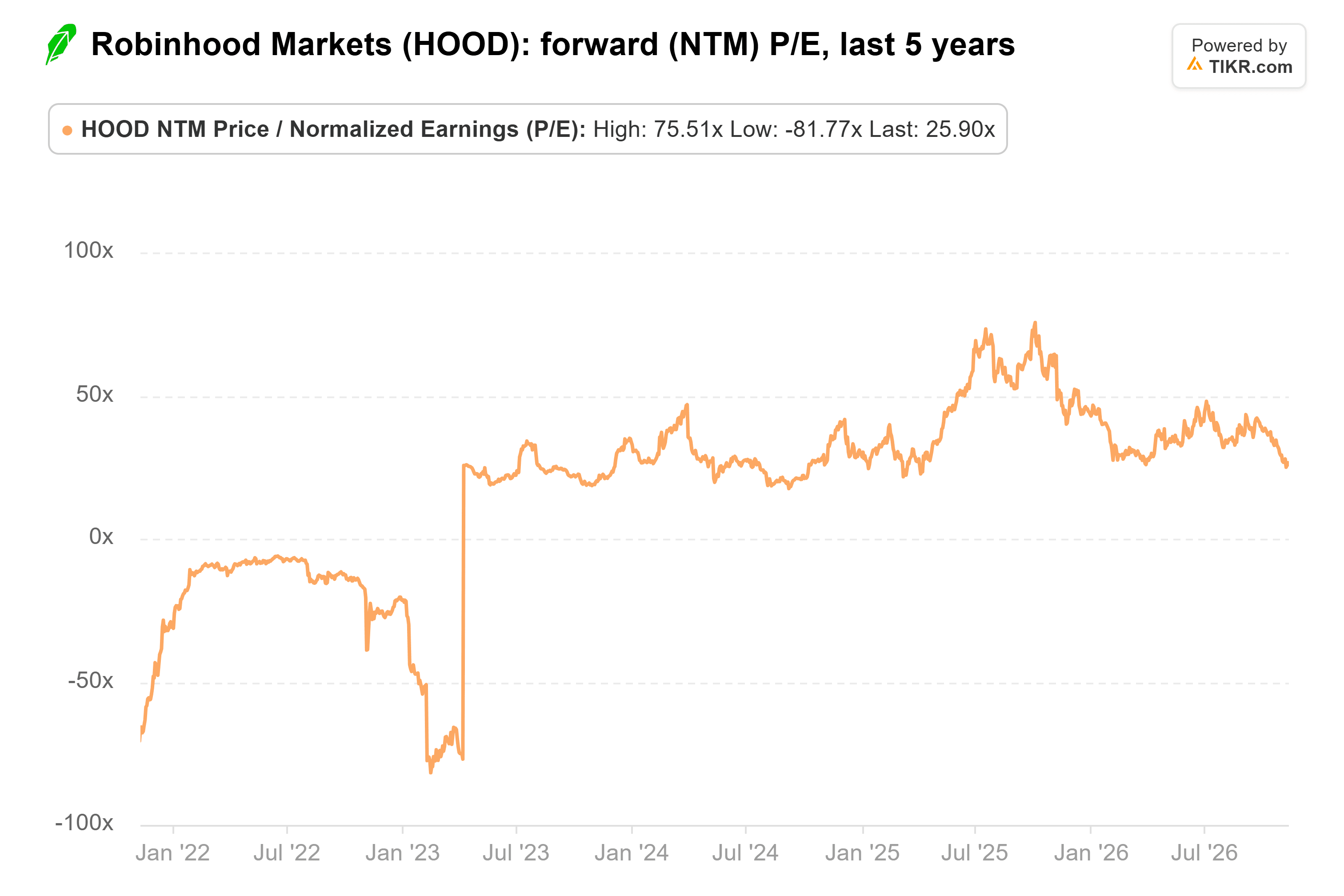
These charges alone don’t look like a reason to sell Robinhood. That changes if the CFTC’s case turns out to be broader than Kalshi says, or if Robinhood still depends on Kalshi well into 2027.
So what is Robinhood stock actually worth?
TIKR lets you forecast the future price of any stock in less than a minute. Just enter a few assumptions into TIKR’s valuation model and see what Robinhood could be worth. Start from Wall Street consensus estimates, or adjust the inputs to reflect your own view of the business. It’s free to use.
Disclaimer:
Please note that the articles on TIKR are not intended to serve as investment or financial advice from TIKR or our content team, nor are they recommendations to buy or sell any stocks. We create our content based on TIKR Terminal’s investment data and analysts’ estimates. Our analysis might not include recent company news or important updates. TIKR has no position in any of the stocks mentioned. Thank you for reading, and happy investing!