


Key Takeaways
- Oracle says a gigawatt on new AI contracts now brings in $16 billion a year at full ramp, up 60% from $10 billion in October 2025.
- CFO Hilary Maxson says it’s mainly memory costs passed through cost-plus contracts, so each gigawatt costs more too.
- CoreWeave says new long-term contracts price at $20 million to $25 million per megawatt a year, above Oracle’s $16 million.
- The higher price helps the fiscal 2029 free cash flow target less than the 60% suggests, and OpenAI is still about half the backlog.
Oracle (ORCL) could use some good news. Reports on Nov. 4 and 6 said it had canceled a $7 billion Tencent deal and that Microsoft was winding down a contract.
Management is pointing to a different number: $16 billion.
Faber Did the Math on Oracle’s Gigawatt
On Nov. 10, CNBC’s David Faber reminded CFO Hilary Maxson on Squawk on the Street that a year ago, Oracle said “a gigawatt of data center compute would provide Oracle with lease payments that equal $10 billion a year.” At its Oct. 28 Investor Day, “one gigawatt now is $16 billion a year.”
His follow-up: “Well that would imply that in some ways your business has become 60% more profitable.”
Yet Oracle’s fiscal 2030 revenue target is still “$225 billion plus,” the same figure it set in October 2025. Faber asked why a 60% jump only added the “plus.” Maxson: “The plus is very real, but we don’t think the market was necessarily even reflecting the $225.”
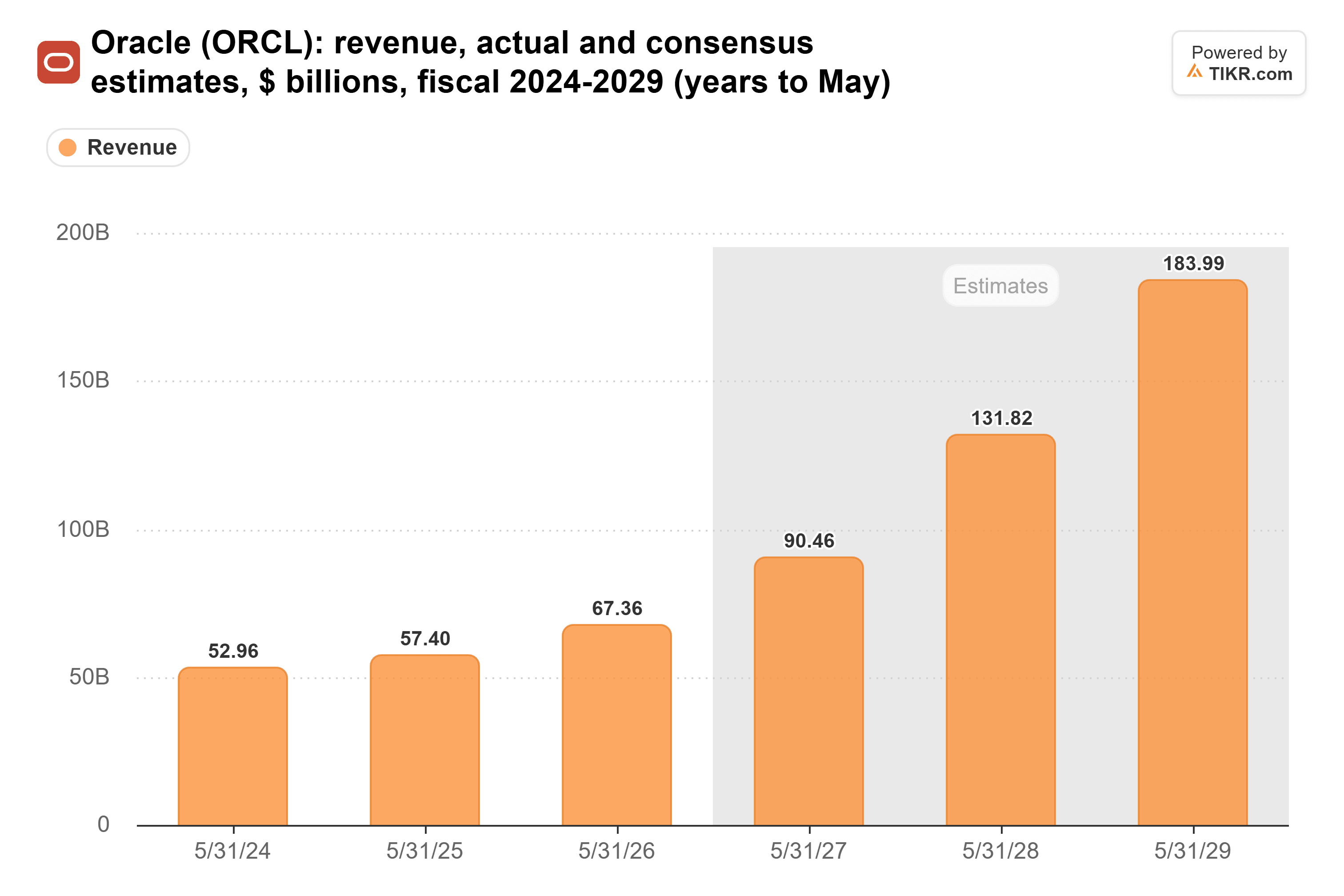
Consensus gets there: $225.4 billion in fiscal 2030, up from $67.4 billion in fiscal 2026:
Most of Oracle’s Raise Is Memory
“I think it’s primarily cost inflation,” Maxson said, pointing to memory. Oracle’s big AI contracts are priced cost-plus, with “a fixed gross margin percentage. So the gross margin dollars can go up and down or more recently up.”
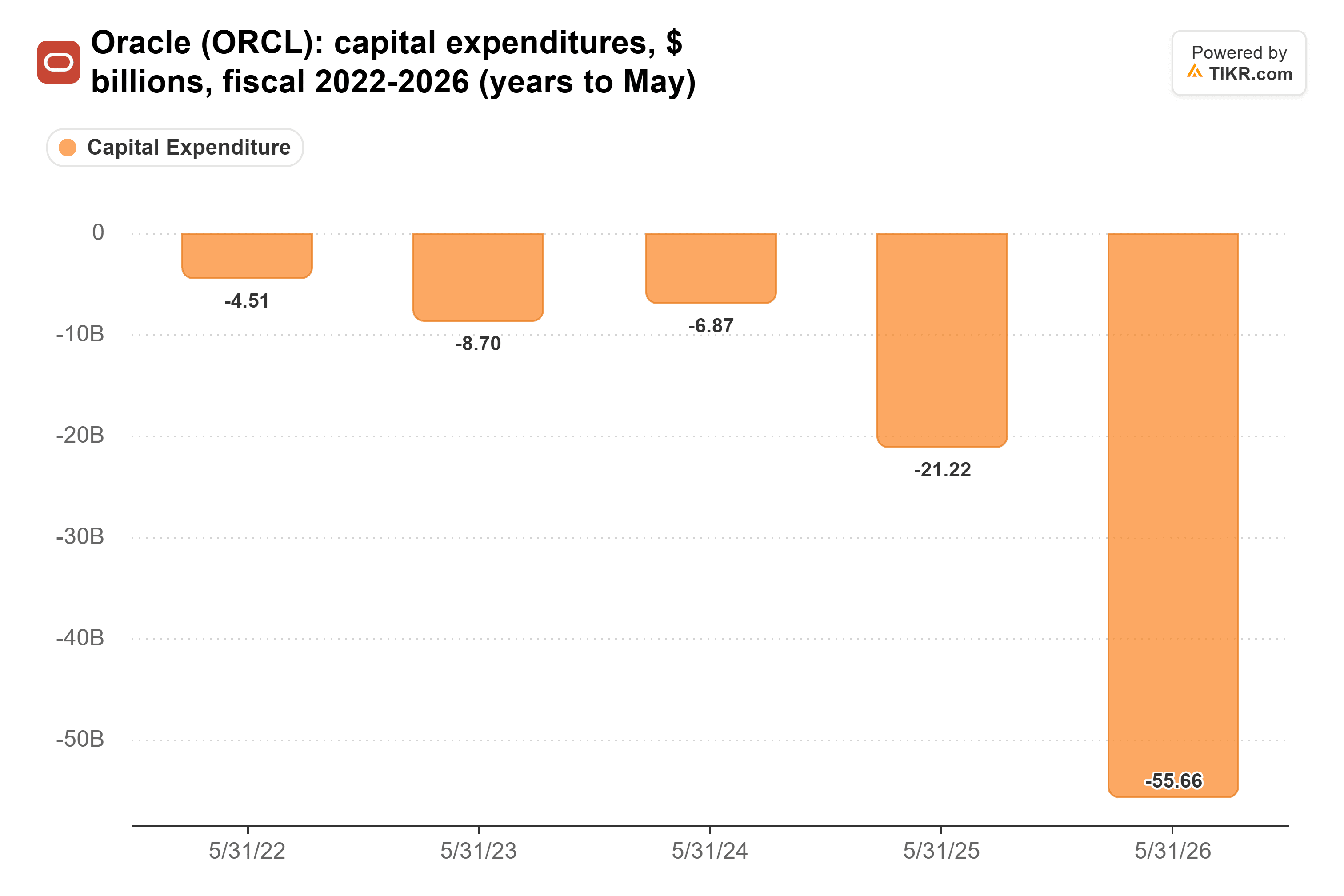
So Faber is half right. At the 35% gross margin in Oracle’s October 2025 example, a gigawatt’s margin rises from $3.5 billion a year to $5.6 billion. But a fixed percentage means the cost of each gigawatt rose just as fast. Capex has gone from $4.5 billion in fiscal 2022 to $55.7 billion in fiscal 2026:
Cost-plus pricing protects the margin percentage, not the return on capital, which depends on what Oracle pays up front. Vendor financing, prepayments and customer-provided hardware shrink that. The other upside is Maxson’s second reason: “the market is strengthened in terms of overall pricing for AI computers.” CoreWeave said on Nov. 10 that new four- and five-year contracts are pricing at $20 million to $25 million per megawatt a year, against Oracle’s $16 million.
TIKR Tracks 42 Analysts on Oracle. How Many Say “Buy”?
See the full breakdown of Buy, Hold, and Sell ratings on Oracle, along with Wall Street’s revenue and earnings estimates, all in one place. More than 500,000 investors use TIKR to research stocks like this one. See Oracle’s Analyst Ratings
Oracle’s Cash Still Depends on OpenAI
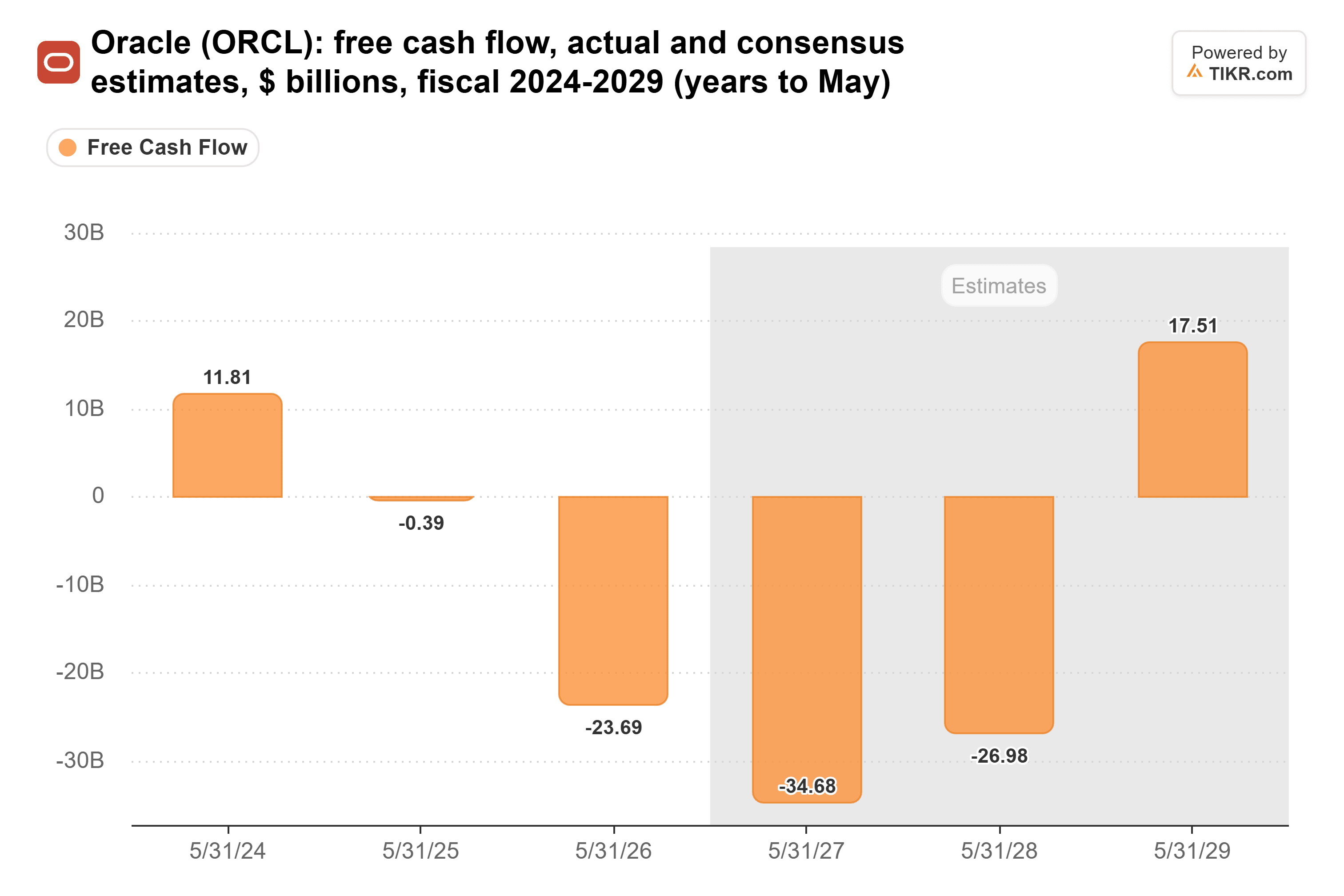
Maxson repeated Oracle’s plan to turn cash-positive and then some: “cash flow positive in the second half of our 28, $30 billion plus free cash flow in 29.” Consensus has free cash flow negative through fiscal 2028 and $17.5 billion in fiscal 2029, well short of that target:
S&P has said OpenAI accounts for about half of Oracle’s backlog, and the Wall Street Journal reported that OpenAI’s leaders have discussed resetting next year’s data-center plans.
The Catch in Oracle’s $16 Billion
The $16 billion helps, just less than the 60% suggests. Maxson put most of the $6 billion rise down to cost inflation, so the increase alone doesn’t show Oracle can close the $12.5 billion gap to its fiscal 2029 target. Better pricing could, but nobody has sized it. The target rides on capex falling after fiscal 2028. None of it fixes the OpenAI risk. Mid-December’s second-quarter results come next: watch the backlog and who’s signing.
So What Is Oracle Stock Actually Worth?
TIKR lets you forecast the future price of any stock in less than a minute. Just enter a few assumptions into TIKR’s valuation model and see what Oracle could be worth. Start from Wall Street consensus estimates, or adjust the inputs to reflect your own view of the business. It’s free to use.
Disclaimer:
Please note that the articles on TIKR are not intended to serve as investment or financial advice from TIKR or our content team, nor are they recommendations to buy or sell any stocks. We create our content based on TIKR Terminal’s investment data and analysts’ estimates. Our analysis might not include recent company news or important updates. TIKR has no position in any of the stocks mentioned. Thank you for reading, and happy investing!


