Key Takeaways
- Robinhood shares fell 8% in premarket trading after third-quarter diluted EPS of $0.51 missed the $0.55 consensus.
- Prediction markets brought in $173 million, more than six times last year’s figure, while crypto revenue fell 55% to $120 million.
- Credit loss provisions nearly tripled to $71 million, and a $67 million investment markdown squeezed profit even as revenue hit a record $1.42 billion.
- CFO Shiv Verma is pushing for retail access to Anthropic’s IPO, and the fourth-quarter report expected in February will test October’s deposit surge.
Robinhood Markets (HOOD) just posted the biggest revenue quarter in its history. Investors sold the stock anyway.
Shares fell 8% in premarket trading on October 28 after third-quarter diluted EPS of $0.51 missed the $0.55 consensus. Revenue rose 12% to a record $1.42 billion, in line with expectations.
Crypto did the damage. Bitcoin had dropped nearly 28% over the prior three months, and Robinhood’s crypto revenue fell 55% to $120 million.
Coinbase Global (COIN) felt the same chill. Its third-quarter transaction revenue fell 44% to about $590 million, so the slump goes well beyond one app.
Yet the more telling number sits elsewhere. Prediction markets brought in $173 million, more than six times last year’s figure and well ahead of crypto.
Crypto shrank while the rest grew
CFO Shiv Verma called it the company’s “highest quarter ever for revenues.” The breakdown shows where that growth came from:
- Transaction revenue rose 19% to $867 million, led by options revenue of $399 million, up 31%.
- Equities revenue jumped 41% to $121 million on record trading volumes.
- Net interest revenue fell 9% to $415 million on lower securities lending and short-term rates.
Profit, though, moved the other way…
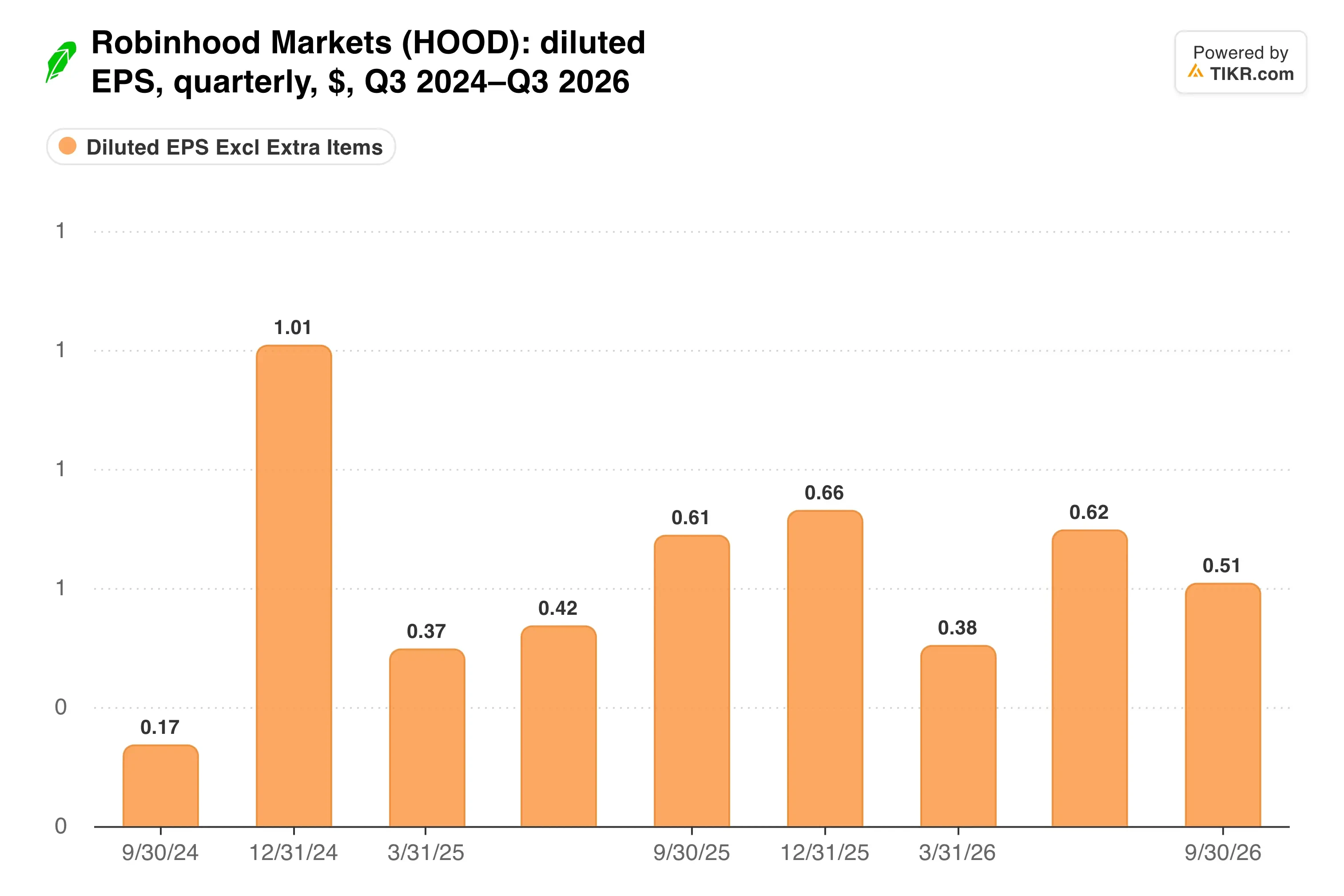
Net income fell 14% to $476 million. A $67 million mark-to-market loss tied to Robinhood Ventures Fund I cut $0.07 from EPS, and adjusted EPS came in at $0.60.
So part of the miss came from an investment markdown. The rest came from higher costs, and those deserve a closer look.
Prediction markets carry the load
Crypto made up roughly 8% of revenue this quarter. A year earlier, it was about a fifth.
That shift matters because Robinhood now controls more of its prediction market business. Rothera, its exchange venture with Susquehanna International Group, passed $100 million in annualized revenue in its first full quarter. Meanwhile, event contracts traded jumped more than sevenfold to 16.4 billion.
Coinbase is pushing into prediction markets too. However, its total revenue fell 35% last quarter while Robinhood’s grew 12%. How far apart have the two drifted?
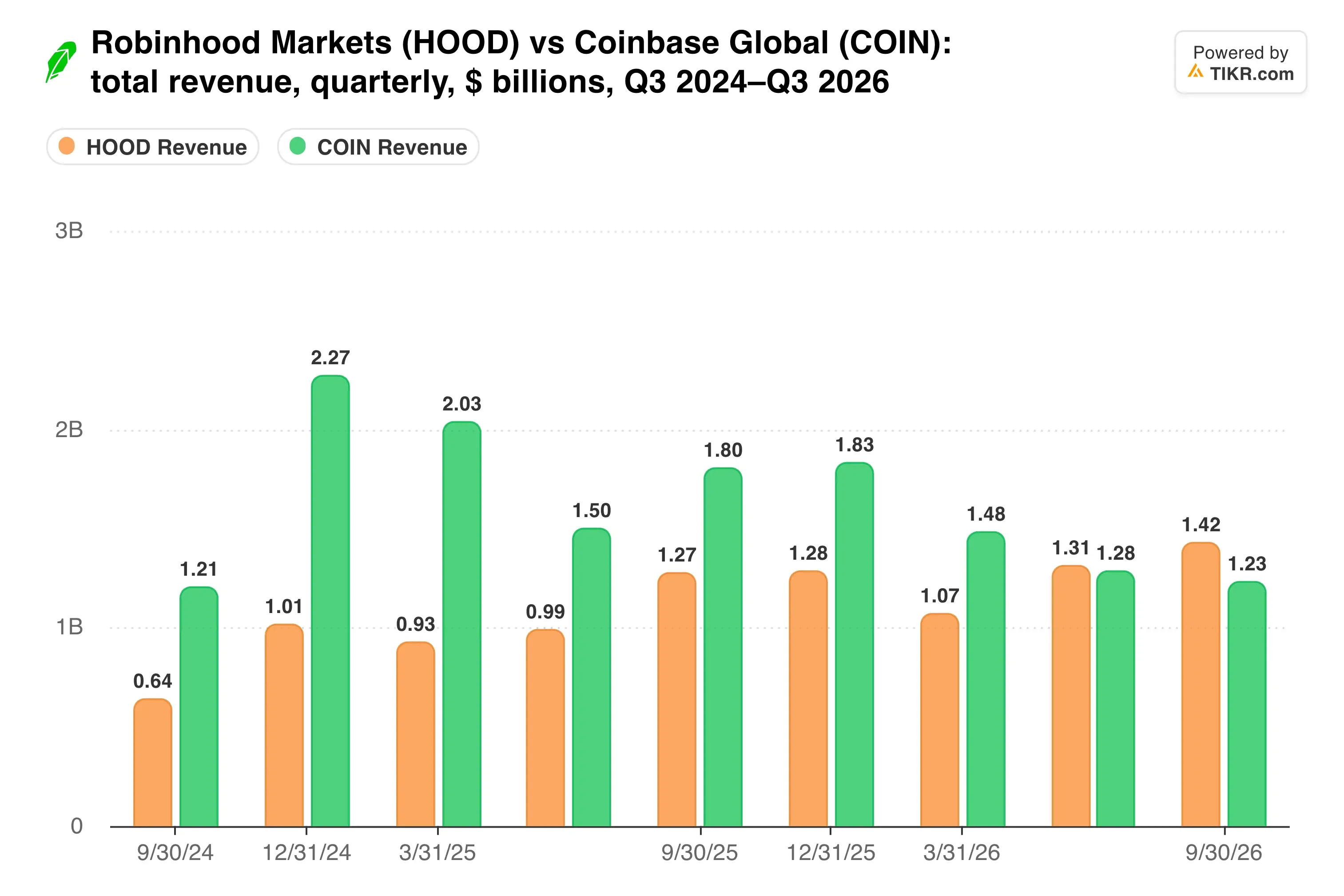
Robinhood’s growth has held up because customers keep adding money. Net deposits reached $15.7 billion, and Gold subscribers rose 34% to 5.2 million.
Verma also wants a bigger slice of Anthropic’s IPO for those customers. Anthropic’s updated filing lists Robinhood among the brokerages offering shares to retail investors. He told Bloomberg Television that “we’re making sure the companies know retail is here.”
TIKR tracks 31 analysts on Robinhood. How many say “Buy”?
See the full breakdown of Buy, Hold, and Sell ratings on Robinhood, along with Wall Street’s revenue and earnings estimates, all in one place. More than 500,000 investors use TIKR to research stocks like this one. See Robinhood’s Analyst Ratings
Credit costs cloud the margin
Total operating expenses rose 16% to $739 million, faster than revenue. Provision for credit losses nearly tripled to $71 million as the Gold Card loan book grows. Trump Accounts and Rothera added costs too.
Margins have already started to give some of that back.
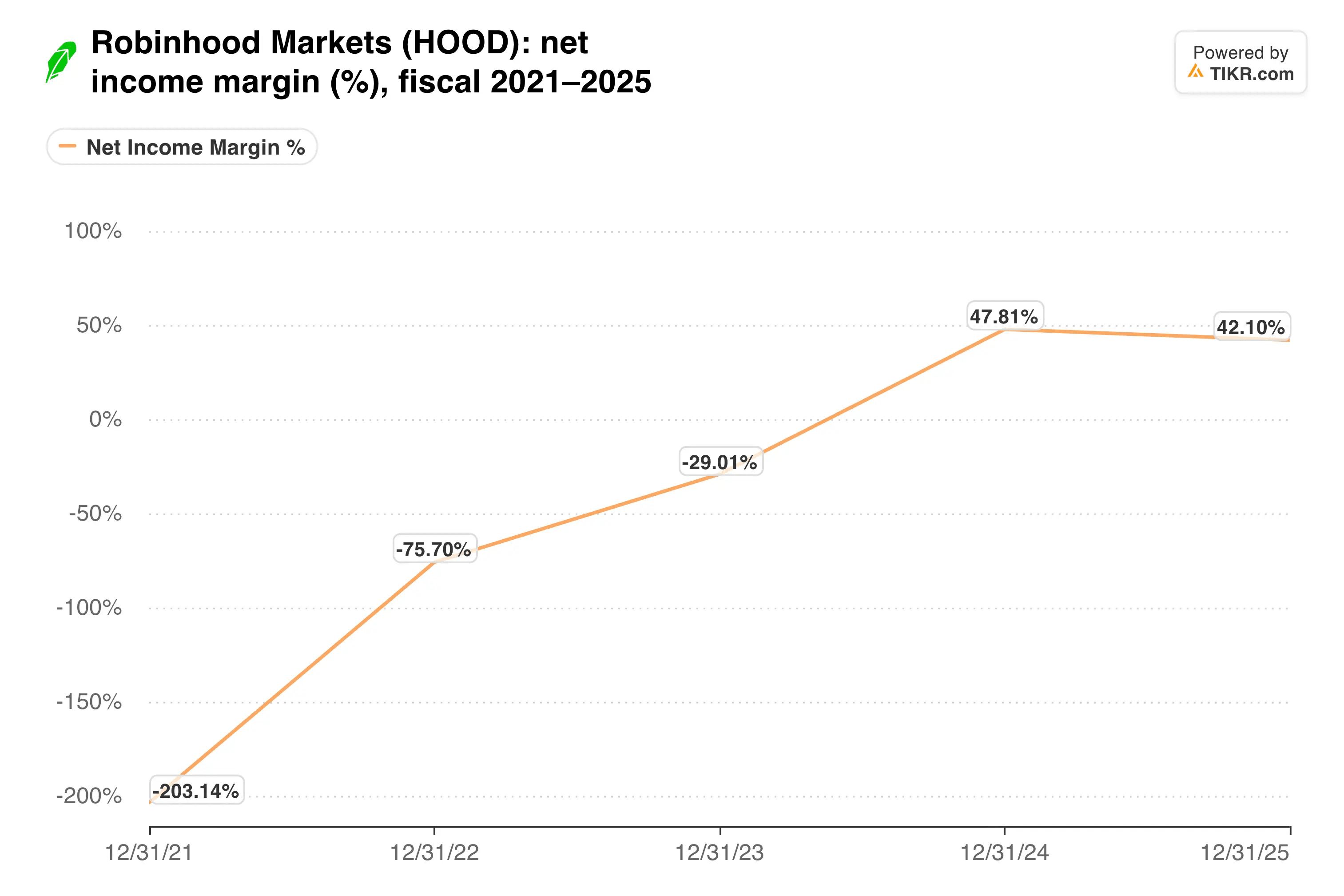
Net margin fell to 33% in the third quarter from 44% a year earlier. Even so, management trimmed the top of its 2026 adjusted expense and SBC outlook by $25 million, to a range of $2.675 billion to $2.75 billion.
The risks are easy to list. Crypto volumes could stay weak, and sports event contracts still face state challenges. Card losses could also climb as the book grows.
My take: Robinhood looks less like a crypto proxy every quarter, and prediction markets are the clearest proof. The stock still trades with bitcoin, though, so sentiment will keep swinging with it. I’d want to see credit costs level off before paying up for the transition.
Robinhood presents at the Wolfe Research Wealth Symposium on November 11. But the bigger test is the fourth-quarter report, expected in February. It will show whether October’s $13 billion in month-to-date deposits, including $6 billion from the Dell family’s Trump Accounts contribution, turned into revenue.
So what is Robinhood stock actually worth?
TIKR lets you forecast the future price of any stock in less than a minute. Just enter a few assumptions into TIKR’s valuation model and see what Robinhood could be worth. Start from Wall Street consensus estimates, or adjust the inputs to reflect your own view of the business. It’s free to use.
Disclaimer:
Please note that the articles on TIKR are not intended to serve as investment or financial advice from TIKR or our content team, nor are they recommendations to buy or sell any stocks. We create our content based on TIKR Terminal’s investment data and analysts’ estimates. Our analysis might not include recent company news or important updates. TIKR has no position in any stocks mentioned. Thank you for reading, and happy investing!