Key Takeaways
- Bristol Myers Squibb yields 4.1% and AbbVie 2.5%, and AbbVie just raised its quarterly dividend 5% to $1.82 a share.
- Bristol Myers’ dividend took 55% of its free cash flow over the past twelve months, and AbbVie’s took 65%.
- AbbVie’s revenue grew 10% last quarter and Bristol Myers’ grew 7%, and Bristol Myers expects a $1.5 billion to $2 billion drop in Eliquis sales in 2027.
- $10,000 pays $410 a year from Bristol Myers today and $250 from AbbVie, and AbbVie’s dividend is growing faster.
AbbVie (ABBV) gave its shareholders a raise on Oct. 30. Its quarterly dividend goes up 5.2%, from $1.73 to $1.82 a share.
That came a day after Bristol Myers Squibb (BMY) lifted its 2026 revenue guidance to between $49.75 billion and $50.25 billion.
Both drugmakers are replacing old blockbusters that are losing sales to cheaper copies. So which is the better dividend stock?
| Metric | Bristol Myers Squibb (BMY) | AbbVie (ABBV) |
|---|---|---|
| Dividend yield | 4.1% | 2.5% |
| Dividend growth, fiscal 2020-2025 | 6.2% a year | 6.6% a year |
| Dividend growth, fiscal 2015-2025 | 5.3% a year | 12.2% a year |
| Cash dividend payout ratio (TTM to Sept. 30, 2026) | 55% | 65% |
| Net debt/EBITDA (LTM) | 1.7x | 2.0x |
| Interest coverage (LTM) | 9.9x | 8.2x |
| Forward P/E (NTM) | 9.8x | 18x |
Source: TIKR, Nov. 5, 2026.
6 safe dividend stocks paying retirees 6%+ yields
There are over 100 stocks paying 6%+ annual dividends today.
But after an extensive investment review leveraging TIKR’s proprietary data, we now believe only six of them are truly safe for retirees.
They’re all yours for free as part of our new investment report, which you can access right here.
Bristol Myers has room to spare
Bristol Myers’ newer drugs are doing the heavy lifting. Its Growth Portfolio grew 12% to $7.7 billion in the third quarter of 2026, while Revlimid fell 47% and Sprycel fell 38% as generics ate into them. Total revenue rose 7% to $13.1 billion.
From fiscal 2021 to fiscal 2025, the dividend took 29% to 39% of free cash flow each year:
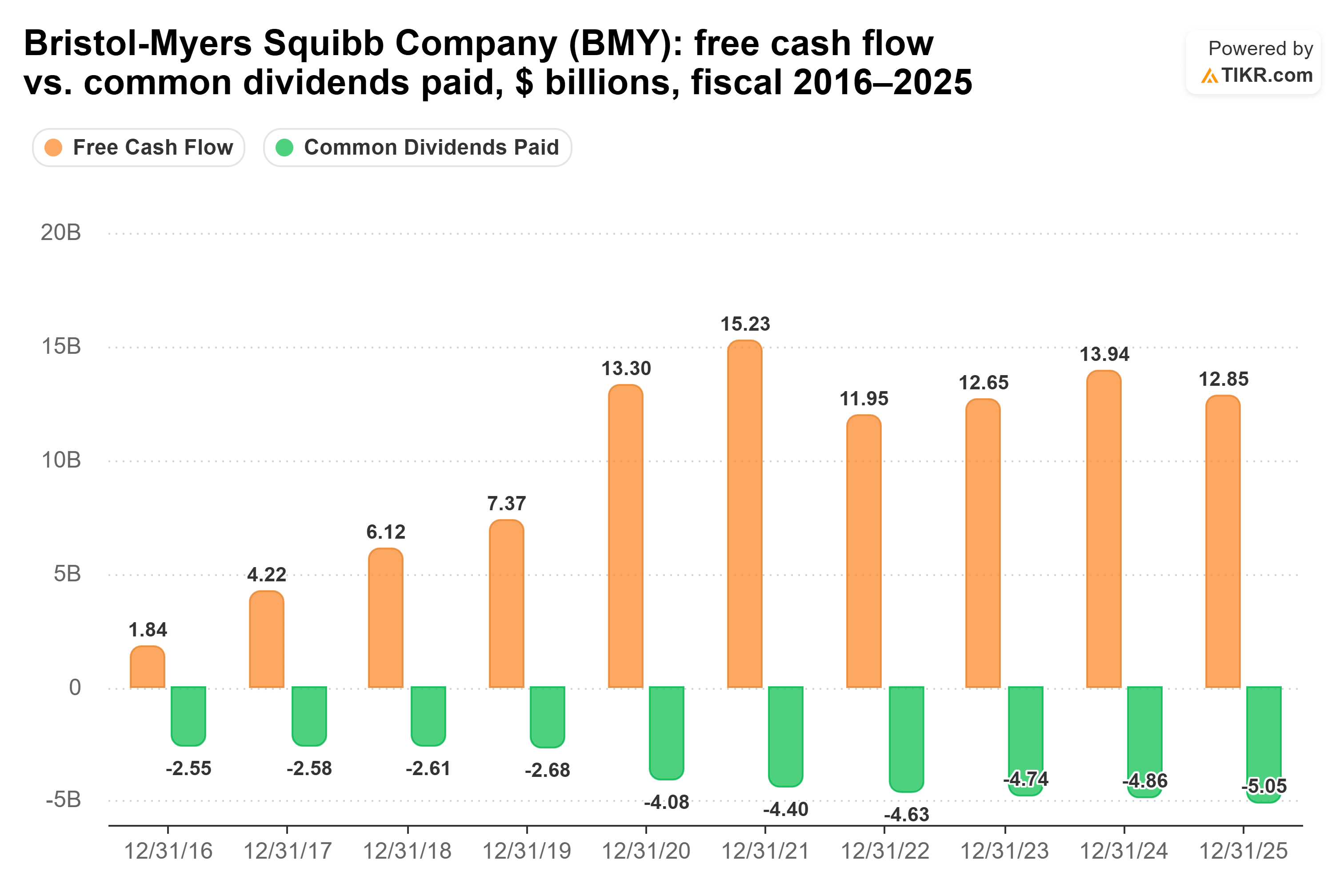
Over the twelve months to Sept. 30, 2026, the ratio rose to 55%, from 39.3% in fiscal 2025, on $9.29 billion of free cash flow and $5.12 billion of dividends. That’s still well-covered, and it leaves money for deals. On the company’s third-quarter call, CFO David Elkins said: “Business development remains a priority, and we are regularly evaluating opportunities in the therapeutic areas we know best, while continuing to return cash to our shareholders through our commitment to the dividend.”
The main risk is Eliquis. Bristol Myers expects Eliquis revenue to fall by $1.5 billion to $2 billion in 2027 as it loses exclusivity in Europe. On Oct. 23, it also disclosed a patient death from septic pneumonia in an early-stage trial of zola-cel in multiple sclerosis. That’s a pipeline setback, but today’s dividend is paid from drugs already on the market.
AbbVie grows faster, with less room to spare
AbbVie is further along in the same switch. Humira sales fell 31.2% to $683 million in the third quarter of 2026. But Skyrizi grew 22.7% to $5.78 billion and the neuroscience drugs grew 19.4% to $3.39 billion, so total revenue rose 10.3% to $17.4 billion.
Its free cash flow is another matter. It fell from $24.3 billion in fiscal 2022 to $17.8 billion in fiscal 2024, and came in at $17.8 billion again in fiscal 2025. Dividends paid rose every year:
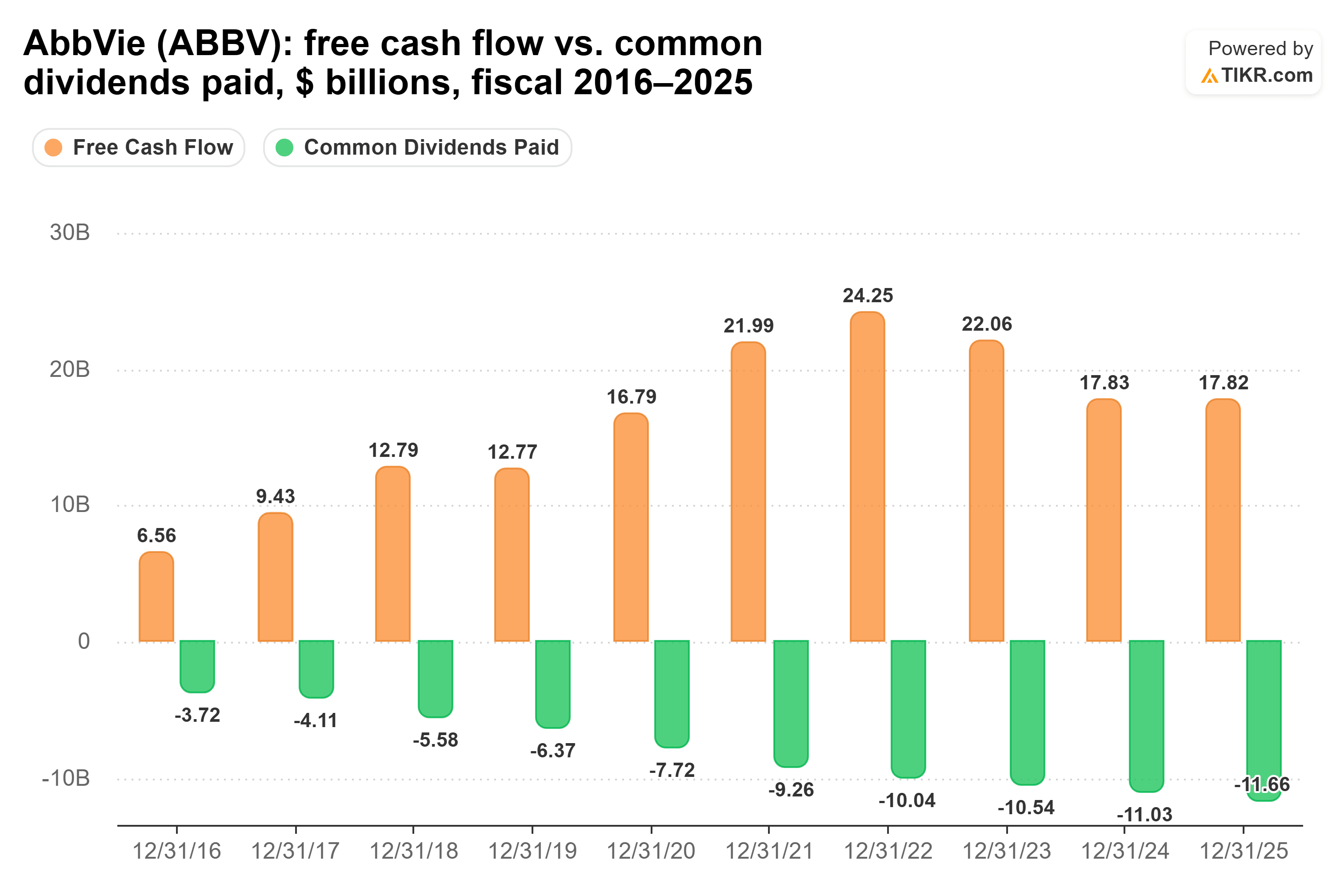
Dividends paid grew from $10.0 billion in fiscal 2022 to $11.7 billion in fiscal 2025, so the payout ratio climbed from 41.4% to 65.4% over those years. It was 65% over the twelve months to Sept. 30, 2026. The dividend is still covered, but the cushion is much thinner than Bristol Myers’.
On its third-quarter call, management said AbbVie’s “robust free cash flow supports a strong and growing quarterly dividend.” AbbVie has the record for the growing part: it says it has raised its quarterly dividend 355% since its 2013 inception.
So which dividend wins?
Bristol Myers Squibb is the better dividend stock. It pays the bigger check and covers it more comfortably, with 55% of free cash flow going to the dividend versus AbbVie’s 65%. It also carries less debt, at 1.7x net debt to EBITDA to AbbVie’s 2.0x.
AbbVie’s faster growth won’t close that income gap any time soon. $10,000 in Bristol Myers pays $410 a year at today’s yield, and the same amount in AbbVie pays $250. Bristol Myers raised its dividend per share 2.9% in fiscal 2025, and AbbVie raised its dividend 5.7%. Even at those paces, AbbVie’s income wouldn’t pass Bristol Myers’ until about 2045.
This isn’t to say AbbVie’s dividend is in trouble. Its business is growing faster, it just raised the dividend again, and analysts expect its normalized EPS to climb from $10.00 in fiscal 2025 to $18.06 in fiscal 2028:
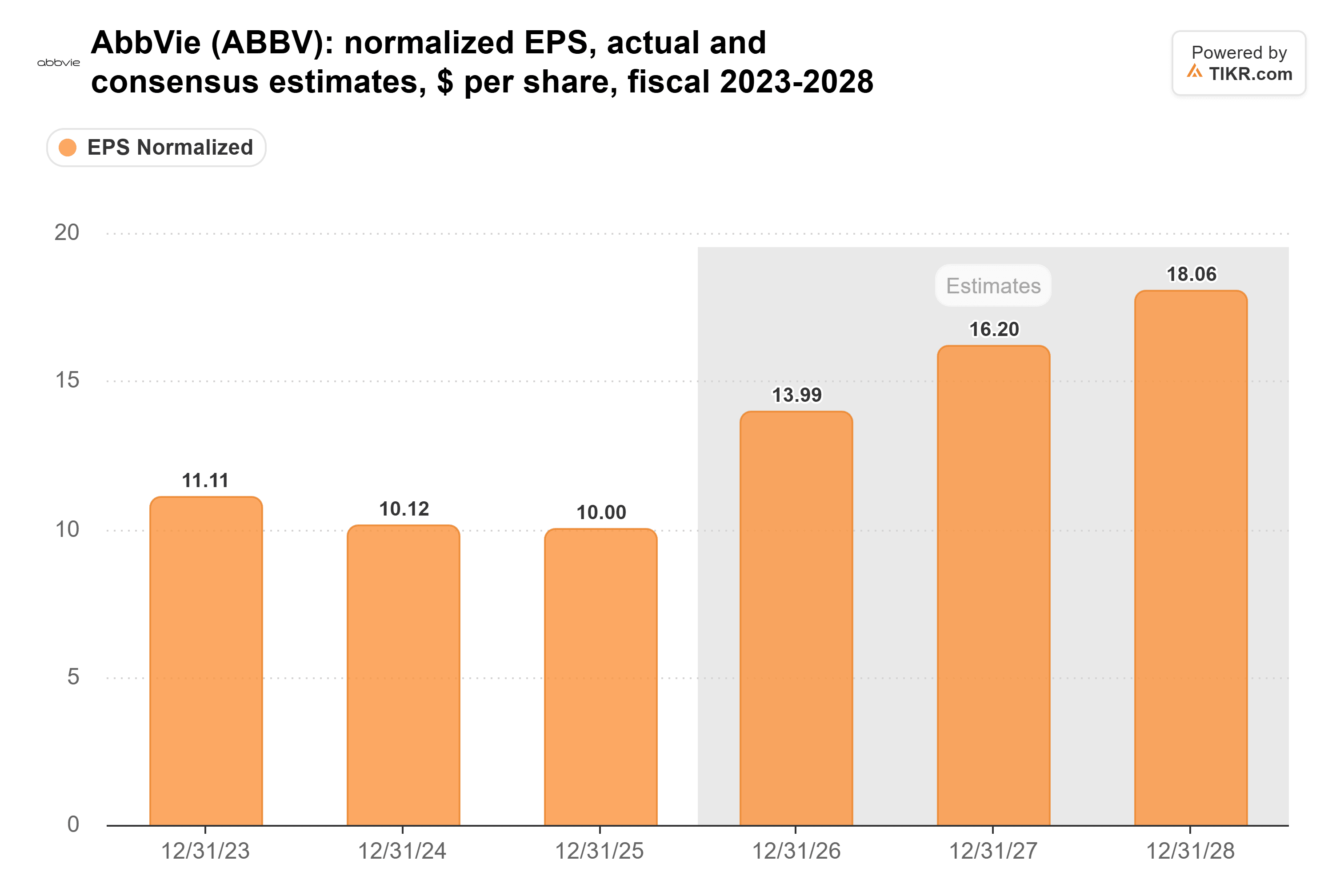
If that growth shows up in free cash flow, AbbVie’s payout ratio would come back down without any help. It’s just that, when it comes down to it, I’d rather collect the bigger check with more cushion behind it today than wait almost two decades for AbbVie’s check to catch up.
Of course, Bristol Myers still has to replace Eliquis. The next big test is its milvexian trial in atrial fibrillation, with results expected in the first quarter of 2027.
Forget Bristol Myers Squibb: 6 safe 6%+ dividend yields you can buy right now
Dividends can hold the key to enormous wealth. But only if you buy the right ones.
Picking the right high-yield dividend stock can be the difference between a dream retirement…and scraping by every month, waiting for the next Social Security check to clear.
We’ve identified six stocks yielding 6%+ that we believe every retiree should know about right now. (And Bristol Myers Squibb isn’t one of them.)
Disclaimer:
Please note that the articles on TIKR are not intended to serve as investment or financial advice from TIKR or our content team, nor are they recommendations to buy or sell any stocks. We create our content based on TIKR Terminal’s investment data and analysts’ estimates. Our analysis might not include recent company news or important updates. TIKR has no position in any of the stocks mentioned. Thank you for reading, and happy investing!