Key Takeaways
- Verizon stock is up 11% in the past month, winning back its October selloff after SpaceX agreed to buy nationwide wireless spectrum.
- Verizon added 406,000 postpaid phones in the third quarter, its best third quarter in five years, and raised guidance for the third straight quarter, though revenue missed as equipment sales fell.
- Elon Musk says SpaceX can build a carrier network in two or three years, against Verizon CEO Dan Schulman’s four to six, and SpaceX’s reported cell-site talks could help tower owner Crown Castle.
- Verizon trades near its usual valuation and its dividend is well covered by free cash flow, so the stock still looks like a buy. The FCC’s ruling on SpaceX’s spectrum deal is the next thing to watch.
Verizon (VZ) stock is up 10.6% in the past month, while the Nasdaq 100 fell 9.6%.
That’s quite a turnaround from Oct. 9, when Verizon fell 8.75%, its worst day since 2002, after SpaceX (SPCX) agreed to buy a nationwide block of 800 MHz spectrum for its Starlink Mobile service.
Then Bloomberg reported on Oct. 22 that SpaceX is in talks for at least 80,000 US cell sites, including those of Crown Castle (CCI). The carriers slid on the news while tower owners rallied, and Crown Castle has climbed more than 10% since Oct. 9.
TIKR tracks 24 analysts on Verizon. How many say “Buy”?
See the full breakdown of Buy, Hold, and Sell ratings on Verizon, along with Wall Street’s revenue and earnings estimates, all in one place. More than 500,000 investors use TIKR to research stocks like this one. See Verizon’s Analyst Ratings
The quarter beat, and the stock fell anyway
Verizon reported its third quarter on Oct. 26. It added 406,000 postpaid phones, its best third quarter in five years, and postpaid phone churn improved to 0.94% from 0.98%. Free cash flow rose 12.1% to $7.8 billion, and Verizon raised its full-year guidance for the third quarter in a row.
But revenue of $34.3 billion missed estimates, and the stock fell 3.5% that day. Equipment revenue dropped 9%, mostly because customers are upgrading less often and Verizon is spending less on phone subsidies. That shrinks revenue but fattens margins: the adjusted EBITDA margin hit a record 40.2%, up from 37.8%.
CEO Dan Schulman said in the release that “we are only one year into a multi-year growth story.” Analysts agree, with normalized EPS climbing from $4.71 in fiscal 2025 to $5.31 in fiscal 2027:
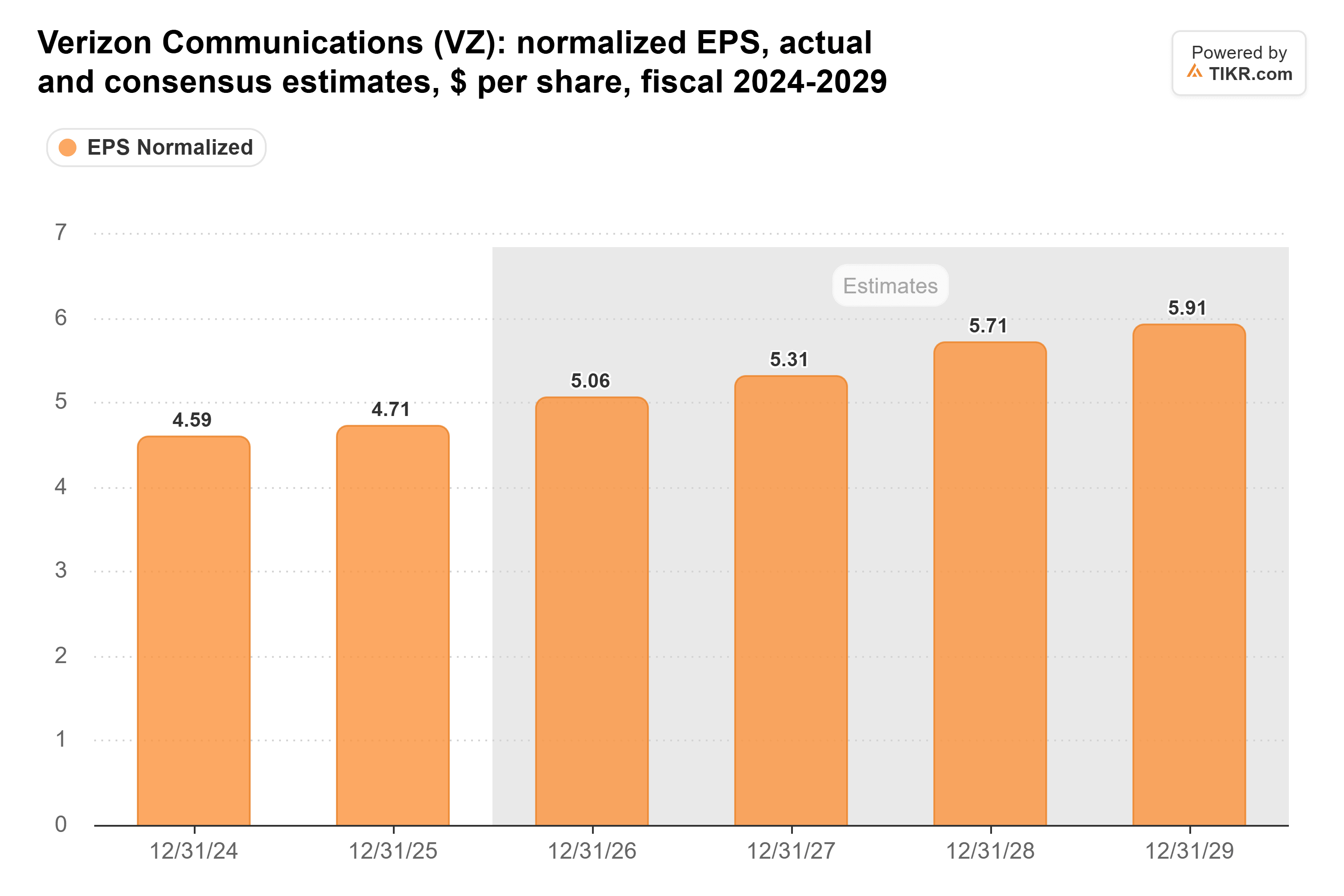
Verizon now guides for $5.04 to $5.06 of adjusted EPS in 2026, in line with the $5.06 consensus, so the revenue miss shouldn’t drag estimates down.
SpaceX needs more than spectrum
On the Oct. 26 earnings call, Schulman said SpaceX would need at least four to six years and $300 billion to $500 billion to fully build out a mobile network.
Elon Musk’s reply on X? “Will take 2 or 3 years.”
SpaceX’s own schedule has already slipped once: on its Oct. 20 call, it pushed next-generation Starlink Mobile service to the first half of 2028, from the end of 2027. The network also competes with AI for cash, which took $16.4 billion of SpaceX’s $19.6 billion in third-quarter capex.
SpaceX is hunting for shortcuts, too. The Washington Post reported in early November that Musk had talks with EchoStar about buying Boost Mobile or using its network, though MoffettNathanson doubts Boost’s network deals would transfer. If Starlink Mobile launches on time, Verizon’s pricing will be tested.
The same reports that hit the carriers are good news for Crown Castle. Its third-quarter site rental revenue fell to $966 million from $1.01 billion, as DISH’s lease terminations cost it $61 million. Crown Castle still raised its 2026 outlook on Oct. 21. Nothing is signed with SpaceX, but even a slice of those 80,000 sites would help refill the hole DISH left.
Still a buy at under 9x earnings
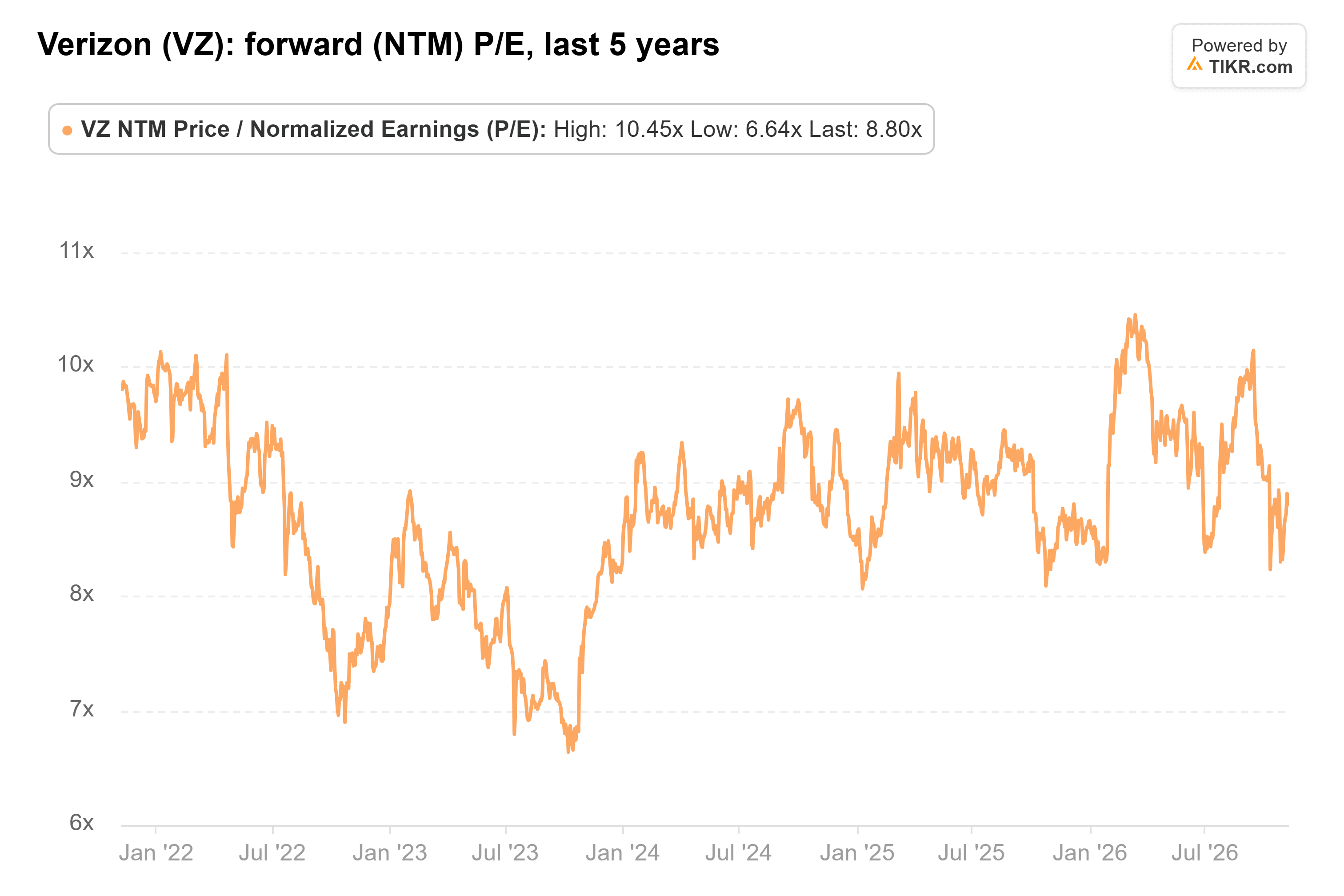
Even after the rebound, Verizon traded at 8.8x forward earnings on Nov. 6. That’s near the middle of its five-year range of 6.6x to 10.5x, and well below the March peak:
Free cash flow has risen every year since fiscal 2022, and management now expects growth approaching 12% in 2026:
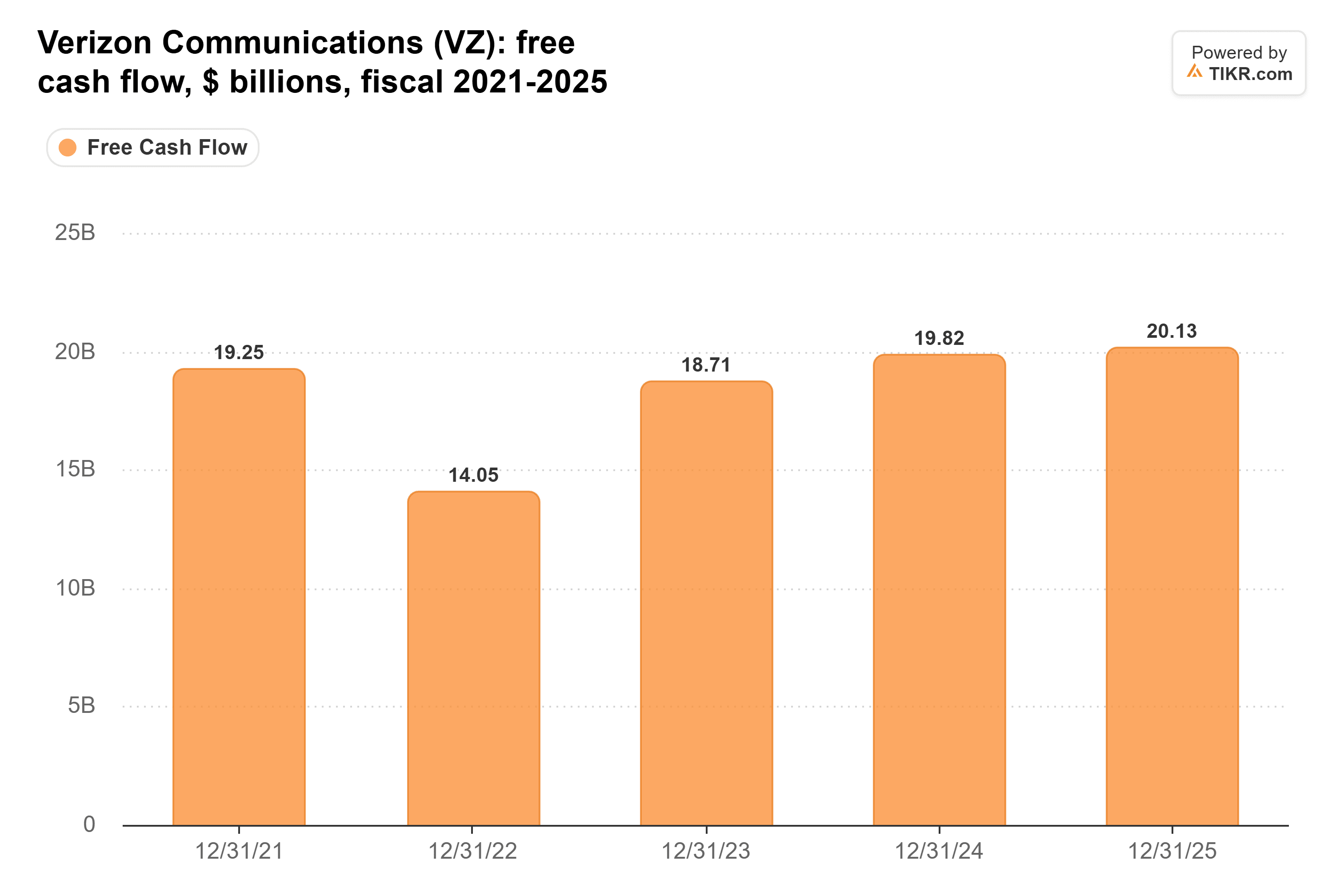
Dividends took a well-covered 52% of free cash flow over the twelve months to Sept. 30, for a yield of about 6%. The Street’s average price target of $50.65 is about 10% above Monday’s close of $46.06.
SpaceX is a real threat, but it’s years from a full network, and Verizon pays investors well to wait. At this price, the stock still looks like a buy for the income. The next tests are fourth-quarter results, expected in late January, where Verizon has to deliver about 4% growth in mobility and broadband service revenue, and the FCC’s ruling on SpaceX’s spectrum deal. A signed SpaceX tower deal would make Musk’s timeline much harder to dismiss.
So what is Verizon stock actually worth?
TIKR lets you forecast the future price of any stock in less than a minute. Just enter a few assumptions into TIKR’s valuation model and see what Verizon could be worth. Start from Wall Street consensus estimates, or adjust the inputs to reflect your own view of the business. It’s free to use.
Disclaimer:
Please note that the articles on TIKR are not intended to serve as investment or financial advice from TIKR or our content team, nor are they recommendations to buy or sell any stocks. We create our content based on TIKR Terminal’s investment data and analysts’ estimates. Our analysis might not include recent company news or important updates. TIKR has no position in any of the stocks mentioned. Thank you for reading, and happy investing!