Key Stats for Robinhood
- 52-Week Range: $63.52 – $153.86
- Market Cap: $84.9B
- Street Mean Target: $119.82
- LTM Gross Margin: 91.9%
- Net Cash: $980M
- Fwd 2-Yr Rev. CAGR: ~20%
- Gold Subscribers: 4.4M
Robinhood Markets (HOOD) had the kind of quarter that would make most companies’ investor relations teams very happy. Revenue grew 50% year over year. Net deposits hit a record $21.7 billion. Adjusted EPS of $0.51 came in roughly 19% ahead of consensus, and the GAAP figure of $0.62 beat estimates by 44%.
Prediction markets, a category that barely existed on the platform a year ago, generated $156 million in Q2 revenue. Yet the stock fell after the report and sits roughly 38% below its January high. Understanding why requires separating what the business is actually doing from what investors chose to focus on.
Most investors never know if a stock is truly undervalued or overpriced. TIKR’s professional-grade valuation tools give you a clear, data-backed answer across 60,000+ stocks for free →
A Platform in Transformation
Robinhood started as a commission-free stock trading app for younger investors. It became famous and then infamous during the meme-stock era of 2021, when retail trading volumes exploded and then collapsed. What has happened since is a genuine business transformation.
The company now operates as a diversified financial platform offering brokerage, options trading, cryptocurrency, a subscription service called Robinhood Gold, a credit card, prediction markets for sports and political events, and international services launched recently in Singapore.
The selloff from the January high tells the story of a stock that ran hard on that thesis, then hit a series of setbacks.

The max drawdown exceeded 57% at its worst in early spring, as crypto markets weakened, Q1 earnings disappointed on take rates, and risk-off sentiment hit high-beta fintech names hard. The stock partially recovered through July, then sold off again after Q2 results despite the headline beat.
The reason is specific: GAAP EPS of $0.62 included a one-time $106 million gain from the deconsolidation of Robinhood Ventures Fund. The underlying adjusted EPS of $0.51 was still well ahead of estimates, but the optics created confusion.
Crypto transaction revenue also fell 38% quarter over quarter to $100 million, which investors treated as a red flag even as equities revenue surged 95% and prediction markets grew tenfold year over year.
See historical and forward estimates for Robinhood stock (It’s free!) >>>
The Revenue Growth Is Real
Strip away the noise, and the trajectory is compelling. Robinhood grew from roughly $1.4 billion in annual revenue in 2022 to $4.47 billion in 2025, with the pace of acceleration increasing rather than moderating.
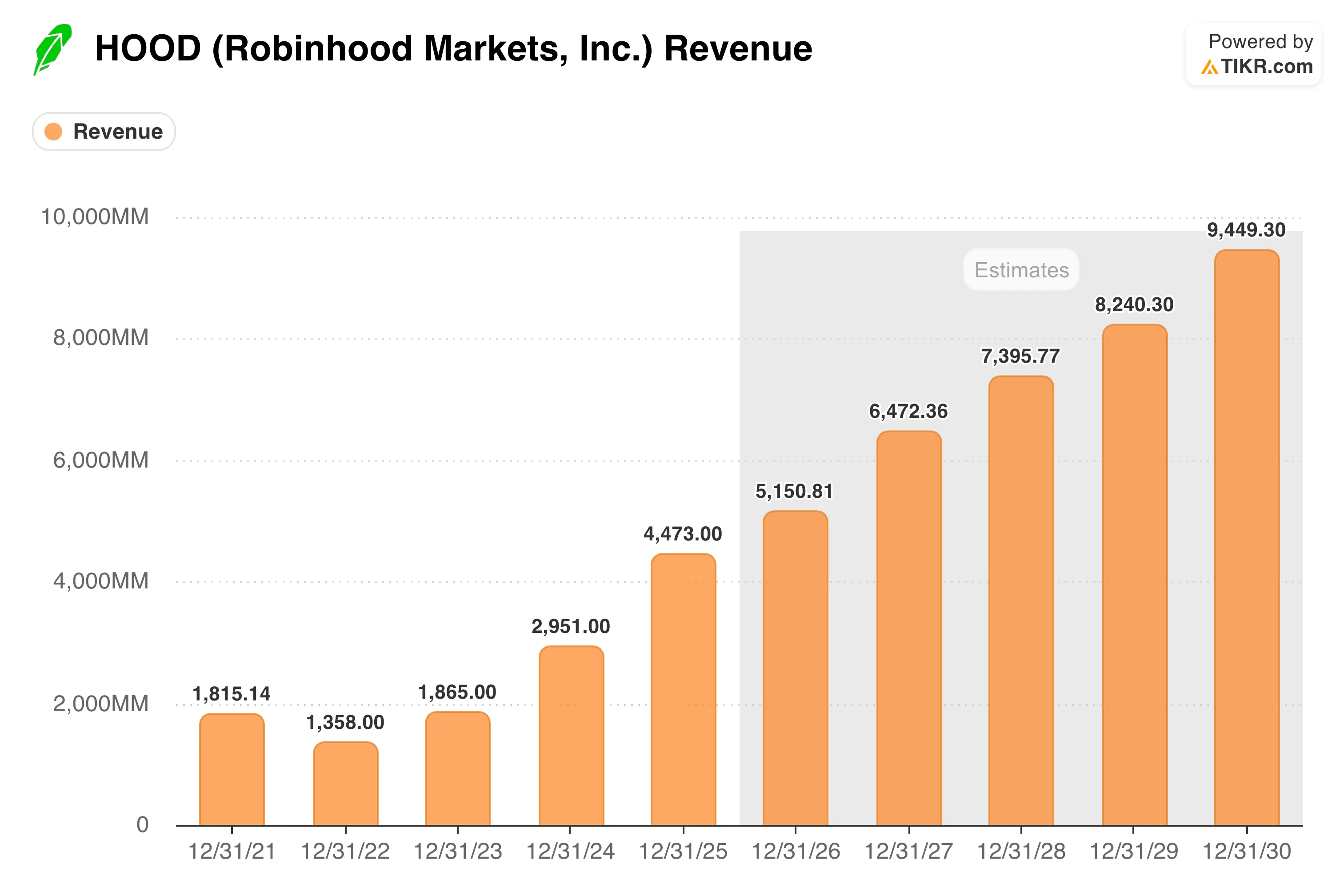
Consensus estimates project continued growth toward around $5.15 billion in 2026 and approaching $9.45 billion by 2030, a forward CAGR of roughly 20% annually.
Gold subscribers reached 4.4 million in Q2, up 59% year over year, generating around $140 million in annualized subscription revenue. Assets under custody grew 77% year over year to $270 billion. The Gold credit card attracted over 2 million applications.
CEO Vlad Tenev noted that customers are moving more money onto Robinhood and using more products, which is the flywheel the business needs to demonstrate at scale. The one soft note was July net deposits of roughly $4 billion, the slowest monthly pace of 2026, which management framed as seasonal.
See how Robinhood performs against its peers in TIKR (It’s free!) >>>
What the Valuation Model Says
At roughly $96, Robinhood trades at around 35x forward earnings, demanding for a brokerage, but more defensible for a fintech growing revenue at 20% with 92% gross margins. The TIKR valuation model warrants honest reading.

The model targets around $260 per share on mid-case assumptions, implying a total return of roughly 176% through 2030 and an annualized IRR of around 26% per year.
These numbers require the business to compound at rates that are demanding even by high-growth fintech standards: around 15% annual revenue growth and net income margins near 41%.
The Street is more measured, with 15 buys, 3 holds, and zero sells, and a mean target around $120 implying roughly 25% upside on a twelve-month basis.
Should You Invest in Robinhood Stock?
Robinhood is harder to evaluate than most because the business is genuinely changing faster than investors can track. A year ago it was a trading platform correlated to retail sentiment.
Today it is a financial services platform with a credit card, a subscription business, prediction markets, and international operations. The 38% pullback has created a more interesting entry point than January, and the operating momentum is real.
The risks are equally real: heavy reliance on trading volumes, crypto revenue that can swing 40% in a quarter, and a valuation that still demands consistent execution. For investors comfortable with that profile and a long time horizon, the story is more durable than the recent selloff suggests.
See analysts’ growth forecasts and price targets for Robinhood stock (It’s free!) >>>
Looking for New Opportunities?
- See which stocks billionaire investors are buying to follow the smart money.
- Analyze stocks in as little as 5 minutes with TIKR’s all-in-one, easy-to-use platform.
- The more rocks you overturn… the more opportunities you’ll uncover. Search 100K+ global stocks, global top investor holdings, and more with TIKR.
Disclaimer:
Please note that the articles on TIKR are not intended to serve as investment or financial advice from TIKR or our content team, nor are they recommendations to buy or sell any stocks. We create our content based on TIKR Terminal’s investment data and analysts’ estimates. Our analysis might not include recent company news or important updates. TIKR has no position in any of the stocks mentioned. Thank you for reading, and happy investing!