Key Stats for Johnson and Johnson
- 52-Week Range: $172.70 – $274.90
- Market Cap: $626.1B
- Enterprise Value: $654.4B
- Street Mean Target: $272.50
- Dividend Yield: 2.1%
- LTM Gross Margin: 68.1%
- Fwd 2-Yr EPS CAGR: ~7%
Johnson and Johnson (JNJ) has been one of the stronger performers in large-cap healthcare this year, up roughly 25% year to date coming into August. The rally has been grounded in something real: a best-in-class oncology portfolio growing faster than expected, steady execution in MedTech, and a pipeline that management believes can sustain growth well beyond the current product cycle.
Q2 2026 results, reported in mid-July, continued the pattern. Revenue reached $25.3 billion for the quarter, up 6.6% year over year, adjusted EPS came in at $2.90, and management raised full-year guidance to $101.1 billion in sales at the midpoint. In 140 years of history, Johnson and Johnson has never crossed $100 billion in annual revenue. It is about to.
Now Live: Discover how much upside your favorite stocks could have using TIKR’s new Valuation Model (It’s free)>>>
Two Engines, One Direction
Johnson and Johnson operates through two segments. Innovative Medicine, the pharmaceutical business, is the primary growth engine, generating $16.4 billion in Q2 revenue, up 7.8% year over year. The growth is being driven by a handful of oncology and immunology products that have moved from promising launches to genuine blockbusters.
Darzalex, a multiple myeloma treatment, reached $4.2 billion in quarterly revenue. Tremfya, which targets psoriasis and inflammatory bowel disease, surged 72.5% to $2 billion in the quarter, driven by expanded indications.
Carvykti, Tecvayli, and Rybrevant combined to generate $2.6 billion in H1 2026 revenue and are still in early adoption phases relative to their peak potential.
The EPS chart below captures the inflection the new portfolio is creating.

Normalized EPS was essentially flat from 2021 through 2025, hovering near $10, as the company worked through the Stelara patent cliff, the Kenvue consumer health spinoff, and a period of heavy investment in new launches.
Consensus estimates now project a meaningful step-up: around $11 in 2026, $12.31 in 2027, $15.34 in 2028, and approaching $20.65 by 2030. Management has said it believes 10 products in the Innovative Medicine portfolio have the potential to reach $5 billion in peak annual sales each.
The MedTech segment contributed $8.93 billion in Q2, up 4.5%, with growth across cardiovascular, surgical, vision, and orthopedic trauma categories, though it came in slightly below analyst expectations.
See analysts’ growth forecasts and price targets for Johnson and Johnson stock (It’s free) >>>
The Balance Sheet Behind the Pipeline
Building a pharmaceutical pipeline at this scale requires capital, and Johnson and Johnson’s cash position reflects a company that has been deploying it aggressively while maintaining a fortress balance sheet.
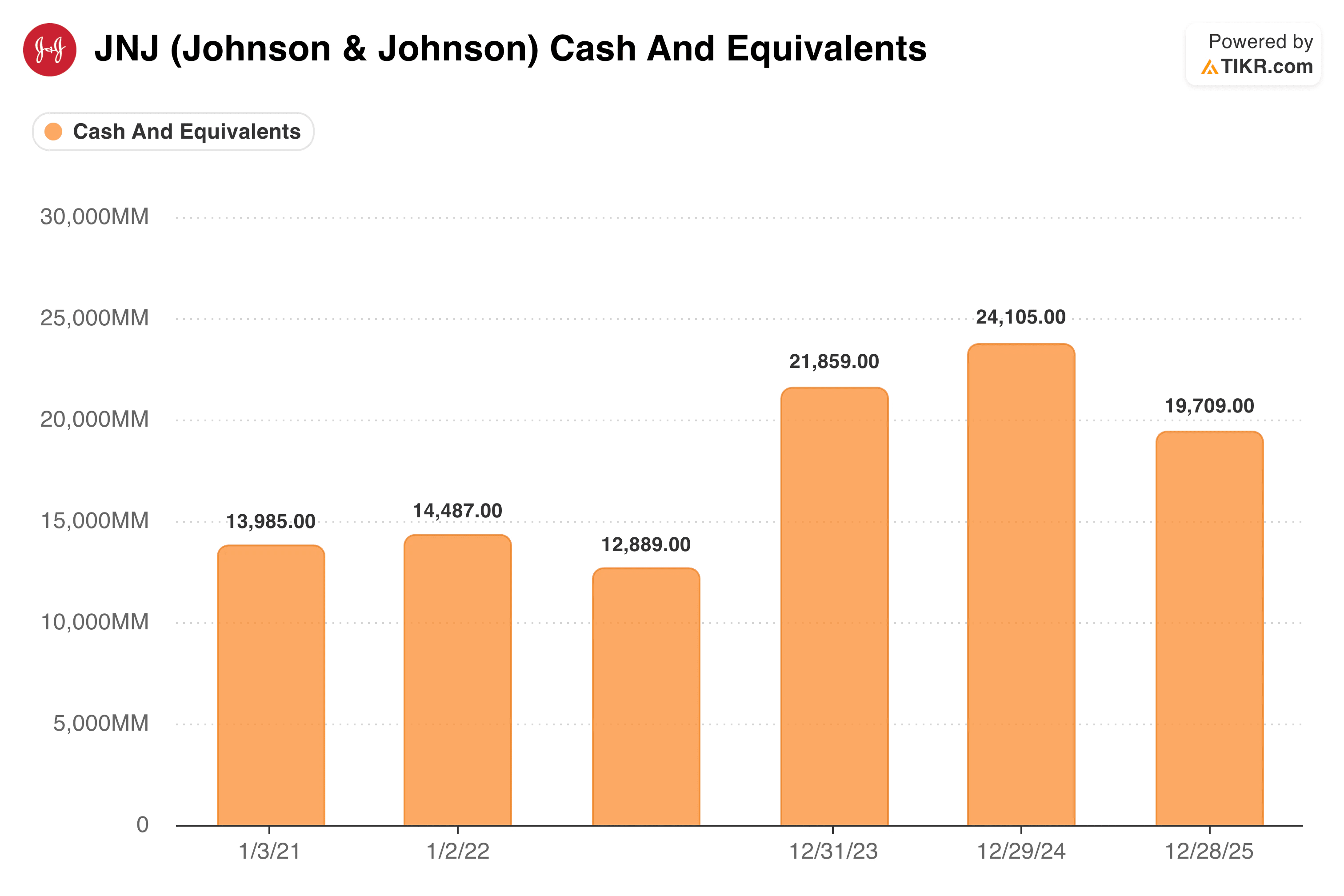
Cash and equivalents peaked at $24.1 billion in 2024 before pulling back to $19.7 billion at year-end 2025, largely reflecting the $14.6 billion acquisition of Intra-Cellular Therapies in April 2025, the deal that brought Caplyta and the neuroscience pipeline into the fold.
The company generated $11.1 billion in operating cash flow in the first half of 2026 alone, which more than covers the dividend, share repurchases, and bolt-on deals. In Q2, Johnson and Johnson agreed to acquire Firefly Bio for $1 billion in cash, adding an early-stage pipeline asset.
The one meaningful overhang is the talc liability, where approximately 76,000 US plaintiffs remain, and the company holds a reserve with a present value of roughly $3.7 billion. Management has stated this is not expected to materially affect the overall financial position, and so far that has proven accurate.
Value your favorite stocks like JNJ with 5 years of analysts’ forecasts using TIKR’s new Valuation Model (It’s free) >>>
What the Valuation Model Says
Johnson and Johnson trades at roughly 23x forward earnings, which reflects the quality of the franchise and the improving earnings trajectory. The TIKR valuation model offers an honest read on what the current price implies for forward returns.

The mid-case target is around $277 per share, implying a total return of roughly 7% through the end of 2030 and an annualized IRR of only around 2% per year.
The high case is more interesting, pointing to approximately $420 and an IRR of around 6% annually, if the oncology pipeline delivers on its peak sales potential and multiple expansion follows.
The Street mean target of $272.50 implies essentially no upside from current levels on a twelve-month basis. None of this suggests the business is broken. It suggests the stock’s strong 2026 performance has pulled a meaningful amount of future return forward.
Should You Invest in Johnson and Johnson Stock?
Johnson and Johnson is a genuinely exceptional business: diversified across two durable healthcare segments, led by one of the most compelling oncology pipelines in the industry, with a balance sheet capable of funding acquisitions and returning capital to shareholders simultaneously. The concern is not the quality of the company. It is the price.
At $260, with the valuation model pointing toward roughly 2% annualized returns in the mid case, new investors are paying a full price for a business that will need its pipeline to perform at a high level just to justify the current multiple over the next several years. For existing holders, the case for staying is straightforward.
For investors considering a new position, the risk-reward is more balanced than the strong 2026 performance might suggest, and patience for a better entry point may be warranted.
See the exact moment Wall Street upgrades a stock before the rest of the market piles in and track analyst rating changes in real time with TIKR for free →
Looking for New Opportunities?
- See which stocks billionaire investors are buying to follow the smart money.
- Analyze stocks in as little as 5 minutes with TIKR’s all-in-one, easy-to-use platform.
- The more rocks you overturn… the more opportunities you’ll uncover. Search 100K+ global stocks, global top investor holdings, and more with TIKR.
Disclaimer:
Please note that the articles on TIKR are not intended to serve as investment or financial advice from TIKR or our content team, nor are they recommendations to buy or sell any stocks. We create our content based on TIKR Terminal’s investment data and analysts’ estimates. Our analysis might not include recent company news or important updates. TIKR has no position in any of the stocks mentioned. Thank you for reading, and happy investing!