
Key Stats for Procter & Gamble
- 52-Week Range: $137.62 – $167.25
- Market Cap: $337.5B
- Enterprise Value: $363.6B
- Street Mean Target: $160.57
- Dividend Yield: 3.0%
- LTM Gross Margin: 50.9%
- LTM EBIT Margin: 24.8%
Procter and Gamble (PG) is one of those businesses that investors tend to either own forever or avoid entirely, and right now, the stock is giving both camps something to think about. The company just closed fiscal year 2026 with $87 billion in net sales, up 3% from the prior year, and delivered core EPS of $6.89, up 1%.
Those are not exciting numbers, but they are steady ones. What the market is more focused on is what comes next: a $1 billion after-tax cost headwind expected to weigh on fiscal 2027 results, concentrated in the first half of the year, driven by higher raw materials, energy, and transportation costs stemming largely from geopolitical disruption and the ongoing conflict in the Middle East.
The stock has sold off roughly 13% from its 2026 high as a result, and now sits near the lower end of its year-to-date range.
Most investors never know if a stock is truly undervalued or overpriced. TIKR’s professional-grade valuation tools give you a clear, data-backed answer across 60,000+ stocks for free →
What the Numbers Actually Show
Procter and Gamble owns some of the most recognized consumer brands in the world, including Tide, Pampers, Gillette, Always, Downy, Charmin, Crest, and Olay, sold across roughly 70 countries.
The business model is built around pricing power, distribution scale, and the kind of brand loyalty that keeps households reaching for the same products year after year. Fiscal 2026 organic sales grew 1%, with flat volumes and one point of pricing, which is about as modest as PG gets.
Nine of ten product categories held or grew organic sales, and all seven geographic regions contributed positively, including Greater China, which stabilized at 4% organic growth after a difficult stretch.
The beats and misses table below captures a dynamic that has frustrated investors all year.
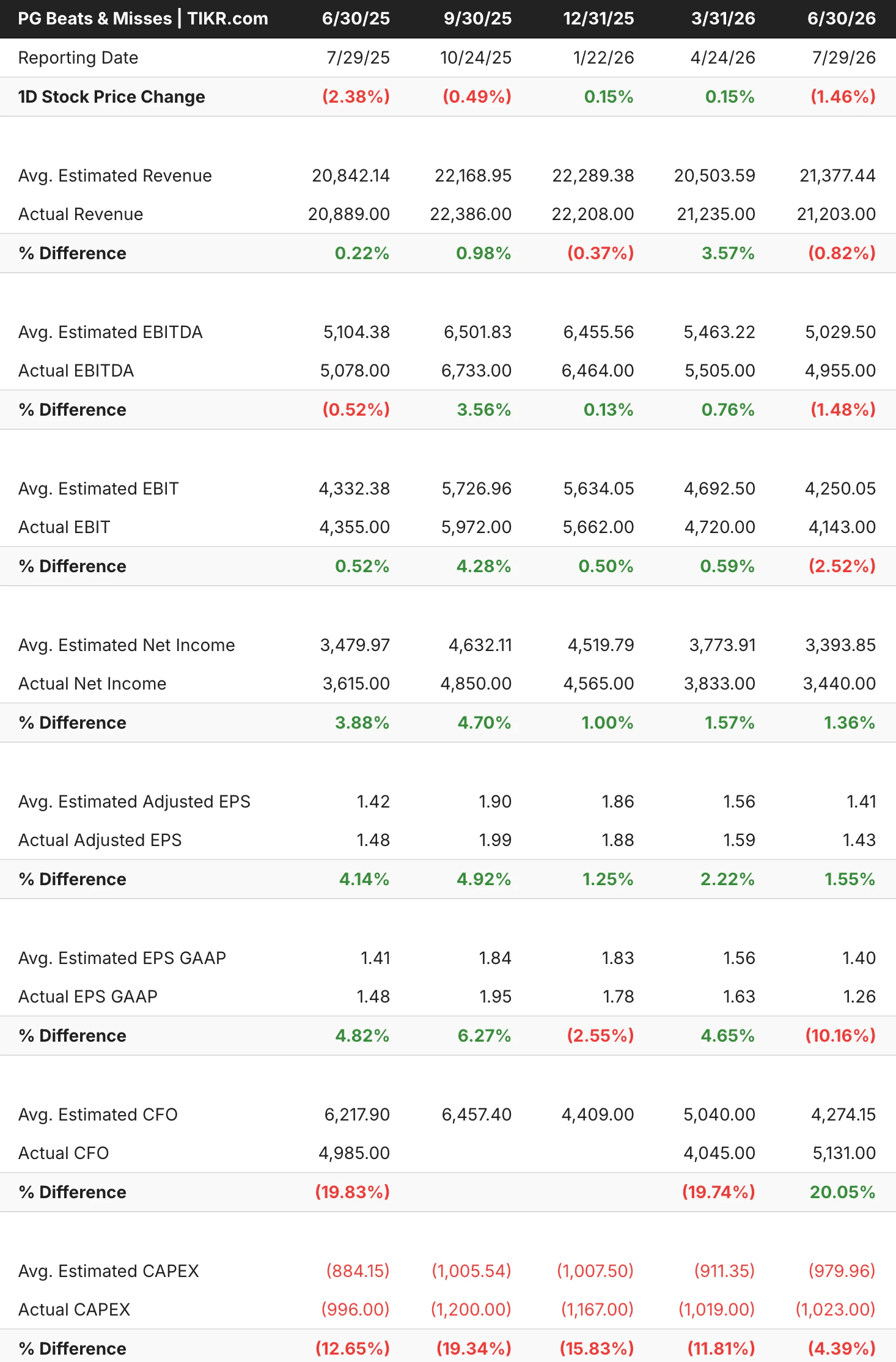
Adjusted EPS has beaten consensus estimates in each of the last five quarters, consistently coming in 1% to 5% above expectations. Net income has beaten every quarter as well.
But GAAP EPS missed badly in the most recent quarter, down more than 10% versus consensus, largely due to restructuring charges associated with a cost reduction program expected to generate $1 billion to $1.6 billion in total savings before the end of fiscal 2027.
Revenue has been mixed, with modest beats and misses. EBIT missed in Q4 by about 2.5%, reflecting the gross margin compression that has been building all year. For the full fiscal year, gross margin fell 100 basis points, and operating margin fell 160 basis points, which is the real source of investor concern.
PG can manage the EPS line through cost discipline, but margin contraction in a low-volume environment raises questions about the durability of pricing power.
See historical and forward estimates for PG stock (It’s free!) >>>
Why the Stock Has Pulled Back
Procter & Gamble is the kind of stock that investors have historically paid a premium for, specifically because it does not do this. The appeal of owning a business selling Tide and Pampers is that demand is relatively inelastic, volumes are stable, and pricing compounds predictably over time. When volumes flatten and costs rise simultaneously, the core thesis gets stress-tested.
The drawdown chart shows how that stress has registered in the stock price this year.

The max drawdown reached 16.15% on June 3, and the stock currently sits about 13% below its year-to-date high.
Two separate sell-off phases are visible: the first running through late 2025 as investors rotated away from defensives, and the second beginning in April 2026 as tariff and commodity cost concerns intensified. The most recent leg down followed the July 29 earnings report, when the stock fell roughly 3% despite an adjusted EPS beat, as guidance for fiscal 2027 was cautious.
Management signaled that Q1 FY2027 earnings could be down around 5% year over year before the year improves from there, and the full-year EPS range of $6.89 to $7.11 implies essentially no growth at the midpoint. That is a tough ask at a 21x earnings multiple.
Access Professional Tools to Analyze PG stock on TIKR for Free →
What the Valuation Model Says
At $145, PG trades at roughly 21x forward earnings and yields 3%, which is the combination that tends to attract income-oriented investors who want stability over growth. The TIKR valuation model offers a multi-year frame for the return potential.
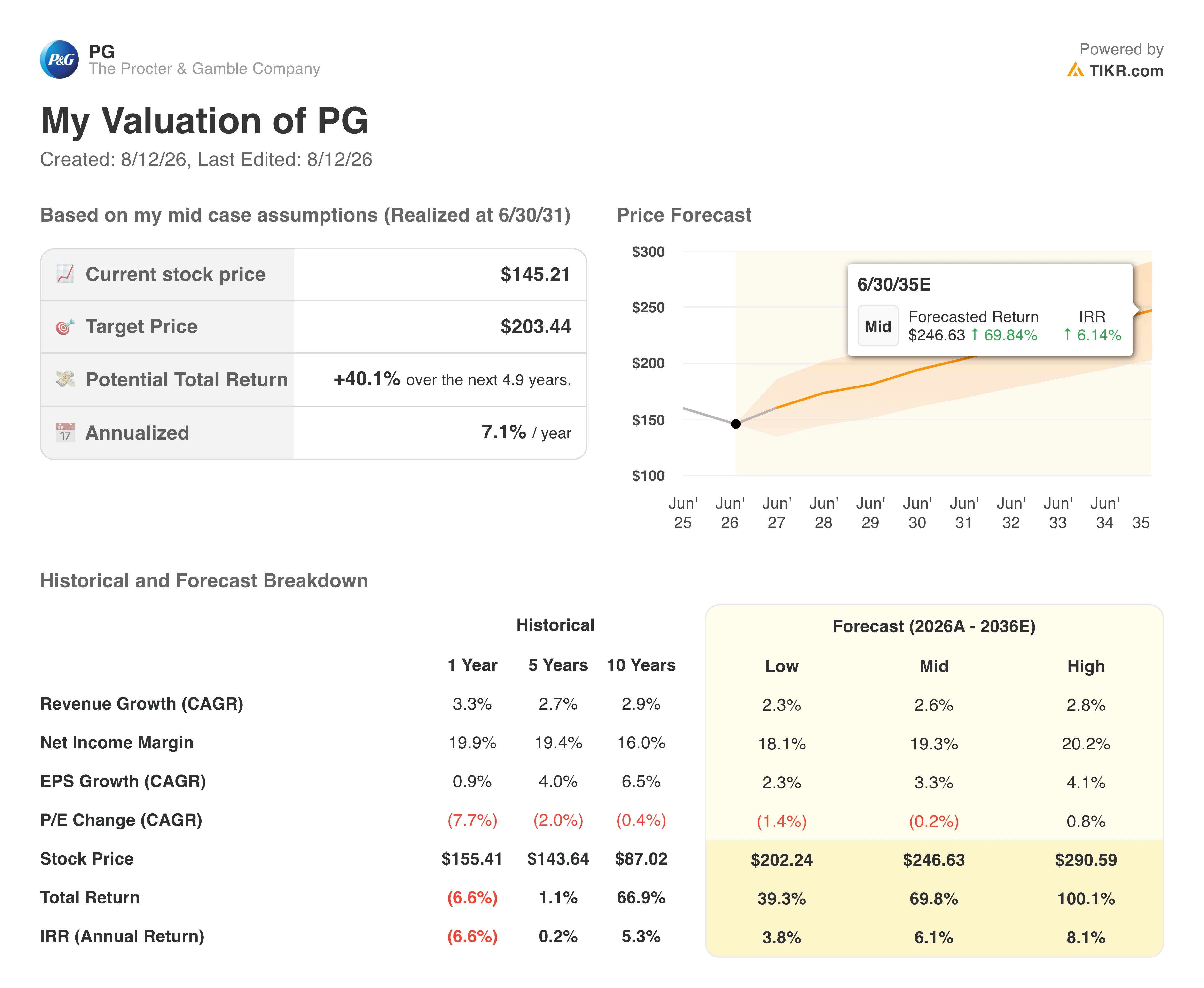
The model targets around $203 per share under mid-case assumptions, implying a total return of roughly 40% through mid-2031 and an annualized IRR of around 7%. Including the 3% dividend yield, the total annual return in the mid case is meaningful for a company of this risk profile.
The low case points to approximately $202 and the high case to roughly $291, with the mid case assuming around 3% annual revenue growth and net income margins near 19%.
The Street mean target of around $161 implies roughly 11% upside from current levels on a twelve-month basis, though most of that gap will require the cost environment to improve and volume trends to reaccelerate.
Should You Invest in Procter and Gamble Stock?
Procter & Gamble is not a business in structural decline, and the current headwinds are real but well understood. The $1 billion cost headwind is largely timing-related, the restructuring program is designed to fund future investment while protecting margins, and the brand portfolio is as durable as any in consumer staples.
The question is whether 21x earnings is the right price to pay while volumes are flat, margins are compressing, and near-term guidance implies no EPS growth. For investors who already own PG, the 3% dividend and the multi-year valuation model provide a reasonable case for holding. For new investors, the more interesting question is whether the first half of fiscal 2027, when cost headwinds peak, might create a better entry point than today.
See the exact moment Wall Street upgrades a stock before the rest of the market piles in and track analyst rating changes in real time with TIKR for free →
Looking for New Opportunities?
- See which stocks billionaire investors are buying to follow the smart money.
- Analyze stocks in as little as 5 minutes with TIKR’s all-in-one, easy-to-use platform.
- The more rocks you overturn… the more opportunities you’ll uncover. Search 100K+ global stocks, global top investor holdings, and more with TIKR.
Disclaimer:
Please note that the articles on TIKR are not intended to serve as investment or financial advice from TIKR or our content team, nor are they recommendations to buy or sell any stocks. We create our content based on TIKR Terminal’s investment data and analysts’ estimates. Our analysis might not include recent company news or important updates. TIKR has no position in any of the stocks mentioned. Thank you for reading, and happy investing!