Key Takeaways
- Realty Income (O) offered a dividend yield of approximately 5.7% on November 2, compared with 7.2% for VICI Properties (VICI), which trades at a lower valuation but carries greater tenant concentration risk.
- Caesars Entertainment (CZR) accounts for 38% of VICI’s contractual rent, while MGM Resorts (MGM) contributes another 32%, making their financial health critical to VICI’s outlook.
- Both REITs have approximately 73% dividend payout ratios based on 2026 consensus AFFO and dividend estimates from TIKR.
- VICI trades near 10x estimated 2026 AFFO, compared with approximately 13x forward AFFO for Realty Income, but its valuation discount comes with significant Caesars-related uncertainty.
What Happened?
Realty Income (O) and VICI Properties (VICI) offer investors two different approaches to real estate dividend income.
At their November 2 prices, VICI offered an annualized dividend yield of approximately 7.2%, compared with roughly 5.7% for Realty Income, giving investors a higher starting income yield in exchange for greater tenant concentration risk.
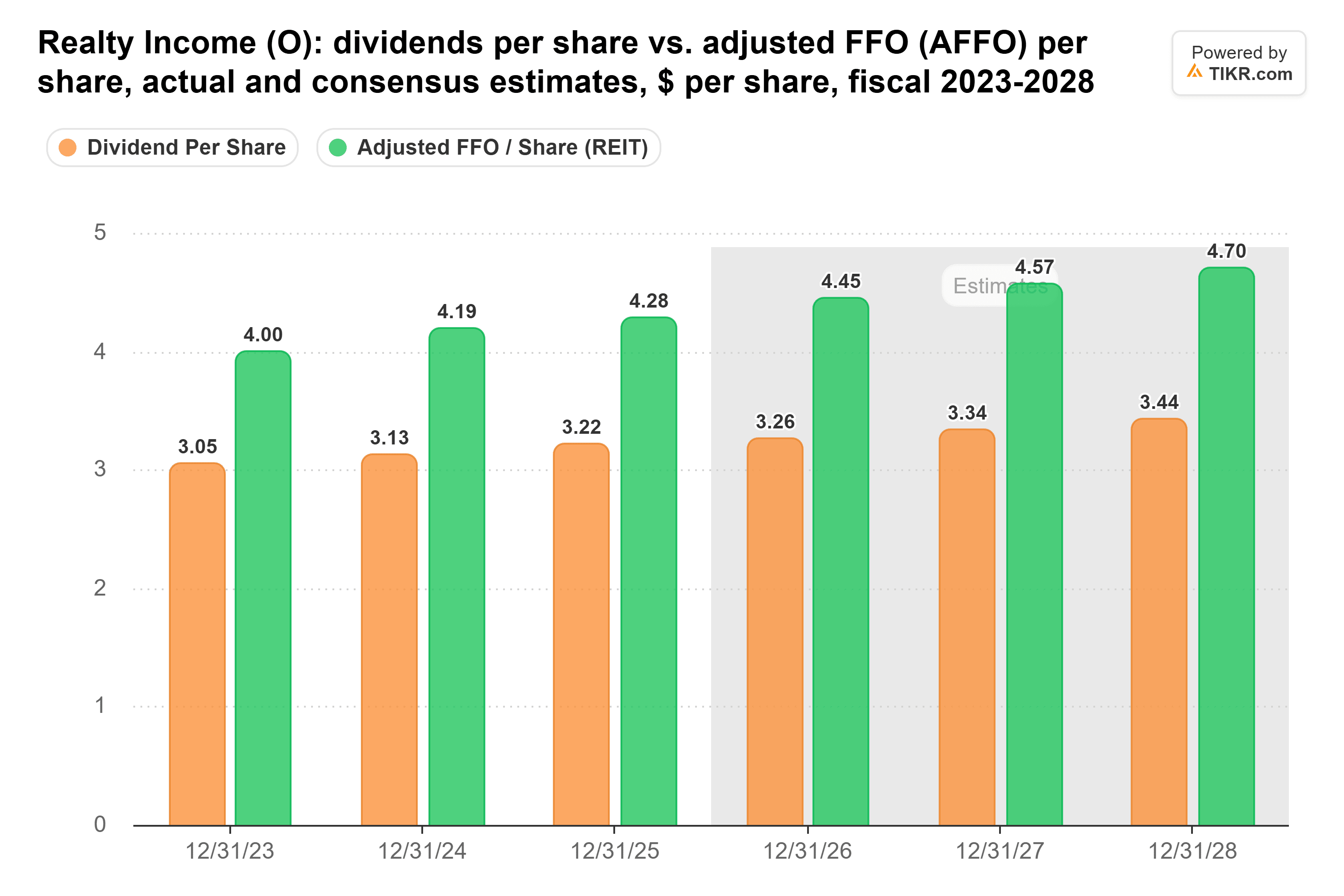
Both companies raised their 2026 adjusted funds from operations (AFFO) guidance following third-quarter earnings, with Realty Income targeting $4.45–$4.46 per share and VICI expecting $2.47–$2.48 per share.
However, VICI faces uncertainty surrounding Caesars Entertainment (CZR) following Fertitta Entertainment’s proposed $17.6 billion acquisition announced in May 2026.
Caesars shareholders approved the transaction in September, although regulatory approvals remained outstanding in the company’s latest quarterly filing.
According to VICI’s third-quarter filing, its credit-loss allowance increased by approximately $313 million related to Caesars, reflecting concerns about the casino operator’s anticipated financial structure and future regional lease obligations.
The adjustment was noncash rather than an immediate loss of rental income, but it highlighted potential risks associated with VICI’s concentrated portfolio.
Despite those concerns, VICI reported third-quarter revenue growth of 5.8% and AFFO per share growth of 4.3% year over year.
CEO Edward Pitoniak said the results demonstrated the “flow-through efficiency of our business model,” emphasizing the company’s ability to grow AFFO.
Meanwhile, Realty Income announced another monthly dividend increase on November 10, raising its payment from $0.2715 to $0.2740 per share, equivalent to $3.288 annually.
Two Tenants Account for 70% of VICI’s Rent
According to VICI’s third-quarter financial disclosures, Caesars represented 38% of contractual rent, while MGM Resorts (MGM) contributed another 32%.
In comparison, Realty Income’s largest tenant, 7-Eleven, accounted for just 3.3% of annualized base rent at the end of 2025.
VICI’s financial supplement showed that its Caesars Regional Master Lease and Joliet Lease generated approximately $740.5 million in gross annual contractual rent, or $730.9 million after adjusting for the noncontrolling interest.
That adjusted amount represents approximately 27% of VICI’s projected $2.7 billion in annual AFFO.
In a simplified stress scenario, losing half of Caesars’ regional rental income could raise VICI’s projected dividend payout ratio from approximately 73% to 85%, assuming the lost rent reduces AFFO dollar for dollar and no offsetting recoveries.
A complete loss of regional rental income could push the payout ratio above 100%, potentially leaving the dividend uncovered by AFFO.
These are hypothetical stress tests rather than forecasts. Actual results would depend on lease enforcement, recoveries, expenses, and other financial adjustments.
The concentration helps explain why VICI trades at a discount, even though its current operations continue generating substantial cash flow.
Is Realty Income or VICI Stock Undervalued?
VICI offers the cheaper valuation, but Realty Income’s diversified portfolio provides a stronger defense against individual tenant problems.
According to TIKR consensus estimates, Realty Income is expected to generate approximately $4.45 in AFFO per share in 2026 against $3.26 in forecast dividends, representing a payout ratio near 73%.
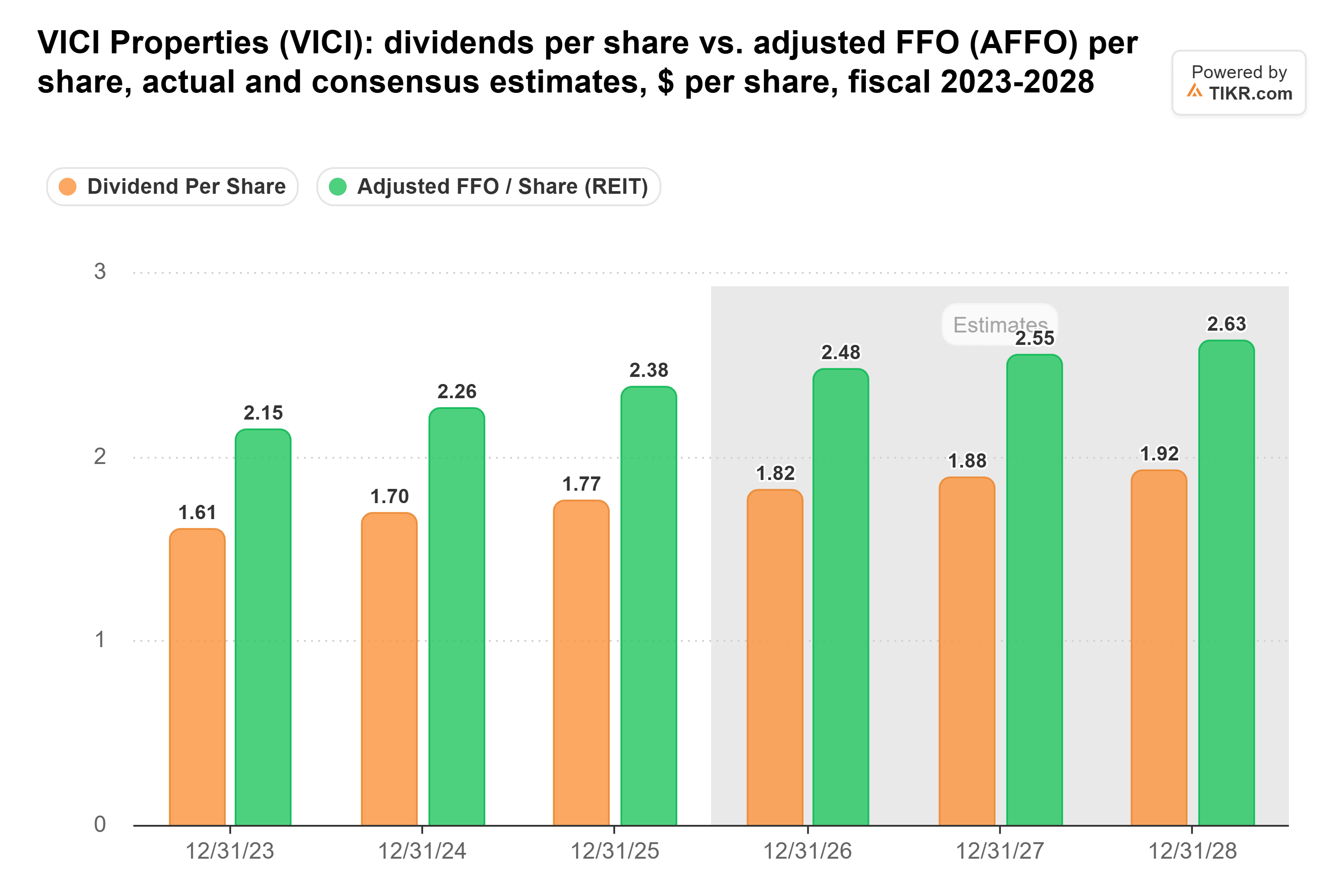
VICI is expected to generate approximately $2.48 in AFFO per share against $1.82 in forecast dividends, producing a similar payout ratio near 73%.
Its dividend increased approximately 9% between fiscal 2023 and 2025, compared with nearly 6% growth for Realty Income.
VICI’s latest declared quarterly dividend of $0.46 also represents an annualized payment of $1.84, slightly above the chart’s 2026 consensus estimate.
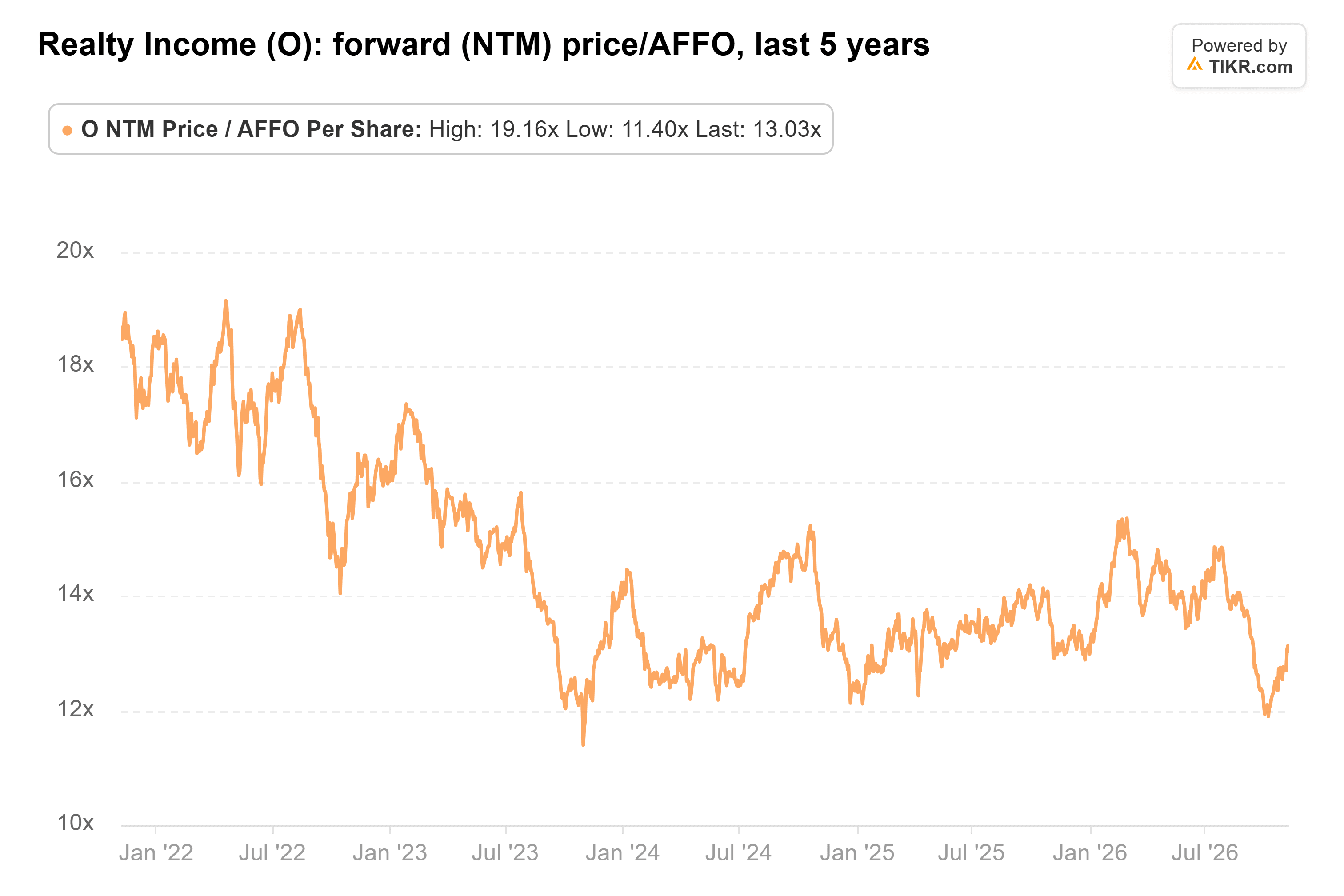
Realty Income traded near 13x forward AFFO as of November 6, below its five-year historical average of approximately 15x.
VICI traded near 10x estimated 2026 AFFO based on its November 2 valuation, although the two multiples use different forecast periods.
Realty Income’s A- S&P credit rating, compared with VICI’s BBB-, highlights the difference in their credit profiles. While VICI offers a cheaper valuation, Realty Income’s stronger rating and more diversified tenant base provide additional financial protection.
Over the next 12 months, VICI’s outlook will depend heavily on Caesars’ acquisition financing, regional lease arrangements, and continued rental payments.
Realty Income’s prospects will depend on acquisition activity, borrowing costs, and its ability to sustain AFFO growth while raising dividends.
VICI looks more attractively valued for investors seeking higher income and comfortable with casino tenant exposure, while Realty Income offers a more conservative alternative for those prioritizing dividend stability.
The valuation gap could narrow if Caesars remains financially stable, but deteriorating tenant finances could justify VICI’s continued discount.
So what is VICI Properties stock actually worth?
TIKR lets you forecast the future price of any stock in less than a minute. Just enter a few assumptions into TIKR’s valuation model and see what VICI Properties could be worth. Start from Wall Street consensus estimates, or adjust the inputs to reflect your own view of the business. It’s free to use.
Value VICI Properties for free
Disclaimer:
Please note that the articles on TIKR are not intended to serve as investment or financial advice from TIKR or our content team, nor are they recommendations to buy or sell any stocks. We create our content based on TIKR Terminal’s investment data and analysts’ estimates. Our analysis might not include recent company news or important updates. TIKR has no position in any of the stocks mentioned. Thank you for reading, and happy investing!