Key Stats for PEP Stock
- Past week performance: -1.5%
- 52-week range: $126 to $171
- Valuation model target price: $155
- Implied upside: 22.5% over 2.2 years
Find out whether PepsiCo’s slide is a bargain using 5 years of analyst estimates on TIKR (It’s free) >>>
A Downgrade, a Price Hike and a Fresh 52-Week Low
PepsiCo (PEP) fell about 1.5% over the past week and closed near $126 on Thursday, slipping below its prior 52-week low. Shares now sit roughly 27% under their 52-week high of $171. The mood is cautious. Investors worry that cost pressure will keep squeezing profits before growth returns.
The sharpest blow came on September 29, when JPMorgan downgraded the stock to neutral and shares fell. Days earlier, PepsiCo confirmed low to mid single-digit price increases on certain chips. Affected brands include some Lay’s, Doritos and Ruffles products. The hikes respond to rising input costs, and prices will stay below levels seen before earlier cuts.
India adds another headache. PepsiCo India and Monster Beverage sued India’s food regulator over a ban on labeling high-caffeine drinks as “energy drinks.” PepsiCo said it had 492 million bottles and 26 million cans carrying the disputed label as of July 31. Relabeling that much inventory costs money and could disrupt a fast-growing category.

Q2 set the tone. Net revenue rose 6.4%, but organic revenue, which strips out currency and deals, grew only 2.4%. On the call, CFO Steve Schmitt said results “may be towards the low end of the EPS range.” If PEP stock is going to recover, Q3 must show that affordability moves are bringing shoppers back.
A Discounted Dividend Giant Waiting for Volume to Return
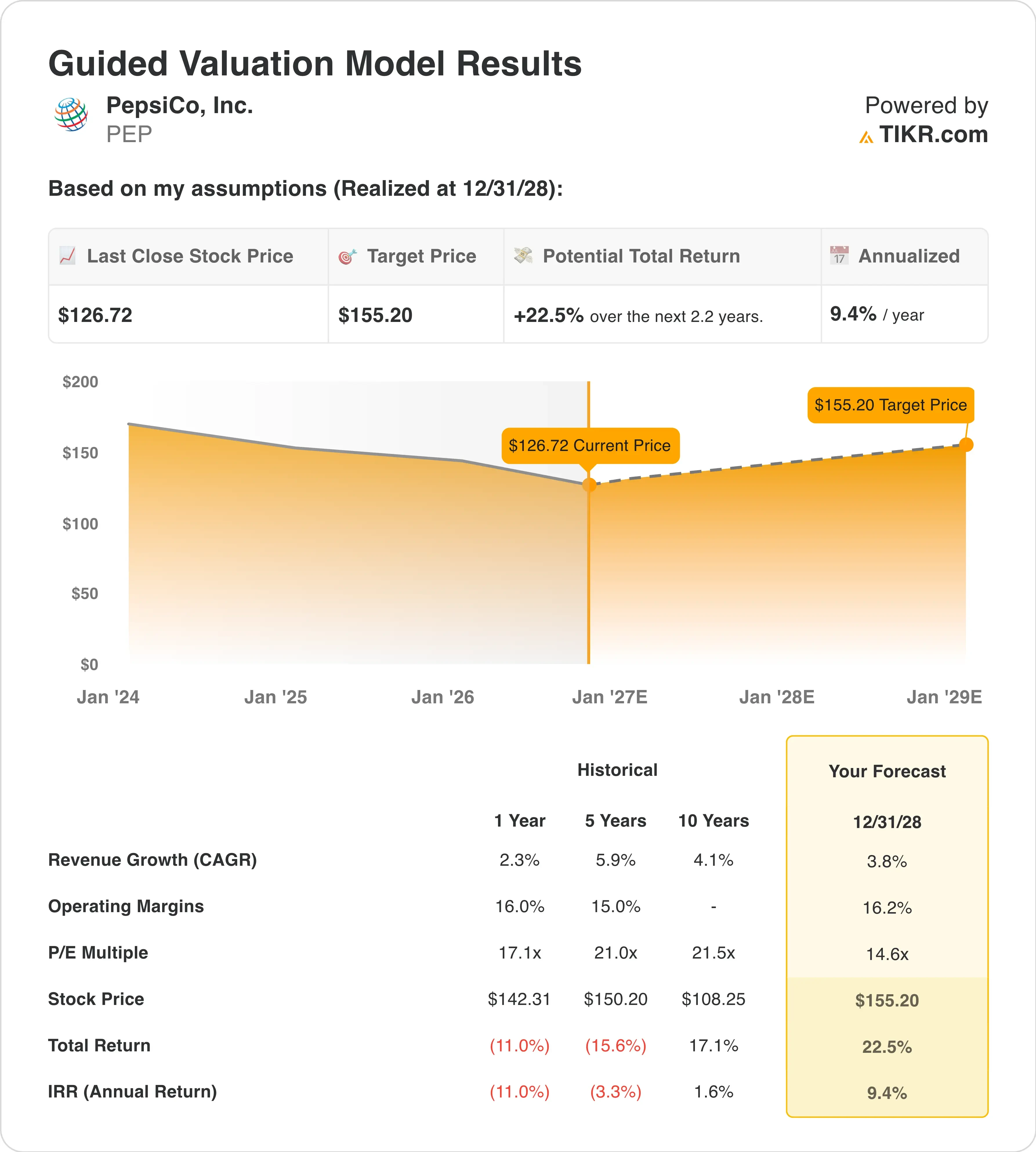
Under valuation model assumptions realized through 12/31/28, the stock is modeled using:
- Revenue Growth (CAGR): 3.8%
- Operating Margins: 16.2%
- Exit P/E Multiple: 14.6x
Based on these inputs, the model estimates a target price of $155, implying 22.5% total upside from the current share price of $127 and a 9.4% annualized return over the next 2.2 years.
A 9.4% annual return makes PepsiCo moderately attractive, just short of the 10% bar. Notably, the model does not need a re-rating to get there. Its 14.6x exit P/E matches today’s forward multiple. Returns come from steady earnings growth instead.

This is a valuation reset story. PepsiCo averaged 21.0x earnings over five years and 21.5x over a decade, yet it now trades near 14.6x. That discount prices in years of weak volume. So any sign of recovery could matter more than usual.
The inputs look conservative. Revenue growth of 3.8% sits only modestly above the 2.3% PepsiCo posted over the past year, while 16.2% margins barely move from 16.0% today. Volume is the real risk, since PepsiCo Foods North America volume was flat in Q2. Fixing that is what the price cuts and new hikes are trying to balance.
Shareholders also collect a 4.7% dividend yield while they wait. That yield runs unusually high for PepsiCo because the share price fell so far. However, a 74.7% payout ratio limits big increases if profits stall. Next to Coca-Cola’s 25.3x multiple, PepsiCo looks cheap, but it is cheap for a reason.
Run PepsiCo’s bull, base and bear scenarios yourself (Free with TIKR) >>>
PepsiCo’s Discount Against Coke and Mondelez
Coca-Cola (KO) is outrunning PepsiCo on nearly every metric. In Q2, Coca-Cola grew organic revenue 6% and unit case volume 5%, versus PepsiCo’s 2.4% organic growth. Coca-Cola’s operating margin of 31.8% is about twice PepsiCo’s 16.0%. That explains why Coca-Cola trades at 25.3x forward earnings while PepsiCo sits at 14.6x.
Mondelez International (MDLZ) is the closer snack comparison. It grew organic revenue 2.2% in Q2, nearly matching PepsiCo, and raised its 2026 outlook to at least 2%. Pricing added 1.5 percentage points of that growth, while volume added only 0.7. Both companies are fighting the same cautious snack shopper.
PepsiCo’s edge is scale across snacks and drinks, with Lay’s and Doritos still category leaders. But that breadth also means more exposure to potato, corn and cooking oil costs. Mondelez faces cocoa and wheat, while Coca-Cola mostly worries about sweeteners and aluminum.
The comparison shows a market paying for momentum. PepsiCo grew revenue 5.9% annually over five years, so its slowdown is recent rather than permanent. If volumes recover, the discount to its own history could narrow.
Weigh whether PepsiCo’s snack-volume recovery can carry it toward $179 by 2027 >>>
What’s Driving PEP Stock Going Forward?
Q3 results on October 8 come first. The quarter ended September 5, so the new chip price hikes will not show up yet. Investors will instead check whether earlier price cuts lifted volumes enough to offset margin pressure. Management’s tone on guidance will matter most.
PepsiCo reaffirmed its 2026 outlook in July but flagged the low end of its EPS range. Any cut on October 8 would likely hit sentiment hard. A reaffirmation, by contrast, could ease fears after the downgrade.
Longer term, PepsiCo is expanding AI and regenerative farming tools across 4.7 million acres in more than 60 countries. Regenerative farming improves soil health to protect crop yields. Because potatoes and corn drive snack costs, steadier harvests could reduce price swings. The payoff is real but slow.
International growth offers support. PepsiCo plans to invest $1 billion in Colombia over the next five years, and international operating margins expanded by one percentage point in Q2. Going forward, the U.S. snack recovery remains the swing factor for the stock.
Monitor PepsiCo’s earnings estimates as Q3 approaches (Free with TIKR) >>>
What is PepsiCo stock actually worth?
TIKR lets you forecast the future price of any stock in less than a minute. Just enter a few assumptions into TIKR’s valuation model and see what PepsiCo could be worth. Start from Wall Street consensus estimates, or adjust the inputs to reflect your own view of the business. It’s free to use. Value PEP for free.
Disclaimer:
Please note that the articles on TIKR are not intended to serve as investment or financial advice from TIKR or our content team, nor are they recommendations to buy or sell any stocks. We create our content based on TIKR Terminal’s investment data and analysts’ estimates. Our analysis might not include recent company news or important updates. TIKR has no position in any stocks mentioned. Thank you for reading, and happy investing!