Key Takeaways
- Paul Tudor Jones’s Tudor Investment held 1.67 million Microsoft shares at June 30, 148% more than a quarter earlier, and the stock is up 43% since then.
- His other buys were mixed: Meta and Amazon are both up 14% since June 30, while Tesla and Netflix are down 10% and 11%.
- Even after the run, Microsoft trades at 26x forward earnings, below its five-year average of 29x, and analysts expect its earnings per share to grow about 16% in the year to June 2027.
- Microsoft still looks worth following into, with shrinking free cash flow the main risk and Tudor’s next 13F, due by Nov. 16, the next thing to watch.
Paul Tudor Jones’s Tudor Investment has until Nov. 16 to show what it held at the end of September. Its last 13F, for the quarter ended June 30, already holds a big winner: Microsoft (MSFT), up 43% from its June 30 close to Tuesday’s.
Microsoft led a mixed batch
Tudor’s 13F for the quarter ended June 30, filed Aug. 14, showed 1.67 million Microsoft shares worth $624 million. That was 148% more shares than a quarter earlier, and it made Microsoft the No. 3 position at 2.6% of its 13F stocks. In all, Tudor Investment manages $107 billion, and the filing listed $24.2 billion of US stocks across 1,679 positions.
Microsoft has done the best of the 11 stocks Tudor bought that quarter. At Meta Platforms (META), Tudor’s share count rose 109% to 443,729, and the stock is up 14%. Amazon (AMZN), where Tudor added 37% to reach 1.22 million shares, has gained 14%. Tesla (TSLA), up 30% in shares to 759,222, is down 10%, and Netflix (NFLX) is down 11%. Of the five, Netflix is where Tudor raised its count the most, by 1,237% to 2.67 million shares. The worst of the 11, Sandisk, is down 62%.
Each of those moves runs from the stock’s June 30 close to Tuesday’s. They aren’t Tudor’s returns, since a 13F doesn’t show when in the quarter the fund bought, what it paid, or whether it still holds the shares today.
TIKR tracks 58 analysts on Microsoft. How many say “Buy”?
See the full breakdown of Buy, Hold, and Sell ratings on Microsoft, along with Wall Street’s revenue and earnings estimates, all in one place. More than 500,000 investors use TIKR to research stocks like this one. See Microsoft’s Analyst Ratings
Tudor held puts, too
If you copy Tudor’s share counts, you miss part of the trade. The same filing lists call and put options on all five stocks. On Microsoft, the puts carried a notional value of $635 million, slightly more than the $624 million of shares. On Tesla, the puts’ $420 million topped the $319 million of shares. The Meta and Amazon puts were smaller than the shares: $211 million and $255 million, against $250 million and $291 million. The 13F doesn’t say whether those puts hedged the shares or were bets of their own, and it doesn’t show short positions at all. So the share count alone may overstate how much Tudor was betting on Microsoft.
Microsoft still isn’t expensive
For Microsoft, the case rests on earnings, and analysts expect plenty more of them:
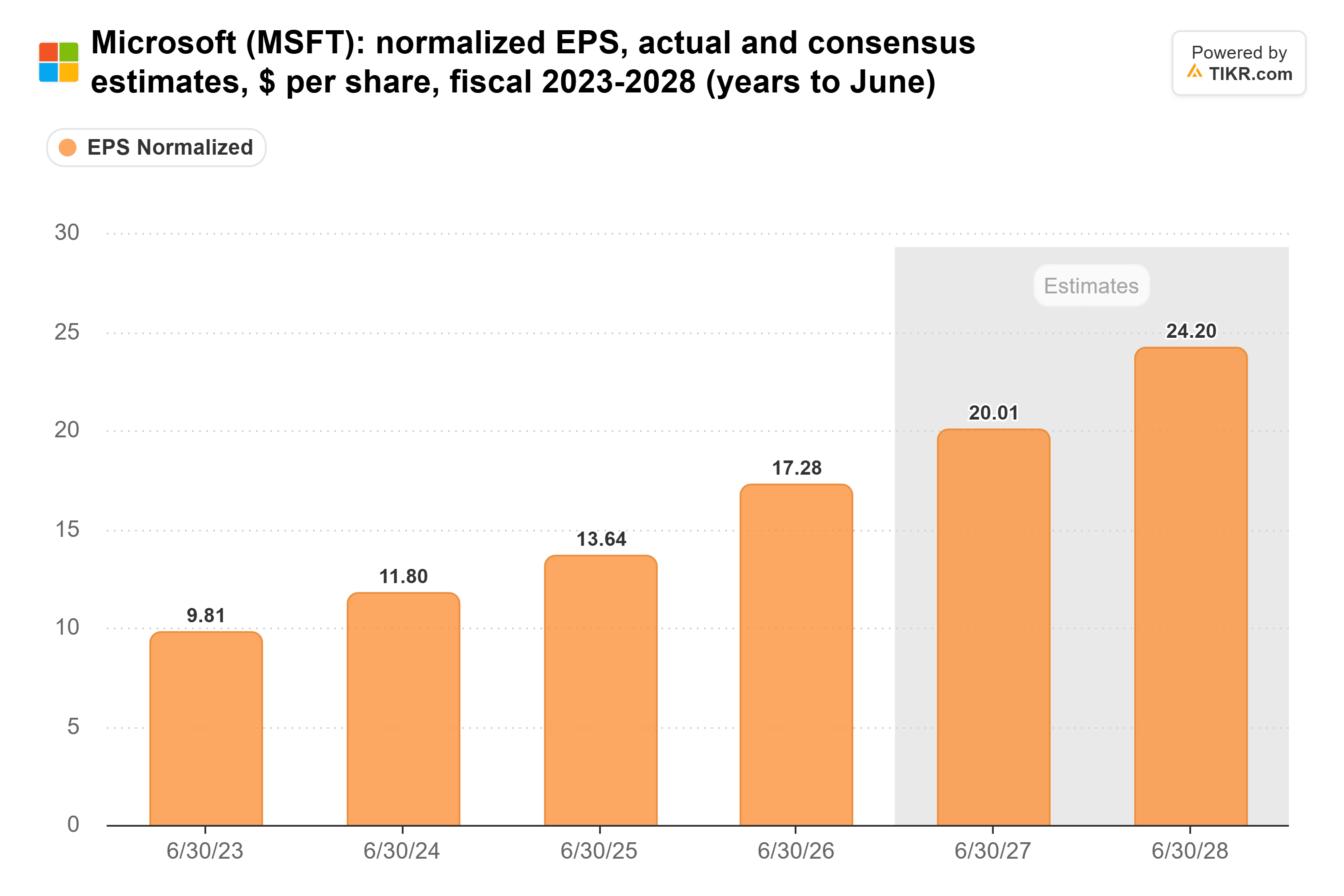
Normalized EPS rose from $9.81 in fiscal 2023 to $17.28 in fiscal 2026. The consensus calls for $20.01 in fiscal 2027 and $24.20 in fiscal 2028, gains of about 16% and 21%. Just before Microsoft’s October report, the fiscal 2027 figure was $19.76, so analysts have raised it since.
The 43% run hasn’t stretched the multiple:
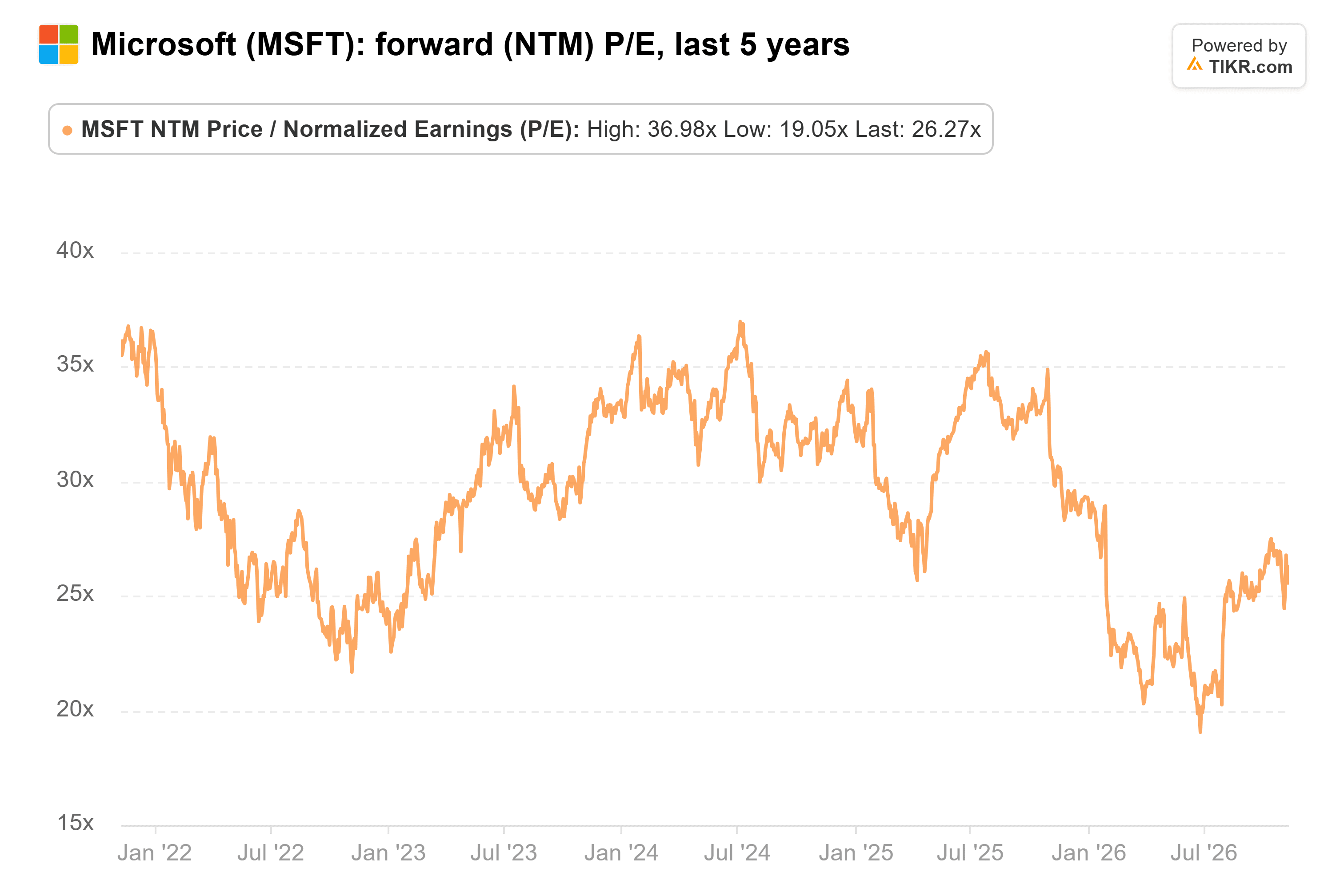
Microsoft trades at 26x forward earnings. That’s below its five-year average of 29x and well under its 37x peak in July 2024. Much of the run came as the multiple climbed back from its five-year low of 19x, on June 25.
Analysts still see room above today’s price:
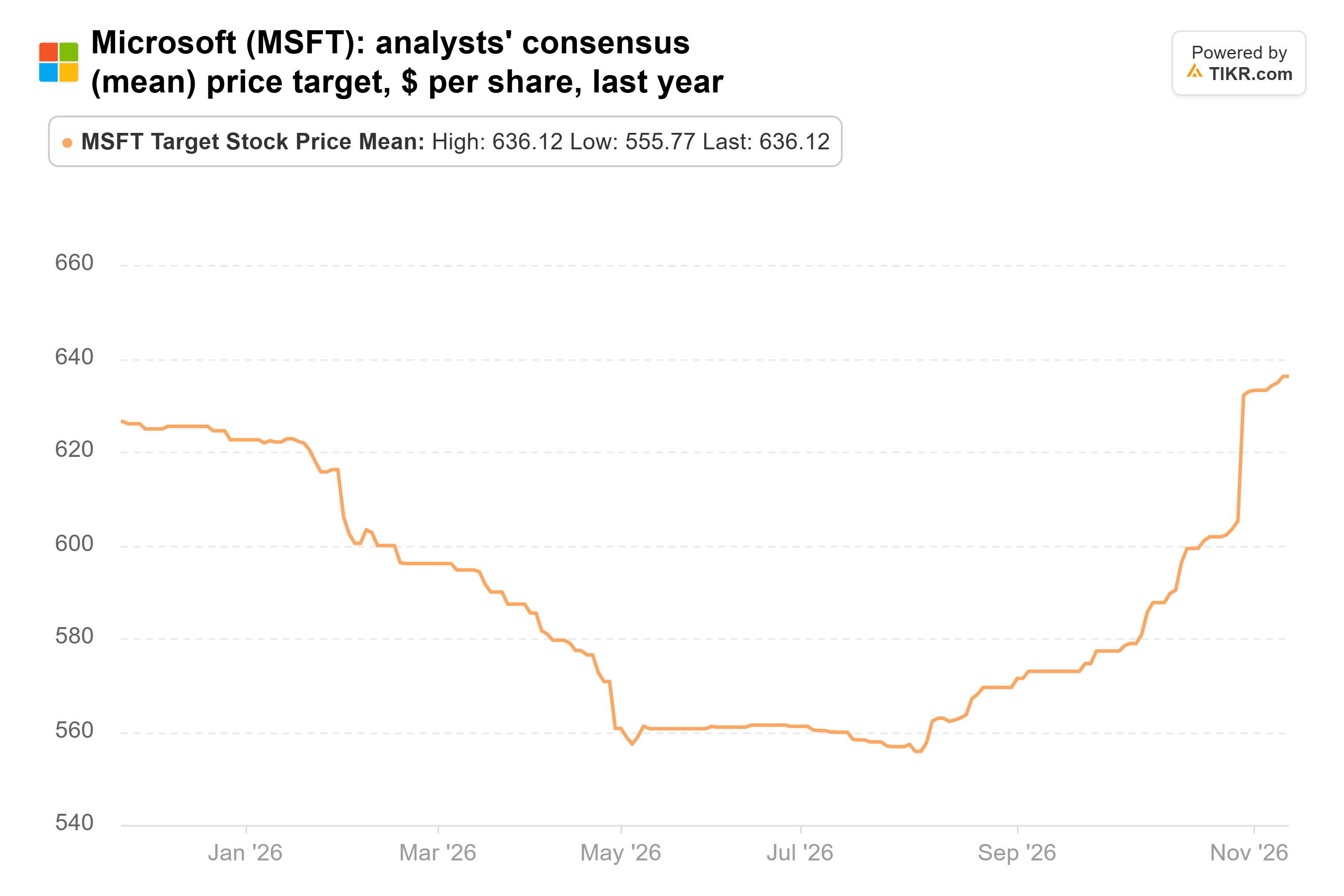
The consensus target of $636 is 19% above Tuesday’s close, up from $556 at its low in late July. The 58 analysts’ targets run from $440 to $870.
It isn’t too late for Microsoft
The risk is cash. Microsoft’s cash capital spending jumped to $115.9 billion in fiscal 2026 from $64.6 billion, and free cash flow fell for a second straight year, to $67.0 billion. Analysts expect $34.0 billion in fiscal 2027, and Dan Ives expects Big Tech’s free cash flow to bottom in the first half of 2027 before it rebounds.
Even so, I’d still follow Tudor into Microsoft at 26x. You’re paying less than its five-year average for earnings that analysts expect to grow faster in fiscal 2028 than in fiscal 2027. The next read comes by Nov. 16, when Tudor’s 13F for the quarter ended Sept. 30 shows whether it still held the shares, and the puts, after the run.
So what is Microsoft stock actually worth?
TIKR lets you forecast the future price of any stock in less than a minute. Just enter a few assumptions into TIKR’s valuation model and see what Microsoft could be worth. Start from Wall Street consensus estimates, or adjust the inputs to reflect your own view of the business. It’s free to use.
Disclaimer:
Please note that the articles on TIKR are not intended to serve as investment or financial advice from TIKR or our content team, nor are they recommendations to buy or sell any stocks. We create our content based on TIKR Terminal’s investment data and analysts’ estimates. Our analysis might not include recent company news or important updates. TIKR has no position in any of the stocks mentioned. Thank you for reading, and happy investing!