Key Takeaways
- OpenAI posted a third-quarter operating loss of about $13.5 billion including stock-based compensation ($10.9 billion on an adjusted basis), and its latest funding round has reached a reported $15 billion, half its original target.
- S&P puts OpenAI at about half of Oracle’s backlog, so much of Oracle’s growth depends on a customer that has to keep raising money.
- OpenAI’s half of the backlog comes to more than six years of its revenue at September’s run rate, and Oracle is borrowing to build the capacity behind it.
- CoreWeave’s disclosed OpenAI contracts make up a much smaller share of its backlog. Oracle’s mid-December report will show whether its new contracts are coming from other customers.
Oracle (ORCL) has a customer problem.
S&P said in July that OpenAI accounts for about half of Oracle’s backlog. And OpenAI’s latest numbers show how fast it’s burning money.
Its third-quarter operating loss was about $13.5 billion including stock-based compensation, according to figures Wall Street Journal reporter Berber Jin posted on X. On the adjusted basis the Journal reported first, the loss was $10.9 billion. OpenAI closed the first $11 billion of its latest funding round on Nov. 6.
AI critic Ed Zitron put it more bluntly: OpenAI “could only scrape together $11bn, or around half of what it needed to get through this quarter.”
CNBC reported on Nov. 12 that the round has since reached $15 billion, about half of the $30 billion OpenAI originally set out to raise. That covers roughly one to one and a half quarters of operating losses, depending on the measure.
CoreWeave (CRWV) rents computing capacity to OpenAI too. But Oracle has bet far more of its future on OpenAI being able to keep raising money.
TIKR tracks 42 analysts on Oracle. How many say “Buy”?
See the full breakdown of Buy, Hold, and Sell ratings on Oracle, along with Wall Street’s revenue and earnings estimates, all in one place. More than 500,000 investors use TIKR to research stocks like this one. See Oracle’s Analyst Ratings
Half the backlog is more than six years of OpenAI’s revenue
Oracle’s remaining performance obligations were $638 billion at the end of May, the latest figure when S&P made its estimate. OpenAI’s half of that comes to about $319 billion. OpenAI CFO Sarah Friar told Yahoo Finance’s Deirdre Bosa on Tuesday that the company’s annual revenue run rate was roughly $50 billion at the end of September. Divide $319 billion by $50 billion, and OpenAI’s commitments to Oracle alone come to more than six years of revenue at that pace.
That’s a lot to ask of one customer.
The backlog has grown since then, to $664 billion at the end of August. Oracle expects only 13% of it to turn into revenue over the next 12 months, so OpenAI has to keep paying for years. CoreWeave’s disclosed contracts with OpenAI total up to $22.4 billion, about a sixth of its roughly $132.5 billion backlog at the end of September, though it expanded the relationship again last quarter without giving a figure. If OpenAI ever can’t pay, CoreWeave loses a big customer, and Oracle loses about half its backlog.
Oracle is paying for the build up front
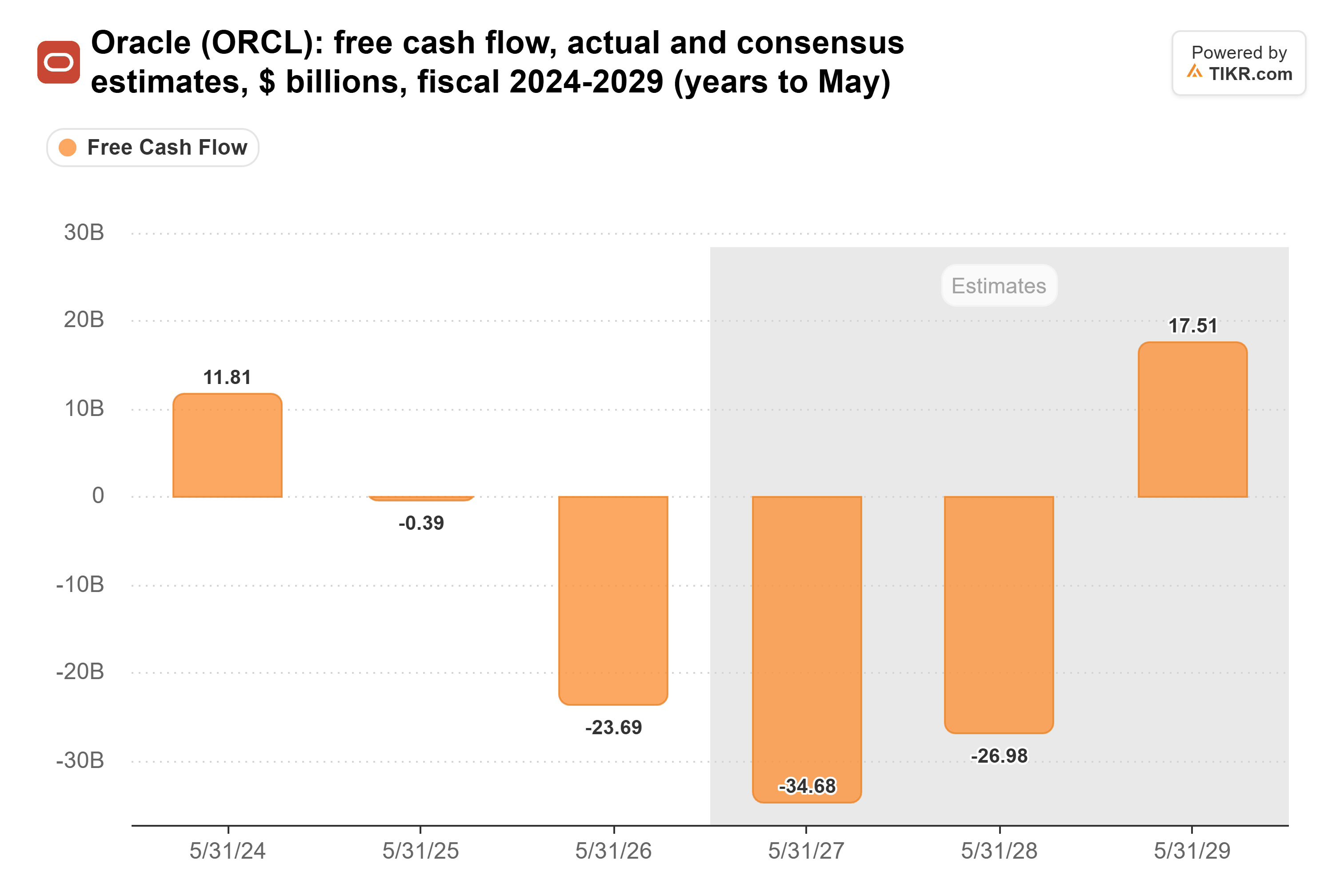
Oracle is building the data centers behind those contracts before the revenue comes in, and that has pushed its free cash flow far below zero. Free cash flow was negative $23.7 billion in fiscal 2026 (the year to May), and analysts expect negative $34.7 billion in fiscal 2027 before it turns positive in fiscal 2029:
Oracle has borrowed to cover the gap. Total debt, leases included, has more than doubled since fiscal 2022:
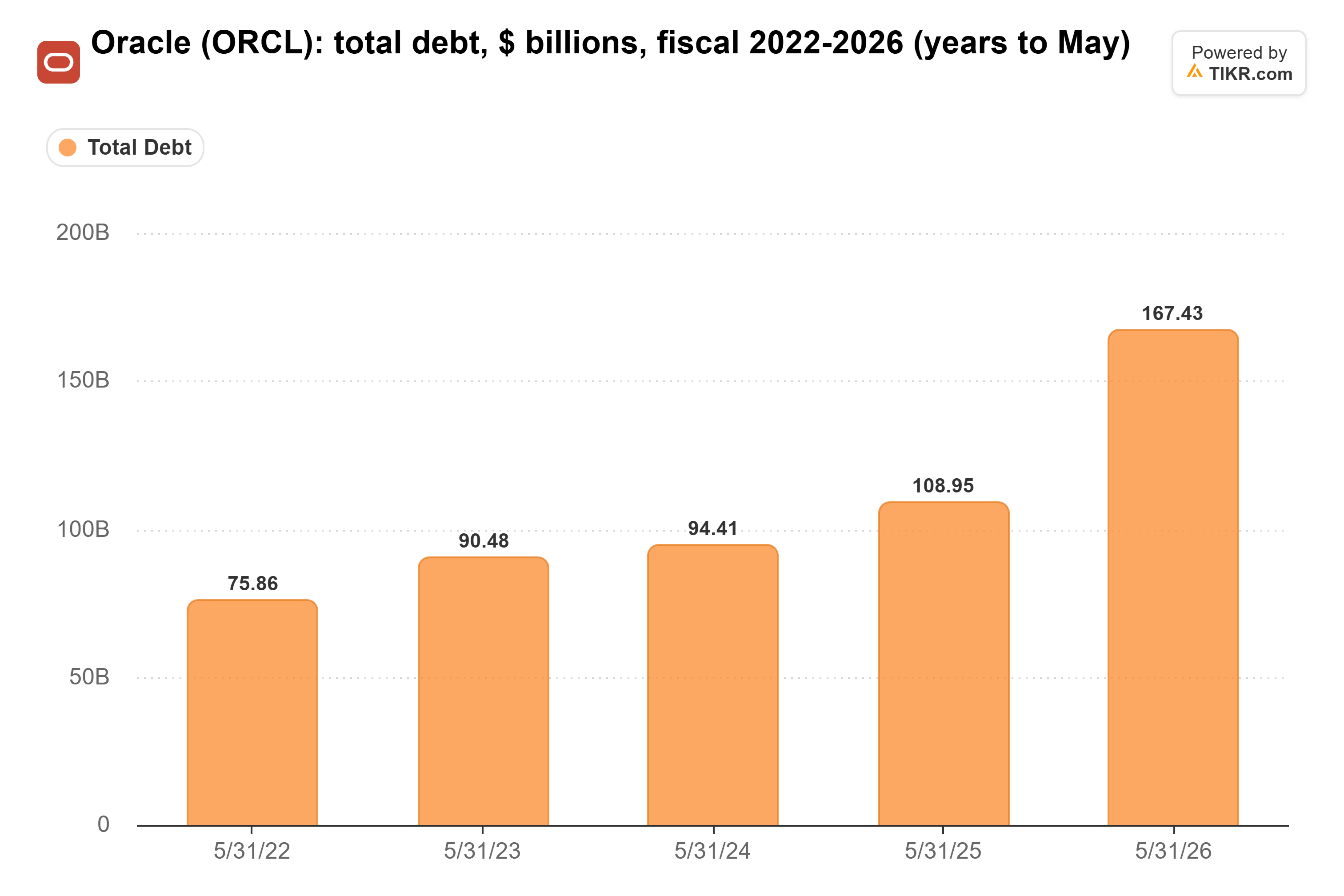
At the end of August it was even higher, at $169.1 billion. Then Oracle sold another $10 billion of notes in early November, with coupons of 7% to 8.65%, alongside about $10 billion of new stock. S&P already rates Oracle BBB-, one step above junk.
OpenAI’s growth buys Oracle time
Still, OpenAI is growing fast. Friar said third-quarter revenue rose nearly 50% from the second quarter to $10 billion, and its enterprise business doubled.
Oracle has also found customers that bring their own money. In October 2025, management said it had signed $65 billion of contracts in 30 days with four customers, none of them OpenAI. By May, $75 billion of Oracle’s contracts were on terms where customers prepay or supply their own hardware. Customer prepayments added $11.4 billion to operating cash flow in the quarter to August alone.
Oracle needs OpenAI’s next raise as much as OpenAI does
A company whose revenue grew nearly 50% in one quarter will probably find more money. But OpenAI’s latest round covers only about one to one and a half quarters of operating losses, so it will likely be back for more soon. It has also reportedly been weighing smaller data center plans. Each round it raises now holds up Oracle’s backlog too, while Oracle keeps borrowing to build. Until the backlog grows mostly from other customers, about half of it is best read as a bet on OpenAI’s fundraising.
Oracle’s second-quarter report, due in mid-December, will show how much the backlog grew and, if management says, which customers signed.
So what is Oracle stock actually worth?
TIKR lets you forecast the future price of any stock in less than a minute. Just enter a few assumptions into TIKR’s valuation model and see what Oracle could be worth. Start from Wall Street consensus estimates, or adjust the inputs to reflect your own view of the business. It’s free to use.
Disclaimer:
Please note that the articles on TIKR are not intended to serve as investment or financial advice from TIKR or our content team, nor are they recommendations to buy or sell any stocks. We create our content based on TIKR Terminal’s investment data and analysts’ estimates. Our analysis might not include recent company news or important updates. TIKR has no position in any of the stocks mentioned. Thank you for reading, and happy investing!