Key Takeaways
- Oracle CFO Hilary Maxson told CNBC that Oracle will be cash-flow positive in the second half of fiscal 2028 and produce more than $30 billion of free cash flow in fiscal 2029, days after Oracle lost a Tencent deal.
- Her case rests on capital spending peaking. Oracle says its recent $20 billion raise is all the outside money it needs, so spending has to stop climbing while its $664 billion backlog starts paying.
- Analysts expect $17.5 billion of free cash flow in fiscal 2029, well below the target, and total debt reached $169.1 billion by Aug. 31.
- The cap on new funding makes the turn more believable than the stock’s fall suggests, and OpenAI’s ability to pay is the main risk.
Oracle (ORCL) had a brutal week before its CFO ever went on air. In three days, it lost a roughly $7 billion Tencent deal and a contract with Microsoft (MSFT).
On Nov. 10, Hilary Maxson sat down with David Faber on CNBC’s Squawk on the Street. It was her first broadcast interview as Oracle’s CFO, and she put dates on the recovery.
“We’re fully funded, cash flow positive in the second half of our 28, $30 billion plus free cash flow in 29,” she said.
That’s quite a promise from a company that burned $23.7 billion of free cash flow in fiscal 2026, the year ended May 2026.
TIKR tracks 42 analysts on Oracle. How many say “Buy”?
See the full breakdown of Buy, Hold, and Sell ratings on Oracle, along with Wall Street’s revenue and earnings estimates, all in one place. More than 500,000 investors use TIKR to research stocks like this one. See Oracle’s Analyst Ratings
Analysts see the turn, just a smaller one
Analysts already expect Oracle’s free cash flow to swing back. They just see it happening later and smaller than Maxson does:
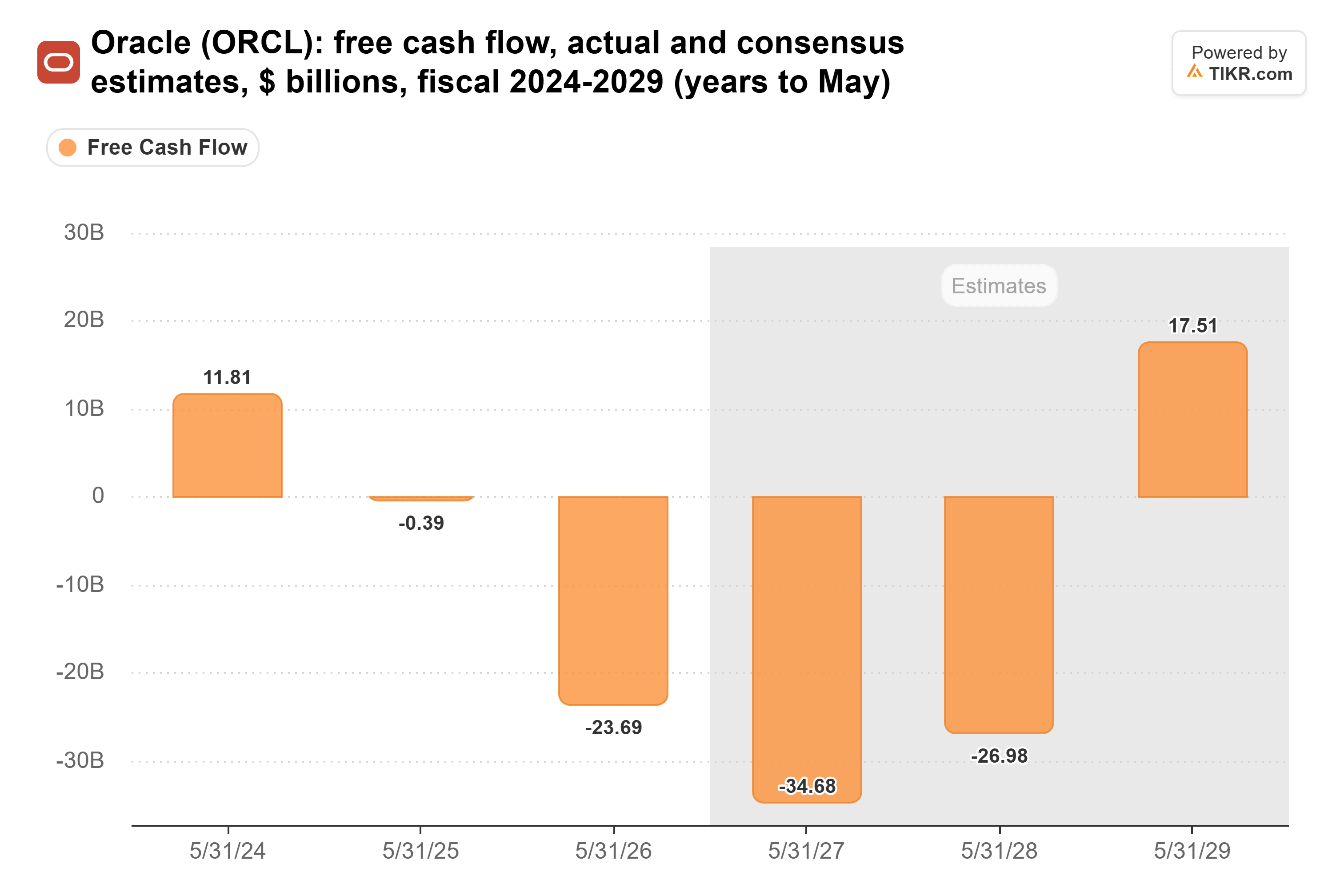
Consensus has Oracle burning another $34.7 billion in fiscal 2027 and $27.0 billion in fiscal 2028. Then free cash flow flips to $17.5 billion in fiscal 2029, the year ending May 2029. Maxson’s “$30 billion plus” is about $12.5 billion above that.
Her timing is also ahead of the Street’s. Oracle’s second half of fiscal 2028 runs from December 2027 to May 2028, which she called “almost as early as 27 calendar for the rest of us.” Analysts still have that whole year deep in the red.
Analysts have bought into her fiscal 2030 targets of more than $225 billion in sales and $21 of earnings per share. Consensus sits at $225.4 billion and $20.78. It’s the cash they’re less sure of.
Capex has to peak
The cash burn comes from Oracle building AI data centers as fast as it can, and its capital spending shows it:
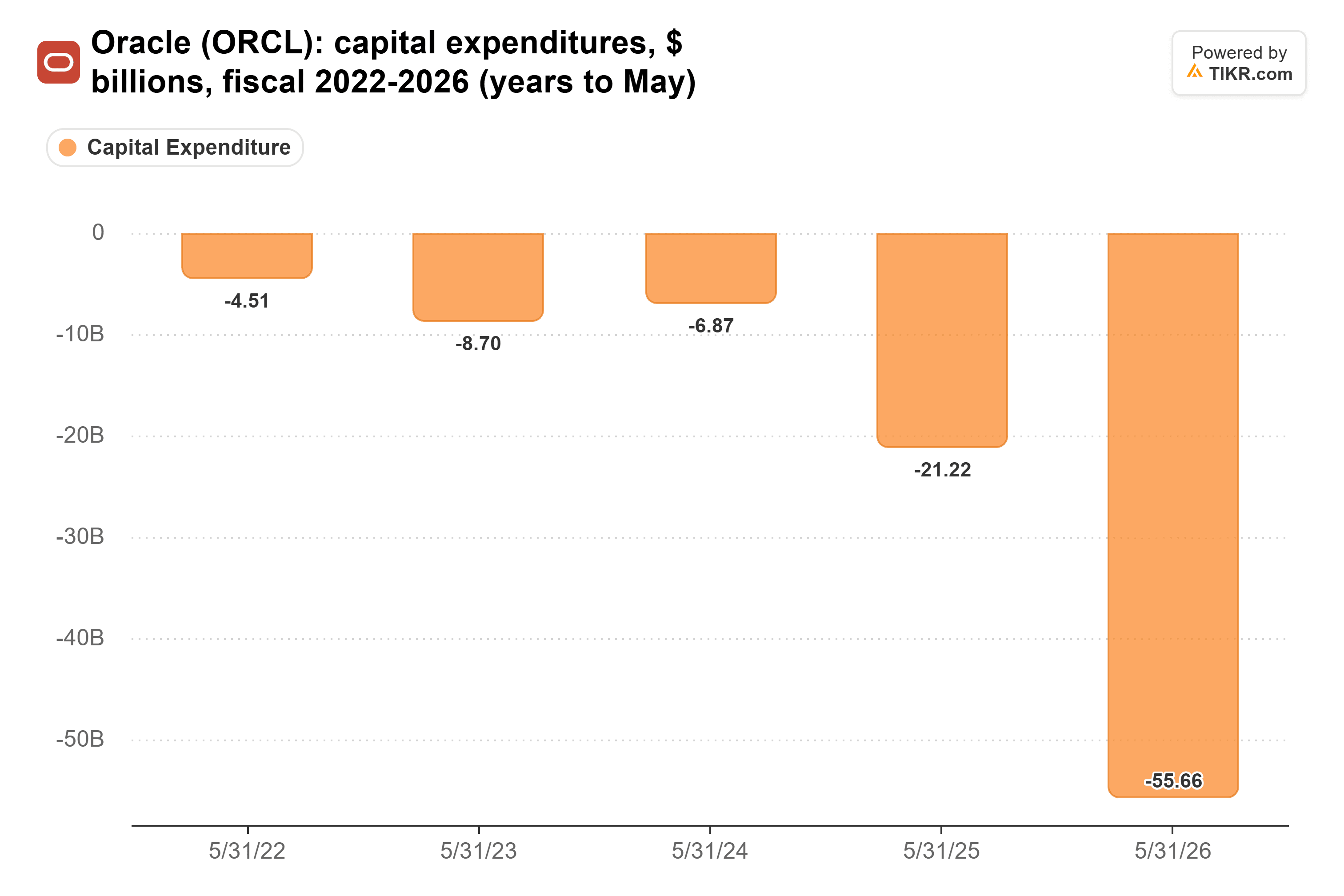
Capex rose from $4.5 billion in fiscal 2022 to $55.7 billion in fiscal 2026. Management guides to $90 billion to $95 billion this fiscal year, or no more than $70 billion after customer prepayments. Customers are paying for more of it up front: Oracle collected $11.4 billion of prepayments in its first quarter, and it says more than $30 billion of contracts signed that quarter need no Oracle capital at all.
This is the peak Maxson is promising. Faber summed up the message from Oracle’s Investor Day as “we’re doing $20 billion and then we’re done.” Within days, Oracle sold $10 billion of stock and $10 billion of notes. Maxson said Oracle moved fast because “we thought there was real merit in getting out there and being the first of the fully funded hyperscalers.”
The debt came first
The catch is that Oracle has already borrowed heavily to get this far:
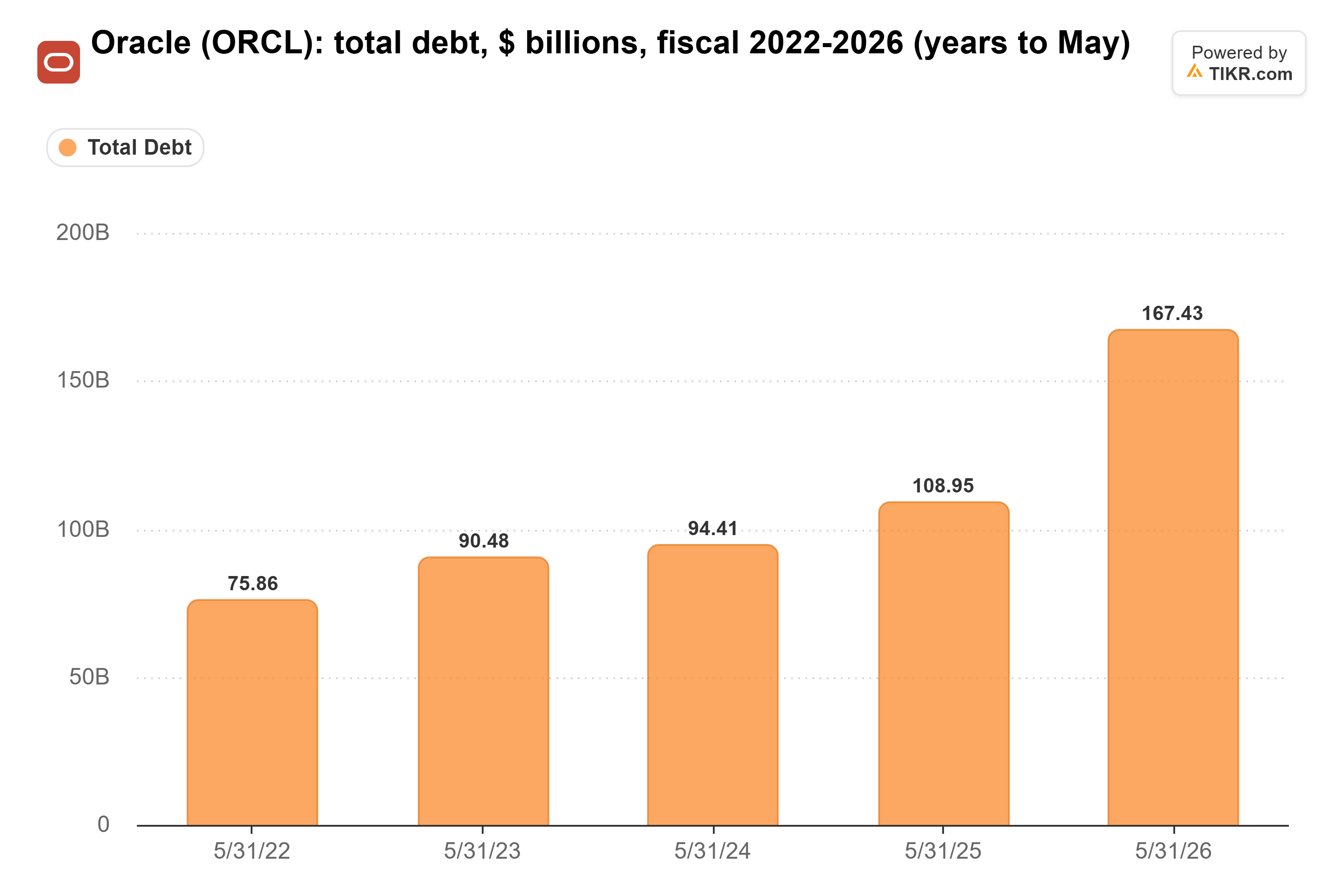
Total debt, leases included, climbed from $75.9 billion in fiscal 2022 to $167.4 billion in fiscal 2026, and it hit $169.1 billion by Aug. 31. In July, S&P cut Oracle to BBB-, one notch above junk. It said it could cut again if no path to positive free operating cash flow appears by fiscal 2029. That’s the same year Maxson picked for her target.
Steve Eisman, the investor made famous by The Big Short, has been hard on Oracle’s balance sheet. Even so, he said on The Real Eisman Playbook that “if the AI story succeeds, then all this leverage will simply look like good investments.”
Everything runs through OpenAI
Whether that story succeeds depends on one customer more than any other. S&P has estimated that OpenAI accounts for about half of Oracle’s backlog, which stood at $664 billion at Aug. 31, up from $455 billion a year earlier. Eisman thinks that’s behind the selloff: “From the peak, the stock is down around 70-ish percent. That decline is because the market perceives an over-reliance on OpenAI.”
Last week’s losses added to the worry. The Financial Times reported that Oracle dropped the Tencent lease, worth about $7 billion or roughly 1% of the backlog, after pressure from the Trump administration. Microsoft’s exit matters more than its size. According to Bloomberg, which couldn’t determine the deal’s value, Microsoft is switching off rented Oracle servers that run older Nvidia chips. In September, Oracle said GPUs coming up for renewal, most of them four years old or older, were renewed or resold at a 20% premium. An Oracle spokesperson told Reuters that demand “remains strong, including for earlier-generation GPUs.”
The funding cap is what matters
Bottom line: the $20 billion cap is the most important thing Maxson said. A company that has told investors it’s done raising money has to let its spending peak. The Street already sees free cash flow turning positive in fiscal 2029. I’d count on something closer to analysts’ figure than her “$30 billion plus.” But the stock is priced as if the spending never peaks, and I think that’s the less likely outcome.
The risk is plain: if OpenAI can’t keep paying, Oracle is left with the debt and the leases without the revenue. The first real check comes with Oracle’s second-quarter results in mid-December. Watch whether net capex stays within the $70 billion pace, and whether new backlog comes from customers other than OpenAI.
So what is Oracle stock actually worth?
TIKR lets you forecast the future price of any stock in less than a minute. Just enter a few assumptions into TIKR’s valuation model and see what Oracle could be worth. Start from Wall Street consensus estimates, or adjust the inputs to reflect your own view of the business. It’s free to use.
Disclaimer:
Please note that the articles on TIKR are not intended to serve as investment or financial advice from TIKR or our content team, nor are they recommendations to buy or sell any stocks. We create our content based on TIKR Terminal’s investment data and analysts’ estimates. Our analysis might not include recent company news or important updates. TIKR has no position in any of the stocks mentioned. Thank you for reading, and happy investing!