Key Takeaways
- Alphabet’s free cash flow was negative $9.1 billion in the third quarter, its second straight quarter in the red, and management still expects capex to increase significantly in 2027.
- Investors who hope Alphabet will start spending with Microsoft’s discipline are likely to be disappointed: Alphabet’s co-founder, its guidance and the demand for Cloud all point to more spending.
- Analysts now expect Alphabet’s free cash flow to fall to negative $41.8 billion in 2027 before it turns slightly positive in 2028.
- The next test is Alphabet’s 2027 capex figure, due on its fourth-quarter call in early February.
Alphabet (GOOG) just burned cash for a second straight quarter, and the question hanging over the stock is whether it’ll start spending more like Microsoft (MSFT).
On Monday, Carson Group’s Ryan Detrick offered an answer of sorts in a post on X, quoting Google co-founder Larry Page: “I’m willing to go bankrupt rather than lose this race.”
The line isn’t new. Atreides Management’s Gavin Baker passed it along on an August 2024 episode of Invest Like the Best, saying Page “has evidently said internally at Google many times, ‘I am willing to go bankrupt rather than lose this race.’”
So it’s a secondhand quote from two years ago. And Alphabet has spent every one of those two years acting like Page meant it.
The cash hole gets deeper in 2027
Alphabet’s free cash flow came in at negative $9.1 billion in the third quarter, after negative $5.9 billion in the second, as capex hit $51.4 billion.
Management didn’t blink. It reiterated its $195 billion to $205 billion capex guidance for 2026, and CFO Anat Ashkenazi said on the third-quarter call that she still expects capex to increase significantly in 2027. The actual figure is due on the fourth-quarter call.
Before the report, Evercore ISI’s Mark Mahaney said on Bloomberg Tech that “the street has about 30 billion in negative free cash flow for Google next year.” TIKR’s consensus has a deeper hole: free cash flow of negative $18.0 billion this year and negative $41.8 billion in 2027, before it turns positive in 2028:
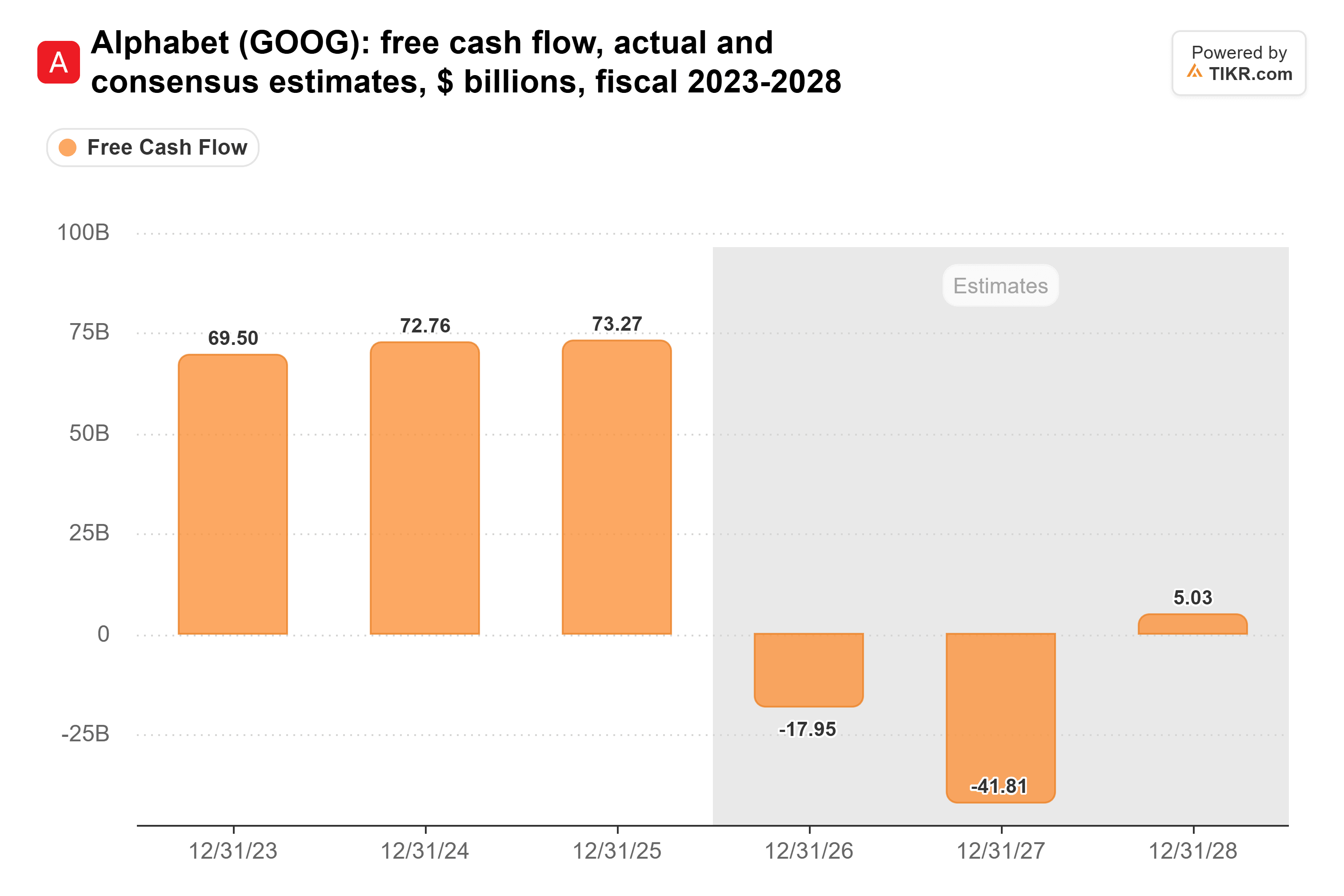
Even that 2028 estimate, $5.0 billion, is a sliver of the $73.3 billion Alphabet generated in 2025.
TIKR Tracks 57 Analysts on Microsoft. How Many Say “Buy”?
See the full breakdown of Buy, Hold, and Sell ratings on Microsoft, along with Wall Street’s revenue and earnings estimates, all in one place. More than 500,000 investors use TIKR to research stocks like this one. See Microsoft’s Analyst Ratings
From $25 billion to $200 billion a year
Alphabet’s capex rose 63% in 2024, the year Baker passed along Page’s line, to $52.5 billion. It then rose another 74% in 2025, to $91.5 billion:
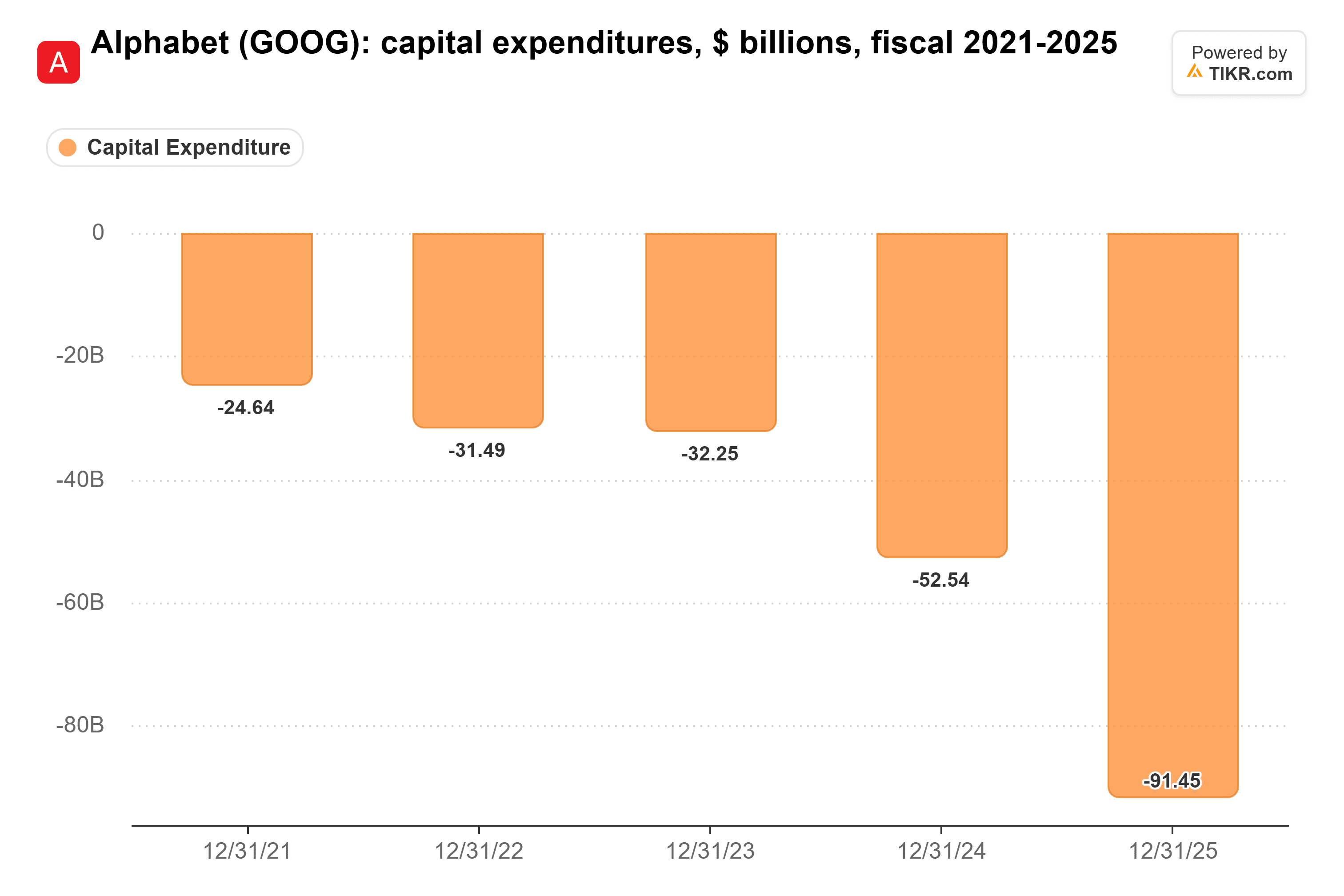
This year’s guidance more than doubles that again, and analysts have 2027 at $308.0 billion, about half the revenue they expect that year.
Alphabet is borrowing and selling stock to pay for it. In June, it launched an equity raise that included $10 billion from Berkshire Hathaway and a $40 billion program to sell shares over time. In the third quarter, it sold $12.4 billion of shares through that program, issued $28.7 billion of notes and bought back none. As NYU’s Scott Galloway put it on Prof G Markets, “Microsoft renovated with cash on hand and Alphabet appears to be taking out second mortgages for the same renovation.”
Pulling back would mean turning customers away
The demand is there. Google Cloud’s revenue grew 103% to $30.7 billion in the third quarter, and its backlog of signed contracts reached $561 billion. Its operating margin rose to 36.2%, up from 23.7% a year earlier.
In fact, Alphabet is so short on capacity that it started renting third-party computing late in the quarter, and it plans to rent more in the fourth. Ashkenazi warned that this will pressure Cloud margins in the near term. That’s a cost Alphabet is choosing to pay rather than turn customers away.
Plus: Alphabet needs the AI build to work for Search too. Search & other revenue grew 12% in the third quarter, down from 17% in the second. Chief Business Officer Philipp Schindler put part of the slowdown on lower monetization in AI Mode. Search is turning into AI answers, and Alphabet has to win there to keep its biggest profit engine.
Don’t wait for a pullback
The way I see it, anyone waiting for Alphabet to spend like Microsoft is going to be waiting a long time. I expect the 2027 capex figure to come in big, and the cash hole to get deeper before Cloud’s backlog starts paying it back.
Analysts still expect normalized EPS to rise from $15.14 in 2027 to $18.26 in 2028. So shareholders are being asked to look past a year of red ink in the cash flow statement for the earnings on the other side.
Of course, Cloud could turn that backlog into revenue faster than analysts expect, and the hole would shrink with it.
So what is Alphabet stock actually worth?
TIKR lets you forecast the future price of any stock in less than a minute. Just enter a few assumptions into TIKR’s valuation model and see what Alphabet could be worth. Start from Wall Street consensus estimates, or adjust the inputs to reflect your own view of the business. It’s free to use.
Disclaimer:
Please note that the articles on TIKR are not intended to serve as investment or financial advice from TIKR or our content team, nor are they recommendations to buy or sell any stocks. We create our content based on TIKR Terminal’s investment data and analysts’ estimates. Our analysis might not include recent company news or important updates. TIKR has no position in any of the stocks mentioned. Thank you for reading, and happy investing!