Key Takeaways
- NVIDIA (NVDA) stands out among four high-ROE stocks because its historical returns came largely from operating profitability rather than financial leverage.
- Home Depot (HD) also generated an ROE above 80%, but its debt increased by nearly $20 billion between fiscal 2021 and fiscal 2025.
- Apple (AAPL) generates strong returns on its assets, while Boeing (BA) shows how heavy leverage can inflate reported ROE.
- NVIDIA’s November 17 earnings showed revenue rising 103% to $115.8 billion, with a 74.8% gross margin reinforcing its profitability advantage.
Four companies with returns on equity above 80% might look equally impressive. But one investor argues that only NVIDIA passes Warren Buffett’s test for a profitable business that doesn’t rely heavily on debt.
In a November 16 discussion on Reddit’s r/ValueInvesting community, the investor compared NVIDIA, Home Depot, Apple, and Boeing by examining what their assets earn and how much leverage increases those returns.
The argument comes from Buffett’s 1987 Berkshire Hathaway shareholder letter, which favored “businesses earning good returns on equity while employing little or no debt.”
That’s an important distinction. A company can generate extraordinary ROE through exceptional profitability, a relatively small equity base, or both.
NVIDIA’s and Home Depot’s November 17 earnings give investors fresh evidence to evaluate that comparison.
TIKR tracks 61 analysts on NVIDIA. How many say “Buy”?
See the full breakdown of Buy, Hold, and Sell ratings on NVIDIA, along with Wall Street’s revenue and earnings estimates, all in one place. More than 500,000 investors use TIKR to research stocks like this one. See NVIDIA’s Analyst Ratings.
Why Apple’s and Boeing’s high ROE can mislead investors
The investor’s calculations show how differently these four companies generated their reported returns:
| Company | ROE | ROA | Financial leverage | Debt/Equity |
|---|---|---|---|---|
| NVIDIA | 84.2% | 60.2% | 1.40x | 0.15x |
| Home Depot | 85.6% | 13.0% | 6.58x | 3.18x |
| Apple | 117.9% | 32.7% | 3.61x | 0.71x |
| Boeing | 116.9% | 4.5% | 26.08x | 7.01x |
Apple’s reported 32.7% return on assets suggests strong underlying profitability, but its relatively small equity base lifts its ROE to nearly 118%.
Boeing presents a more extreme example. Its reported 4.5% return on assets, multiplied by approximately 26 times financial leverage, produces an ROE above 116%.
NVIDIA’s figures tell a different story. Its reported 60.2% return on assets accounts for most of its 84.2% ROE, suggesting the underlying business generates most of that return without relying heavily on leverage.
NVIDIA’s high returns come with less debt
NVIDIA’s historical balance sheet supports that argument.
Between fiscal 2022 and fiscal 2026, total debt remained relatively stable, moving from approximately $11.8 billion to $11.4 billion. Meanwhile, cash and short-term investments nearly tripled from $21.2 billion to $62.6 billion.
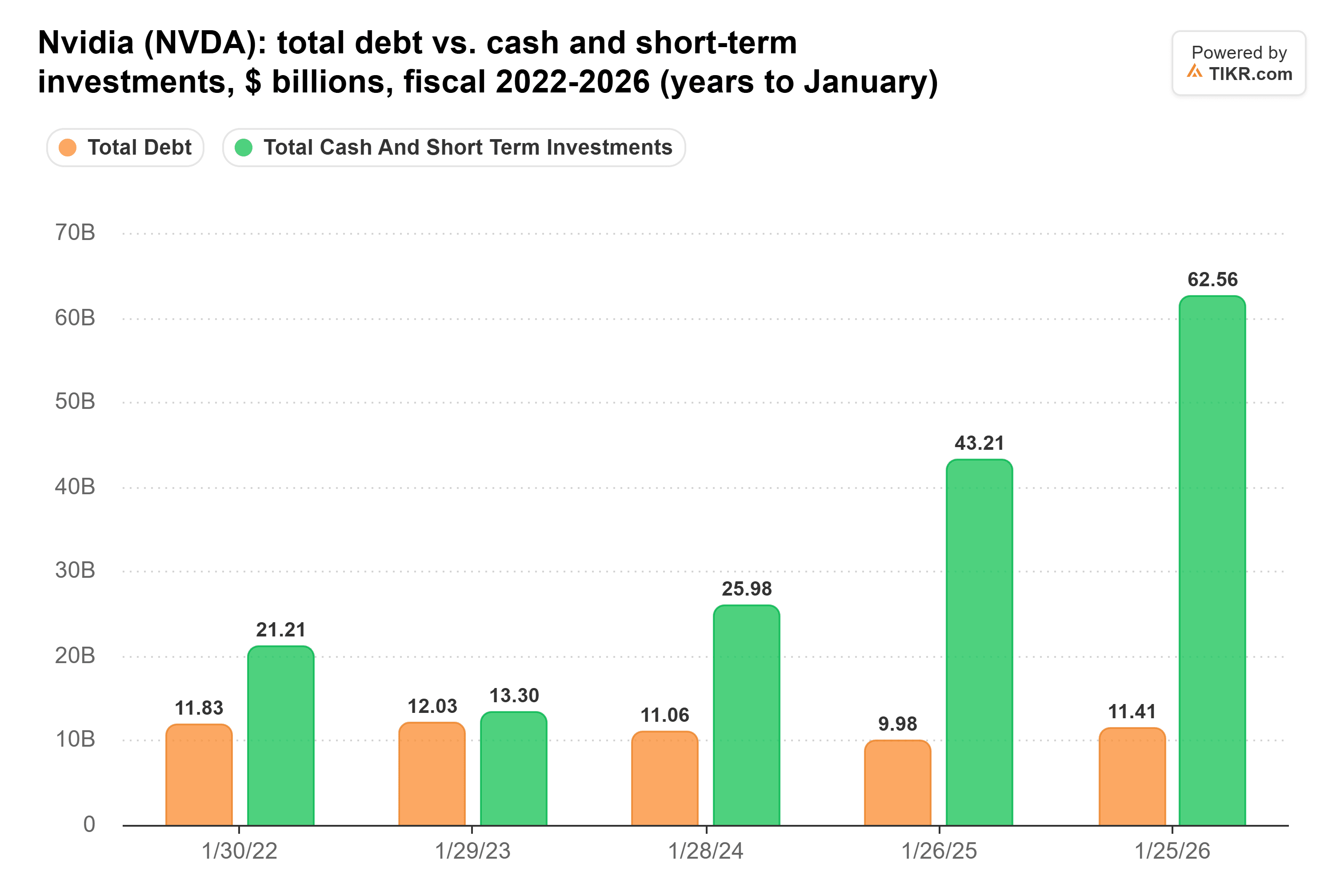
NVIDIA subsequently increased its borrowing, issuing $25 billion in notes during June 2026. By July 26, outstanding debt had reached approximately $33.4 billion. The company’s October 25 balance sheet showed approximately $53.5 billion in cash, cash equivalents, and marketable debt securities, leaving substantial liquidity despite the additional borrowing.
NVIDIA’s financial exposure extends beyond conventional borrowing. The company disclosed potential guarantees of up to $108.5 billion, including a $105 billion commitment associated with AI infrastructure development in Ohio. These conditional obligations could create substantial financial exposure if triggered.
NVIDIA’s November 17 earnings reinforced its operating strength.
Quarterly revenue reached $115.8 billion, up 103% year over year, while data center revenue increased 110% to $107.6 billion.
Those results strengthen the argument that NVIDIA’s profitability comes primarily from its technology business rather than financial leverage.
Home Depot’s 85.6% ROE relies more on leverage
Home Depot reaches a similarly high return on equity in a different way.
Home Depot’s 13.0% return on assets, combined with approximately 6.6x financial leverage, produced an 85.6% return on equity, according to the Reddit investor’s calculations.
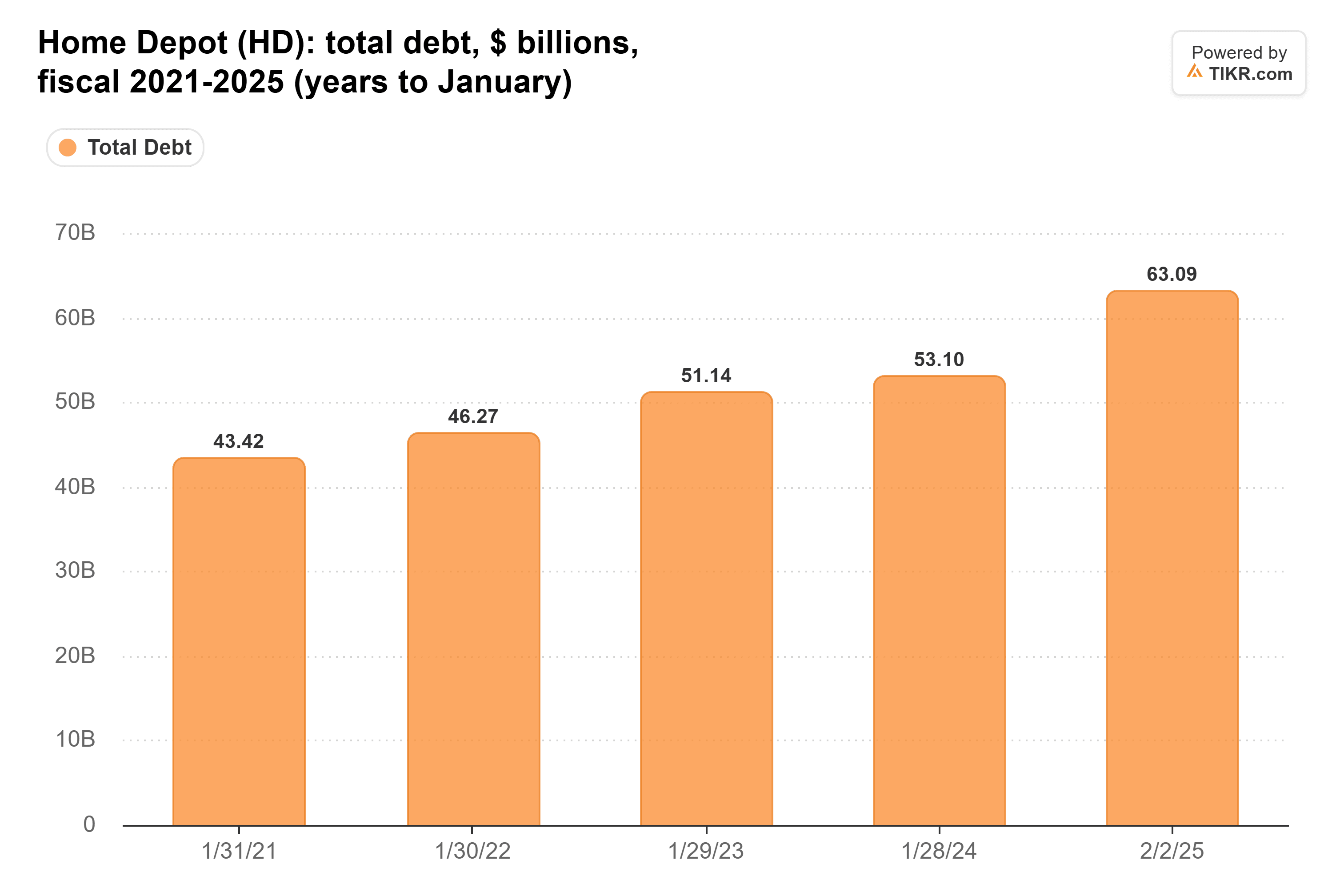
Between fiscal 2021 and fiscal 2025, Home Depot’s total debt increased from approximately $43.4 billion to $63.1 billion, partly reflecting acquisitions such as SRS Distribution and GMS.
Home Depot’s November 17 results showed that the business remains profitable.
Third-quarter sales increased 4.9% to $43.4 billion, while net earnings reached $3.7 billion, compared with $3.6 billion a year earlier.
Those results support Home Depot’s operating resilience, but its high ROE still depends more heavily on its capital structure than NVIDIA’s.
Paying down acquisition debt could strengthen Home Depot’s financial position, even if reported ROE declines.
NVIDIA’s 74.8% gross margin reinforces its profitability
NVIDIA’s operating margins provide another reason its high returns stand out.
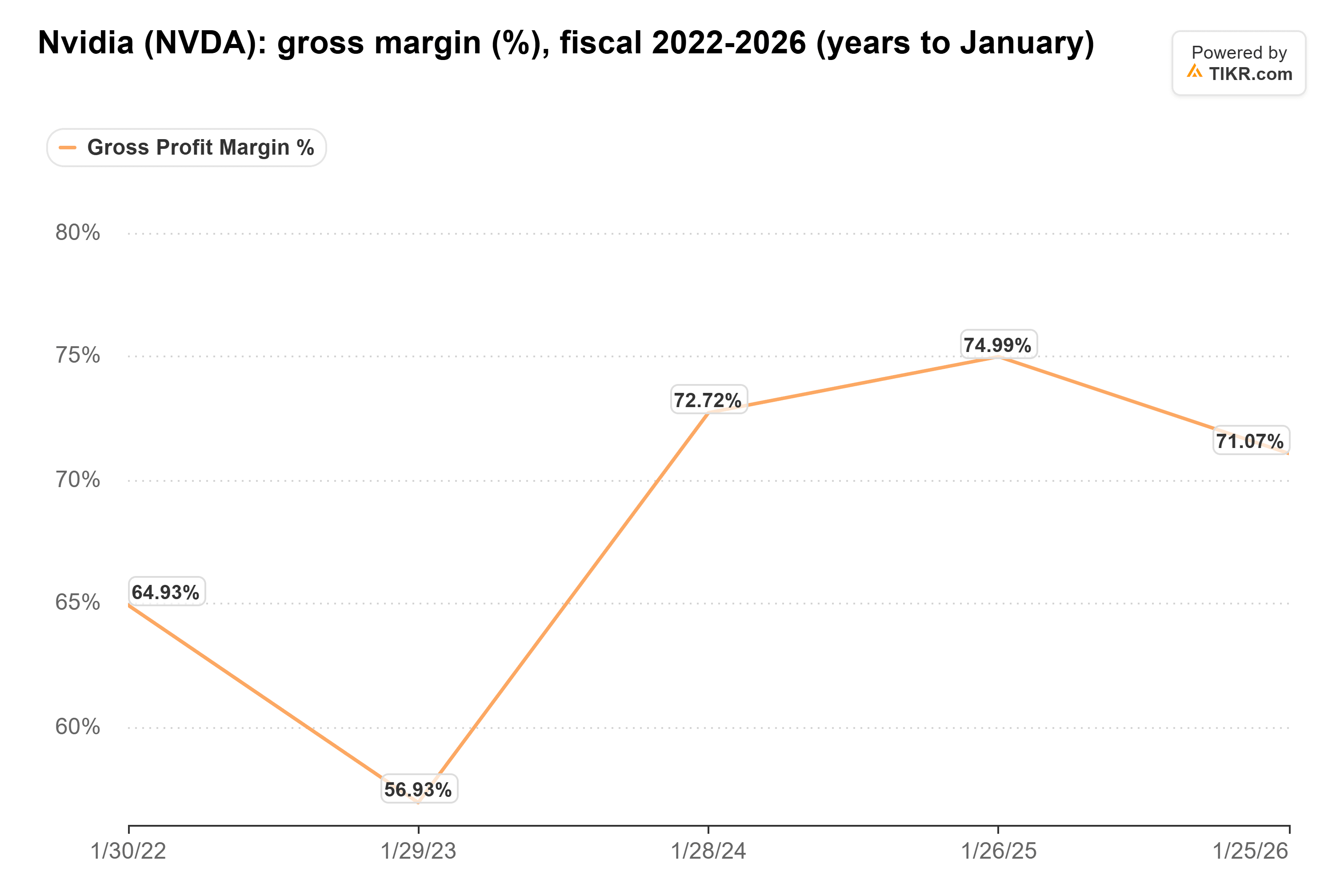
Gross margin fell to 56.9% in fiscal 2023 before recovering to 72.7% in fiscal 2024 and 75.0% in fiscal 2025. It remained above 71% in fiscal 2026.
The November 17 earnings report reinforced that trend.
NVIDIA reported a 74.8% GAAP gross margin in its fiscal third quarter, compared with 73.4% a year earlier. Operating income more than doubled to $77.5 billion.
“Our momentum is real,” said interim CEO and CFO Colette Kress, as the company reported continued demand for AI computing infrastructure.
Management projected approximately $130 billion in revenue for the January 2027 quarter, with gross margins expected between 71% and 72%.
That guidance suggests continued revenue growth, supported by demand for NVIDIA’s computing platforms. Its fiscal 2023 downturn also demonstrates that even exceptional margins can weaken during an industry slowdown.
NVIDIA is the best Buffett-style pick of these four
The Reddit investor’s central argument is convincing: NVIDIA’s historical shareholder returns were supported by stronger underlying asset profitability and significantly less financial leverage than the other companies in the comparison.
Its November 17 results make that argument more compelling.
NVIDIA closed at $151.83 on November 18, with forward earnings estimates implying a valuation near 11 times earnings.
That looks attractive for a company whose quarterly revenue more than doubled, whose gross margin remained near 75%, and whose data center business continued expanding rapidly.
Apple remains highly profitable, while Home Depot generates substantial retail cash flows. Boeing’s heavy leverage makes its triple-digit ROE a less persuasive measure of underlying business quality.
At approximately $152 per share and near 11 times forward earnings, I see NVIDIA as undervalued and would buy it over Home Depot, Apple, or Boeing. Its exceptional operating profitability, rapid revenue growth, and relatively modest conventional borrowing make it the strongest fit for Buffett’s profitability-and-debt criterion.
The main risk is that weaker AI infrastructure spending, declining margins, or substantial financial commitments could undermine its earnings outlook.
So what is NVIDIA stock actually worth?
TIKR lets you forecast the future price of any stock in less than a minute. Just enter a few assumptions into TIKR’s valuation model and see what NVIDIA could be worth. Start from Wall Street consensus estimates, or adjust the inputs to reflect your own view of the business. It’s free to use.
Disclaimer:
Please note that the articles on TIKR are not intended to serve as investment or financial advice from TIKR or our content team, nor are they recommendations to buy or sell any stocks. We create our content based on TIKR Terminal’s investment data and analysts’ estimates. Our analysis might not include recent company news or important updates. TIKR has no position in any of the stocks mentioned. Thank you for reading, and happy investing!