Key Takeaways
- A hypothetical $600,000 portfolio split evenly across Healthpeak Properties, Verizon and NNN REIT pays $37,054 a year in dividends at today’s prices, a 6.2% yield.
- Verizon pays out 52% of its free cash flow, and NNN REIT just raised its dividend for the 37th year in a row.
- Healthpeak is the least covered of the three, paying out 72% of its AFFO in fiscal 2025, and it has cut its dividend twice in the past decade.
- If Healthpeak halved its dividend, the portfolio’s income would fall to about $30,800 a year, though its payout ratio is now the lowest since at least fiscal 2016.
If you’re living off dividends in retirement, a 6% yield is hard to ignore. Healthpeak Properties (DOC), Verizon Communications (VZ) and NNN REIT (NNN) all pay about that today.
Take a hypothetical retiree who splits $600,000 evenly across the three. At today’s prices, that buys about 10,298 shares of Healthpeak, about 4,339 of Verizon and about 4,924 of NNN, which together pay $37,054 a year, or about $3,090 a month. That’s a 6.2% yield on this part of the portfolio. (Of course, no one should ever own just three stocks.)
Each dividend check comes from a very different business, and the income splits almost evenly between them:
| Stock | Shares | Cost | Income a year | Share of income | Coverage |
|---|---|---|---|---|---|
| Healthpeak (DOC) | 10,298 | $199,987 | $12,564 | 34% | 72% of AFFO |
| Verizon (VZ) | 4,339 | $199,964 | $12,279 | 33% | 52% of free cash flow |
| NNN REIT (NNN) | 4,924 | $199,964 | $12,212 | 33% | 69% of AFFO |
Source: TIKR; each company’s current dividend rate, at today’s prices. Coverage is fiscal 2025 for Healthpeak and NNN, and the twelve months to Sept. 30, 2026, for Verizon.
6 safe dividend stocks paying retirees 6%+ yields
There are over 100 stocks paying 6%+ annual dividends today.
But after an extensive investment review leveraging TIKR’s proprietary data, we now believe only six of them are truly safe for retirees.
They’re all yours as part of our new investment report. Learn more about how to get access right here.
Healthpeak is betting big on senior housing
Janus Living, Healthpeak’s senior housing business, grew revenue 78% in the third quarter of 2026 from a year earlier, on acquisitions and record entry fee sales. Its lab buildings are still recovering, with lab same-store adjusted NOI down 0.7% in the quarter. Even so, Healthpeak raised its 2026 guidance for FFO as Adjusted to $1.76-$1.78 a share on Nov. 2, from $1.73-$1.77 in August.
The dividend has a rougher history. Healthpeak cut it from $2.10 a share in fiscal 2016 to $1.48 in fiscal 2017, then to $1.20 in fiscal 2021. That last cut, plus AFFO growth from $1.35 to $1.69 a share between fiscal 2021 and fiscal 2025, took its payout ratio from 102% of AFFO in fiscal 2020 to 72% in fiscal 2025:
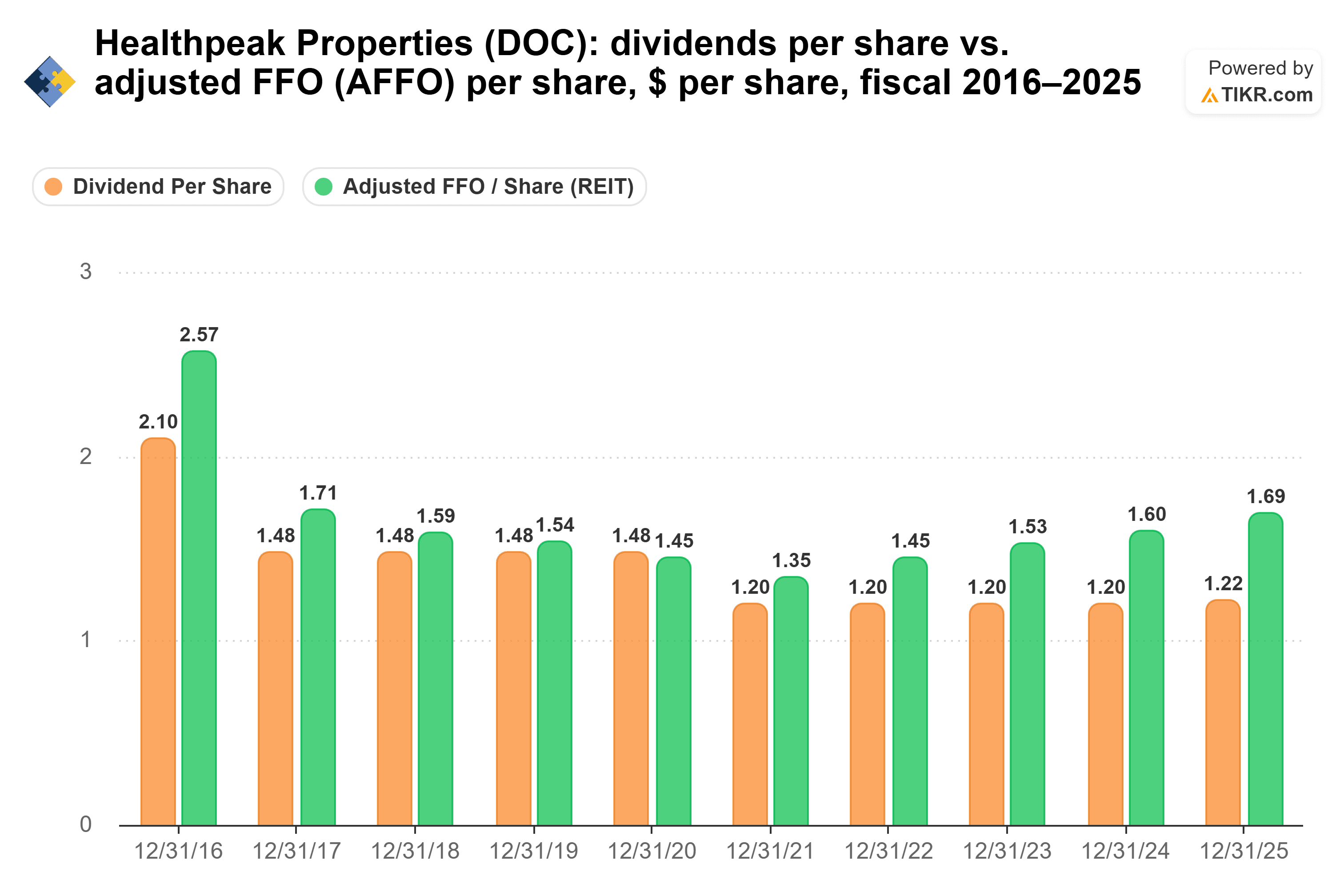
Analysts expect 75% for 2026.
The risk is its debt. Management said on the call that about $1.4 billion comes due in 2027. It took out a new $500 million term loan to help, and had $3.8 billion of liquidity as of Oct. 30.
Verizon is winning customers without paying up for them
Verizon’s check comes from a much bigger pool of cash. It added 406,000 postpaid phones in the third quarter of 2026 while spending less on device subsidies. That’s by design. As CEO Dan Schulman said on the third-quarter call, “Net adds are easy if your cost of acquisition goes way up and you give away a free line. I don’t consider free lines to even be net adds.”
In October, Verizon raised its 2026 guidance again: it now expects free cash flow growth to approach 12%, up from 9% to 10%.
Over the twelve months to Sept. 30, 2026, Verizon paid $11.7 billion in dividends out of $22.4 billion of free cash flow. That’s a comfortable 52%, and analysts expect 53% for fiscal 2026. Free cash flow has covered the dividend every year since fiscal 2018, with the least room in fiscal 2022, at 77%:
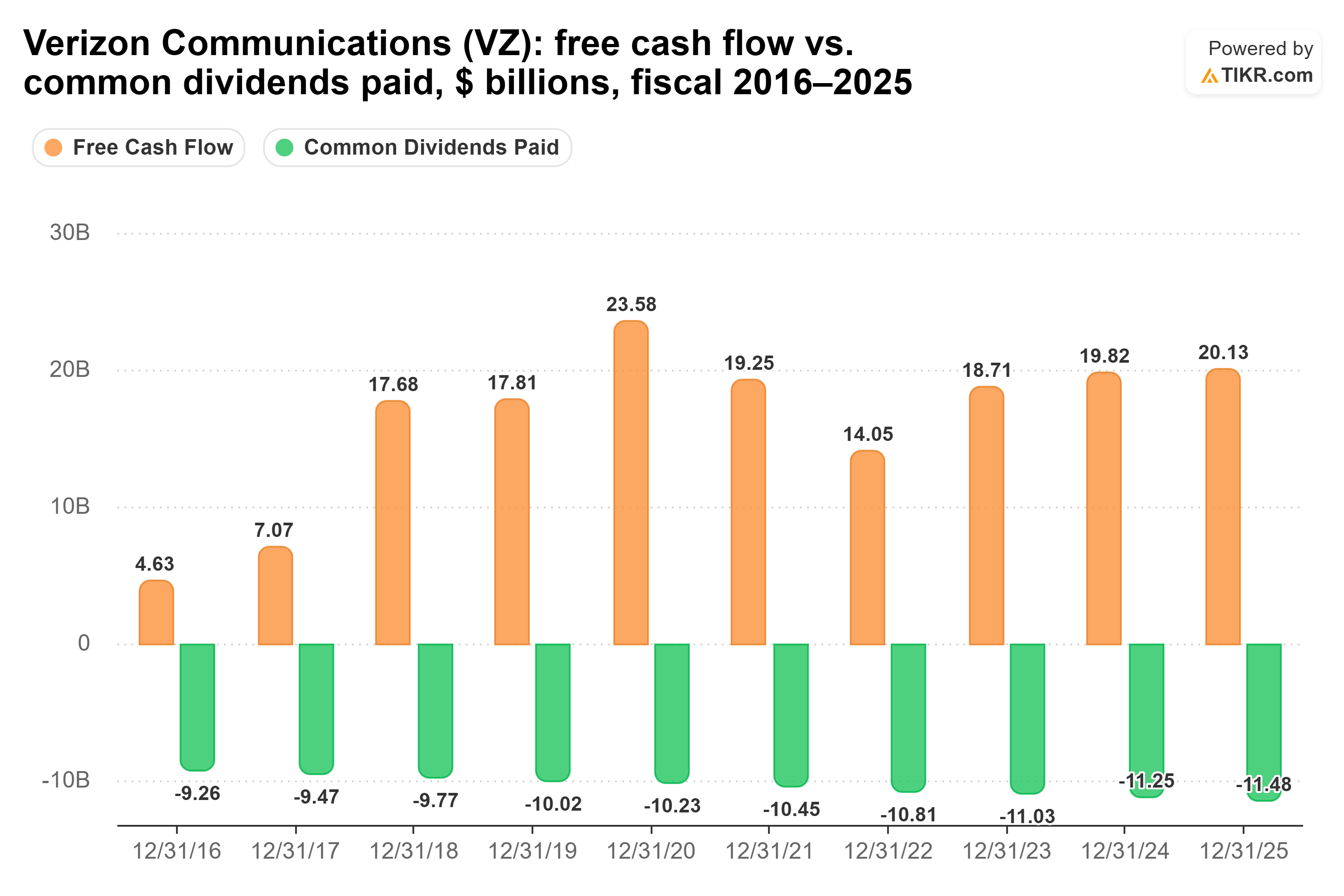
The catch is growth. Verizon’s dividend rose 1.9% a year from fiscal 2020 to fiscal 2025, from $2.48 to $2.73 a share. Management said on the call it remains “committed to growing the dividend,” but with net debt at 3.3x EBITDA, it’s also still paying down debt.
NNN keeps raising, whatever the cycle
NNN is a REIT like Healthpeak, but its dividend record looks nothing like it. Its properties were 99.2% occupied at the end of the third quarter of 2026. Annual base rent rose 6.8% from a year earlier to $974.0 million, and AFFO rose 5.8% to $0.91 a share. On Oct. 15, NNN raised its quarterly dividend 3.3% to $0.62 a share, which management called on the call “our 37th consecutive annual dividend increase.”
It paid out 69% of its AFFO in fiscal 2025, and analysts expect 68% for 2026. Its dividend rose every year from fiscal 2016 to fiscal 2025, from $1.78 to $2.36 a share. That includes fiscal 2020, when AFFO fell to $2.51 a share from $2.80:
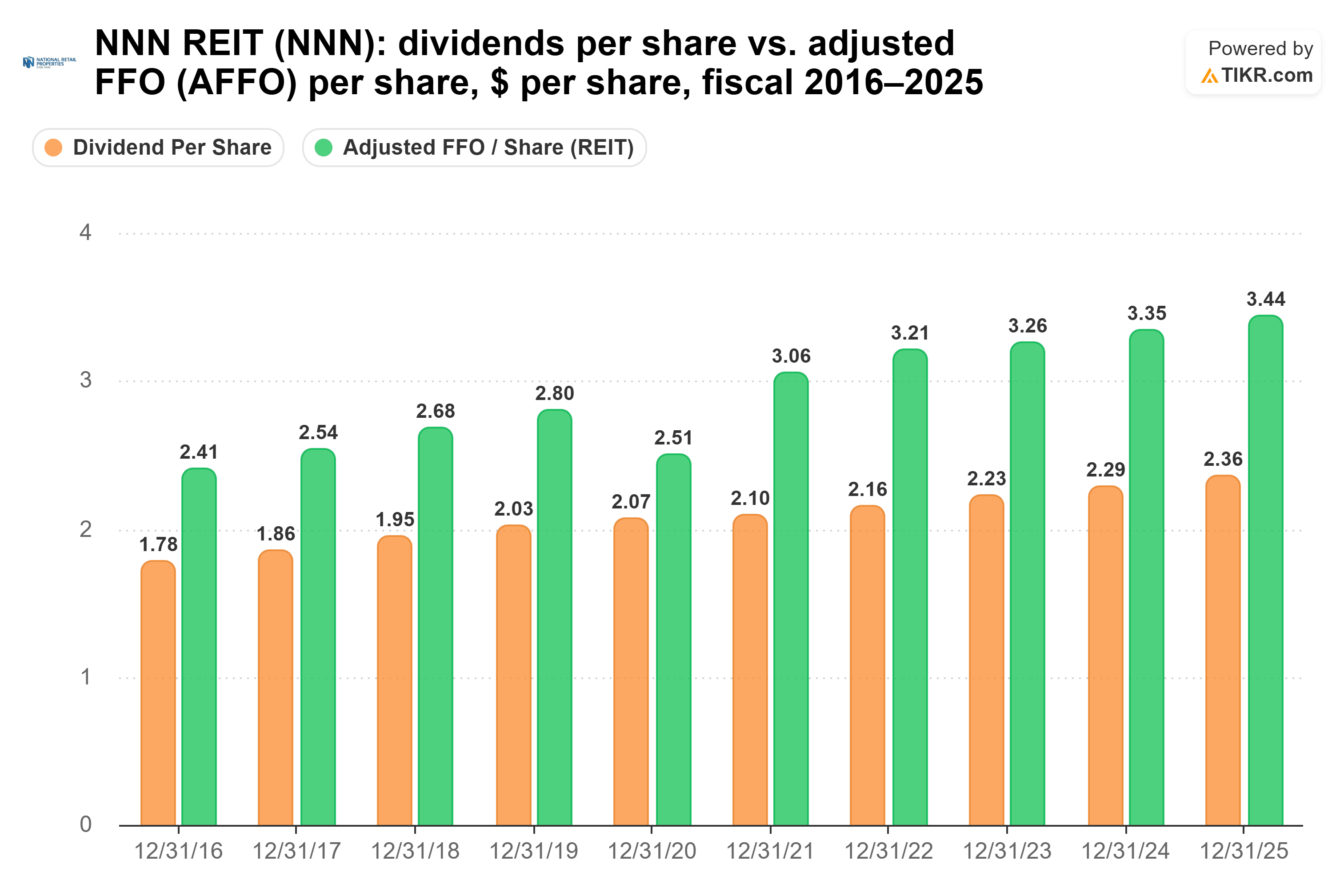
The risk is consumer pressure on some restaurant and entertainment tenants, and NNN has a $350 million bond due in December.
Two checks I’d count on, and one I’d watch
Healthpeak is the least covered of the three, so it’s the one to test. If it halved its dividend, this portfolio’s income would fall to about $30,800 a year. If it stopped paying altogether, Verizon’s and NNN’s checks would still bring in about $24,500 a year between them.
Healthpeak still has room, though: it’s paying out less of its AFFO than in any year since at least fiscal 2016.
The way I see it, Verizon’s check is safe but slow, NNN’s is safe and growing, and Healthpeak’s is the one I’d keep an eye on. I don’t expect a third cut. Given its history, though, I want to see how it refinances that 2027 debt, since higher interest costs would come out of the same cash that funds the dividend.
Enjoy your retirement in style with these safe 6%+ dividend yields
Dividends can hold the key to enormous wealth. But only if you buy the right ones.
Picking the right high-yield dividend stock can be the difference between a dream retirement…and scraping by every month, waiting for the next Social Security check to clear.
We’ve identified six stocks yielding 6%+ that we believe every retiree should know about right now.
Disclaimer:
Please note that the articles on TIKR are not intended to serve as investment or financial advice from TIKR or our content team, nor are they recommendations to buy or sell any stocks. We create our content based on TIKR Terminal’s investment data and analysts’ estimates. Our analysis might not include recent company news or important updates. TIKR has no position in any of the stocks mentioned. Thank you for reading, and happy investing!