Key Takeaways
- Scott Galloway said NVIDIA has “arguably the widest moat of any company in AI” after Jensen Huang resigned as CEO.
- That moat is NVIDIA’s product, and a 75.0% gross margin in the July 2026 quarter shows buyers still pay up for it.
- Analysts expect revenue of $689 billion in the year ending January 2028, though chips from Alphabet and Amazon are starting to reach outside buyers.
- The stock trades at 14x forward earnings, its lowest in five years, and the Nov. 17 margin guide is the next test.
NVIDIA (NVDA) reports on Nov. 17, its first earnings report without Jensen Huang. The co-founder resigned as CEO on Nov. 12, four days after the board opened an investigation into reports that he had been the target of a foreign intelligence effort, and the stock closed down 4.34% at $166.19 that day.
Wall Street hasn’t taken it well. On Nov. 13, HSBC cut the stock to Hold and slashed its target to $170 from $365, saying the uncertainty will last “until a permanent succession plan is laid out.”
Scott Galloway sees it differently. On Pivot, the NYU Stern professor said the bear case “is that they’re going to find that 20% of the chip sales were going to bad actors.”
Then he added: “It’s probably not that. And this company has arguably the widest moat of any company in AI.”
The numbers back him up. The moat is the product itself, and buyers have yet to find a better one.
Sold out through 2027
Start with demand. Bloomberg equities reporter Ryan Vlastelica said on Bloomberg Tech that nearly every analyst and investor he’d spoken to sees NVIDIA’s fundamentals as intact. “It is sold out really for 2027,” he said.
Analysts’ estimates show how much growth that order book carries:
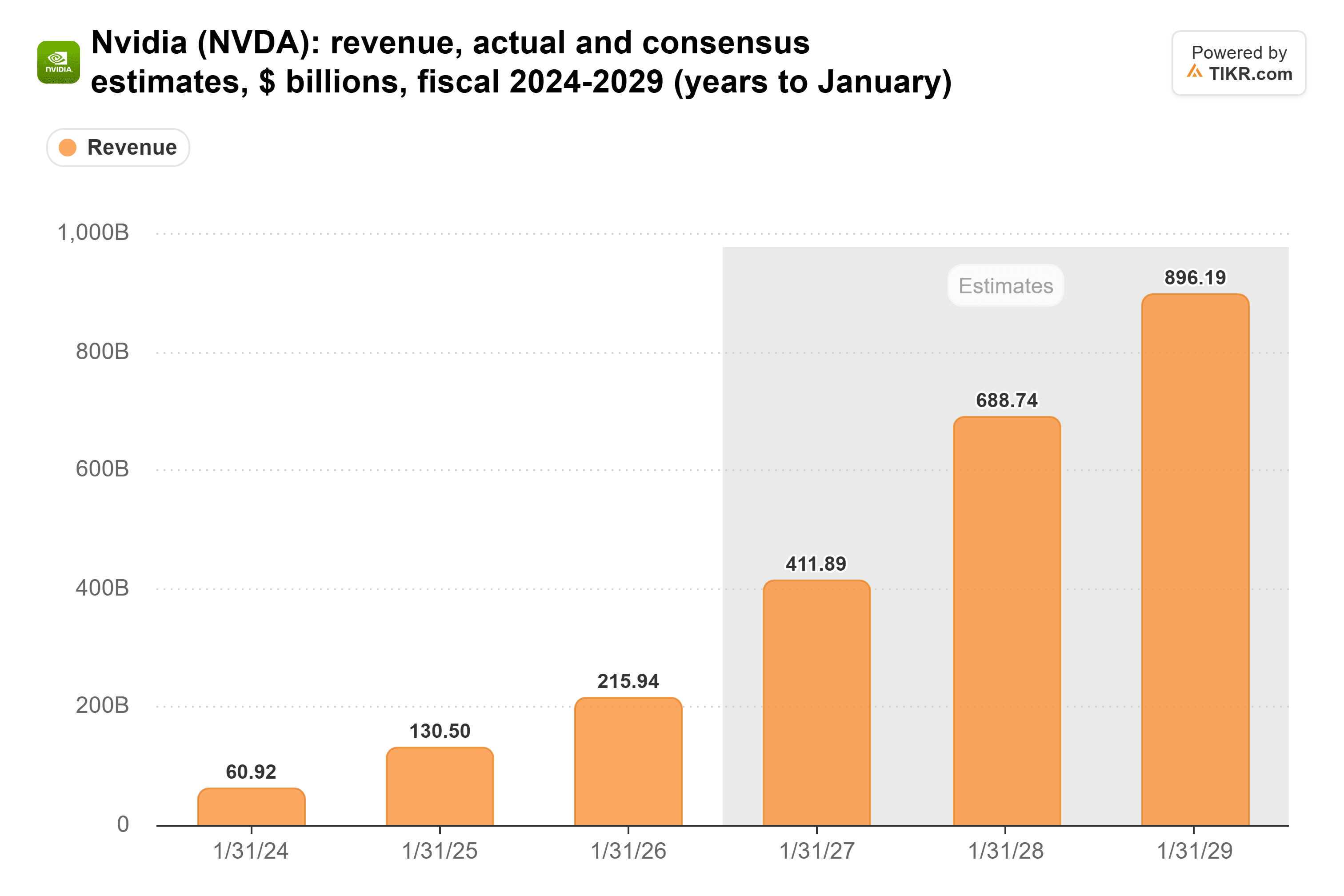
Revenue was $216 billion in the year ended January 2026. Consensus has $412 billion for the year ending January 2027, then $689 billion for the year after, which covers most of calendar 2027. In August, management guided to about 70% growth for that year and said the limit on it is how much its suppliers can build. A new CEO doesn’t unwind orders that are already placed.
TIKR tracks 62 analysts on Nvidia. How many say “Buy”?
See the full breakdown of Buy, Hold, and Sell ratings on Nvidia, along with Wall Street’s revenue and earnings estimates, all in one place. More than 500,000 investors use TIKR to research stocks like this one. See Nvidia’s Analyst Ratings
Buyers still pay up
Pricing power is the clearest sign of a moat, and NVIDIA’s gross margin has stayed in the 70s for three straight fiscal years:
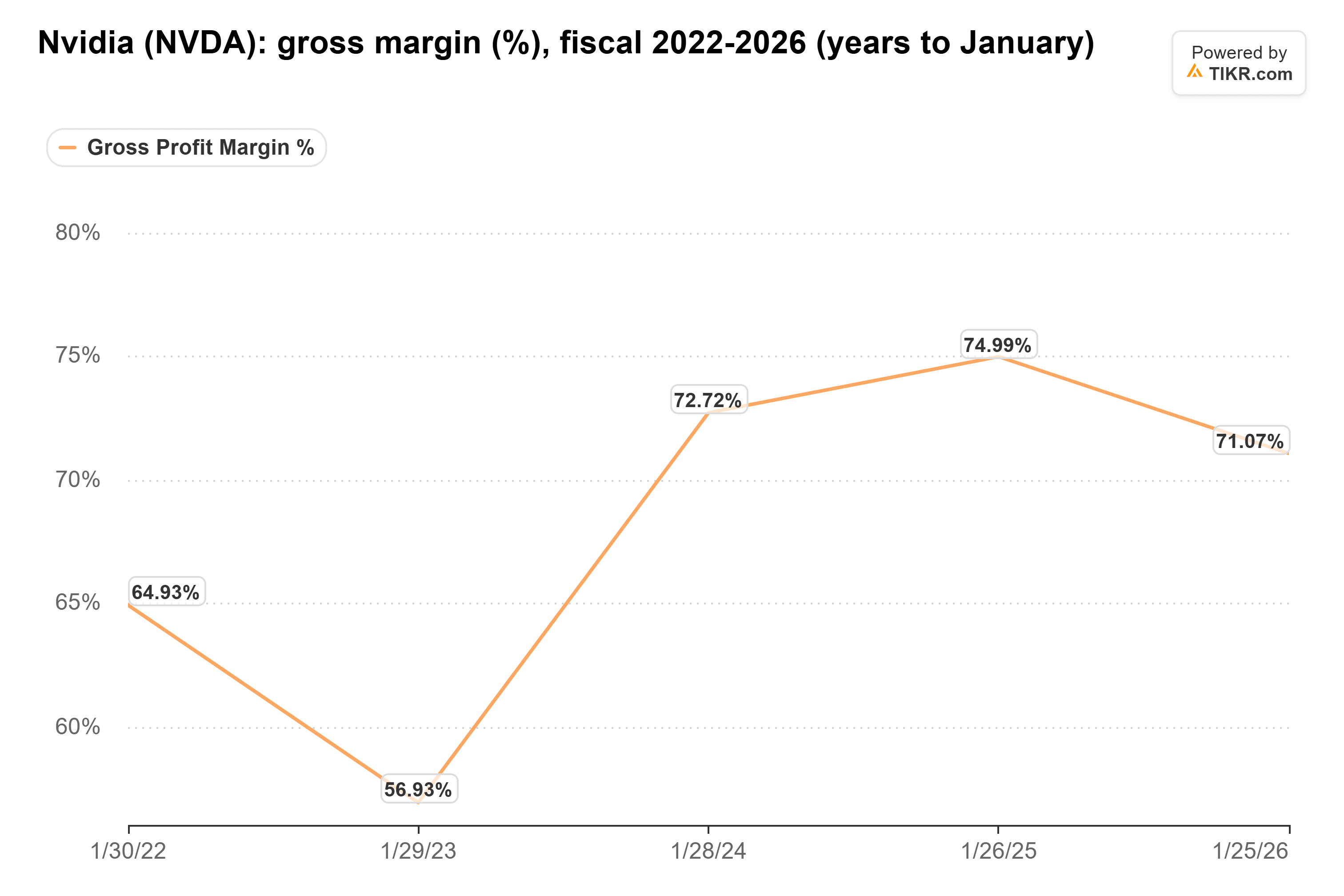
The one real dip came in the last downturn, when revenue stalled: gross margin fell to 56.9% in the year ended January 2023. The slip to 71.1% in the year ended January 2026 included a $4.5 billion charge tied to its H20 chip for China, and gross margin was back at 75.0% in the July 2026 quarter.
Management does expect it to bottom at 71% to 72% in the January 2027 quarter as memory prices climb. But it has already pushed through price increases that take effect early in 2027, which it expects to lift margin back to 72% to 73% in the year ending January 2028. A company that can pass a cost spike on to its customers has something they can’t get anywhere else.
Malcolm Ethridge, managing partner at Capital Area Planning Group, put it plainly on CNBC’s Halftime Report: “I don’t think there’s any product on the market that anyone seriously working in the AI field would say is a better product than the Vera cluster, like Rubin.”
Alphabet and Amazon are coming for the margins
The real threat is the hyperscalers’ own chips, which are now headed to outside buyers. Morgan Stanley estimates Alphabet’s direct sales of TPU systems at $84 billion in 2027, up from about $8 billion in 2026. Those TPUs sell at prices well below NVIDIA’s, which Bloomberg Intelligence says could be a big factor. Amazon plans to start selling Trainium outside AWS late in 2027.
Both could pressure NVIDIA’s pricing, but its own supply is already spoken for through 2027. AWS is still deploying 2 million more NVIDIA GPUs in 2027 and 2028. And Ethridge said he’d change his mind once a rival can “stand toe-to-toe with the way NVIDIA builds,” which he doesn’t expect to hear about in the next three months.
Priced like the moat is already gone
Going into Nov. 17, NVIDIA’s forward P/E sits at its lowest point in five years:
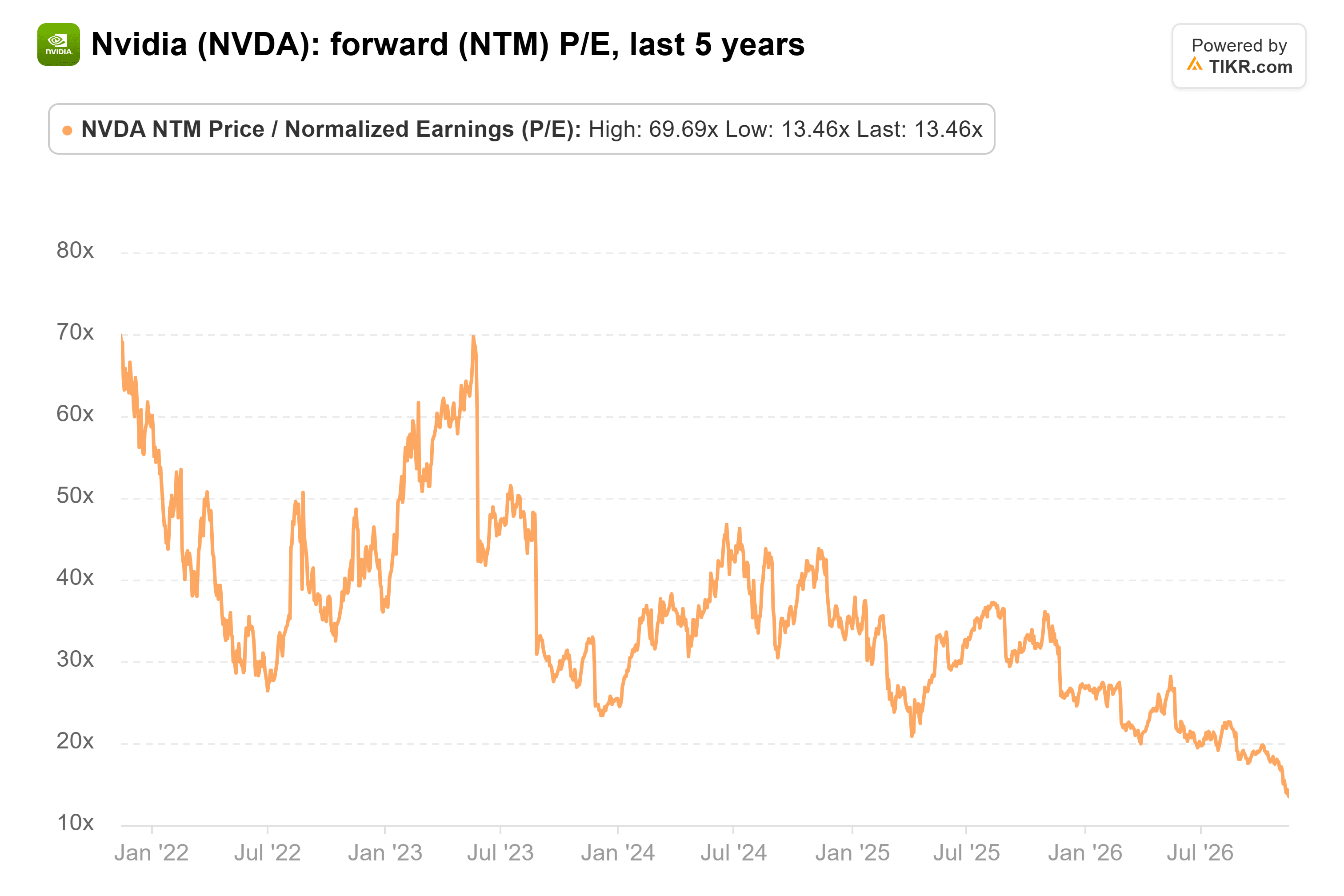
That’s 14x, against a five-year average of 36x and a peak near 70x in May 2023.
Galloway’s read holds up. A sold-out 2027, gross margins in the 70s and, in Ethridge’s view, no better product than Vera Rubin add up to arguably the widest moat in AI, and none of it walked out the door with Huang. At 14x, investors are paying as if that moat were already shrinking, and the data so far doesn’t show it.
Of course, the first test comes fast. If management’s Nov. 17 guide for the January quarter’s gross margin comes in below that 71% floor, memory costs are outrunning NVIDIA’s price increases, and the moat is narrower than Galloway suggests.
So what is NVIDIA stock actually worth?
TIKR lets you forecast the future price of any stock in less than a minute. Just enter a few assumptions into TIKR’s valuation model and see what NVIDIA could be worth. Start from Wall Street consensus estimates, or adjust the inputs to reflect your own view of the business. It’s free to use.
Disclaimer:
Please note that the articles on TIKR are not intended to serve as investment or financial advice from TIKR or our content team, nor are they recommendations to buy or sell any stocks. We create our content based on TIKR Terminal’s investment data and analysts’ estimates. Our analysis might not include recent company news or important updates. TIKR has no position in any of the stocks mentioned. Thank you for reading, and happy investing!