Key Takeaways
- NVIDIA reportedly insures its directors and officers for up to $900 million but carries no D&O cover for the company, so its shareholder-suit costs come out of its cash.
- Venture capitalist Bill Gurley calls that sensible for a company NVIDIA’s size, and the numbers back him.
- Analysts see about $190 billion of free cash flow in the year to January 2027, and NVIDIA held $56.6 billion of cash and debt securities in July.
- The bigger unknown is the Megaspeed criminal inquiry, and the Nov. 17 report is the next chance to hear whether NVIDIA can size a loss.
NVIDIA (NVDA) reports earnings on Nov. 17 facing a shareholder lawsuit and federal scrutiny tied to former CEO Jensen Huang, and it reportedly has no D&O coverage for the company itself.
The Financial Times reported on Nov. 14 that NVIDIA bought up to $900 million of Side A coverage, which protects directors and officers personally when the company can’t. It reportedly skipped Side B, which repays a company for covering its executives’ costs, and Side C, which covers securities claims against the company itself.
One investor on r/stocks called that “huge,” because it “means any big legal hit comes straight out of pocket.”
Venture capitalist Bill Gurley saw it the other way: “This is not insane at all.”
Less Than Two Days of Cash Flow
Gurley gave three reasons it “would actually make sense to self-insure”:
- Every D&O program has a cap, and NVIDIA can carry the risk itself.
- An insurer’s required return beats NVIDIA’s cost of capital, so “they would be giving away money.”
- Big programs draw lawsuits, since coverage gets disclosed early in a suit (which he calls “ridiculous”).
Analysts expect free cash flow to roughly double, from $96.7 billion in the year ended January 2026 to about $190 billion in the year ending January 2027:
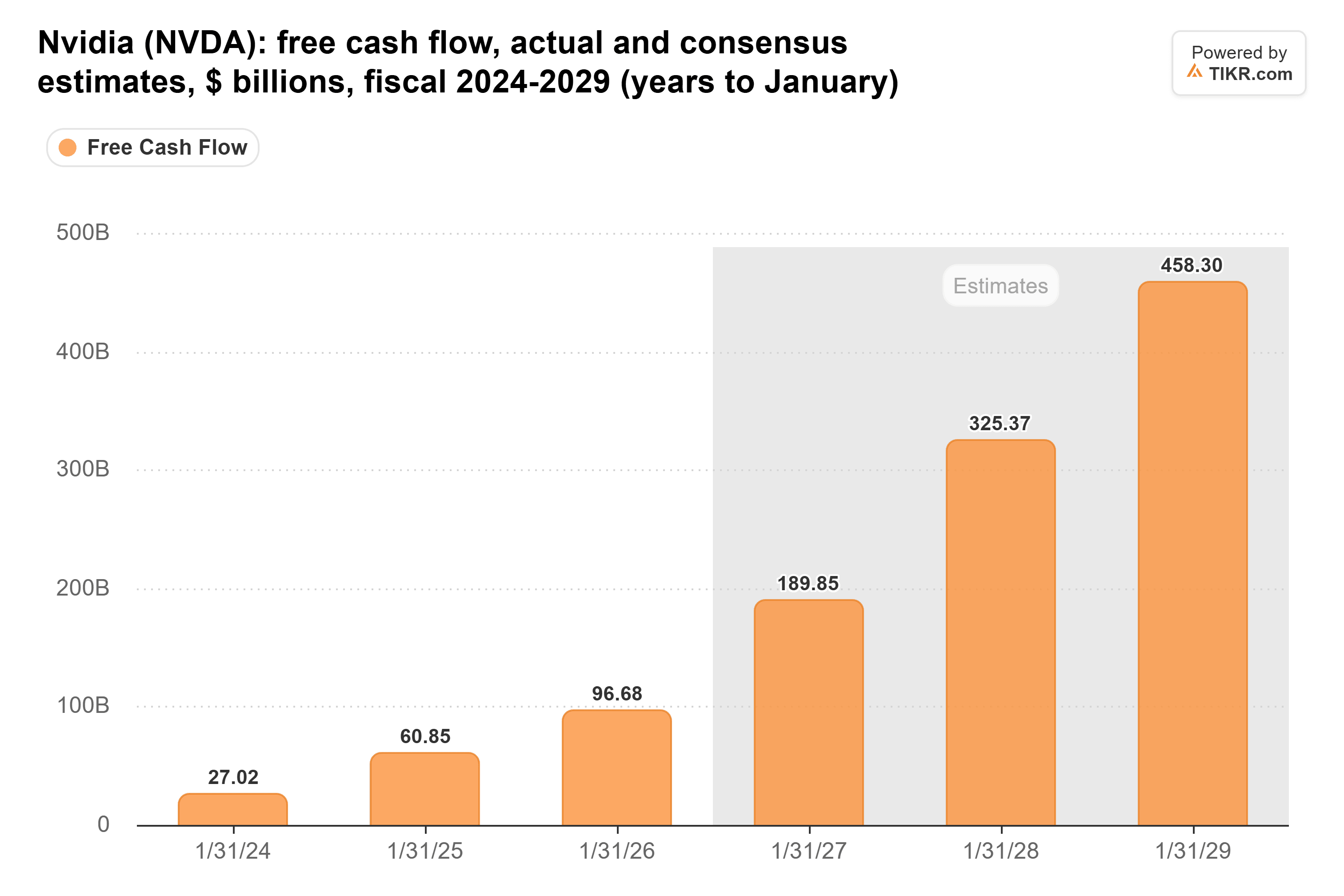
At that pace, NVIDIA generates the whole $900 million limit in under two days.
Cash ran well ahead of debt through January:
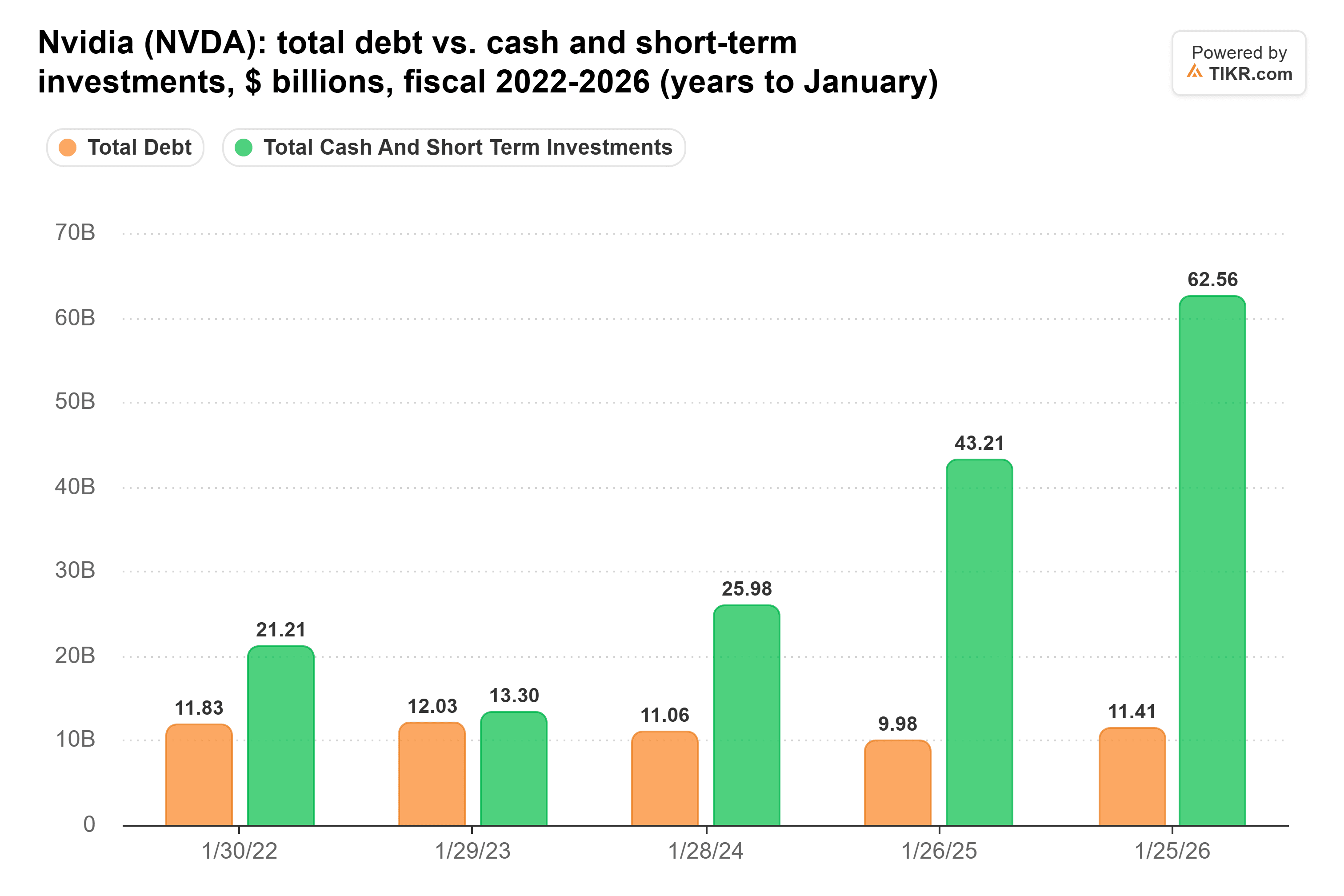
It has since sold $25 billion of bonds, but its latest 10-Q still shows $56.6 billion of cash and marketable debt securities at the end of July against $33.4 billion of notes.
That’s Gurley’s second point: premiums cover expected claims plus the insurer’s costs and profit, and self-insuring keeps that margin with NVIDIA.
TIKR Tracks 61 Analysts on Nvidia. How Many Say “Buy”?
See the full breakdown of Buy, Hold, and Sell ratings on Nvidia, along with Wall Street’s revenue and earnings estimates, all in one place. More than 500,000 investors use TIKR to research stocks like this one. See Nvidia’s Analyst Ratings
Big Policies Paint a Target
Gurley’s third point matters because NVIDIA already has a shareholder suit. A proposed class action filed Nov. 9 in federal court in San Jose names NVIDIA and Huang, alleging they hid Huang’s relationship with a former Megaspeed executive. It seeks unspecified damages, and none of the allegations has been tested in court.
Side A could still cover claims against Huang and other directors, including derivative suits, but anything NVIDIA owes as a defendant comes from its own cash.
NVIDIA’s Real Legal Risk Isn’t the Insurance Gap
A Commerce Department probe into Megaspeed, which imported billions of dollars of NVIDIA equipment into Malaysia, went to the Justice Department as a criminal inquiry. If investigators found NVIDIA knew chips were headed to China, penalties and lost licenses could cost far more than a $900 million policy would ever pay.
Gurley’s right on the economics. On average, self-insuring saves NVIDIA the insurer’s costs and profit built into premiums, though one huge loss could make a policy look cheap in hindsight. I wouldn’t sell over the insurance gap.
The Nov. 17 report is the first chance to hear whether management can estimate a loss or has set money aside, and Huang has agreed to a closed-door briefing with three House committees.
So What Is NVIDIA Stock Actually Worth?
TIKR lets you forecast the future price of any stock in less than a minute. Just enter a few assumptions into TIKR’s valuation model and see what NVIDIA could be worth. Start from Wall Street consensus estimates, or adjust the inputs to reflect your own view of the business. It’s free to use.
Disclaimer:
Please note that the articles on TIKR are not intended to serve as investment or financial advice from TIKR or our content team, nor are they recommendations to buy or sell any stocks. We create our content based on TIKR Terminal’s investment data and analysts’ estimates. Our analysis might not include recent company news or important updates. TIKR has no position in any of the stocks mentioned. Thank you for reading, and happy investing!