Key Takeaways
- The New York Times reported that a Commerce Department probe into Megaspeed was halted after NVIDIA’s top lawyer named a Trump-nominated official. Megaspeed imported billions of dollars of NVIDIA equipment into Malaysia for data centers serving Chinese clients, including Alibaba.
- The case has since gone to the Justice Department as a criminal inquiry into Megaspeed, which makes export compliance a bigger risk for NVIDIA than Jensen Huang’s affair.
- The sales at stake look small next to the $692 billion of revenue analysts expect in the fiscal year ending January 2028.
- At 15x forward earnings, about half its three-year average, the stock already prices in a lot of bad news, with earnings on Nov. 17 and a congressional briefing on Nov. 18 still ahead.
NVIDIA (NVDA) shares fell 5% on Monday after Jensen Huang admitted to an affair with a former executive at Megaspeed, an NVIDIA customer. The bigger news for shareholders came later that day, in a New York Times report on Megaspeed itself. Megaspeed is a Singapore-based company that built data centers around Southeast Asia to serve Chinese clients, including Alibaba (BABA).
The report’s headline said a Commerce Department inquiry into Megaspeed “Was Halted After Nvidia Intervention.”
So this story is now about more than Huang’s personal life. It’s also about whether NVIDIA’s chips reached China, and what NVIDIA did when the government went looking.
TIKR tracks 61 analysts on Nvidia. How many say “Buy”?
See the full breakdown of Buy, Hold, and Sell ratings on Nvidia, along with Wall Street’s revenue and earnings estimates, all in one place. More than 500,000 investors use TIKR to research stocks like this one. See Nvidia’s Analyst Ratings
NVIDIA’s lawyer emailed the agents
“The United States began investigating Megaspeed and Ms. Huang in 2024, after the company started importing billions of dollars’ worth of advanced Nvidia A.I. equipment into Malaysia,” according to the report. Renting that computing power to Chinese clients is legal. The concern was “that some of the Nvidia chips the company had bought were illegally routed into China.”
In August 2025, while the probe was under way, NVIDIA general counsel Tim Teter emailed the agents. He wrote that Jeff Kessler, their boss and a Trump-nominated under secretary, had given NVIDIA permission to reach out about the case. The agents turned down a meeting and forwarded the emails to Kessler. Some of them saw his contact with NVIDIA “as violating government procedure and potentially tainting the case.” The Justice Department then asked Commerce to pause its work, and the case moved to the DOJ, which is now running a criminal inquiry into Megaspeed.
A Commerce official said Kessler never ordered anyone to share information with NVIDIA. NVIDIA said its contacts with officials were meant to provide information and ask for guidance.
This one can land on the company
Huang’s affair raises questions about one man, and TIKR has already covered the worry that NVIDIA has no natural successor. Export rules are NVIDIA’s to follow, though. If chips bought for Malaysia ended up in China, the company could face penalties and tighter limits on the overseas clouds that buy its hardware. Other agencies have reportedly already proposed adding Megaspeed to the Commerce Department’s entity list, its trade blacklist, and Commerce hasn’t done it. That would also close one route to NVIDIA computing power for Chinese buyers like Alibaba.
Washington is paying attention, too. House committee chairs have asked Huang to a closed-door briefing on Nov. 18, and lawmakers want to know whether his past assurances that chips weren’t diverted held up. The answer bears on NVIDIA’s future export licenses. Former SEC Chair Gary Gensler, now a professor at MIT, told CNBC on Monday what he thinks the board’s probe of Huang has to settle: “The question to answer is whether they’ve misled any of their shareholders.”
The dollars look manageable
The report describes officials’ concern that chips were routed into China. It doesn’t show that any were. NVIDIA has also narrowed the channel on its own: the Financial Times reported this month that it told cloud clients to keep Chinese customers to 49% of their business.
Megaspeed’s Malaysian sister company reportedly bought at least $4.8 billion of AI equipment with NVIDIA chips from June 2024 to February 2026. In a Reddit thread on Monday’s drop, one investor passed along an estimate, with no source, that NVIDIA could lose $30 billion of revenue if Megaspeed and others in Southeast Asia were banned.
Analysts expect revenue to climb from $216 billion in the fiscal year that ended in January 2026 to $412 billion this fiscal year and $692 billion the year after:
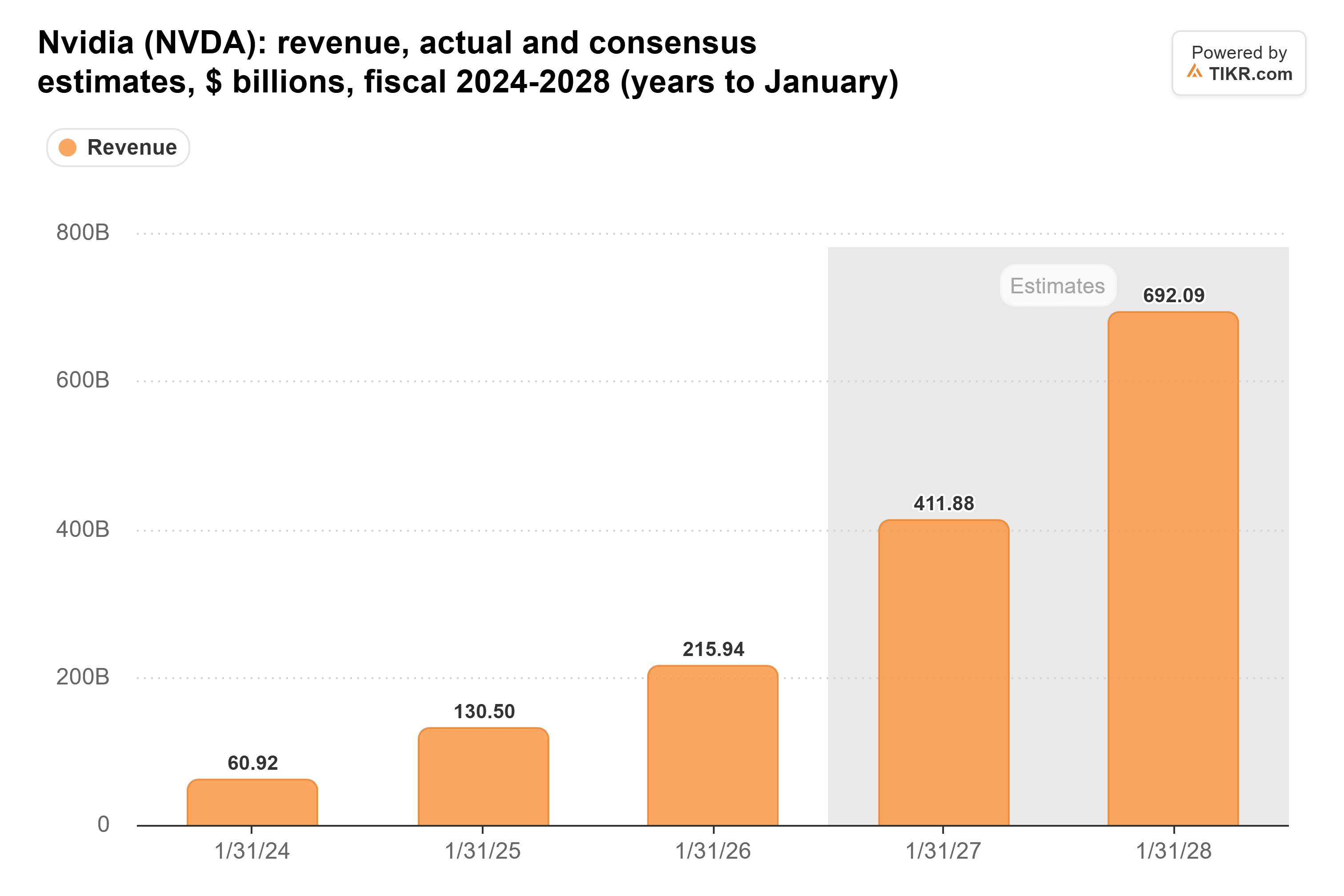
Even the $30 billion figure would be about 7% of this year’s estimate and about 4% of next year’s. That would dent the growth without derailing it.
Investors already expect a lot to go wrong
The selloff has pushed NVIDIA’s forward P/E down to its lowest point in three years:
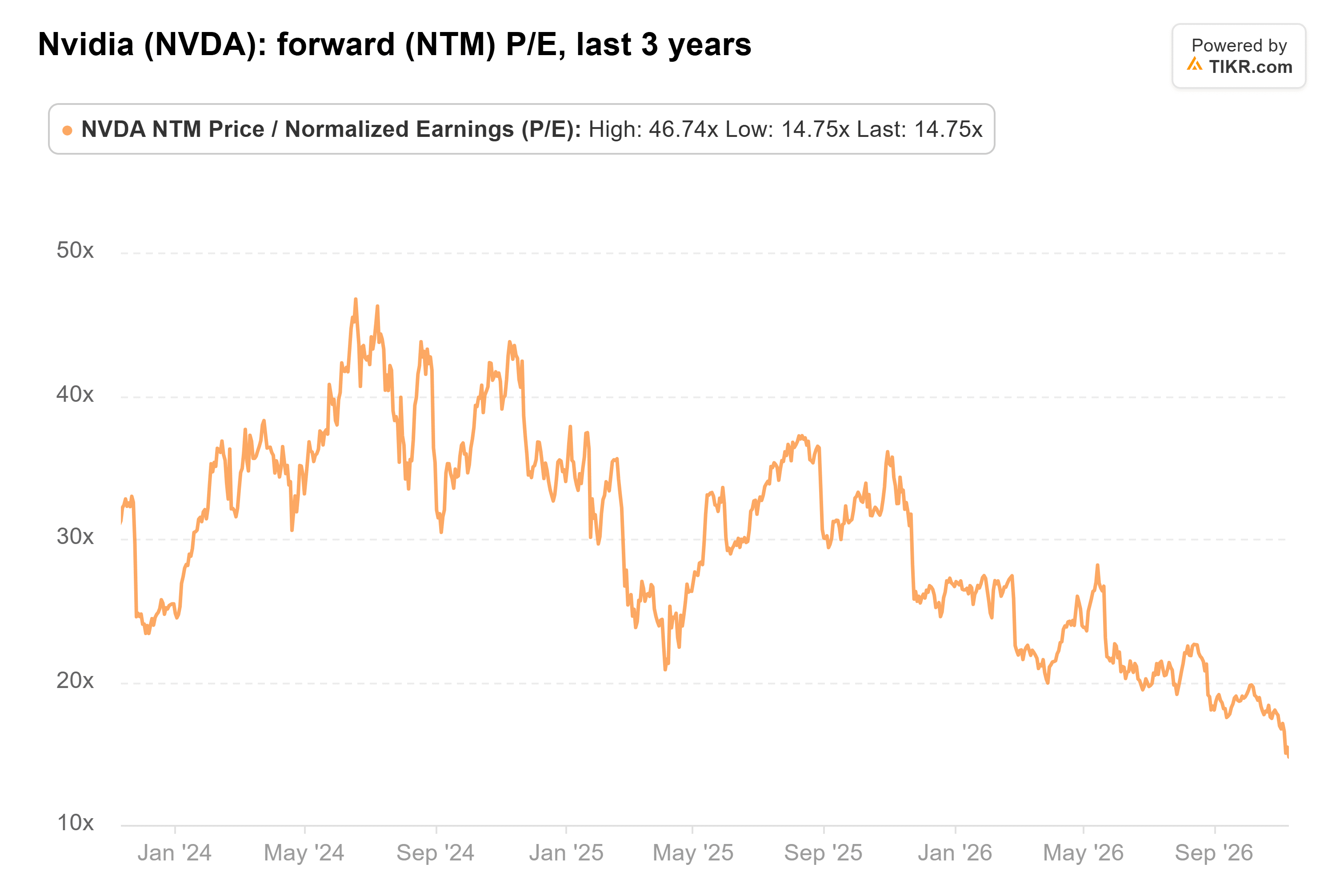
At 15x, it’s about half the 30x average of the last three years, and far below the 47x peak of June 2024.
The real risk is that the DOJ or Congress finds NVIDIA knew its chips were headed to China. That could bring penalties and lost licenses, and it would make management’s word worth less.
Short of that, I think the selling has gotten ahead of the business. The Megaspeed case is the part of this story worth watching, but at 15x forward earnings, investors are already paying for a lot to go wrong. Of course, NVIDIA reports on Nov. 17. If Huang takes the Nov. 18 briefing, lawmakers will ask him directly what NVIDIA knew about where Megaspeed’s chips went.
So what is NVIDIA stock actually worth?
TIKR lets you forecast the future price of any stock in less than a minute. Just enter a few assumptions into TIKR’s valuation model and see what NVIDIA could be worth. Start from Wall Street consensus estimates, or adjust the inputs to reflect your own view of the business. It’s free to use.
Disclaimer:
Please note that the articles on TIKR are not intended to serve as investment or financial advice from TIKR or our content team, nor are they recommendations to buy or sell any stocks. We create our content based on TIKR Terminal’s investment data and analysts’ estimates. Our analysis might not include recent company news or important updates. TIKR has no position in any of the stocks mentioned. Thank you for reading, and happy investing!