
Key Takeaways
- Qualcomm (QCOM) CEO Cristiano Amon said there is no AI correction at his company, citing strong semiconductor demand and industrywide supply shortages despite the recent technology selloff.
- NVIDIA (NVDA) faces its November 17 earnings report following Jensen Huang’s resignation, with investors watching whether AI infrastructure demand can sustain its aggressive growth forecasts.
- NVIDIA traded at 14.3x forward earnings on November 11, compared with its five-year average of 35.7x, while TIKR estimates projected approximately 68% revenue growth for the fiscal year ending January 2028.
- NVIDIA’s revenue forecasts suggest AI demand remains strong, but its November 17 earnings must confirm that growth is sustainable. Revenue above $110.2 billion and strong forward guidance would reinforce that outlook.
What Happened?
Qualcomm (QCOM) CEO Cristiano Amon pushed back against concerns about slowing artificial intelligence demand in a Yahoo Finance interview published on November 12.
“There is no AI correction in Qualcomm,” Amon said, explaining that the company’s expansion into AI data center chips remains in its early stages.
His comments came as NVIDIA (NVDA) faced growing uncertainty ahead of its November 17 earnings report.
On November 12, NVIDIA announced that founder Jensen Huang had resigned as CEO, effective immediately, with Chief Financial Officer Colette Kress appointed interim CEO while retaining her finance responsibilities.
The leadership transition raised questions about NVIDIA’s ability to maintain investor confidence during a period of substantial AI infrastructure investment.
However, Amon’s broader comments suggested semiconductor demand remained resilient.
He described shortages in wafer production, substrates, and chip assembly, arguing that customers continue to demand more capacity than suppliers can provide.
That distinction matters for NVIDIA because supply constraints can delay revenue without necessarily indicating weaker underlying demand.
The central question is whether NVIDIA’s upcoming results can support that confidence despite leadership uncertainty and concerns about future AI spending.
NVIDIA’s Revenue Forecasts Still Point to Strong AI Demand
Despite recent market volatility, Wall Street continues to project substantial revenue growth for NVIDIA.
The company generated approximately $215.9 billion in revenue during its fiscal year ended January 2026, representing 65% growth from the previous year.
According to TIKR consensus estimates as of November 11, analysts projected revenue of approximately $412 billion for the fiscal year ending January 2027, followed by $691 billion in January 2028 and $902 billion in January 2029.

Those projections imply approximately 68% revenue growth for the fiscal year ending January 2028, suggesting analysts still expect substantial expansion in AI infrastructure investment.
NVIDIA has also demonstrated its ability to exceed quarterly revenue guidance.
In its second-quarter fiscal 2027 results, the company reported $96.2 billion in revenue, exceeding the $91 billion midpoint of its previous guidance.
Management subsequently projected third-quarter revenue of $108 billion, plus or minus 2%, placing the upper end of its guidance near $110.2 billion.
Revenue above that level would reinforce confidence in NVIDIA’s execution, although guidance for the following quarter could prove even more important.
Investors will be watching whether major cloud customers continue spending enough on AI infrastructure to support the company’s ambitious revenue forecasts.
Is NVIDIA Stock Undervalued or Overvalued?
NVIDIA’s valuation appears increasingly attractive relative to its historical trading range, although the discount reflects substantial uncertainty.
According to TIKR data as of November 11, NVIDIA traded at approximately 14.3x forward earnings, significantly below its five-year average of 35.7x.
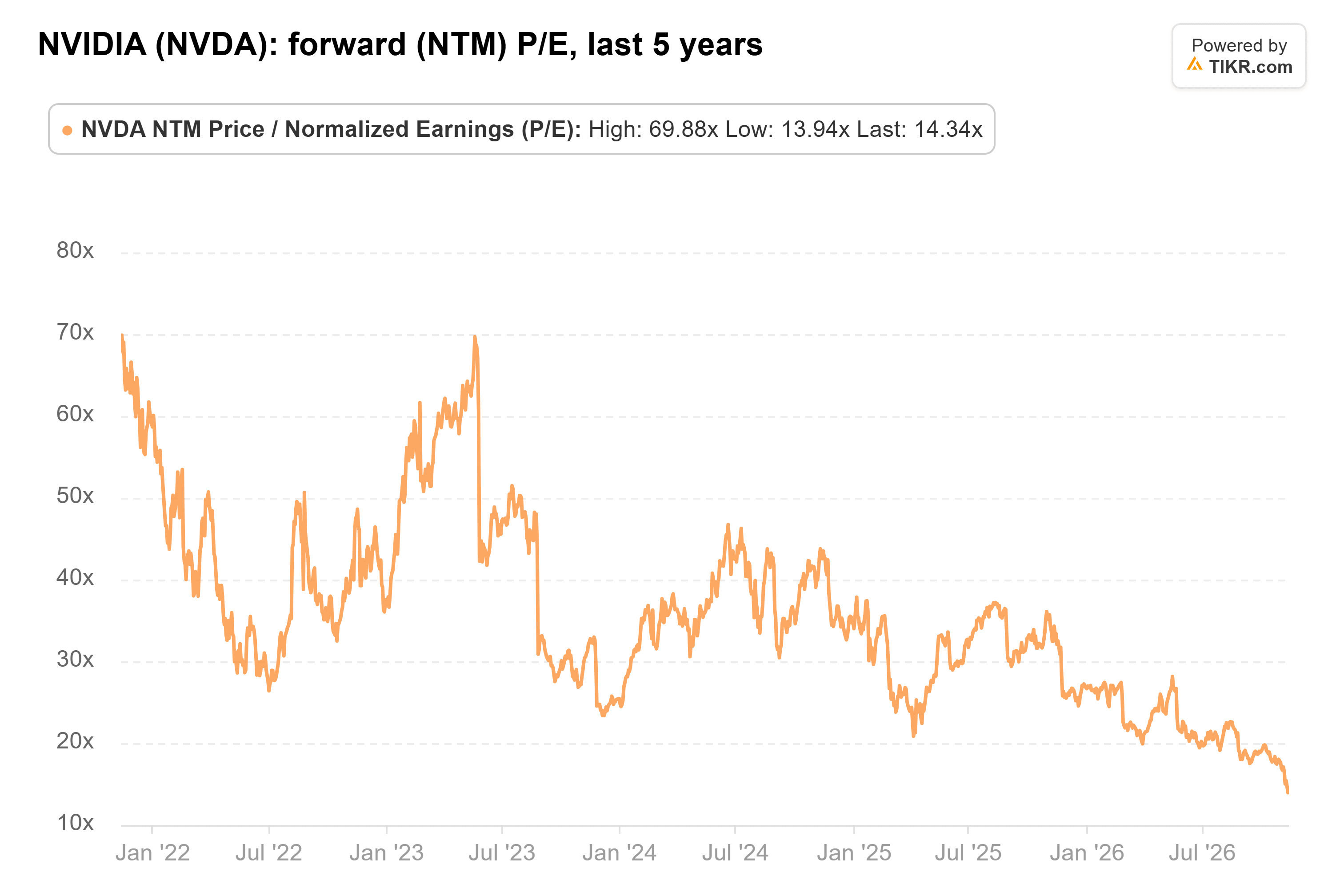
The substantial discount suggests investors are pricing in leadership uncertainty, potentially slower AI infrastructure spending, and downward revisions to future earnings expectations.
NVIDIA appears potentially undervalued relative to its historical valuation, provided analysts’ earnings forecasts remain achievable.
However, a lower earnings multiple does not automatically make the stock inexpensive.
Baird analyst Tristan Gerra downgraded NVIDIA to Neutral on November 11, reducing his price target from $500 to $200 amid uncertainty surrounding future AI infrastructure spending.
Gerra warned that AI capital spending growth among major cloud providers could slow to approximately 40% or less in 2027, potentially pressuring NVIDIA’s longer-term revenue outlook.
The company also faces additional risks from potential export restrictions, supply constraints, and uncertainty surrounding its leadership transition.
Over the next 12 months, NVIDIA’s valuation will depend primarily on sustained AI infrastructure investment, product execution, gross margin stability, and confidence in its leadership.
If future earnings estimates decline significantly, the stock could remain under pressure despite its historically low earnings multiple.
Qualcomm’s AI Expansion Highlights the Risks to NVIDIA
Qualcomm’s financial outlook illustrates why strong AI demand does not necessarily translate into immediate revenue growth.
According to Qualcomm’s fiscal 2026 results, reported revenue declined to approximately $43.1 billion from $44.3 billion in fiscal 2025.
TIKR consensus estimates as of November 11 projected approximately $45.4 billion in fiscal 2027 and $52.5 billion in fiscal 2028.
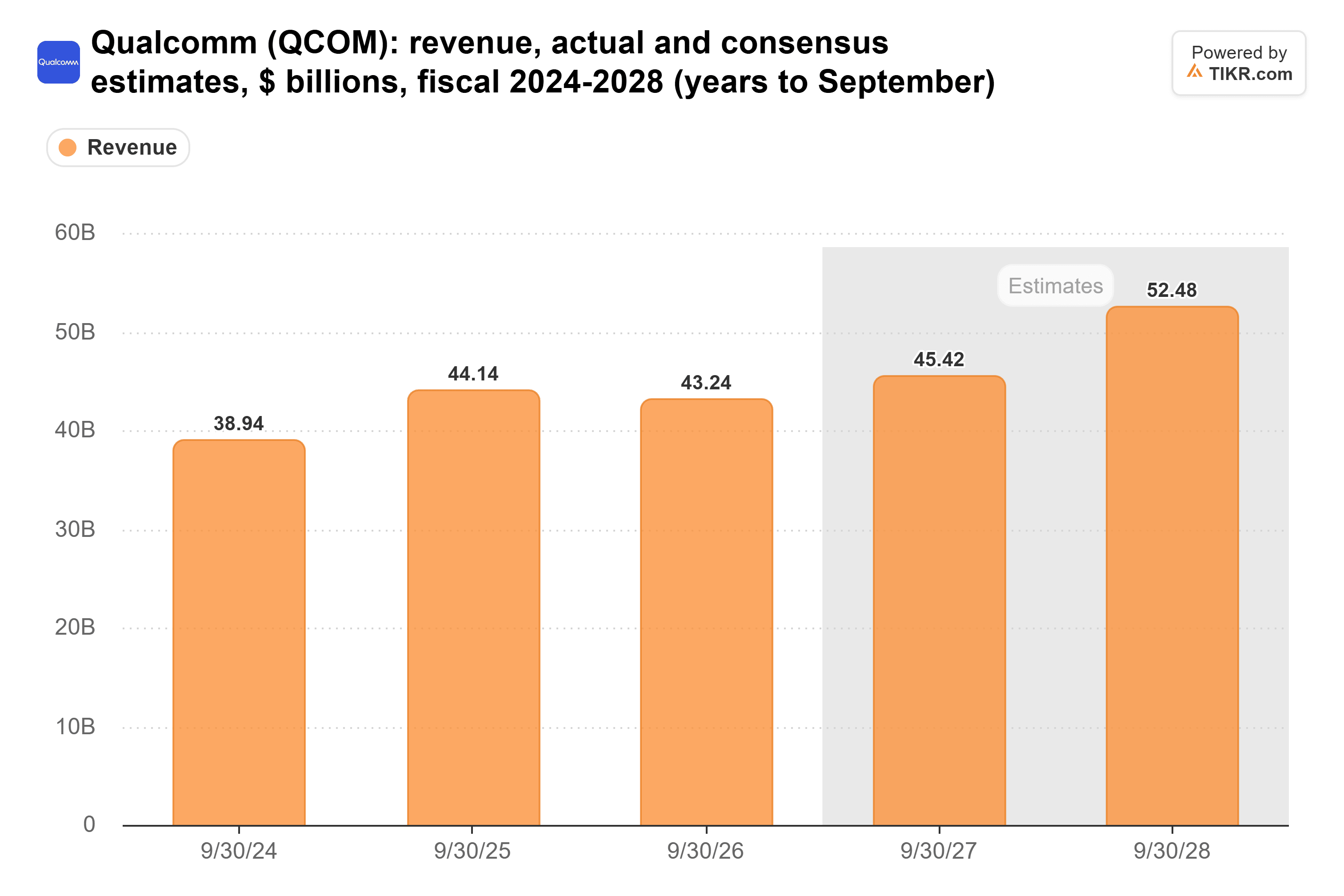
Qualcomm’s emerging AI data center business could support future growth, particularly through its multi-generational collaboration with Amazon involving customized AI chips and advanced connectivity solutions.
However, Qualcomm remains at an earlier stage of its data center expansion than NVIDIA, making customer deployments and infrastructure availability especially important to its growth outlook.
Amon also acknowledged that electricity availability and data center construction could limit the pace of AI infrastructure development.
That concern extends directly to NVIDIA.
Even if customers remain committed to purchasing advanced AI chips, power shortages and construction delays could push deployments into later periods.
For NVIDIA, the November 17 earnings report will therefore represent more than a test of quarterly revenue.
Investors will also evaluate forward guidance, gross margin expectations, and whether management can maintain confidence in the company’s longer-term growth trajectory following Huang’s departure.
NVIDIA previously guided third-quarter gross margins to approximately 74%, plus or minus 0.5 percentage points, making profitability another important indicator of its operating performance.
For now, NVIDIA’s revenue forecasts support the argument that AI demand remains strong, but its November 17 earnings must confirm that growth is sustainable. Revenue above the $110.2 billion upper end of management’s guidance would be an especially encouraging result, while strong forward guidance and stable gross margins would provide greater confidence in the company’s growth outlook.
However, weaker forecasts, declining profitability, or delayed data center spending would challenge that outlook. NVIDIA appears potentially undervalued relative to its historical valuation, but its earnings report must demonstrate that the expected growth can justify that discount.
So what is NVIDIA stock actually worth?
TIKR lets you forecast the future price of any stock in less than a minute. Just enter a few assumptions into TIKR’s valuation model and see what NVIDIA could be worth. Start from Wall Street consensus estimates, or adjust the inputs to reflect your own view of the business. It’s free to use.
Disclaimer:
Please note that the articles on TIKR are not intended to serve as investment or financial advice from TIKR or our content team, nor are they recommendations to buy or sell any stocks. We create our content based on TIKR Terminal’s investment data and analysts’ estimates. Our analysis might not include recent company news or important updates. TIKR has no position in any of the stocks mentioned. Thank you for reading, and happy investing!