
Key Takeaways
- Alphabet CEO Sundar Pichai said Google Cloud is “forgoing short-term revenues” because Google gives its frontier AI work first call on compute. He said it eight days before Alphabet reports third-quarter results.
- The comments read like an attempt to lower expectations for cloud growth before the Oct. 28 report.
- Google Cloud revenue grew 82% in the second quarter of 2026, which was also the first quarter with sales of TPU systems. That makes the third quarter a hard comparison.
- Analysts expect Alphabet’s growth to speed up in 2027, but Pichai said new compute for 2027 is hard to provide, a squeeze he suggested Amazon faces too.
Alphabet (GOOG) reports third-quarter results on Oct. 28, and CEO Sundar Pichai may have just started explaining away its cloud number.
On the Oct. 20 episode of the Big Technology Podcast, host Alex Kantrowitz asked whether Google should give its AI researchers “the biggest possible computer, even if it is to the detriment of today’s profits like the cloud business.”
Pichai’s answer: “We’re all doing some form of that, right? I think our cloud business is at any given moment in time forgoing short-term revenues because we are making compute trade-offs to support frontier AI development. So I think what you’re saying is true already.”
That’s not what you want to hear from a CEO eight days before earnings.
To me, this sounds a lot like a company that knows its cloud results won’t impress and wants to get ahead of the story.
TIKR tracks 61 analysts on Alphabet. How many say “Buy”?
See the full breakdown of Buy, Hold, and Sell ratings on Alphabet, along with Wall Street’s revenue and earnings estimates, all in one place. More than 500,000 investors use TIKR to research stocks like this one. See Alphabet’s Analyst Ratings
The bar is sky-high
Google Cloud has been Alphabet’s star. Its revenue grew 63% in the first quarter of 2026, and its backlog nearly doubled from the prior quarter to over $460 billion. Then it grew 82% in the second quarter, to $24.8 billion. (That was also the first quarter in which Alphabet booked revenue from selling its TPU systems, according to its quarterly filing.)
Wall Street expects the whole company to keep it up. Analysts see Alphabet’s revenue climbing from $403 billion in 2025 to $500 billion this year, then $627 billion in 2027.

That’s roughly 24% growth this year and 25% next, so the Street is counting on growth to speed up in 2027. Yet Pichai says next year’s compute is already spoken for: “if today a customer is coming out and asking us for compute in 27, that is incredibly difficult to do.” If cloud can’t take on much new business for next year, I’d expect those 2027 estimates to drift lower.
$91.5 billion, and still short
Alphabet has thrown plenty of money at the problem. Its capital spending has nearly quadrupled since 2021, to $91.5 billion last year.
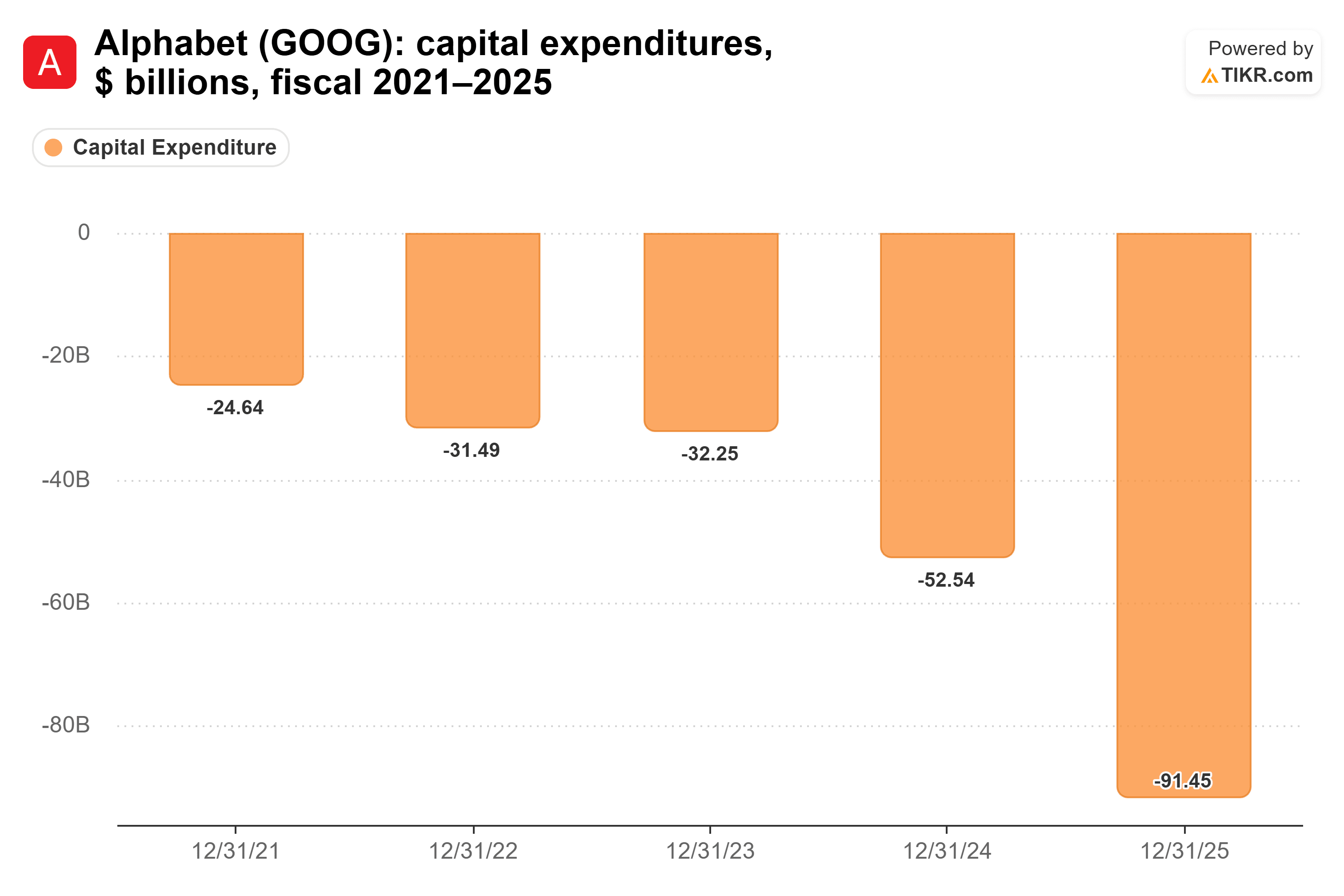
And Pichai still says Google is “capacity constrained on a daily basis.” He also said the compute Google has today “is a function of decisions I made in 2024,” a year when capex was $52.5 billion. So last year’s spending should help, eventually.
So far, all that spending hasn’t dented profitability. Alphabet’s operating margin climbed from 26.5% in 2022 to 32.0% in 2025.
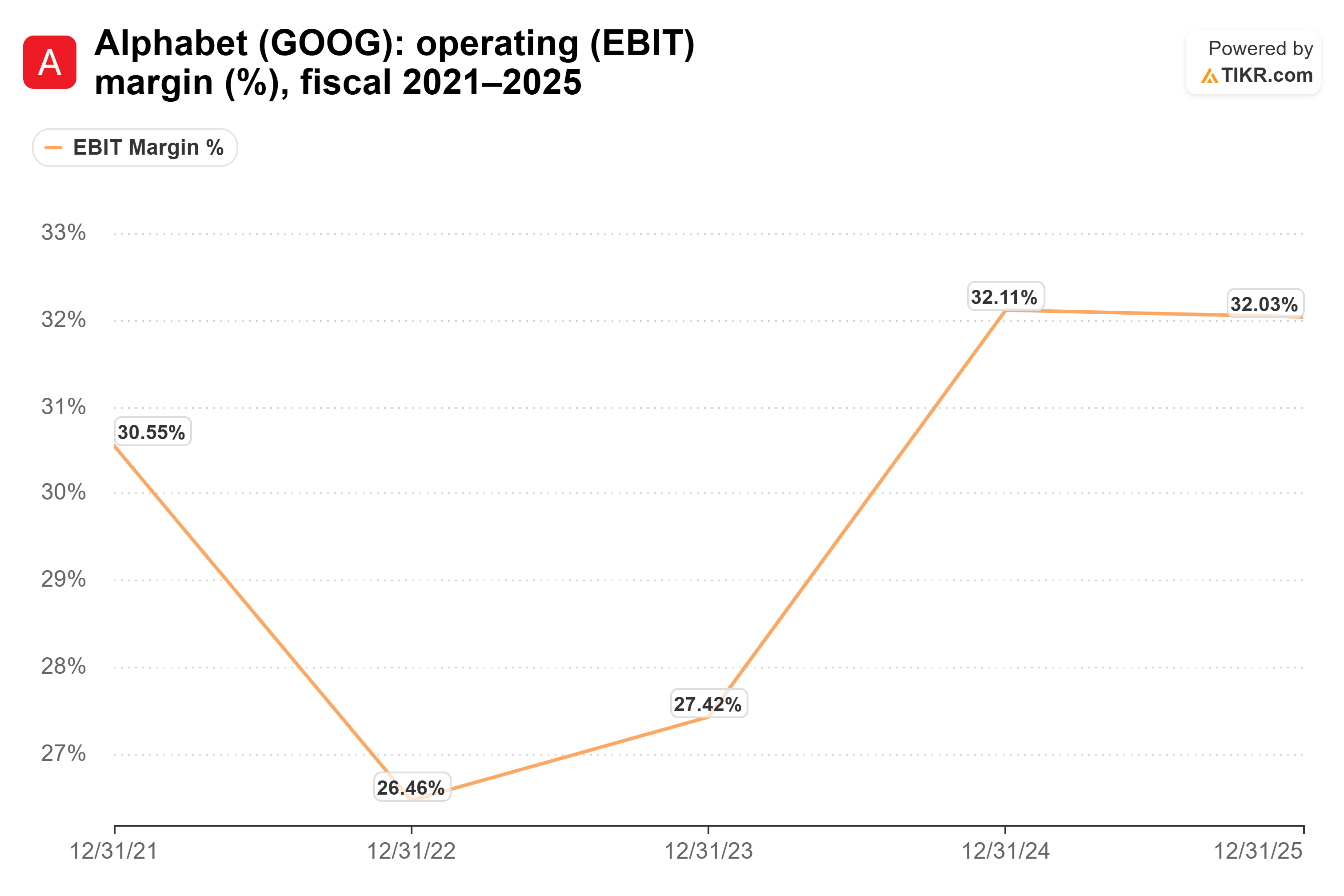
And it hit 34% in the second quarter of 2026. But those data centers land on the income statement as depreciation for years, and Pichai just agreed that compute trade-offs already cost the cloud business today. If margins slip on Oct. 28, the explanation is already out there.
Everybody’s short
Pichai’s case is that the demand is there and the supply isn’t. Google’s newest Gemini model is “almost up to 25 trillion tokens used, which is about 3X what Gemini 3.0 had in the first 72 hours,” he said.
The trouble is that every hyperscaler says it’s short. Kantrowitz brought up Ben Horowitz’s account of Amazon (AMZN) CEO Andy Jassy saying compute was sold out until 2028, and Pichai answered that “we are all dealing with similar timelines.”
If Amazon is rationing too, a capacity crunch doesn’t explain why Google Cloud would grow any slower than its rivals. It just gives every cloud the same excuse. And Pichai allowed that today’s shortage could flip: asked whether there can be an overbuild, his answer began with “Yes.”
Cloud has to deliver on Oct. 28
Pichai is telling investors that Alphabet’s own choices are capping cloud revenue and that new capacity for 2027 is hard to come by. Meanwhile, analysts are modeling faster growth next year. That’s not good.
On Oct. 28, watch cloud growth against the second quarter’s 82%, the backlog, and any early word on 2027 capex.
My take: the demand looks real, but I read this interview as Alphabet lowering the bar ahead of a cloud slowdown. With the Street expecting growth to speed up in 2027, there’s room to disappoint.
Of course, if cloud growth holds anywhere near the second quarter’s pace, this will look like a CEO being candid about a good problem.
So what is Alphabet stock actually worth?
TIKR lets you forecast the future price of any stock in less than a minute. Just enter a few assumptions into TIKR’s valuation model and see what Alphabet could be worth. Start from Wall Street consensus estimates, or adjust the inputs to reflect your own view of the business. It’s free to use.
Disclaimer:
Please note that the articles on TIKR are not intended to serve as investment or financial advice from TIKR or our content team, nor are they recommendations to buy or sell any stocks. We create our content based on TIKR Terminal’s investment data and analysts’ estimates. Our analysis might not include recent company news or important updates. TIKR has no position in any of the stocks mentioned. Thank you for reading, and happy investing!