Key Takeaways
- Nike yields 4.3% after its stock fell on weak fiscal 2027 guidance, while Starbucks raised its quarterly dividend to $0.63 a share on Oct. 29 and yields 2.4%.
- Nike paid out 115% of its free cash flow as dividends over the twelve months to Aug. 31, 2026, against 76% for Starbucks over the twelve months to Sept. 27, 2026.
- Nike carries far less debt than Starbucks, but it guides fiscal 2027 adjusted EPS below its $1.64 annual dividend.
- The next test is Nike’s investor day on Nov. 16-17, where it’s set to lay out its long-term plan.
Nike (NKE) stock fell about 9% on Oct. 1, to near a 13-year low, after the company guided fiscal 2027 revenue down by a high-single-digit percentage. The slide pushed its yield as high as 4.8% by Oct. 7, though the dividend itself never moved. It yields 4.3% today.
Starbucks (SBUX) gave investors the opposite news four weeks later, raising its quarterly dividend to $0.63 a share from $0.62 on Oct. 29. It yields 2.4%.
Both companies are deep in turnarounds, and both call the dividend a priority. So if I could hold just one for the next decade, which one gets my money?
| Metric | Nike (NKE) | Starbucks (SBUX) |
|---|---|---|
| Dividend yield | 4.3% | 2.4% |
| Annual dividend, current rate | $1.64 | $2.52 |
| Dividend growth, fiscal 2021-2026 | 8.8% a year | 1.7% a year |
| Cash dividend payout ratio, TTM | 115% | 76% |
| Cash dividend payout ratio, fiscal 2027 consensus | 92% | 70% |
| Net debt/EBITDA | 0.5x | 2.1x |
| Interest coverage | 18.8x | 7.8x |
6 safe dividend stocks paying retirees 6%+ yields
There are over 100 stocks paying 6%+ annual dividends today.
But after an extensive investment review leveraging TIKR’s proprietary data, we now believe only six of them are truly safe for retirees.
They’re all yours for free as part of our new investment report, which you can access right here.
Nike is paying out more than it makes
Nike’s fix is working in places. Its Performance business, led by Running, grew in the fiscal first quarter ended Aug. 31, 2026, while Sportswear, Jordan Brand and Greater China shrank. Revenue fell 4% to $11.2 billion. Nike now guides fiscal 2027 adjusted EPS to $1.15-$1.35, which is below its $1.64 annual dividend.
Nike’s free cash flow fell from $6.62 billion in fiscal 2024 to $2.18 billion in fiscal 2026 (years to May), while the dividends it paid rose to $2.41 billion.
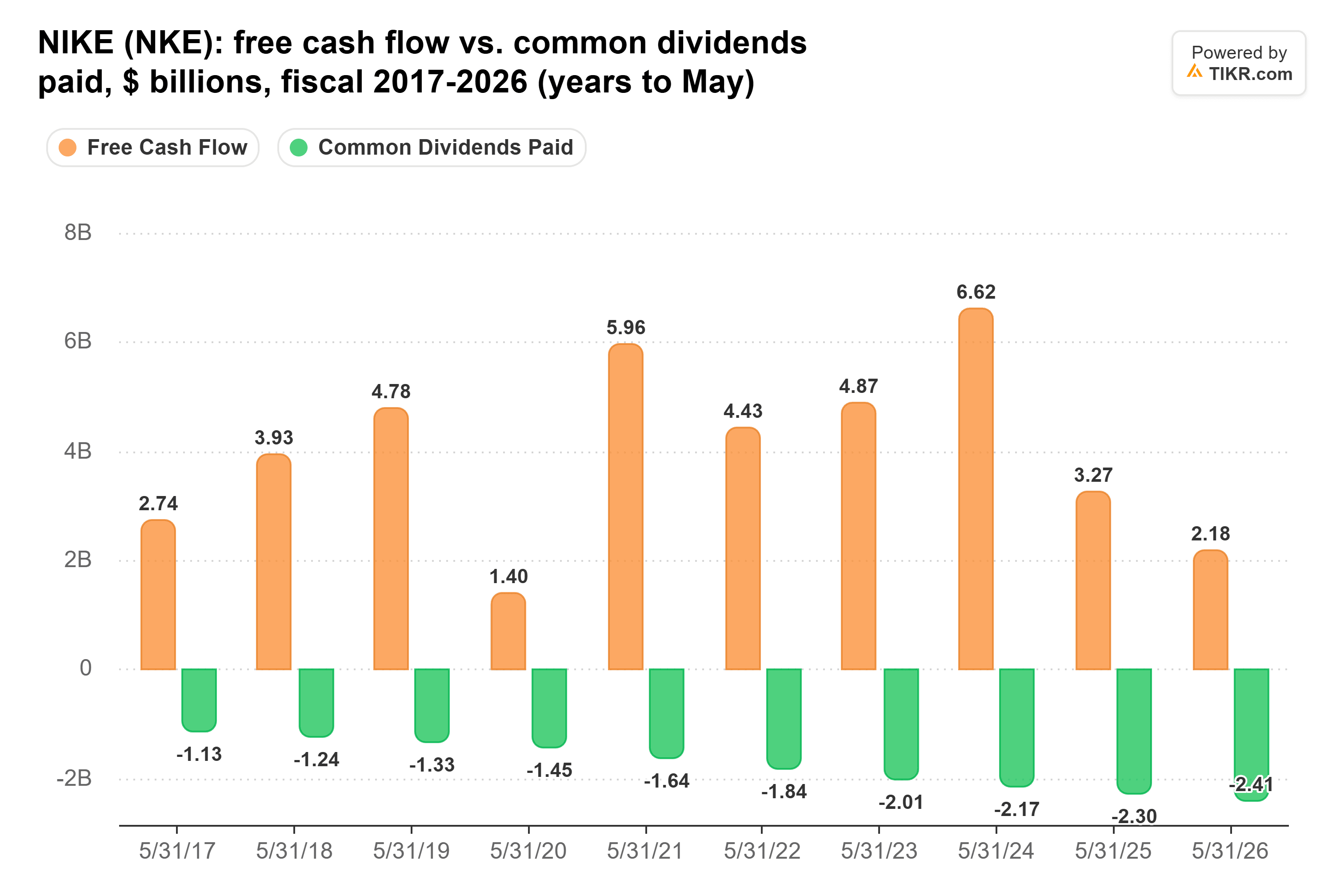
Over the twelve months to Aug. 31, 2026, dividends ate up a risky 115% of free cash flow. Analysts expect a still-tight 92% in fiscal 2027.
CFO Dave Denton said on the Oct. 1 call that “under all scenarios, we have support for maintaining and ultimately growing the dividend over time.” Nike has the balance sheet to back that up. Its net debt is just 0.5x EBITDA, and it held $8.4 billion of cash and short-term investments on Aug. 31.
The fix costs money, though. Nike’s new Pace program should save about $2.5 billion through fiscal 2031. But it brings about $1.0 billion of charges, $0.3 billion of them in fiscal 2027, and the biggest savings don’t arrive until fiscal 2029 and 2030.
Starbucks’ cash is back above its dividend
Where Nike is still guiding down, Starbucks’ turnaround is already showing up in its numbers. In the fiscal fourth quarter ended Sept. 27, 2026, North America comparable sales rose 7.9%, and non-GAAP EPS jumped 54% to $0.80. For fiscal 2027, which has a 53rd week, Starbucks guides non-GAAP EPS to $3.15-$3.25, up from $2.72 in fiscal 2026.
Starbucks’ free cash flow slipped to $2.44 billion in fiscal 2025 (years to September), short of the $2.77 billion it paid out. Then it rebounded to $3.72 billion in fiscal 2026, against $2.82 billion paid.
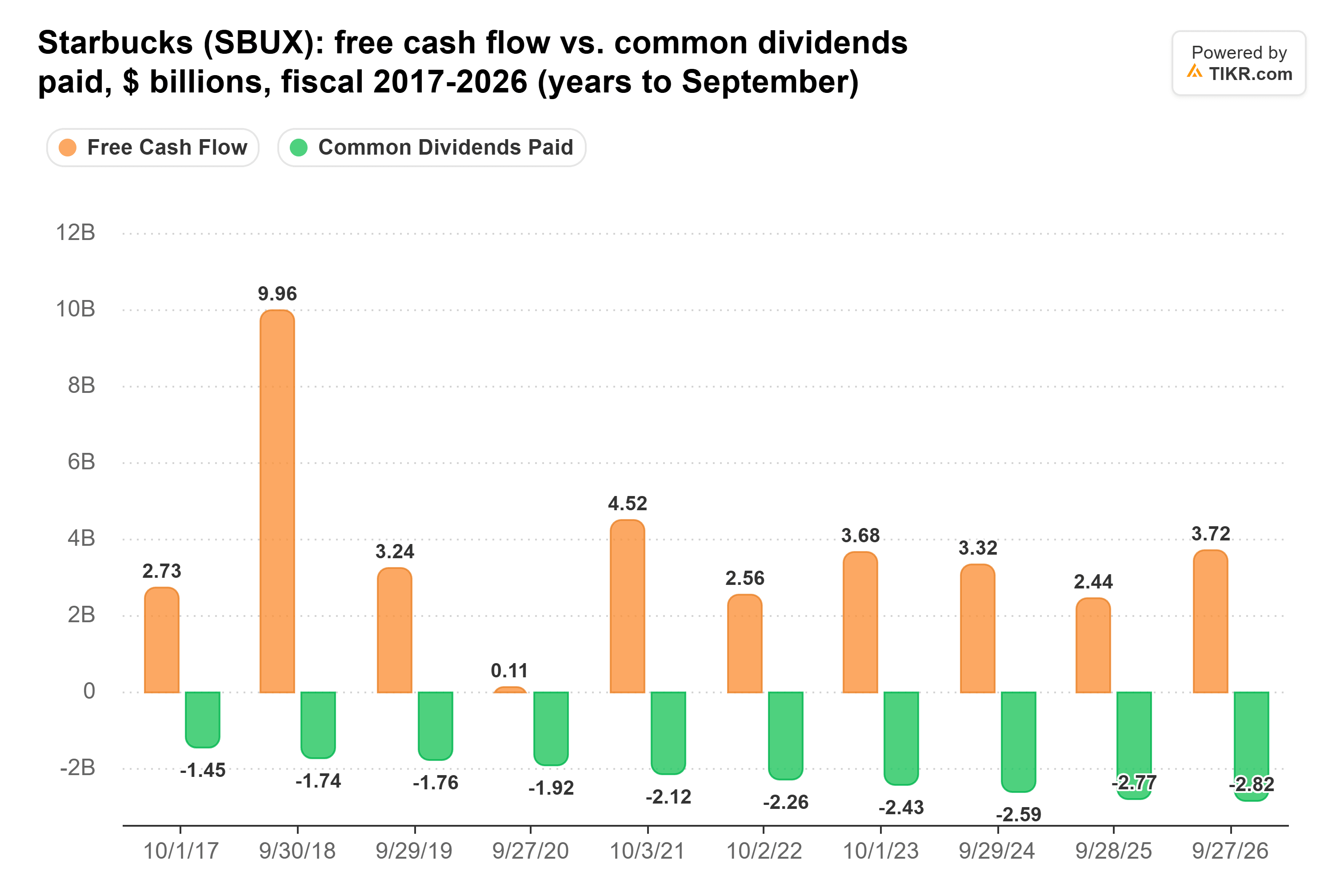
That puts the dividend at a comfortable 76% of free cash flow, and analysts expect 70% in fiscal 2027.
The weak spot is how slowly that dividend grows. Starbucks called October’s raise its “16th consecutive annual increase.” But dividends per share rose just 1.7% a year from fiscal 2021 to fiscal 2026, from $2.29 to $2.49. Starbucks also carries more debt, at 2.1x net debt to EBITDA.
So which dividend wins?
Over the next 10 years, Nike gets my dividend dollars.
The income gap is just too big. At each dividend’s 5-year growth rate, $10,000 invested today pays about $6,466 over the decade in Nike, against about $2,591 in Starbucks. Nike won’t keep up 8.8% a year with earnings guided below its dividend, and its fiscal 2026 raise was 3.8%. Even at that pace, Nike pays about $5,120 in all, nearly twice Starbucks’ roughly $2,584. Frankly, even a frozen Nike dividend would out-pay Starbucks over 10 years, and Nike has the balance sheet to keep paying through a few lean years while Pace kicks in.
Starbucks still has a real case. Analysts expect its normalized EPS to climb from $2.72 in fiscal 2026 to $3.73 in fiscal 2028, after a fall from $3.54 in fiscal 2023 to $2.13 in fiscal 2025.
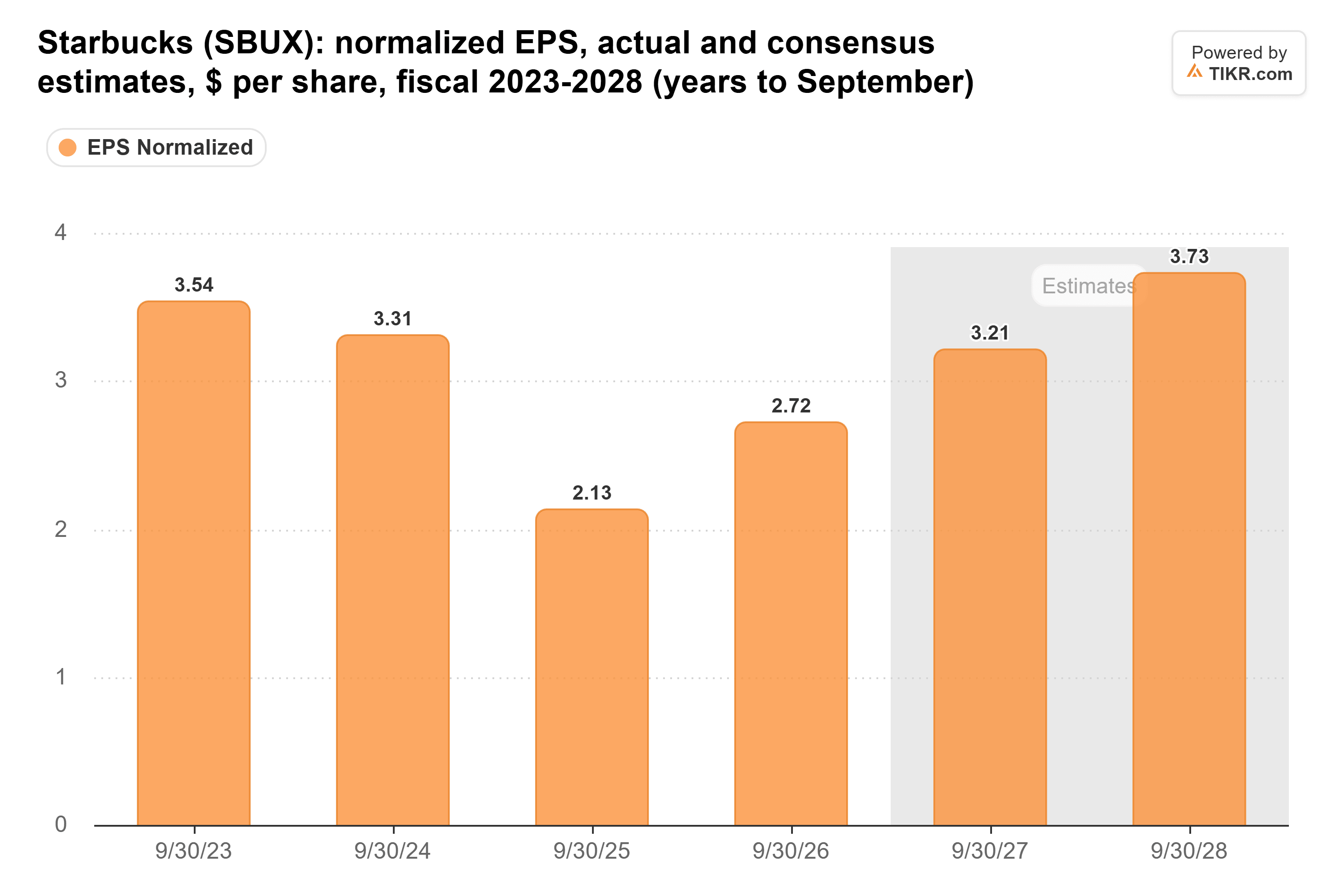
If those estimates hold, I’d expect bigger raises than fiscal 2026’s 1.6%. As CEO Brian Niccol put it, “Back to Starbucks started as our turnaround plan. Now, it’s our growth plan.” It’s just that Starbucks would need years of much faster raises to catch up to the check Nike pays today.
Of course, Nike’s investor day on Nov. 16-17 could change things. If its long-term plan needs more cash than the business has to spare, the dividend is in a tougher spot.
Forget Nike: 6 safe 6%+ dividend yields you can buy right now
Dividends can hold the key to enormous wealth. But only if you buy the right ones.
Picking the right high-yield dividend stock can be the difference between a dream retirement…and scraping by every month, waiting for the next Social Security check to clear.
We’ve identified six stocks yielding 6%+ that we believe every retiree should know about right now. (And Nike isn’t one of them.)
Disclaimer:
Please note that the articles on TIKR are not intended to serve as investment or financial advice from TIKR or our content team, nor are they recommendations to buy or sell any stocks. We create our content based on TIKR Terminal’s investment data and analysts’ estimates. Our analysis might not include recent company news or important updates. TIKR has no position in any of the stocks mentioned. Thank you for reading, and happy investing!