Key Takeaways
- On Oct. 30, Elon Musk posted that orbital compute added each month will probably pass ground-based compute around the end of 2028 and far exceed it in 2029.
- SpaceX’s results over the next two years depend on the ground-based data centers it is building now, and that’s what investors should judge it on.
- SpaceX spent $19.6 billion on capex in the third quarter and guided to $35 billion to $40 billion in the fourth. Musk expects about 1.2 million NVIDIA Blackwell chips at Colossus 2 by year-end.
- The test is whether those chips pay for themselves before orbit takes over. The first signs come in early 2027: first-quarter revenue, and the point when Anthropic can start canceling its compute deal.
SpaceX (SPCX) is spending at a record pace to fill its Memphis data centers with NVIDIA (NVDA) chips. And Elon Musk thinks ground-based compute like that is about to look tiny.
On Oct. 30, Sequoia Capital partner Shaun Maguire posted a bottoms-up model of SpaceX’s business through 2028. (He pointed out that Sequoia is a major SpaceX shareholder.) The X account @SPCX100T charted the model. In those charts, most of the growth comes from terrestrial compute, with capacity scaling from 1 GW in early 2026 to 21 GW by the end of 2028.
Musk replied to those charts: “Terrestrial compute will be peanuts compared to orbital compute. Orbital compute deployed per month probably exceeds terrestrial around the end of 2028 and then far exceeds it in 2029.”
That’s about two years away.
Maguire isn’t so sure. A few hours earlier, an X user had scoffed that the company in his model had little to do with space. Maguire answered: “You’ll see all this flip to space over the next 5 years but not over the next two years.”
TIKR tracks 39 analysts on SpaceX. How many say “Buy”?
See the full breakdown of Buy, Hold, and Sell ratings on SpaceX, along with Wall Street’s revenue and earnings estimates, all in one place. More than 500,000 investors use TIKR to research stocks like this one. See SpaceX’s Analyst Ratings
Wall Street is forecasting the ground business
Analysts expect SpaceX’s revenue to nearly quadruple in 2027 and almost double again in 2028:
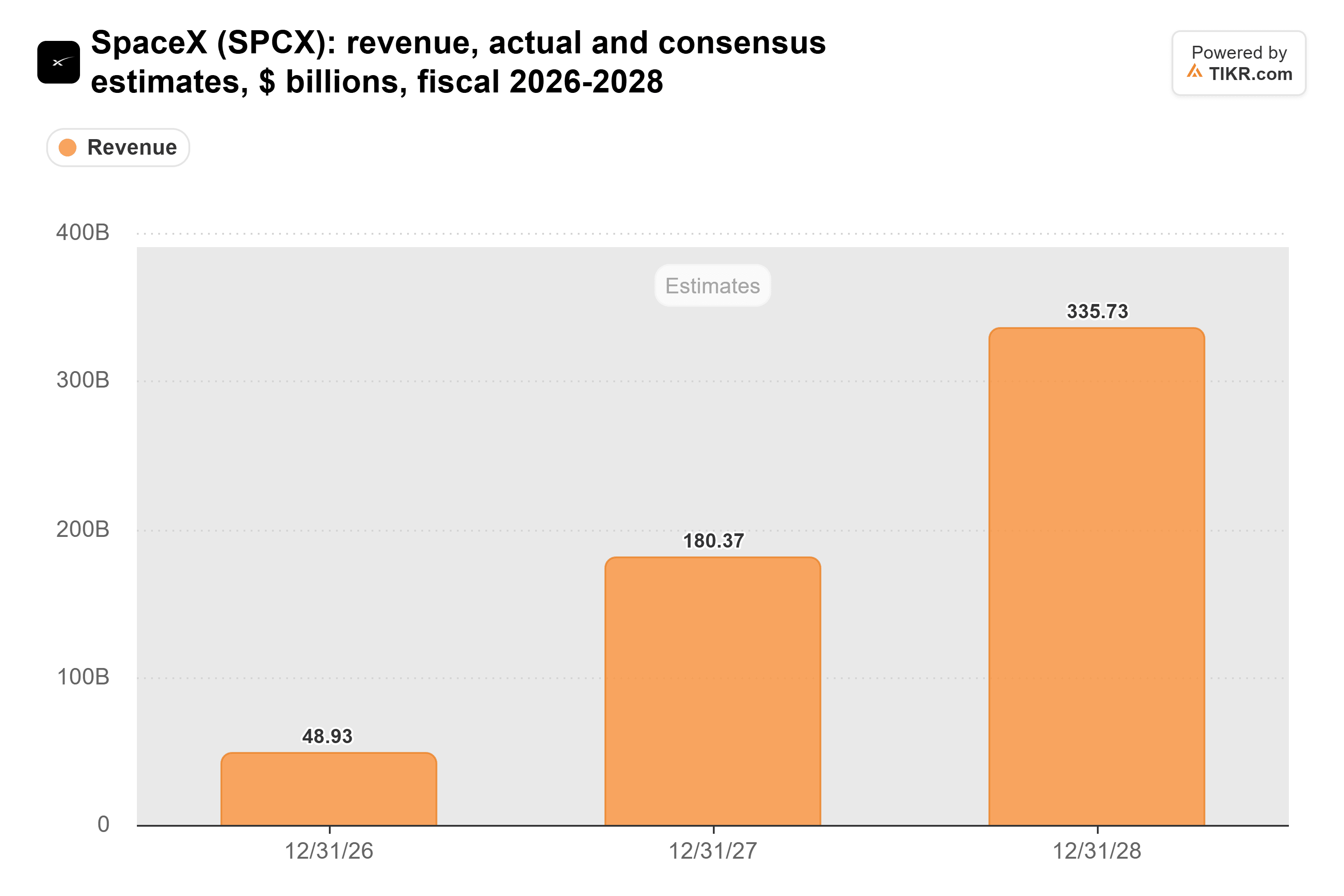
Those estimates run right through the year Musk expects orbit to take over. But orbital compute has no revenue yet for anyone to forecast, so the $336 billion analysts expect for 2028 rests on renting out GPUs on the ground. Even Maguire’s model, which @SPCX100T’s charts put at about $731 billion of 2028 revenue, gets there on terrestrial compute.
The money is going into Memphis
SpaceX’s capex has risen in almost every quarter since the start of 2025, reaching $19.6 billion in the third quarter of 2026:
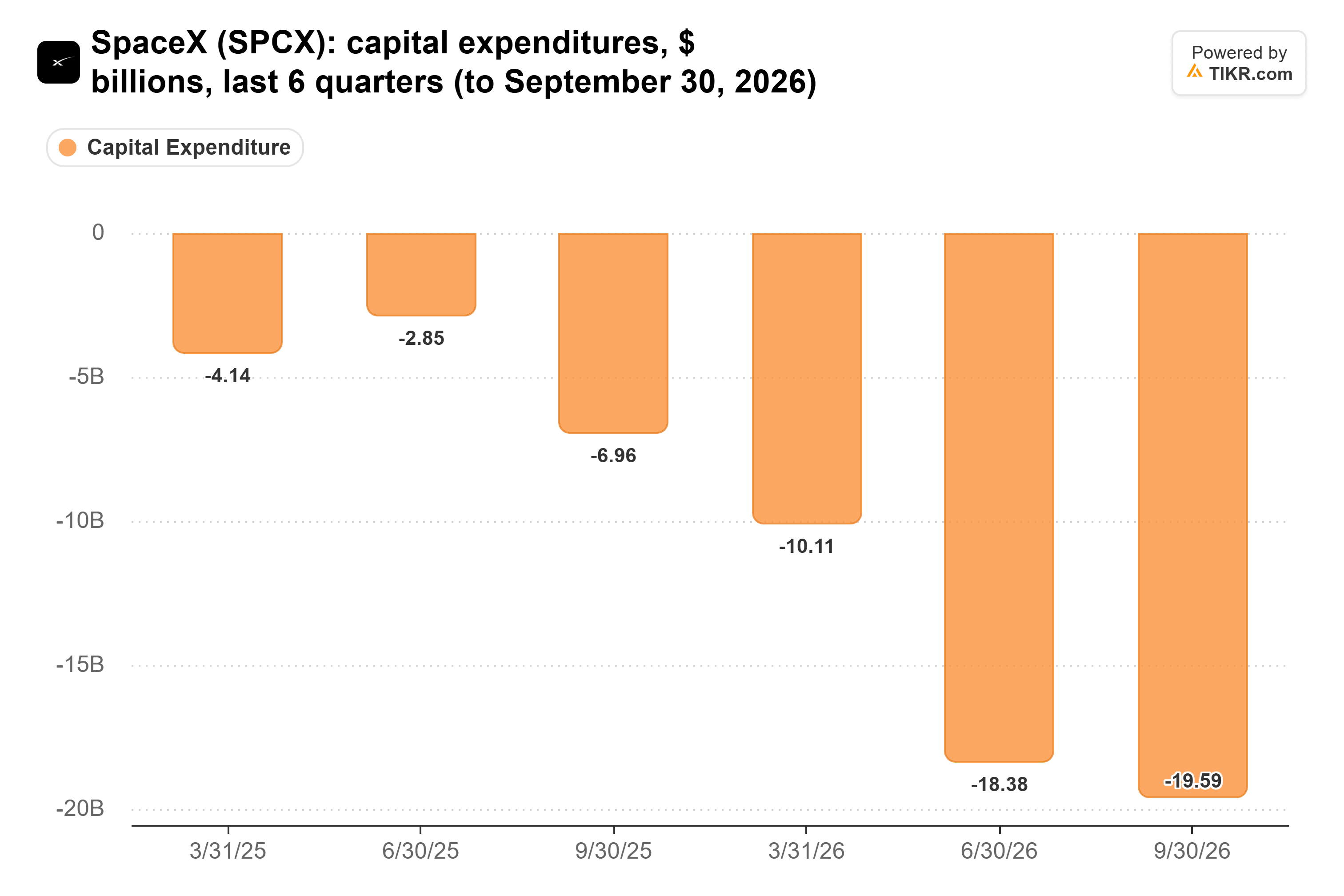
SpaceX’s third-quarter 10-Q shows that the Super Intelligence segment, which holds the data centers, took $40.0 billion of the $48.1 billion SpaceX spent on capex in the first nine months of 2026. On the third-quarter call, management guided fourth-quarter capex to $35 billion to $40 billion.
Musk walked the whole Colossus 2 site around midnight and again the next morning. He then posted that “There will be a total of around 1.2M Blackwells at Colossus 2 by end of year.” He expects two more buildings of NVIDIA’s GB300 chips to come online by then: one for training by the end of November, and one for inference in December.
And SpaceX is borrowing to buy more. It had $39.2 billion of debt at Sept. 30, up from $15.4 billion at March 31, 2025. Now it’s raising $40 billion more, which Musk described as “primarily callable debt for GPU purchases that will arrive in Q1 and Q2.”
The GPUs have about two years to pay off
But Musk’s timeline and the Memphis buildout don’t have to clash. He’s talking about compute added each month, so the GPUs already installed would keep running after orbit pulls ahead on new capacity.
SpaceX’s CFO also said on the third-quarter call that new compute pays for itself in less than a year at current rental prices. If that holds, the chips arriving in the first half of 2027 earn back their cost before the crossover Musk expects.
That’s a big if. Anthropic’s own IPO filing says either side can cancel its deal to spend up to $120.5 billion with SpaceX through 2029 on 90 days’ notice. That right starts once the first noncancelable periods end in January and March 2027, just as the debt-funded GPUs arrive.
And if Musk is right about orbit, I’d expect all that new capacity to drag down the rental prices the payback depends on. (Musk has already said he expects a lot of stranded compute in half-built data centers.)
Judge SpaceX on the ground for now
I’d side with Maguire on the timing. Orbital compute needs Starship to fly often, and Musk’s own schedule has already slipped. On the August call, he talked about at least one flight a day within a year. In October, he guided to weekly flights in the first half of 2027.
So whatever orbit does in 2029, SpaceX’s next two years depend on compute on the ground. I’d judge the stock on whether the Memphis GPUs rent out at today’s prices for long enough to pay for themselves.
Of course, if Starship hits its cadence, orbit could arrive sooner than I expect. The next read on the ground business comes with first-quarter 2027 revenue, which SpaceX guided to $33 billion to $37 billion.
So what is SpaceX stock actually worth?
TIKR lets you forecast the future price of any stock in less than a minute. Just enter a few assumptions into TIKR’s valuation model and see what SpaceX could be worth. Start from Wall Street consensus estimates, or adjust the inputs to reflect your own view of the business. It’s free to use.
Disclaimer:
Please note that the articles on TIKR are not intended to serve as investment or financial advice from TIKR or our content team, nor are they recommendations to buy or sell any stocks. We create our content based on TIKR Terminal’s investment data and analysts’ estimates. Our analysis might not include recent company news or important updates. TIKR has no position in any of the stocks mentioned. Thank you for reading, and happy investing!