


Key Stats for Microsoft Stock
- Current Price: $517.53
- Target Price (Mid): ~$1,145
- Street Target: ~$579
- Potential Total Return: ~121%
- Annualized IRR: ~18% / year
Now Live: Discover how much upside your favorite stocks could have using TIKR’s new Valuation Model (It’s free) >>>
What Happened?
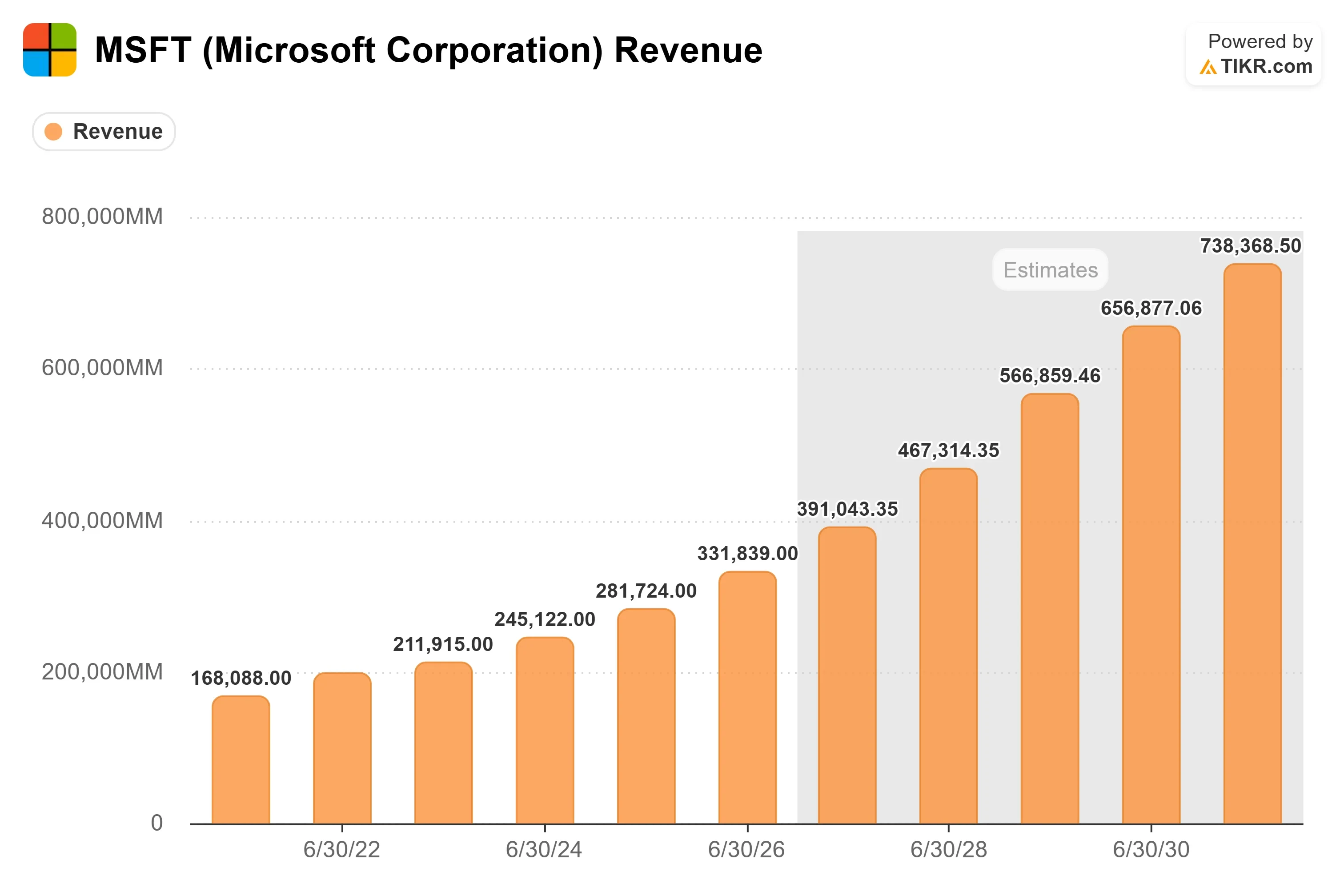
Microsoft (MSFT) is up 7.0% in 2026 through its October 2 close of $517.53, after falling 22.9% in the first half and rising 37.5% in the September quarter. Over that quarter, consensus revenue for fiscal 2030 (ending June 2030) rose about 8% to around $657 billion, per TIKR data, while the mean Street target rose about 3% to around $578. Because the stock outran the targets, the mean target’s premium to the share price shrank from about 50% to about 13%. The company’s fiscal Q4 2026 investor relations materials hold the backlog data behind those long-range numbers.
See historical and forward estimates for Microsoft stock (It’s free!) >>>
Fiscal Q4’s Backlog Growth Came Entirely From Outside the AI Labs
The revisions followed the July 29 fiscal Q4 report. Shares rose 15.51% on July 30 after Microsoft forecast Azure growth of about 45% and signaled continued cash generation.
Commercial remaining performance obligation (contracted revenue not yet recognized) grew 84% year over year to $678 billion, but 25% excluding OpenAI, so OpenAI drove most of that jump. OpenAI also contributed $24.1 billion, about 7%, of fiscal 2026 revenue, per Microsoft’s annual report.
The sequential picture differs. CFO Amy Hood said, “All sequential commercial RPO growth was driven by commitments from customers outside of frontier model companies.” The portion recognized beyond the next 12 months grew 112% year over year, against 37% for the next 12 months. That fits out-year estimates rising most while the fiscal 2027 consensus rose under 2% in the quarter.
Coverage is thin. Nine analysts estimate fiscal 2030, up from seven, so the jump may partly reflect new estimates rather than raises. Fiscal 2031 consensus, from six analysts, rose about 7%.
Microsoft’s Own Chips and Models Are Its Answer to a 61% Gross Margin Forecast
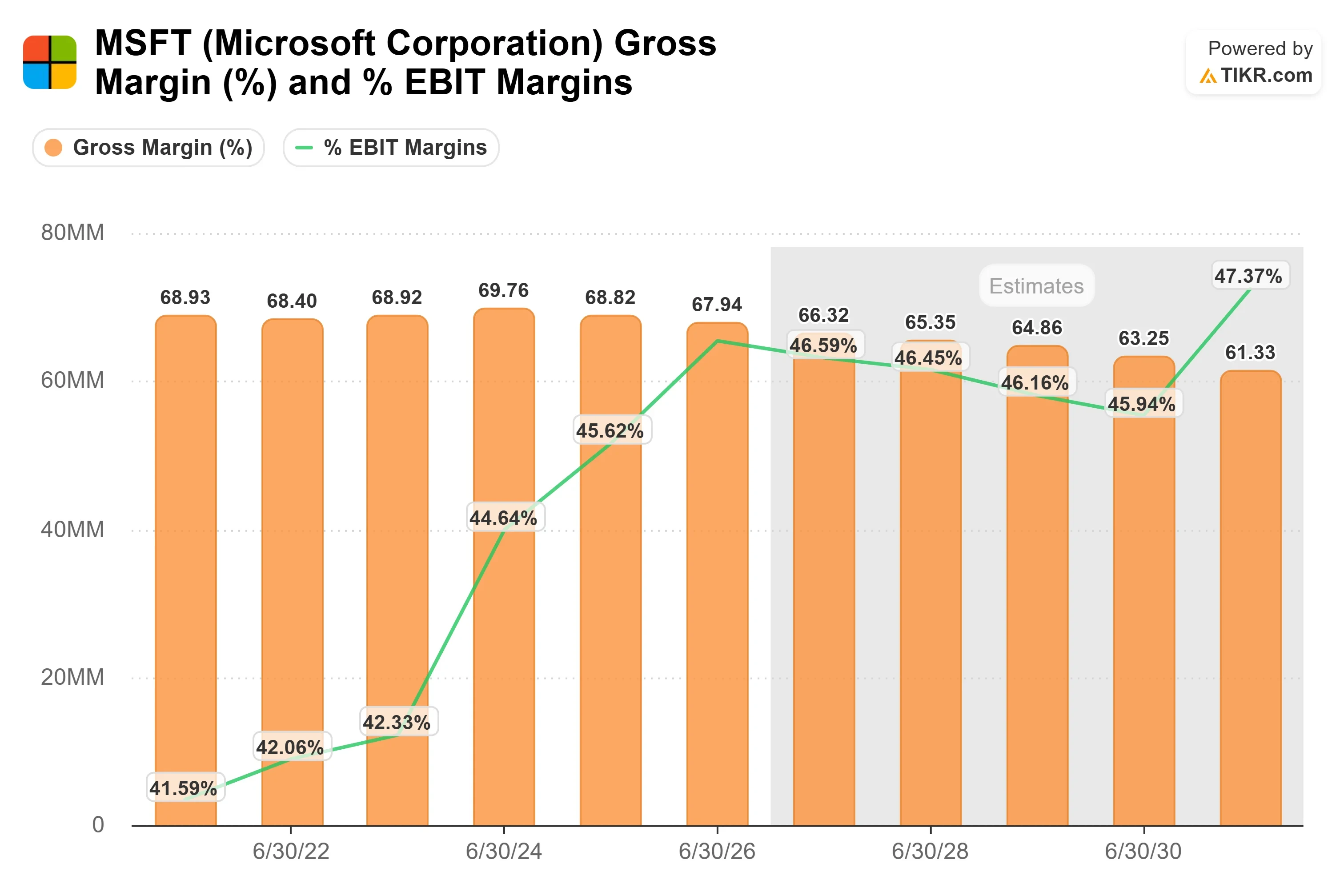
Consensus has gross margin sliding from 67.94% in fiscal 2026 to around 61% by fiscal 2031, while EBIT margin stays between roughly 46% and 47%. The Street, therefore, assumes Microsoft absorbs that squeeze below the gross line.
On the fiscal Q4 call, Microsoft said its Maia 200 chip delivers 30% better performance per dollar than the latest generation hardware in its fleet. In-house models cut GPU costs 89% where Dynamics 365 uses MAI-Voice-2-Flash and up to 84% where PowerPoint uses MAI-Image-2.5. Hood called model diversification “a margin improvement opportunity.” Those are product-level savings, not a company-wide figure.
Fiscal 2027 cuts the other way. Management expects the operating margin to be down less than 1 point and Windows OEM and Devices revenue to be down in the high teens. Consensus free cash flow of about $32 billion is less than half of fiscal 2026’s $66.99 billion.
See how Microsoft performs against its peers in TIKR (It’s free!) >>>
TIKR Advanced Model Analysis
- Current Price: $517.53
- Target Price (Mid): ~$1,145
- Potential Total Return: ~121%
- Annualized IRR: ~18% / year

See analysts’ growth forecasts and price targets for Microsoft stock (It’s free!) >>>
The TIKR model’s mid case projects around $1,145 by June 30, 2031, about 121% above the October 2 close, or around 18% a year. That target is about 28 times consensus fiscal 2031 EPS of around $41, slightly below the 28.83x trailing P/E on October 2. It therefore does not require a higher multiple if those estimates hold. Consensus revenue of about $738 billion in fiscal 2031, from six analysts, implies around 17% annual growth from fiscal 2026.
The primary risk is overbuilding. Answering an analyst’s question on overcapacity, CEO Satya Nadella said, “All of us are reading this 1873 as the book to be read,” adding that Microsoft has to “run an efficient railroad.” Hood said roughly two-thirds of fiscal Q4 capex went to short-lived assets, primarily CPUs and GPUs, which can be slowed if demand changes.
Upside comes from non-frontier demand broadening. The downside comes from gross margin reaching 61% without offsets. Wells Fargo raised its target to $725 from $700 on October 1, about 25% above the Street mean and below the $870 Street high.
Conclusion
Microsoft had not announced the date of its fiscal Q1 2027 report as of October 5, though earnings calendars estimate October 27 or 28 (last year’s came on October 29). It will be the first report under the new two-segment structure. Consensus revenue of about $90.7 billion already sits near the $90.95 billion top of guidance. Revenue above that ceiling, plus another quarter of sequential RPO growth from non-frontier customers, would support the fiscal 2030 estimates. Backlog growth tilting back toward OpenAI would weaken them.
See what stocks billionaire investors are buying so you can follow the smart money with TIKR.
So what is Microsoft stock actually worth?
TIKR lets you forecast the future price of any stock in less than a minute. Just enter a few assumptions into TIKR’s valuation model and see what Microsoft could be worth. Start from Wall Street consensus estimates, or adjust the inputs to reflect your own view of the business. It’s free to use.
Analyze Microsoft on TIKR Free →
Looking for New Opportunities?
- See what stocks billionaire investors are buying so you can follow the smart money.
- Analyze stocks in as little as 5 minutes with TIKR’s all-in-one, easy-to-use platform.
- The more rocks you overturn… the more opportunities you’ll uncover. Search 100K+ global stocks, global top investor holdings, and more with TIKR.
Disclaimer:
Please note that the articles on TIKR are not intended to serve as investment or financial advice from TIKR or our content team, nor are they recommendations to buy or sell any stocks. We create our content based on TIKR Terminal’s investment data and analysts’ estimates. Our analysis might not include recent company news or important updates. TIKR has no position in any stocks mentioned. Thank you for reading, and happy investing!


