Key Takeaways
- Michael Burry says the AI selloff shares 1929’s and 2000’s “lack of a proximate cause in earnings,” and Nvidia fits.
- The whole drop has come from Nvidia’s multiple, now 8.7x forward earnings against a five-year average of 35.4x.
- A reported SEC probe of Nvidia’s accounting now gives the selloff a cause.
- Nvidia’s price already assumes a lot of bad news unless the probe reaches reported revenue.
Michael Burry thinks the AI selloff looks a lot like 1929 and 2000. Nvidia (NVDA) fits his pattern: its stock closed at a 52-week low on Friday, even as the AI build-out around it keeps growing. Broadcom (AVGO) expects its AI chip sales to more than triple from a year earlier this quarter, and Super Micro Computer (SMCI) just nearly quadrupled its sales.
The “Big Short” investor put it this way in a post on X on Friday: “One similarity today to 1929 and 2000 is the lack of a proximate cause in earnings.”
On his Substack, Burry granted that today’s leaders are “killing it with respect to earnings.” But he noted that the peaks of 1929 and 2000 “predated real business deterioration by a year or so.”
Nvidia’s Earnings Haven’t Cracked
On Nov. 17, Nvidia reported $115.8 billion of revenue for the quarter ended Oct. 25, up 103% from a year earlier and $7.8 billion above the midpoint of its own guidance. It guided to about $130 billion for the quarter ending in January, which has an extra week. On the call, interim CEO Colette Kress raised Nvidia’s fiscal 2028 growth outlook to about 75%, from the 70% it gave in August.
Analysts have kept raising their numbers through all of it:
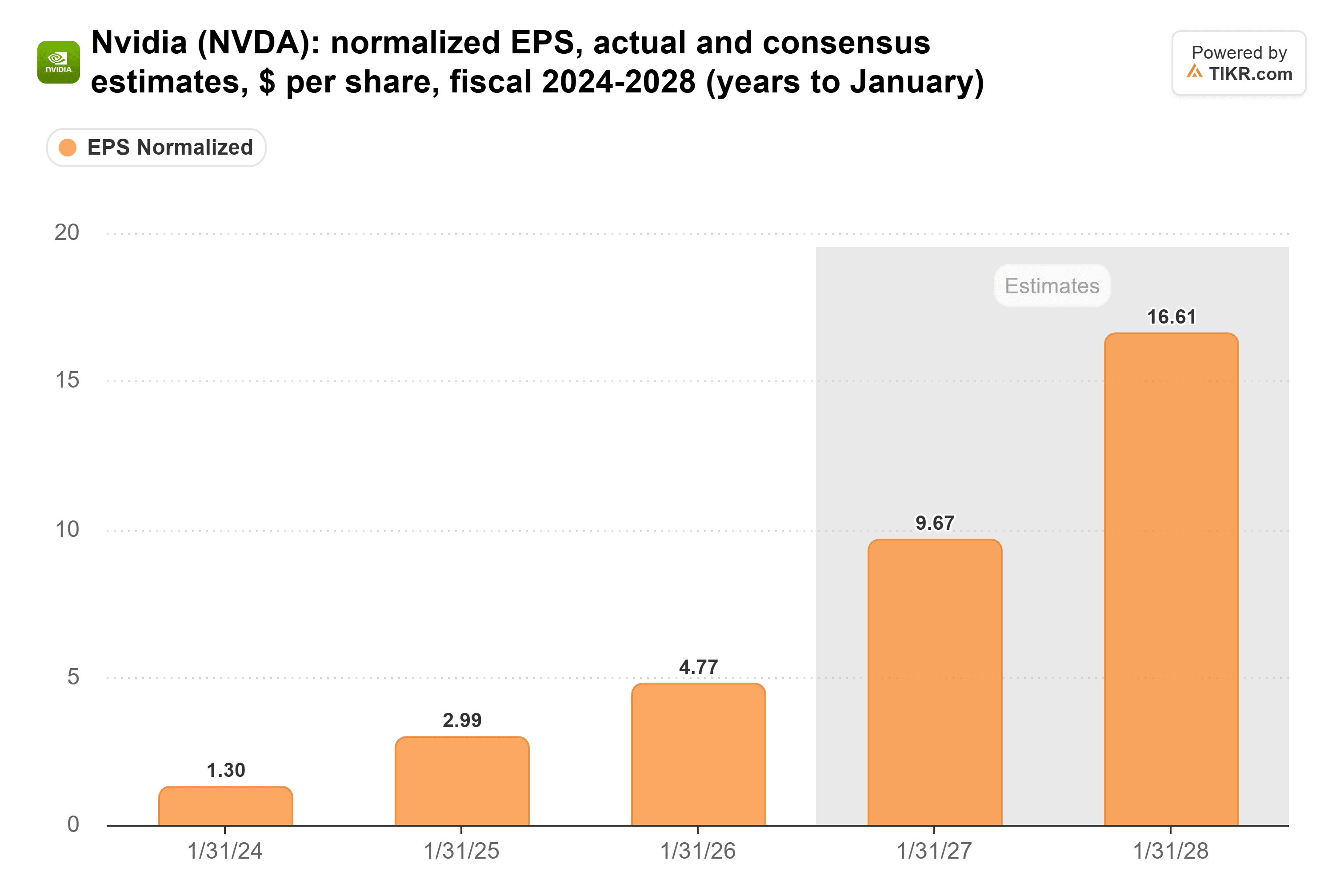
Consensus normalized EPS for fiscal 2028, the year ending January 2028, is now $16.61, up from $15.92 in late October.
TIKR Tracks 63 Analysts on Nvidia. How Many Say “Buy”?
See the full breakdown of Buy, Hold, and Sell ratings on Nvidia, along with Wall Street’s revenue and earnings estimates, all in one place. More than 500,000 investors use TIKR to research stocks like this one. See Nvidia’s Analyst Ratings
The demand shows up around Nvidia, too. Super Micro’s sales jumped to $19.9 billion in its September quarter from $5.0 billion a year earlier, and it now expects $72 billion to $82 billion for its fiscal year ending June 2027. Its 10-Q has since confirmed the sales figure, but its operations used $434 million of cash as inventory climbed to $15.05 billion.
So the Multiple Took the Hit
Nvidia fell 14% on Friday to $125.53, nearly 48% below its Oct. 6 record close. With earnings estimates rising, all of that drop came from the multiple, which is now at the bottom of its five-year range:
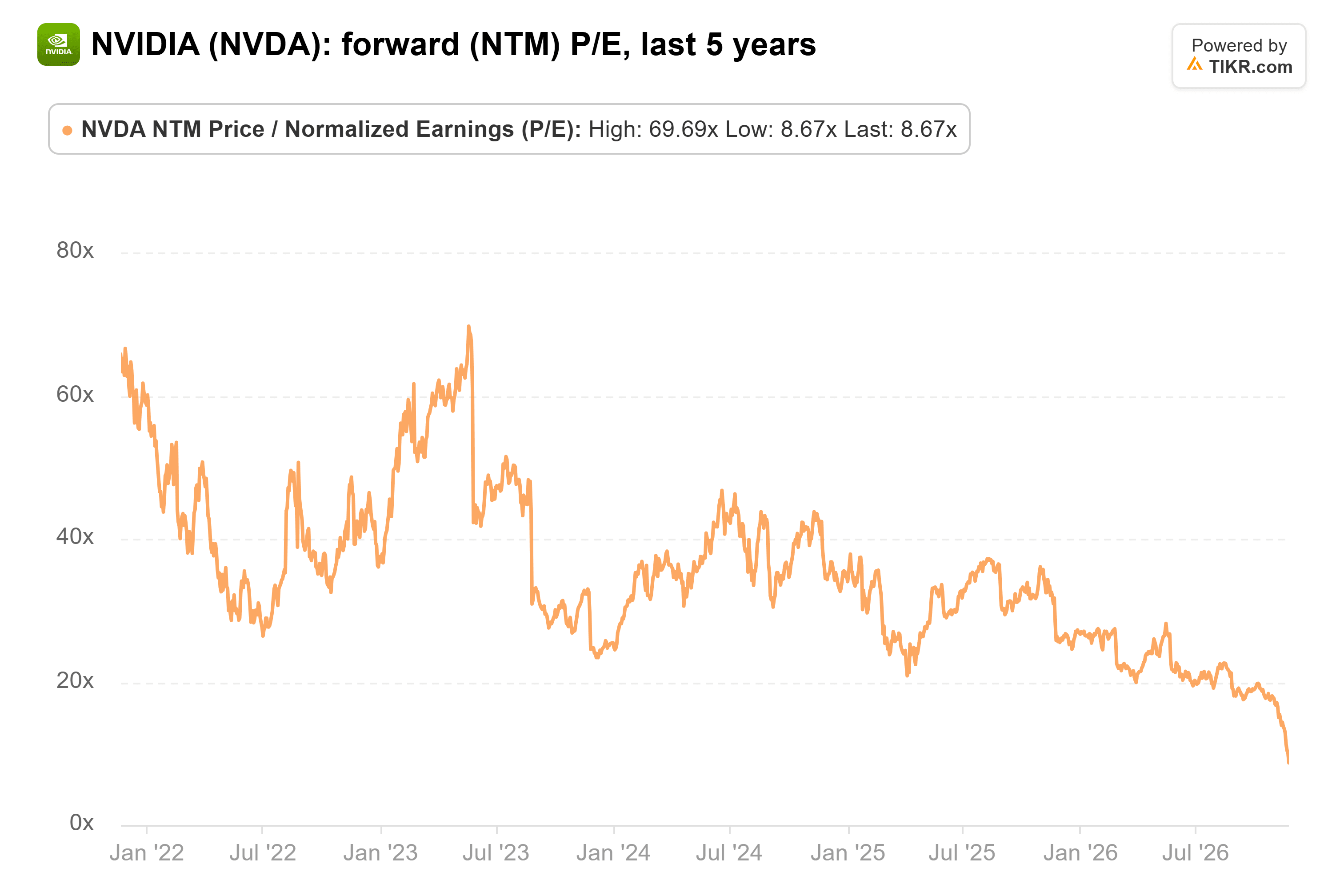
At 8.7x forward earnings, Nvidia trades at about a quarter of its 35.4x five-year average.
Now Nvidia’s Selloff Has a Cause
The stock was already down Friday when Reuters reported that afternoon that SEC enforcement staff are scrutinizing potential accounting issues at the company, citing two people briefed on the matter. The SEC declined to comment, Nvidia didn’t immediately respond, and nobody has said which practices are under review. Nvidia also hasn’t filed its 10-Q, which Kress said would come “in the coming weeks.”
Burry has his own idea of where to look. On X, he wrote: “The real reveal would be evidence that NVDA booked more revenue and profit from Asia than it had let on.” Nobody has tied the probe to that. But with an accounting probe open, investors now have a reason to doubt the earnings themselves.
That makes rising estimates cold comfort. If Burry’s year-long lag holds, the estimates are the last thing to fall.
Why 8.7x Already Prices In a Lot for Nvidia
At this multiple, Nvidia’s price already assumes the estimates on that chart are badly wrong. Unless the probe turns up revenue that shouldn’t have been booked, that’s too pessimistic for a company guiding to 75% growth.
Broadcom’s Dec. 9 report will test the rest of Burry’s thesis without Nvidia’s legal baggage. It guided to $21.7 billion of AI semiconductor revenue for its quarter ended Nov. 1, up 236% from a year earlier. A number at or above that would show the group’s earnings are still climbing.
Nobody outside the SEC knows what it’s looking at yet, though, and a restatement of any quarter’s revenue would break the case at any multiple.
So What is NVIDIA Stock Actually Worth?
TIKR lets you forecast the future price of any stock in less than a minute. Just enter a few assumptions into TIKR’s valuation model and see what NVIDIA could be worth. Start from Wall Street consensus estimates, or adjust the inputs to reflect your own view of the business. It’s free to use.
Disclaimer:
Please note that the articles on TIKR are not intended to serve as investment or financial advice from TIKR or our content team, nor are they recommendations to buy or sell any stocks. We create our content based on TIKR Terminal’s investment data and analysts’ estimates. Our analysis might not include recent company news or important updates. TIKR has no position in any of the stocks mentioned. Thank you for reading, and happy investing!