Key Takeaways
- Elon Musk said on X that “some percentage of the Moon and then probably Mercury” will be turned into computronium.
- SpaceX’s spending and chip-backed debt go to data centers on Earth, so orbital compute is upside it would fund from its own cash.
- Its first step is its own solar cell line from Singulus, due in the first half of 2027, leaving First Solar and Rocket Lab out.
- Its fourth-quarter report in early 2027 will show how much cash that record spending used up.
SpaceX (SPCX) CEO Elon Musk has a plan for solar-powered AI that skips Earth almost entirely. (Fitting, for a rocket company.)
It also skips the companies that sell solar today. SpaceX is making its own cells, so neither First Solar (FSLR) nor Rocket Lab (RKLB), which sells solar for satellites, is in line to supply it.
On Nov. 21, Musk replied on X to Ilya Sutskever’s idea of covering Earth’s surface in solar panels with an alternative:
“It is far easier and scales vastly more to generate power and intelligence in space around the Earth and then deep space around the Sun. Some percentage of the Moon and then probably Mercury next get turned into computronium (silicon PV + aluminum radiators).”
Which is about as big as a business plan gets.
The first step ships from Germany
The Moon is a long way off, but SpaceX is already buying the first piece. On Nov. 10, it said it had signed a supply contract with German equipment maker Singulus Technologies for its Starmind satellite production in Bastrop, Texas. Musk went further: “SpaceX has ordered 100 GW/year of HJT solar manufacturing equipment from Singulus in Germany.” Singulus says the first line ships in the first half of 2027.
100 GW a year would be about 6x the 16 to 17 GW of modules First Solar expects to sell in all of 2026. And Musk has agreed that 100 GW a year of orbital compute at $10 a watt would add $1 trillion of revenue a year, about 3x what analysts expect SpaceX to bring in during 2028.
TIKR tracks 40 analysts on SpaceX. How many say “Buy”?
See the full breakdown of Buy, Hold, and Sell ratings on SpaceX, along with Wall Street’s revenue and earnings estimates, all in one place. More than 500,000 investors use TIKR to research stocks like this one. See SpaceX’s Analyst Ratings
For now, the money stays on the ground
Analysts already expect a lot from SpaceX before a single new panel reaches orbit:

That’s revenue growing nearly 7x in two years, and the spending behind it is going into data centers on Earth. SpaceX’s capital spending grew nearly 5x from 2023 to 2025:
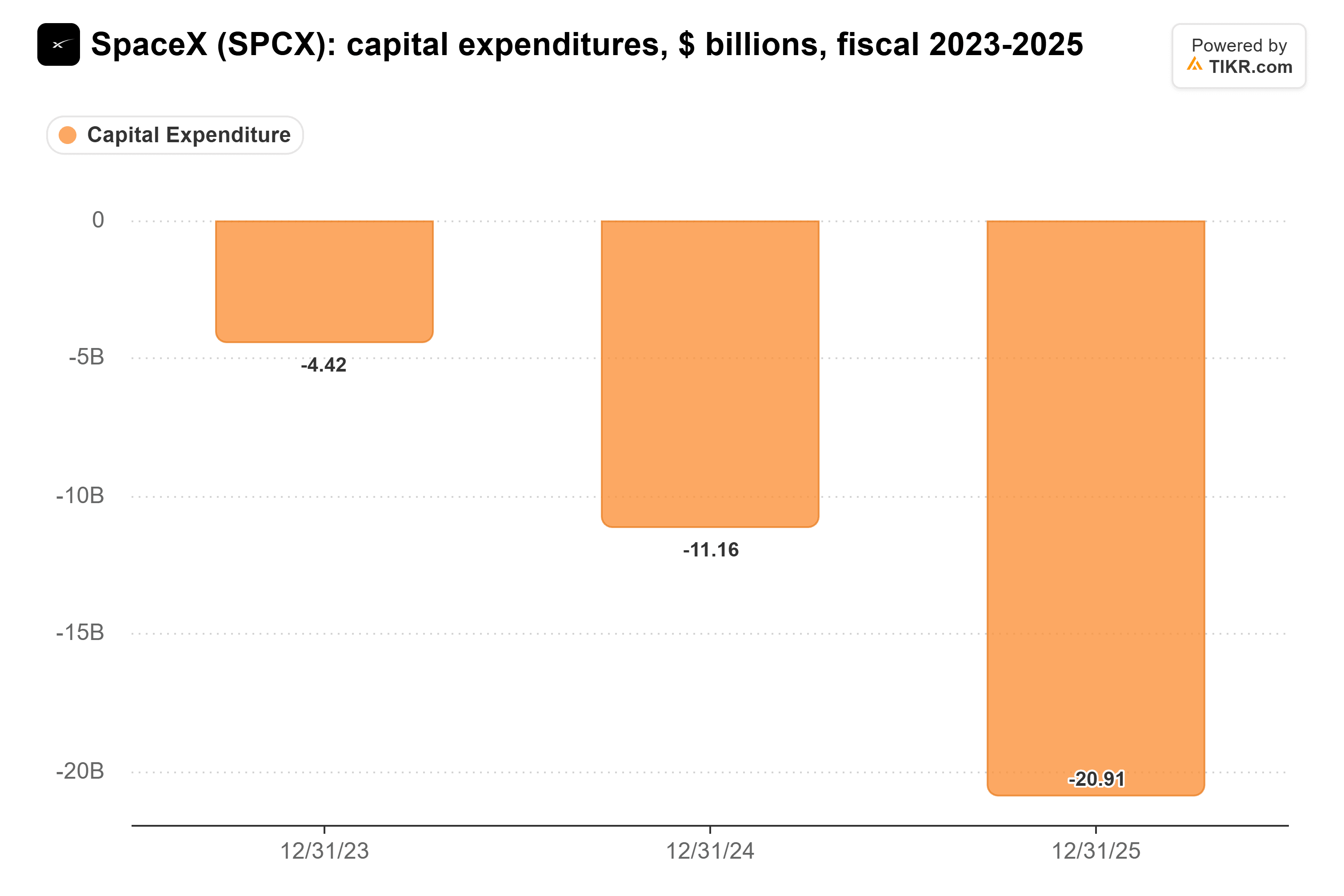
This year it’s even higher: $48.1 billion in the first nine months, $40.0 billion of it in the Super Intelligence segment that rents out compute, with another $35 billion to $40 billion guided for the fourth quarter. It priced $32 billion of chip-backed debt at 8.259% on Nov. 19 for its compute buildout on Earth, so chips headed for orbit would have to come out of SpaceX’s own cash.
The solar makers are on the outside
On Oct. 29, First Solar cut its 2026 sales guidance to $4.6 billion to $4.9 billion, from $4.9 billion to $5.2 billion. Analysts’ $4.80 billion for 2026 sits near the top of that range, a dip from 2025 before growth resumes:

Nothing in Musk’s post should move that $6.48 billion estimate for 2028, since SpaceX is building its own cell lines.
Rocket Lab’s Nov. 9 results release, with a record $3.57 billion backlog, doesn’t mention orbital compute. If SpaceX keeps its space power in-house, Rocket Lab’s solar sales depend on everyone else’s satellites.
Space compute is extra, and so is the bill
The way I see it, the bet is bigger than it looks because everything SpaceX reports today, from its revenue to its borrowing, is about compute on the ground. I’d value SpaceX on the compute it rents out now and count anything in orbit as upside, with capex already at 134% of revenue in the third quarter. The first check is the fourth-quarter report in early 2027, which will show how much of the $89.9 billion in cash and securities SpaceX held at Sept. 30 that quarter used up.
So what is SpaceX stock actually worth?
TIKR lets you forecast the future price of any stock in less than a minute. Just enter a few assumptions into TIKR’s valuation model and see what SpaceX could be worth. Start from Wall Street consensus estimates, or adjust the inputs to reflect your own view of the business. It’s free to use.
Disclaimer:
Please note that the articles on TIKR are not intended to serve as investment or financial advice from TIKR or our content team, nor are they recommendations to buy or sell any stocks. We create our content based on TIKR Terminal’s investment data and analysts’ estimates. Our analysis might not include recent company news or important updates. TIKR has no position in any of the stocks mentioned. Thank you for reading, and happy investing!