Key Takeaways
- Procter & Gamble yields 2.6% and Archer-Daniels-Midland yields 2.9%, and both declared their regular quarterly dividends in the past month.
- Over the twelve months to Sept. 30, 2026, Procter & Gamble’s dividend took 67% of its free cash flow, while ADM’s took 291%.
- ADM’s 7.2% yearly dividend growth over five years would pay more over a decade, but its latest raise was 2%, and at each dividend’s current pace the two pay nearly the same over 10 years.
- Procter & Gamble trades near its five-year average multiple, while ADM’s profit rebound depends on biofuel margins.
If you’re buying a dividend stock to hold for 10 years, the yield you lock in today matters less than whether the company can keep raising the check.
On Oct. 13, Procter & Gamble (PG) declared its quarterly dividend of $1.0885 a share. On Oct. 22, it beat on its first quarter of fiscal 2027 and held its full-year guidance. Archer-Daniels-Midland (ADM) followed on Nov. 3 with its third raise to its 2026 earnings guidance this year, then declared its $0.52 quarterly dividend the next day.
If you could hold only one of them for the next decade, which should it be?
| Metric | Procter & Gamble (PG) | Archer-Daniels-Midland (ADM) |
|---|---|---|
| Dividend yield | 2.6% | 2.9% |
| Current dividend | $4.35 a year | $2.08 a year |
| Dividend growth, 5 years | 5.6% a year (fiscal 2021-2026) | 7.2% a year (fiscal 2020-2025) |
| Record, in its own count | 70 straight years of raises | 379 straight quarterly dividends |
| Cash dividend payout ratio (TTM to Sept. 30, 2026) | 67% | 291% |
| Net debt/EBITDA | 0.9x | 2.3x |
| Interest coverage | 24.2x | 4.1x |
6 safe dividend stocks paying retirees 6%+ yields
There are over 100 stocks paying 6%+ annual dividends today.
But after an extensive investment review leveraging TIKR’s proprietary data, we now believe only six of them are truly safe for retirees.
They’re all yours as part of our new investment report. Learn more about how to get access right here.
Procter & Gamble grew in all 10 categories
In the three months to Sept. 30, Procter & Gamble grew in all 10 of its product categories and all six regions. Organic sales rose 4.0%, and core EPS rose 1% to $2.00. CFO Andre Schulten described the plan on the call: “Growth going forward is not about taking share. Growth going forward is about growing our categories.”
Free cash flow has covered the dividend in every year on the chart:
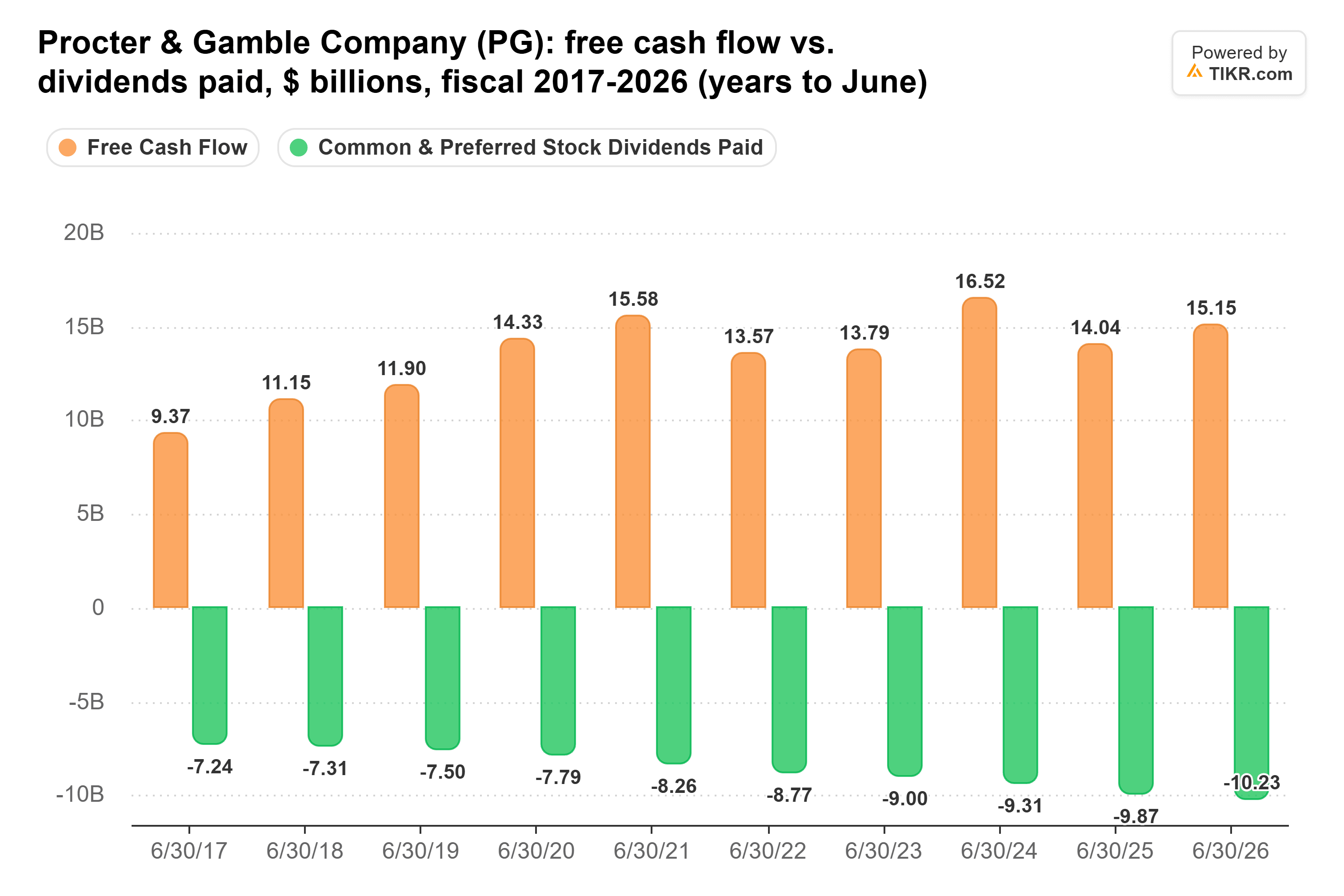
The dividend’s share of that cash has crept up, from 53.0% in fiscal 2021 to 67.6% in fiscal 2026. A 67% payout over the twelve months to Sept. 30 is still well-covered. That backs the company’s line that many shareowners “rely on the steady, reliable income earned with their investment in P&G.”
The risk is cost. Procter & Gamble now expects a commodity headwind of about $1.4 billion after tax this fiscal year, $0.79 a share. Its guidance for core EPS growth runs from flat to 3%.
ADM’s profits ride on biofuels
Procter & Gamble’s cash rarely surprises. ADM’s moves with crop and fuel markets, though. In the third quarter of 2026, adjusted EPS jumped to $1.77 from $0.92 a year earlier. ADM credits a strong North American biofuels margin environment under the finalized Renewable Volume Obligation policy. CEO Juan Luciano said on the call that “we see very strong margins still in Q4, and we still see it going forward into 2027.”
ADM’s free cash flow ran negative every year from fiscal 2016 to fiscal 2020, then swung widely:
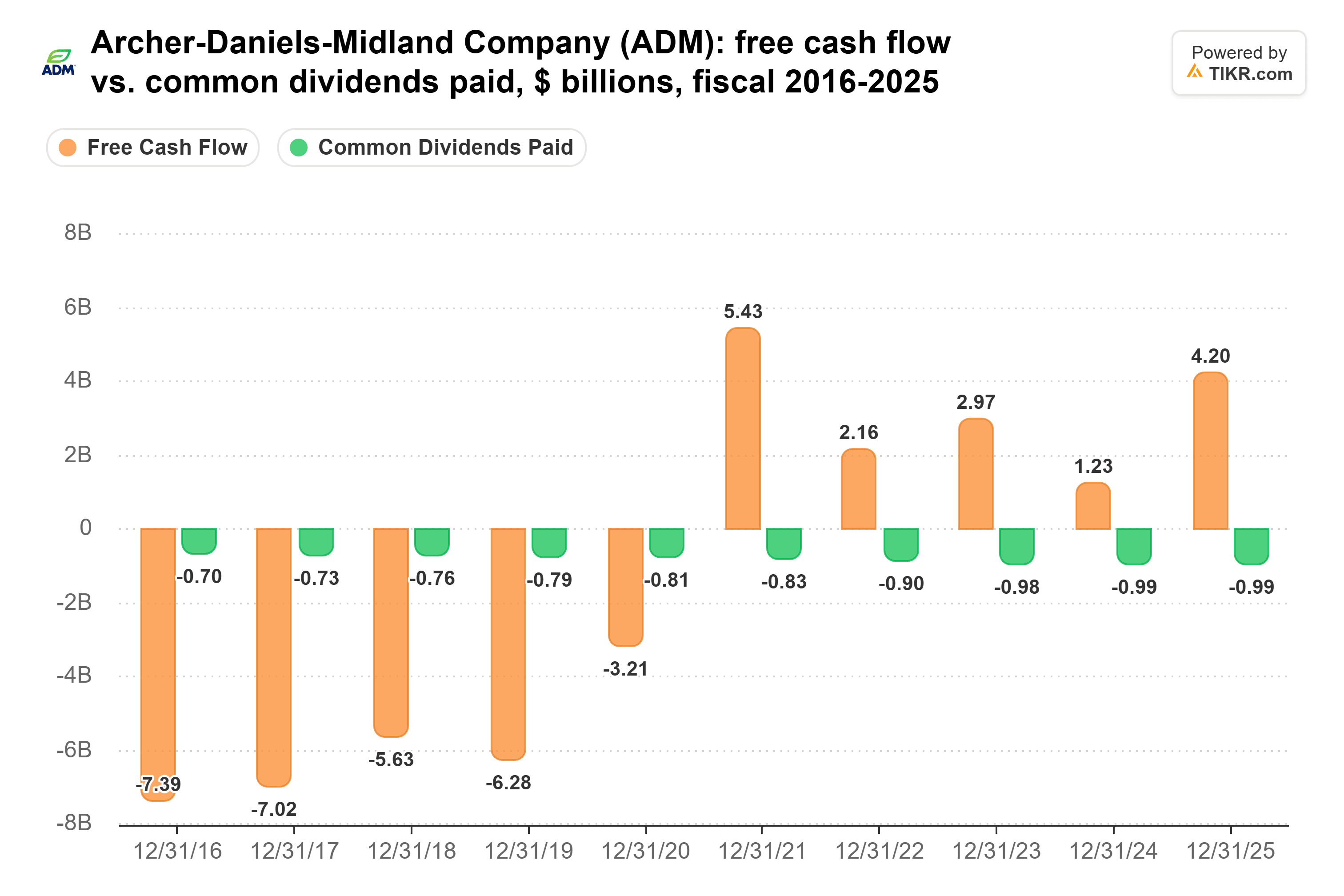
The cash dividend payout ratio went from 15.4% in fiscal 2021 to 80.3% in fiscal 2024, then down to 23.5% in fiscal 2025. Over the twelve months to Sept. 30, 2026, it reached a risky 291%: $1.01 billion of dividends against $346 million of free cash flow. ADM calls dividends “core to our capital allocation priorities.” But the cash behind the check comes and goes, and ADM itself names the durability of biofuel policy beyond 2027 as a risk.
So which dividend wins?
I’d hold Procter & Gamble for the next 10 years.
At ADM’s five-year rate of 7.2% a year, $10,000 would pay about $4,048 over the decade, against about $3,367 from Procter & Gamble. But ADM’s dividend rose just 2.0% in fiscal 2025, compared with 4.4% for Procter & Gamble’s in fiscal 2026. At those paces, Procter & Gamble’s income passes ADM’s around 2031, and the totals over 10 years come out nearly even: about $3,182 against about $3,175.
With the income a wash, coverage decides it. Procter & Gamble’s 67% payout leaves room to keep raising, and ADM’s 291% doesn’t.
You do pay for that steadiness, though less than you might think. Procter & Gamble trades at 24x forward earnings, close to its five-year average:

Over five years, that multiple has ranged from 20x to 27x, so today’s price isn’t stretched.
ADM is still a reasonable choice. It pays the bigger check today and trades at 13x forward earnings. If biofuel margins hold into 2027 the way Luciano expects, its free cash flow could cover the dividend comfortably again. But a 10-year hold is a bet on a check that keeps coming, and Procter & Gamble’s cash has covered its dividend every year for a decade.
Of course, Procter & Gamble still has to absorb this year’s cost headwind, and earnings at the low end of its guidance could mean a smaller raise next time.
Forget Procter & Gamble: 6 safe 6%+ dividend yields you can buy right now
Dividends can hold the key to enormous wealth. But only if you buy the right ones.
Picking the right high-yield dividend stock can be the difference between a dream retirement…and scraping by every month, waiting for the next Social Security check to clear.
We’ve identified six stocks yielding 6%+ that we believe every retiree should know about right now. (And Procter & Gamble isn’t one of them.)
Disclaimer:
Please note that the articles on TIKR are not intended to serve as investment or financial advice from TIKR or our content team, nor are they recommendations to buy or sell any stocks. We create our content based on TIKR Terminal’s investment data and analysts’ estimates. Our analysis might not include recent company news or important updates. TIKR has no position in any of the stocks mentioned. Thank you for reading, and happy investing!