Key Takeaways
- SpaceX shares fell 7.69% on Friday, closing below their $135 IPO price in a broad AI sell-off, a day after the company sold $32 billion of bonds to buy Nvidia chips. The biggest piece yielded 8.259%.
- Lenders reportedly wanted protection against the chips going to space, because there they couldn’t take them back and sell them if SpaceX defaulted.
- Chip-backed debt only works for chips that stay on the ground, so orbital compute would have to be paid for with SpaceX’s own cash. Analysts expect its free cash flow to be -$146 billion in 2027.
- CoreWeave and IREN borrow against chips on the ground, and that 8.259% yield sets a high bar for their next GPU loans.
SpaceX (SPCX) closed down 7.69% at $127.79 on Friday, Nov. 20, below its $135 IPO price, a day after selling $32 billion of bonds to buy Nvidia (NVDA) chips. The whole AI trade sold off: Nvidia fell 14.01% amid reports of an SEC investigation, and the Nasdaq dropped more than 5%. SpaceX’s lenders had a worry of their own. They want to be able to take those chips back.
They worried that if SpaceX “later decided to shoot the valuable chips that underpin their loans into space, it would prevent them from reclaiming and selling the semiconductors in the event of a default,” the Financial Times reported. Companies that keep their chips on the ground, like CoreWeave (CRWV) and IREN (IREN), don’t have that problem. What this deal cost still matters to them.
SpaceX says these chips will run on Earth, and Friday’s pricing announcement ties them to its “terrestrial compute buildout.” It’s unclear whether a restriction made it into the final documents. But the worry is fair. On Wednesday, Elon Musk replied “True” to an X post from Sequoia Capital partner Shaun Maguire arguing that “almost all inference compute will be in space (launched by Starship).”
TIKR tracks 40 analysts on SpaceX. How many say “Buy”?
See the full breakdown of Buy, Hold, and Sell ratings on SpaceX, along with Wall Street’s revenue and earnings estimates, all in one place. More than 500,000 investors use TIKR to research stocks like this one. See SpaceX’s Analyst Ratings
Pricey money, and not much of it
The biggest piece of Thursday’s sale was about $25.2 billion of notes. They yielded 8.259%, Bloomberg reported, against 5.95% for the average US high-grade note. SpaceX leases the chips from a trust for about five years, which keeps the debt off its balance sheet. Investors still wanted in at that price: Apollo and Goldman Sachs said demand let them upsize the full financing to about $44 billion.
And it covers only a small slice of the plan. Kelsey Berro, a fixed income portfolio manager at J.P. Morgan Asset Management, said on Bloomberg Surveillance that it’s “about 10 percent of the total gigawatt capacity that they want to do in terms of expansion for 2027.” Analysts already expect SpaceX to spend far more than it brings in next year:
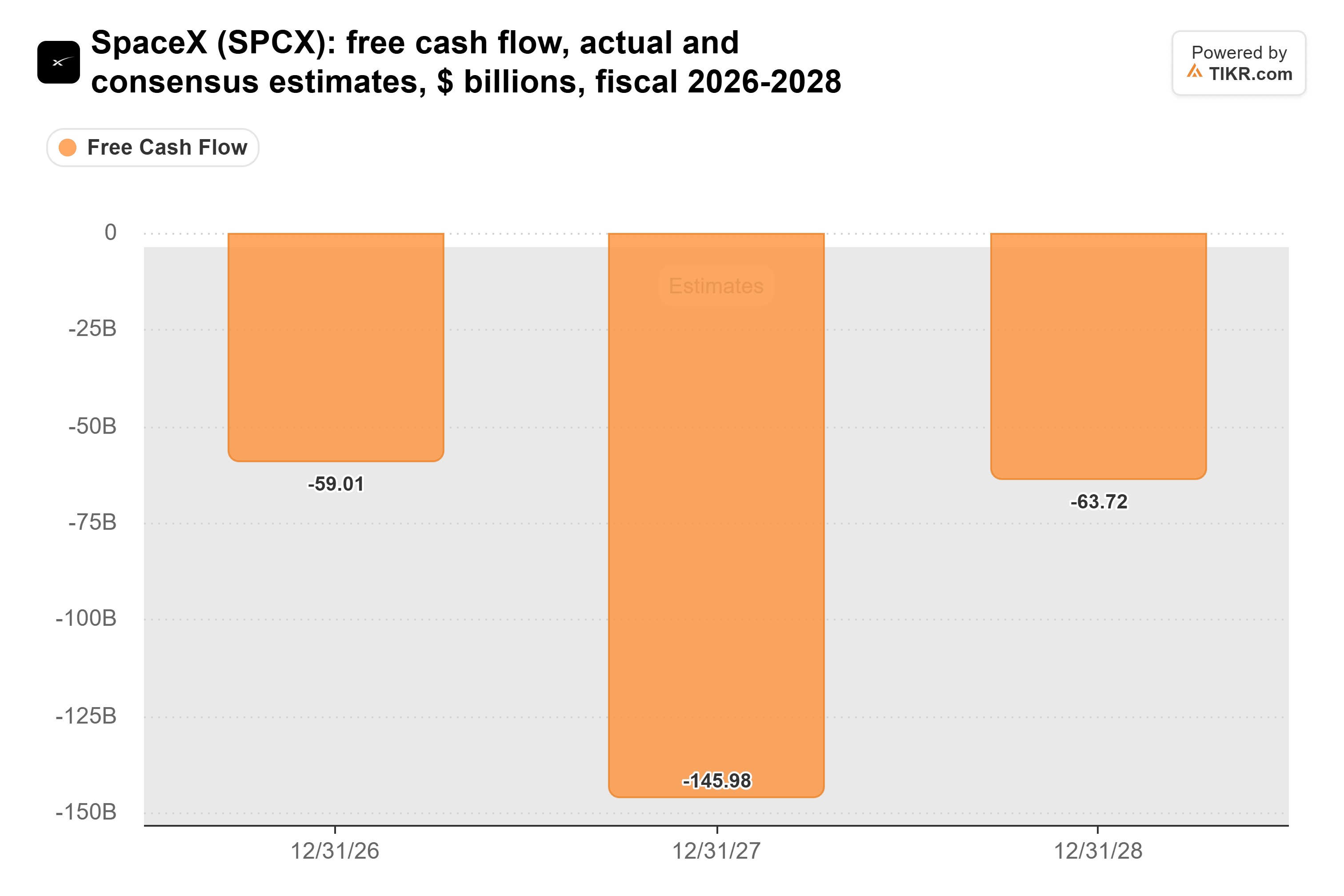
That’s a $146 billion hole in 2027, and lenders won’t fill it with loans backed by chips headed to orbit.
For Nvidia, the deal pays for its Vera Rubin chips, with deliveries due in the first half of 2027. But if lenders want the chips they fund kept on the ground, any Nvidia chips Musk sends to orbital data centers would have to be bought with SpaceX’s own money.
CoreWeave and IREN already work this way, and their borrowing costs still matter. CoreWeave’s net interest expense rose to $846 million in the third quarter from $310 million a year earlier. IREN still has to raise $6 billion of the $15 billion it plans to spend for the rest of fiscal 2027. If a borrower with an investment-grade rating paid 8.259%, what will their next GPU loans cost?
Its own cash covers about half, for now
SpaceX’s CFO Bret Johnsen says “a large portion” of the build “will be just funded by the business itself.” Cash from operations covered about half of third-quarter capex, up from roughly an eighth in the second quarter:
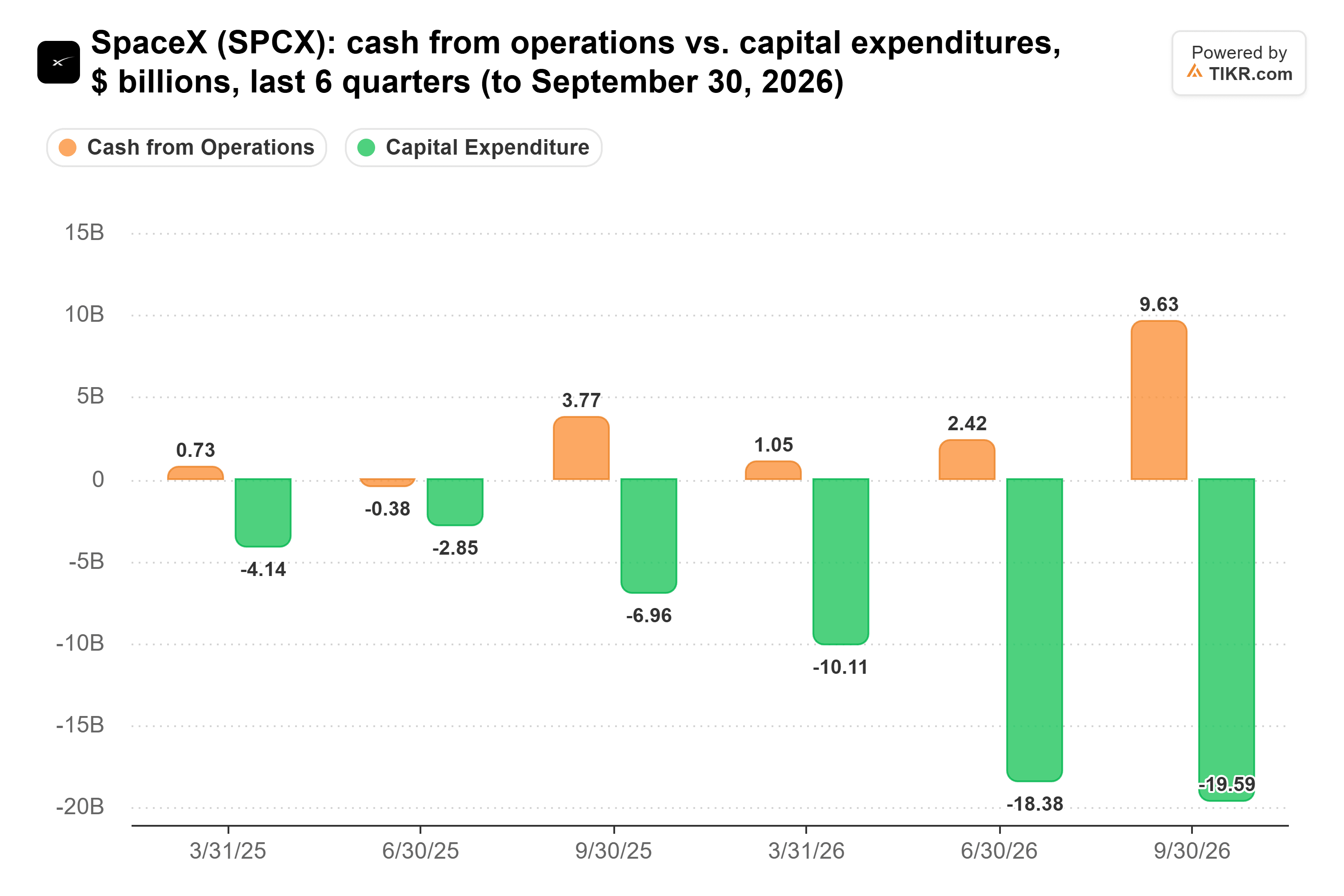
But management expects fourth-quarter capex of $35 billion to $40 billion, and that’s before a single chip heads to orbit.
Strip out Friday’s market-wide sell-off and the discount still looks deserved. SpaceX can borrow against chips on the ground, but anything it sends to orbit has to come from its own balance sheet. The fourth-quarter report in early 2027 is the test: how cash from operations compares with that $35 billion to $40 billion, and how much is left of the $89.9 billion of cash and securities SpaceX held at Sept. 30.
So what is SpaceX stock actually worth?
TIKR lets you forecast the future price of any stock in less than a minute. Just enter a few assumptions into TIKR’s valuation model and see what SpaceX could be worth. Start from Wall Street consensus estimates, or adjust the inputs to reflect your own view of the business. It’s free to use.
Disclaimer:
Please note that the articles on TIKR are not intended to serve as investment or financial advice from TIKR or our content team, nor are they recommendations to buy or sell any stocks. We create our content based on TIKR Terminal’s investment data and analysts’ estimates. Our analysis might not include recent company news or important updates. TIKR has no position in any of the stocks mentioned. Thank you for reading, and happy investing!