Key Takeaways
- British American Tobacco yields 5.3% and Merck yields 2.3%, but Merck raised its dividend 5.8% a year from fiscal 2020 to fiscal 2025, against BAT’s 2.2%.
- BAT’s dividend took 78% of its free cash flow over its latest twelve months, and Merck’s took 66%.
- Merck raised its 2026 profit outlook on Oct. 29, while BAT is reported to be closing a South African cigarette plant as illicit cigarettes take most of that market.
- Merck faces the loss of exclusivity on Keytruda, its biggest drug, and BAT is leaning on nicotine pouches as heated products and vapour shrink.
Merck (MRK) raised its full-year profit outlook on Oct. 29, and on Nov. 6 British American Tobacco (BTI) paid its latest quarterly dividend of 61.26p a share. Both checks come from a company whose biggest product is under pressure: cigarettes for BAT, and the cancer drug Keytruda for Merck.
Whereas BAT yields 5.3% today, Merck yields 2.3%. But Merck has raised its dividend 5.8% a year from fiscal 2020 to fiscal 2025, more than twice BAT’s pace.
So if you put $10,000 into one of them today, which pays you more over the next 10 years?
| Metric | British American Tobacco (BTI) | Merck (MRK) |
|---|---|---|
| Dividend yield | 5.3% | 2.3% |
| Annual dividend | $3.28 (at today’s exchange rate) | $3.40 |
| Dividend growth, fiscal 2020-2025 | 2.2% a year | 5.8% a year |
| Cash dividend payout ratio (TTM) | 78% | 66% |
| Net debt/EBITDA | 2.88x | 1.48x |
Source: TIKR and StockAnalysis, at today’s prices. TTM is the twelve months to June 30, 2026, for BAT and to Sept. 30, 2026, for Merck.
6 safe dividend stocks paying retirees 6%+ yields
There are over 100 stocks paying 6%+ annual dividends today.
But after an extensive investment review leveraging TIKR’s proprietary data, we now believe only six of them are truly safe for retirees.
They’re all yours as part of our new investment report. Learn more about how to get access right here.
BAT’s pouches are growing, and its cash is recovering
BAT’s growth is coming from nicotine pouches. In the U.S., Velo Plus posted triple-digit volume and revenue growth in the first half of 2026. Heated products fell 12% in the first half, and BAT has pulled out of vapour markets in parts of Asia, plus Poland and the U.K.
On BAT’s July 30 half-year call, Chief Executive Tadeu Marroco pointed to “strong cash returns, including our progressive dividend and sustainable share buyback.” BAT’s cash dividend payout ratio ran between 50% and 55% from fiscal 2021 to fiscal 2024. It then jumped to a risky 91% in fiscal 2025 as free cash flow fell from £9.64 billion to £5.79 billion. Over the twelve months to June 30, 2026, the ratio was back to a manageable 78%:
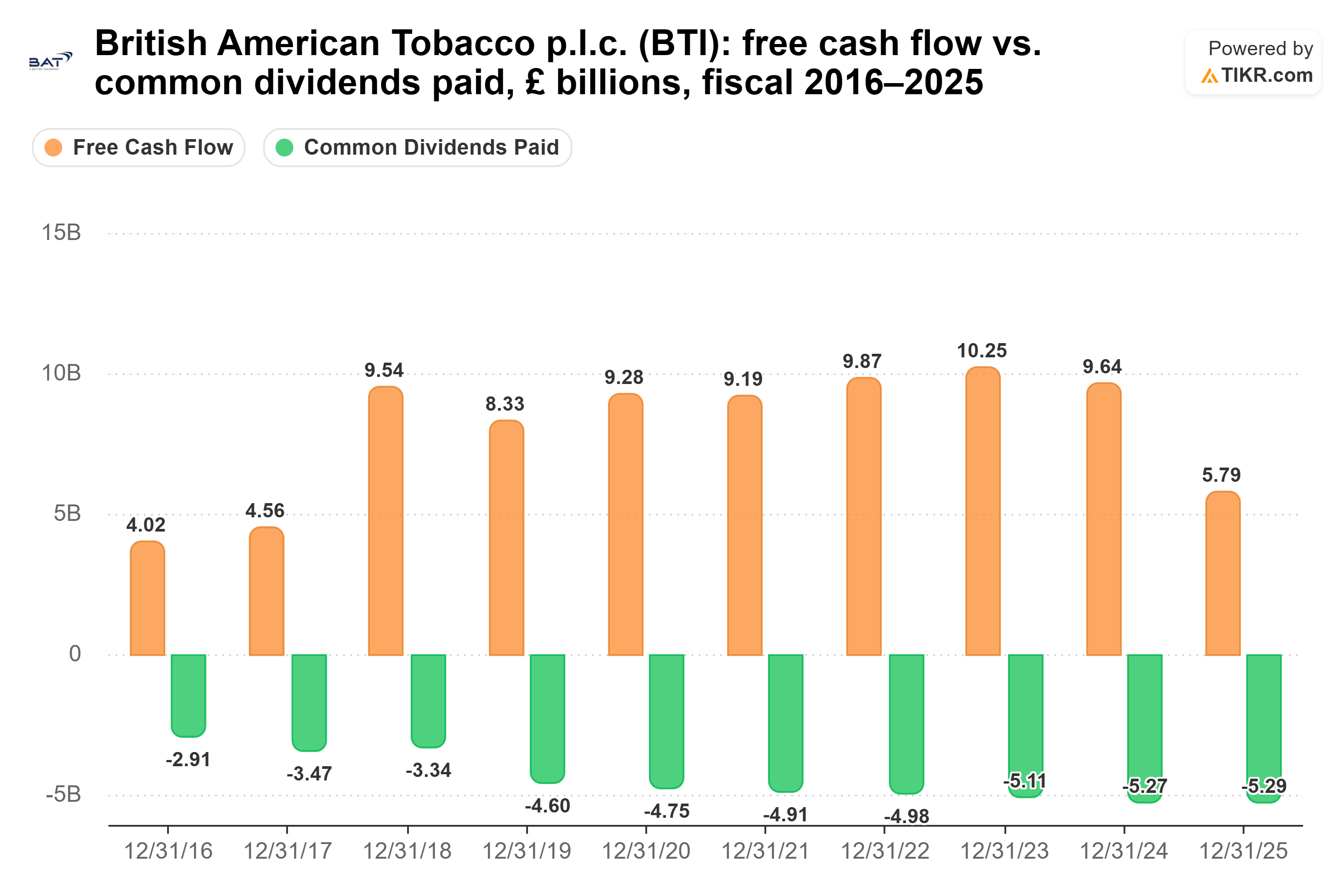
BAT sets its dividend in pence, so the dollar check a U.S. holder collects moves with the pound. The main risk is illicit trade. On Oct. 16, BAT was reported to be closing its South African cigarette plant, where illicit cigarettes are estimated to hold about 75% of the market.
Merck has more cushion, and a hill ahead
Merck’s cash flow has swung from year to year, but its dividend has kept rising. Free cash flow went from $9.14 billion in fiscal 2023 to $18.1 billion in fiscal 2024 and $12.4 billion in fiscal 2025. That put the cash dividend payout ratio anywhere from 43% to 81% between fiscal 2021 and fiscal 2025, and at a comfortable 66% over the twelve months to Sept. 30, 2026:
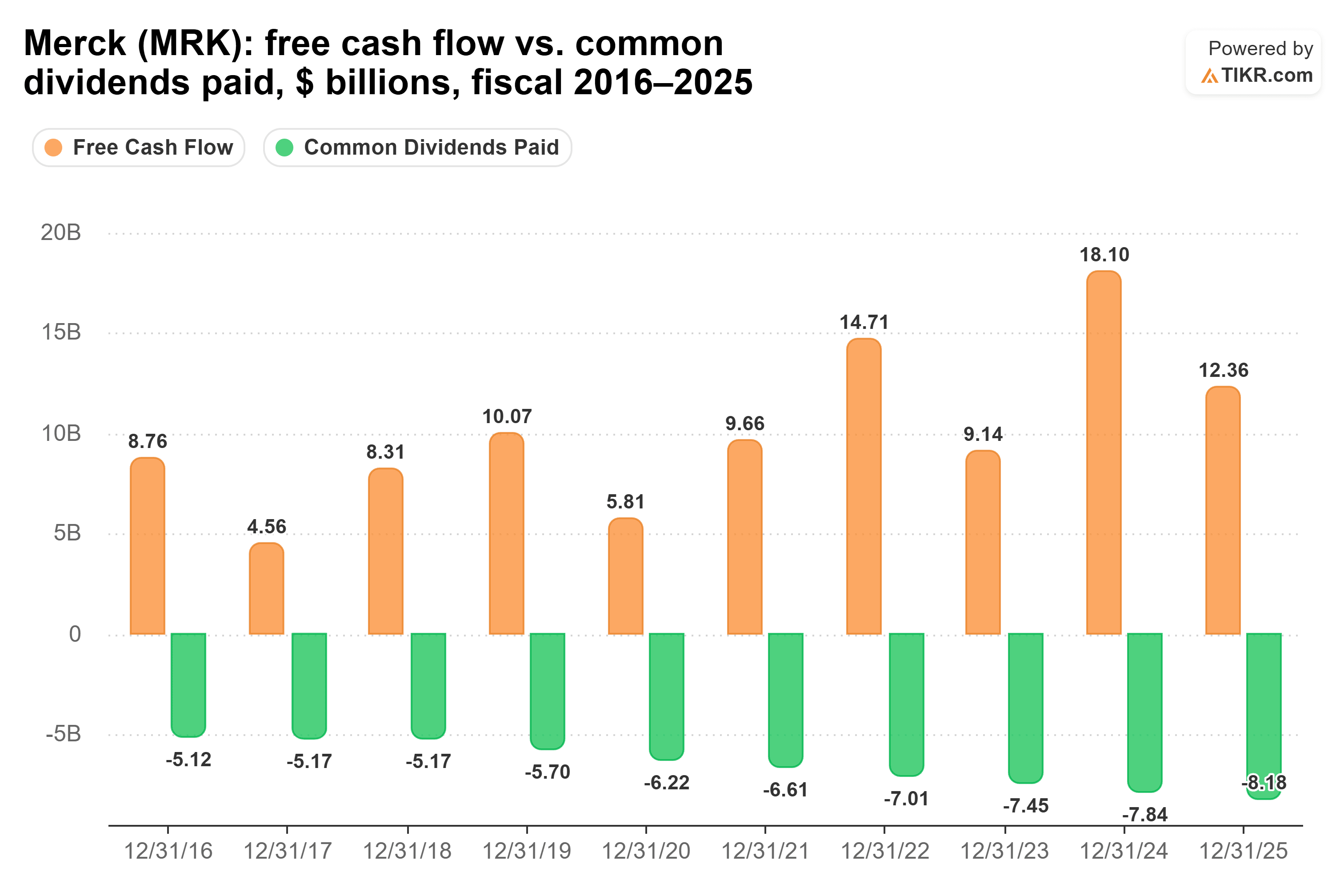
The business is still growing. Third-quarter 2026 sales rose 5% to $18.1 billion, with Keytruda up 6% to $8.6 billion and Winrevair up 93% to $694 million. CFO Caroline Litchfield said Merck remains “committed to the dividend with the goal of increasing it over time.”
Keytruda brings in nearly half of Merck’s sales, and that’s the risk. Its growth is slowing as it reaches peak use in key cancers, and it faces losing exclusivity. Litchfield calls that “really more of a hill on the overall revenues of our company,” with a return to strong growth “in short order.” (The stock fell as much as 2% on Oct. 22 after early melanoma vaccine data leaked, and a law firm opened an investigation on Oct. 30. Neither touches the cash behind the dividend.)
So which dividend wins?
British American Tobacco pays you more over the next 10 years, by a wide margin. At its 5.3% yield and 2.2% a year of growth, $10,000 in BAT pays about $5,867 over the decade. The same $10,000 in Merck, at 2.3% and 5.8% growth, pays about $2,996. At these rates, Merck’s yearly check wouldn’t pass BAT’s until around 2051. (I figured BAT’s income from its dollar yield today, so a weaker pound would shrink it.)
Management expects earnings growth toward the middle of its 5% to 8% range this year, and a 78% payout ratio leaves room for BAT’s 2.2% raises to continue.
Merck has a strong case: a faster-growing dividend, a wider cushion, about half BAT’s leverage and a freshly raised outlook. Over 10 years, though, BAT’s head start is too big for Merck’s raises to close.
Of course, BAT’s raises depend on its cash. Management expects cash conversion above 95% in 2026. If that slips and the payout ratio heads back toward fiscal 2025’s 91%, those small raises could get smaller still.
Forget British American Tobacco: 6 safe 6%+ dividend yields you can buy right now
Dividends can hold the key to enormous wealth. But only if you buy the right ones.
Picking the right high-yield dividend stock can be the difference between a dream retirement…and scraping by every month, waiting for the next Social Security check to clear.
We’ve identified six stocks yielding 6%+ that we believe every retiree should know about right now. (And British American Tobacco isn’t one of them.)
Disclaimer:
Please note that the articles on TIKR are not intended to serve as investment or financial advice from TIKR or our content team, nor are they recommendations to buy or sell any stocks. We create our content based on TIKR Terminal’s investment data and analysts’ estimates. Our analysis might not include recent company news or important updates. TIKR has no position in any of the stocks mentioned. Thank you for reading, and happy investing!