Key Takeaways
- Alibaba’s AI cloud revenue rose 53%, but adjusted earnings of 8.10 yuan per ADS missed estimates of about 11 yuan.
- Free cash flow was a 34.47 billion yuan outflow as capital spending rose 60%.
- Baidu’s AI cloud grew faster on a much smaller base, and GDS Holdings’ Nov. 25 report will show whether China’s big clouds are still building.
- At about 11x forward earnings, Alibaba looks cheap, but the case still depends on free cash flow heading toward break-even.
Alibaba (BABA) reported September-quarter results on Nov. 19, and its AI cloud business grew 53%, faster than the 45% it managed the quarter before. The catch is the cost, and shares closed down 1.26% at $83.31 that day.
Baidu (BIDU), chasing the same AI cloud customers under the same US limits on Nvidia chips, faces that bill too. And GDS Holdings (GDS) needs China’s big clouds to keep building.
The growth is real
Revenue rose 10% to 271.52 billion yuan, a touch above estimates, and AI Cloud and Compute revenue reached 60.97 billion yuan ($9.09 billion). AI-related product revenue grew triple digits for the 13th straight quarter. Earnings were the weak spot, though: Alibaba had missed adjusted EPS estimates five quarters in a row going into this report, so this makes six.
Paying for the servers
Alibaba spent 50.48 billion yuan on capital expenditures in the quarter, and free cash flow was an outflow of 34.47 billion yuan, against 21.84 billion yuan a year earlier. The company said the wider outflow came mainly from cloud infrastructure spending.
Free cash flow went from 156 billion yuan in fiscal 2024 to an outflow of 46.6 billion yuan in fiscal 2026 (the year ended March 2026), and analysts expect it to come back only slowly:
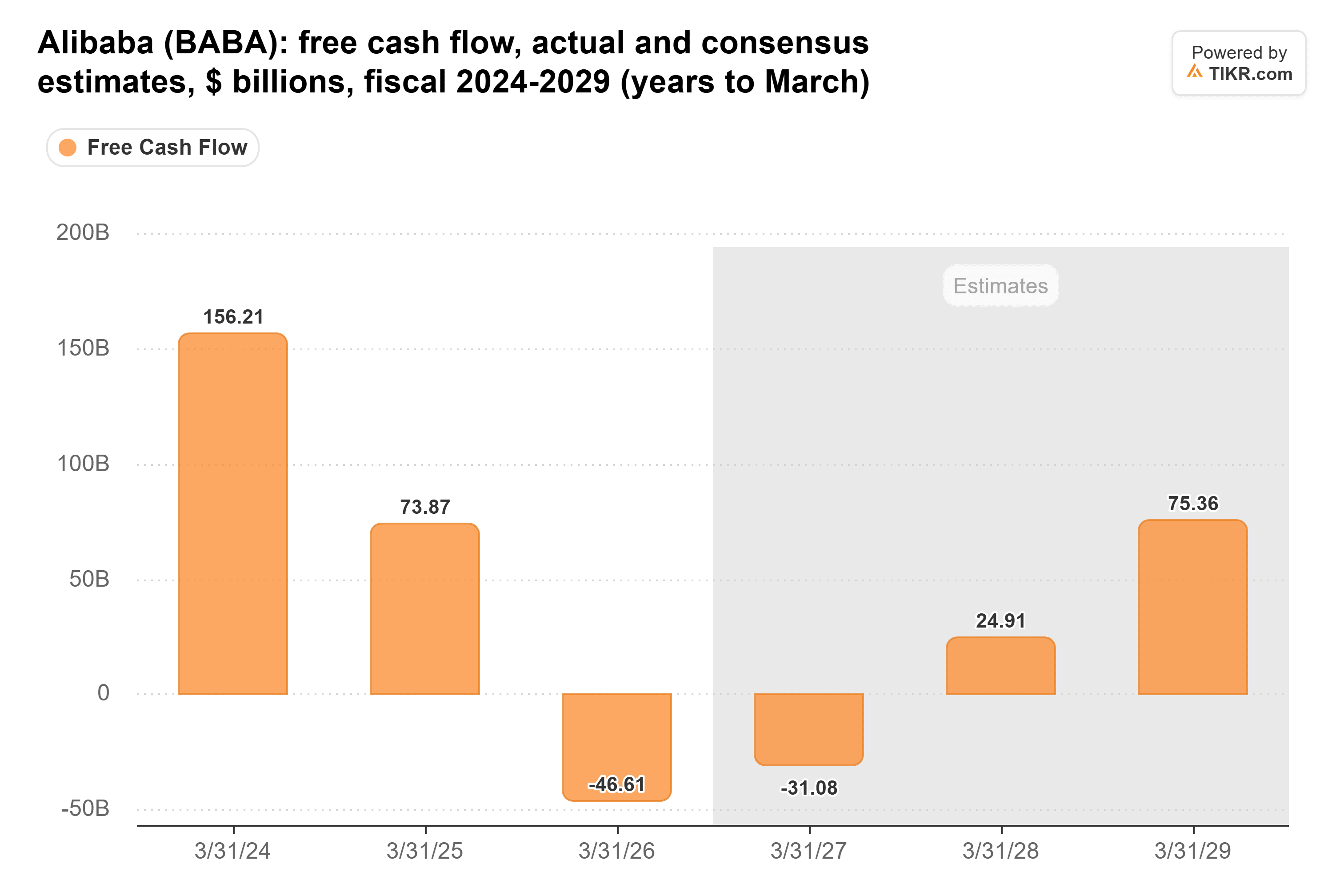
The first half of fiscal 2027 adds up to about 79 billion yuan of outflows, so the next two quarters would need about 48 billion yuan of free cash flow to reach the 31.1 billion yuan full-year outflow that the two analysts with estimates expect. CFO Toby Xu said Alibaba is “targeting to achieve positive free cash flow,” and management told analysts on the call that it expects to get there in the second half of 2028. A 48 billion yuan swing by March is hard to square with that timeline.
TIKR tracks 41 analysts on Alibaba. How many say “Buy”?
See the full breakdown of Buy, Hold, and Sell ratings on Alibaba, along with Wall Street’s revenue and earnings estimates, all in one place. More than 500,000 investors use TIKR to research stocks like this one. See Alibaba’s Analyst Ratings
Cloud can’t cover its own build-out yet
In fiscal 2026, cloud’s adjusted EBITA before depreciation was 43.2 billion yuan, about a third of the group’s 126.1 billion yuan of capex. And the chip curbs raise the bill. On Nov. 16, the Commerce Department issued an interim rule that requires a license to ship advanced chips to data centers selling large amounts of computing to Chinese companies, closing off the rented offshore Nvidia computing Chinese clouds have relied on. That pushes Alibaba to build more of its own capacity at home, and its T-Head unit’s Zhenwu V900 isn’t slated for mass production until early 2027. On the call, management said next fiscal year’s cloud growth target might be 30% to 45%, below this quarter’s 53%, because of the new rules.
Baidu and GDS are watching the same bill
Baidu’s AI Cloud Infra revenue grew 94% to 8.2 billion yuan in the September quarter, roughly 13% the size of Alibaba’s cloud segment. Its operating cash flow stayed positive at 2.8 billion yuan, but capital spending of 7.3 billion yuan outran it. Baidu now has to show it can keep that growth going while buying chips under the same US rules. GDS, whose customers are mostly hyperscale cloud providers, sells into the kind of build-out Alibaba laid out in September: more than 20 gigawatts of data center capacity by 2032. On the Nov. 19 call, management said the new chip rules may lead to a downward revision of that target. GDS reports before the open on Nov. 25.
The payoff is still a promise
Management said in August that its AI servers pay for themselves in about three years and run for five, so this could be a timing problem. Still, Alibaba traded at about 11x forward earnings going into the report, below its five-year average of 13x and less than half its 25x high in January:
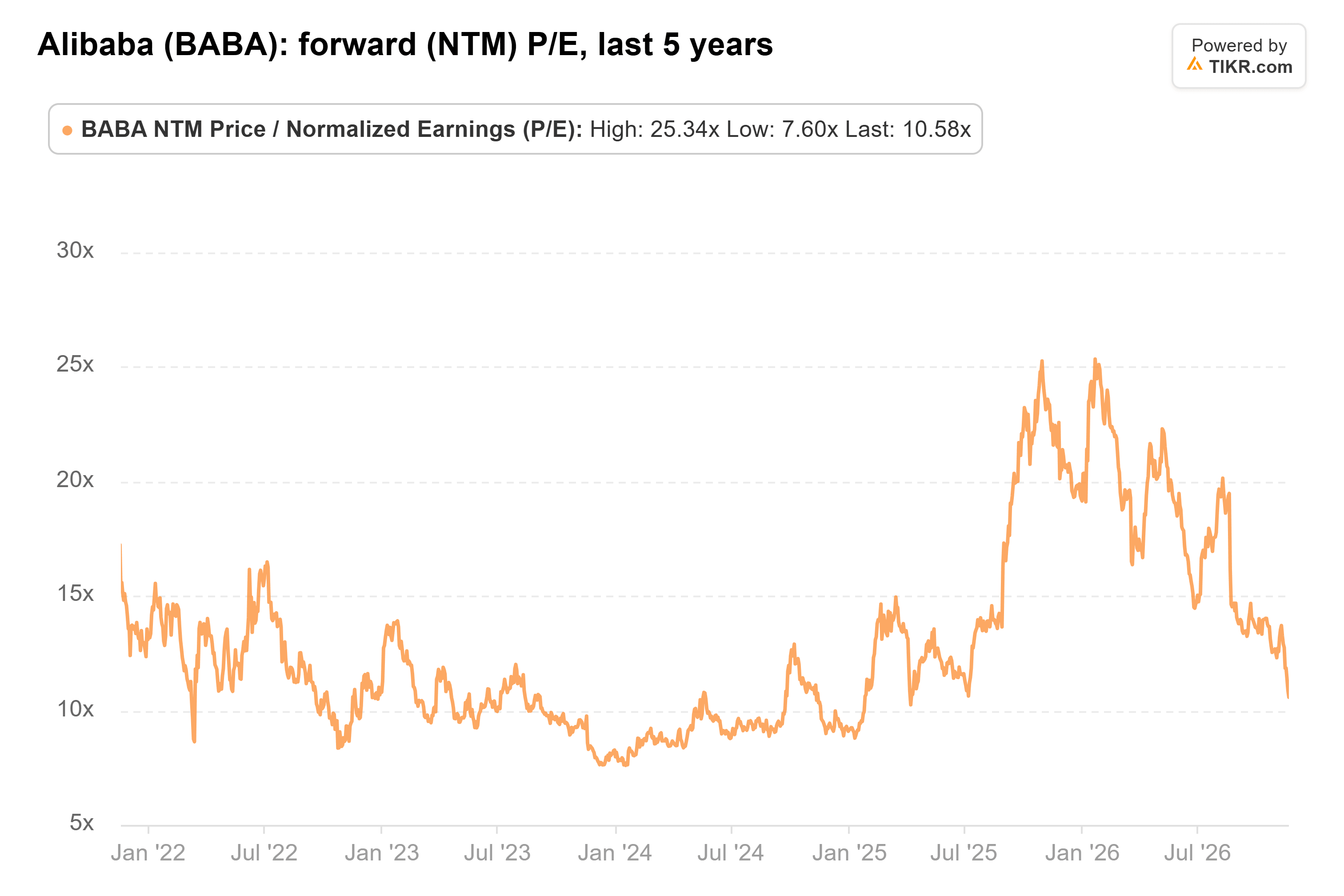
The cloud growth is real, but shareholders are paying for it. Buybacks fell from 86.7 billion yuan in fiscal 2025 to 7.6 billion yuan in fiscal 2026, and Alibaba sold about $10.2 billion of new shares in August. The low multiple only pays off if free cash flow heads toward break-even, and the December-quarter report early next year needs to start closing that 48 billion yuan gap.
So what is Alibaba stock actually worth?
TIKR lets you forecast the future price of any stock in less than a minute. Just enter a few assumptions into TIKR’s valuation model and see what Alibaba could be worth. Start from Wall Street consensus estimates, or adjust the inputs to reflect your own view of the business. It’s free to use.
Disclaimer:
Please note that the articles on TIKR are not intended to serve as investment or financial advice from TIKR or our content team, nor are they recommendations to buy or sell any stocks. We create our content based on TIKR Terminal’s investment data and analysts’ estimates. Our analysis might not include recent company news or important updates. TIKR has no position in any of the stocks mentioned. Thank you for reading, and happy investing!