Key Takeaways
- Elon Musk said Tesla’s Cybercab would win riders even at the same price as rivals, replying to a post about Dallas riders turning down discounts.
- If that holds, Uber and Lyft can’t win those riders back by matching fares, and their robotaxi partners Lucid and Mobileye face a car riders already prefer.
- The evidence is early: Cybercab launched in Dallas on Nov. 19, and Tesla hasn’t reached its $0.30-a-mile cost goal.
- Uber looks better protected than Lyft, and the next test is Tesla’s fourth-quarter report.
On Nov. 22, Sawyer Merritt posted on X that after riding Tesla’s (TSLA) Cybercab in Dallas, “some riders don’t want to use any other robotaxi because of how much they love it, despite competing services offering discounts.”
Elon Musk replied:
“Most people don’t yet realize that Cybercab would win even at price parity and its cost will be much less.”
If he’s right, that’s a bigger problem for Uber (UBER) and Lyft (LYFT) than any price war. It’s a problem for their robotaxi partners too: Lucid (LCID), whose Gravity SUVs run Nuro’s software in a program with Uber, and Mobileye (MBLY), whose self-driving system Lyft picked for Dallas.
Parity is the scary part
Uber and Lyft can always match a rival’s discount. But if riders pick Cybercab at the same fare, matching it doesn’t bring them back. And Tesla sells its rides through its own Robotaxi app, so Uber and Lyft never get a cut.
Analysts expect Uber’s revenue to climb from $52.0 billion in 2025 to $76.7 billion in 2028:
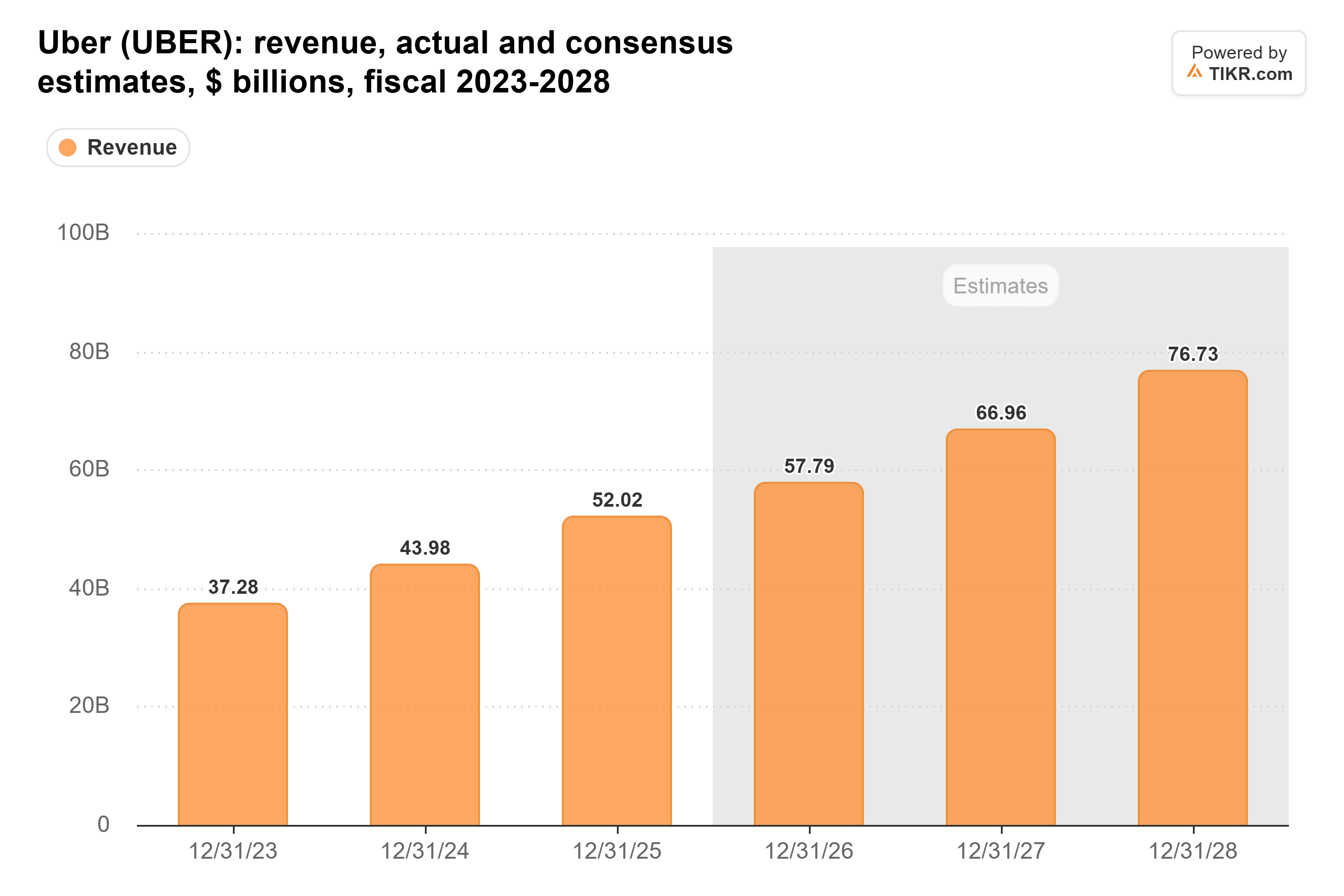
Those estimates assume people keep opening Uber’s app when they need a ride. And if Cybercab’s “cost will be much less,” as Musk says, Tesla could cut prices whenever it wanted.
TIKR tracks 50 analysts on Uber. How many say “Buy”?
See the full breakdown of Buy, Hold, and Sell ratings on Uber, along with Wall Street’s revenue and earnings estimates, all in one place. More than 500,000 investors use TIKR to research stocks like this one. See Uber’s Analyst Ratings
One city and a few happy riders
Still, the evidence is thin. Cybercab launched in Dallas on Nov. 19, with no fleet size given. Merritt’s post doesn’t say how many riders stuck with Cybercab, or which services offered the discounts. And management said on Tesla’s October call that it hasn’t yet reached its goal of $0.30 a mile, so “much less” is still Musk’s forecast.
Analysts expect Tesla’s revenue to grow from $94.8 billion in 2025 to $146 billion in 2028:

Tesla doesn’t yet report Robotaxi revenue as its own line, and Musk expects it to become “noticeable” by the second quarter of 2027. Until then, the Dallas loyalty is a few riders and one post.
Uber is better protected than Lyft
Uber has put robotaxis on its own app. In Dallas, Avride, which runs on Uber’s app, said in September it had passed 100,000 autonomous rides there since December 2025. Lucid said in its third-quarter release that it hit every milestone scheduled through the third quarter in its program with Uber and Nuro, which grew to more than 100 vehicles on the road in August. A Cybercab that wins at the same fare would eat into the volume Lucid is counting on from Uber. But at least Uber already has autonomous cars carrying riders.
Lyft looks more exposed. Its gross margin has stayed between 30.2% and 35.3% over the last five fiscal years:
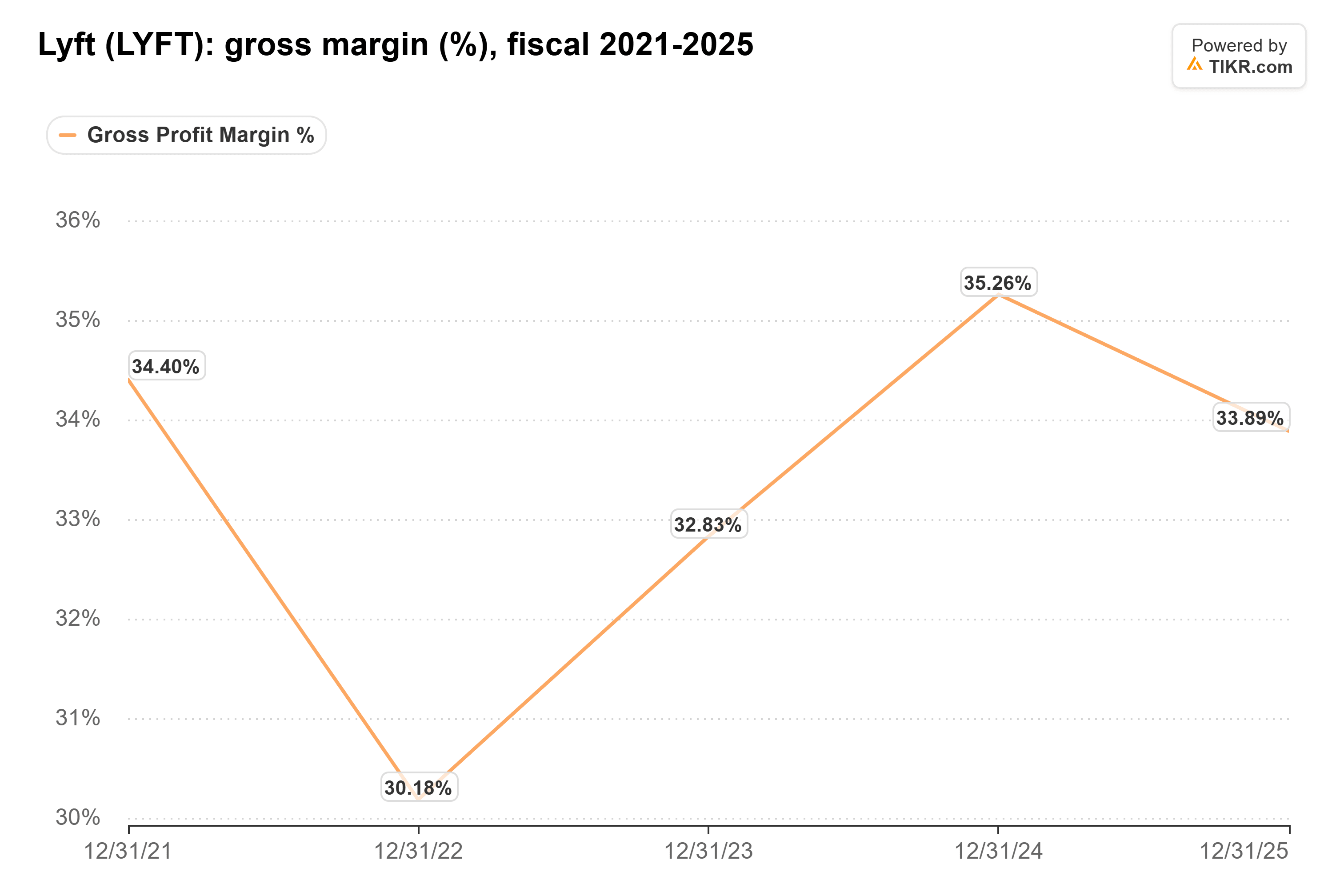
That doesn’t leave much room for discounts, and Merritt’s riders are already turning those down.
Early last year, Lyft said it planned to launch robotaxis running Mobileye’s system in Dallas as soon as 2026. Mobileye’s third-quarter release pointed instead to public ridepooling with safety drivers in Hamburg and testing near Orlando. CEO Amnon Shashua said those deployments mark progress “with driver-out performance remaining a critical milestone.”
A real threat, if Dallas scales
Musk’s claim rests on thin evidence, but it describes the threat Uber and Lyft should worry about most. Lyft’s plan still needs Mobileye to take the safety driver out, so if I had to own one of the two through this, I’d take Uber. The next real check is Tesla’s fourth-quarter report in late January, and whether it finally puts a size on the Dallas fleet.
So what is Uber stock actually worth?
TIKR lets you forecast the future price of any stock in less than a minute. Just enter a few assumptions into TIKR’s valuation model and see what Uber could be worth. Start from Wall Street consensus estimates, or adjust the inputs to reflect your own view of the business. It’s free to use.
Disclaimer:
Please note that the articles on TIKR are not intended to serve as investment or financial advice from TIKR or our content team, nor are they recommendations to buy or sell any stocks. We create our content based on TIKR Terminal’s investment data and analysts’ estimates. Our analysis might not include recent company news or important updates. TIKR has no position in any of the stocks mentioned. Thank you for reading, and happy investing!