Key Takeaways
- Merck and Gilead Sciences both raised their 2026 sales outlooks when they reported third-quarter results on Oct. 29.
- Merck yields 2.3% and raised its dividend 6% a year from fiscal 2020 to fiscal 2025, while Gilead yields 1.8% and raised its dividend 3% a year over the same years.
- Gilead’s dividend took 30% of its free cash flow over the 12 months to Sept. 30, compared with 66% at Merck.
- Keytruda’s loss of exclusivity at Merck and Medicare’s price on Biktarvy at Gilead are the risks to watch.
Merck & Co. (MRK) and Gilead Sciences (GILD) both raised their 2026 sales outlooks on Oct. 29, when each reported its third quarter. Both pay their dividends out of free cash flow, so for anyone holding them for income, that’s the right direction.
The two dividends grow at very different speeds, though. Merck yields 2.3% to Gilead’s 1.8%, and it has raised its dividend faster over the past five years, so which one pays you more over the next 10?
| Metric | Merck & Co. (MRK) | Gilead Sciences (GILD) |
|---|---|---|
| Dividend yield | 2.3% | 1.8% |
| Annual dividend | $3.40 | $3.28 |
| Dividend growth, fiscal 2020-2025 | 5.8% a year | 3.0% a year |
| Cash dividend payout ratio (TTM) | 66% | 30% |
| Net debt/EBITDA (LTM) | 1.48x | 1.23x |
| Interest coverage (LTM) | 5.17x | 11.72x |
6 safe dividend stocks paying retirees 6%+ yields
There are over 100 stocks paying 6%+ annual dividends today.
But after an extensive investment review leveraging TIKR’s proprietary data, we now believe only six of them are truly safe for retirees.
They’re all yours for free as part of our new investment report, which you can access right here.
Merck’s bigger check has a thinner cushion
Merck’s business is still growing. Third-quarter sales rose 5% from a year earlier to $18.1 billion. Merck lifted the low end of its 2026 sales outlook to $66.8 billion, kept the top at $67.3 billion, and raised its adjusted earnings guidance. Keytruda brought in $8.6 billion of the quarter’s sales, and Winrevair sales rose 93% to $694 million. The stock rose 5% that day.
Over the 12 months to Sept. 30, the dividend took a manageable 66% of free cash flow. That cushion has been thinner before. Merck’s free cash flow fell short of the dividend in fiscal 2017 and again in fiscal 2020:
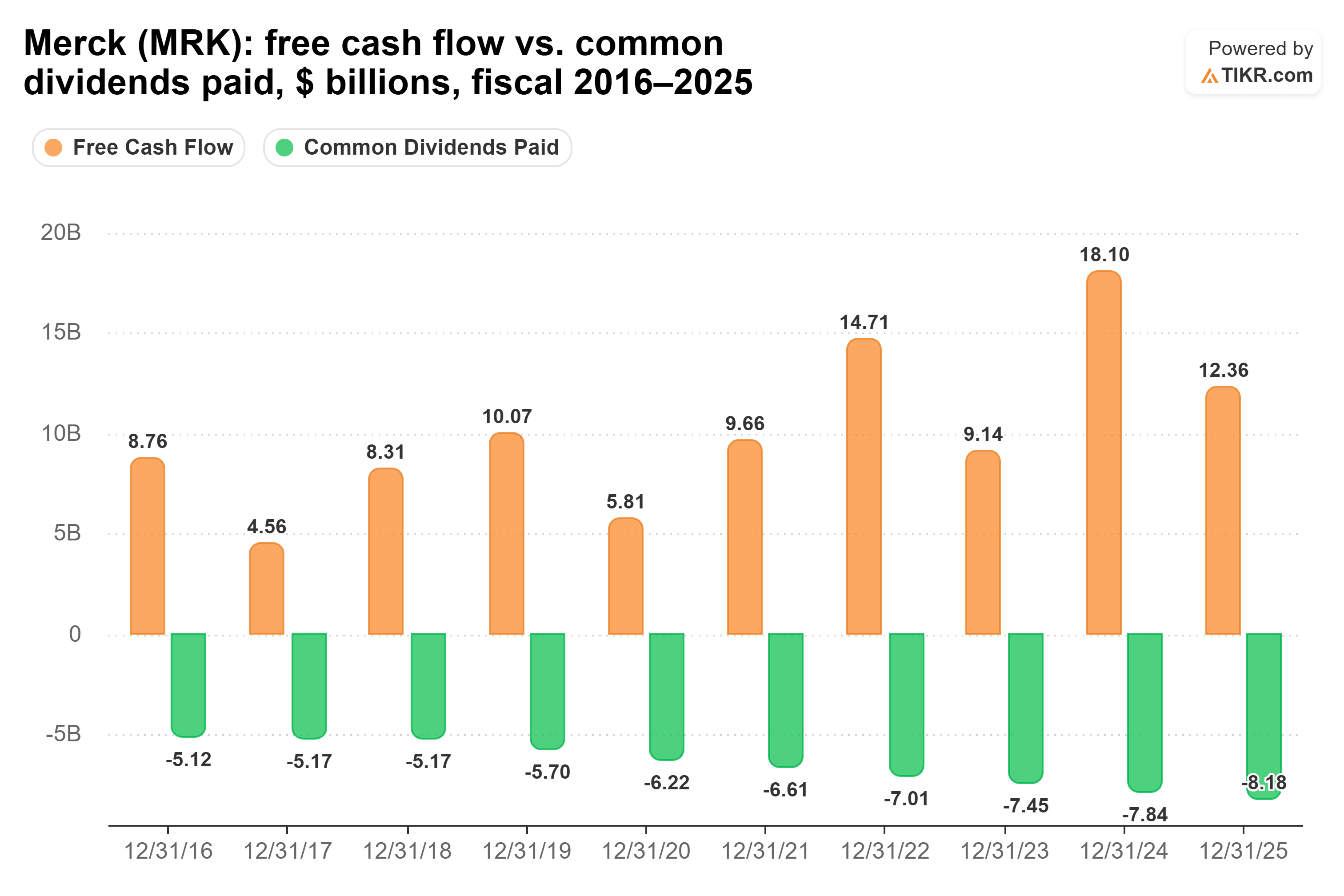
Since fiscal 2021, the dividend has taken between 43% and 81% of free cash flow each year.
“We remain committed to the dividend with the goal of increasing it over time,” CFO Caroline Litchfield said on Merck’s third-quarter call. Merck’s dividend grew 5.8% a year from fiscal 2020 to fiscal 2025, from $2.48 to $3.28 a share, and it pays $3.40 a year now. At that pace, $10,000 in Merck pays $230 a year now and about $380 in year 10. That’s a 3.8% yield on your cash today, and about $2,996 in dividends over the decade.
The main risk is Keytruda’s loss of exclusivity. Litchfield calls it “really more of a hill on the overall revenues of our company,” and Merck expects only moderate sales growth in 2027.
Gilead has room to spare
Gilead’s quarter was even stronger than Merck’s, but its dividend grows more slowly. Third-quarter product sales rose 13% from a year earlier to $8.3 billion. HIV sales grew 18%, and Biktarvy sales rose 10% to $4.1 billion. Gilead also raised its 2026 product sales guidance to $31.0-$31.3 billion, from $30.1-$30.4 billion.
The dividend is very well covered, taking just 30% of free cash flow over the 12 months to Sept. 30. Gilead’s free cash flow was lower in fiscal 2025 than in fiscal 2016, at $9.46 billion against $16.3 billion. It still covered the dividend comfortably in every year:
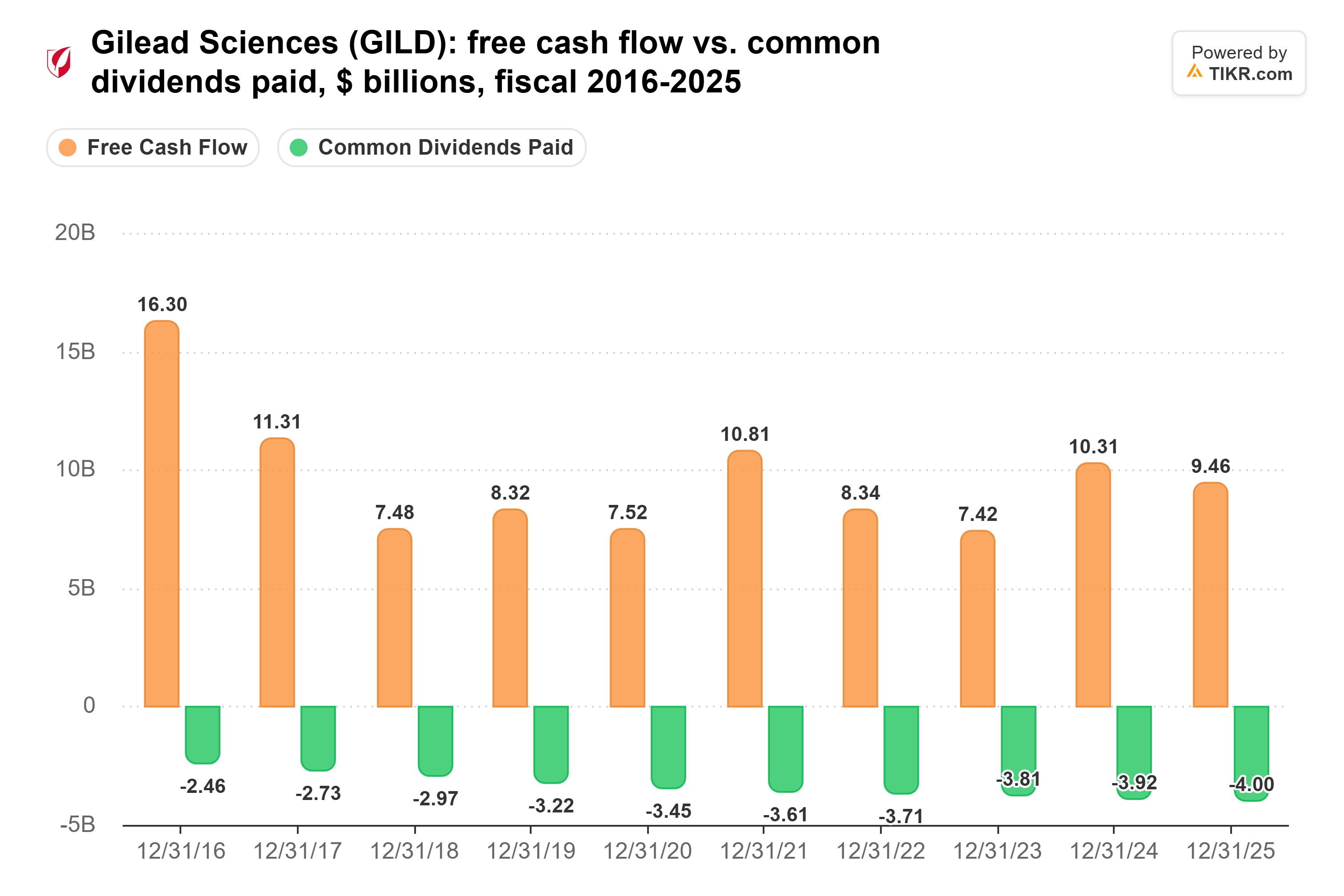
Gilead declared $0.82 a share for the third quarter, up from $0.79 a year earlier. Its board has declared the same $0.82 for the fourth quarter, payable Dec. 30. The dividend grew 3.0% a year from fiscal 2020 to fiscal 2025, from $2.72 to $3.16 a share. That’s well behind its 9.4% a year from fiscal 2015 to fiscal 2025, when it rose from $1.29 a share. At 3.0% a year, $10,000 in Gilead pays $180 a year now and about $236 in year 10. That’s a 2.4% yield on your cash today, and about $2,068 in dividends over the decade.
The main risk is Biktarvy’s Medicare price. Gilead expects it to cut about $1.5 billion from Biktarvy revenue in 2028.
So which dividend wins?
Merck pays you more over the next 10 years. At each company’s pace from fiscal 2020 to fiscal 2025, $10,000 in Merck pays about $2,996 over the decade, compared with about $2,068 for Gilead. That’s about $929 more, and at those rates Gilead never catches up.
I also think Merck can keep that pace. Its 66% payout ratio leaves room for raises, its sales are still growing, and its free cash flow has covered the dividend every year since fiscal 2021.
Gilead’s dividend isn’t in any trouble. Its 30% payout ratio leaves far more room than Merck’s, its interest coverage is 11.72x against Merck’s 5.17x, and its HIV business is growing fast. Gilead could afford bigger raises. It just hasn’t been giving them lately. Over a decade, a bigger check that grows faster puts more money in your pocket, so I’d take Merck.
Of course, Merck’s pace depends on the Keytruda dip being as shallow as management expects. If it runs deeper, Merck’s raises could slow, and Gilead’s extra cushion would count for a lot more.
Forget Merck & Co.: 6 safe 6%+ dividend yields you can buy right now
Dividends can hold the key to enormous wealth. But only if you buy the right ones.
Picking the right high-yield dividend stock can be the difference between a dream retirement…and scraping by every month, waiting for the next Social Security check to clear.
We’ve identified six stocks yielding 6%+ that we believe every retiree should know about right now. (And Merck & Co. isn’t one of them.)
Disclaimer:
Please note that the articles on TIKR are not intended to serve as investment or financial advice from TIKR or our content team, nor are they recommendations to buy or sell any stocks. We create our content based on TIKR Terminal’s investment data and analysts’ estimates. Our analysis might not include recent company news or important updates. TIKR has no position in any of the stocks mentioned. Thank you for reading, and happy investing!