Key Takeaways
- Dell shares fell nearly 11% on Friday, October 30, after Intel warned that memory prices and tight supply are slowing PC demand.
- Satori Fund founder Dan Niles says Dell’s inventory, nearly tripled from a year ago, shows chip supply is much closer to demand than chipmakers think, and Dell’s balance sheet backs him up.
- Most of Dell’s $21.3 billion of inventory is parts it hasn’t yet built into finished products, which suggests suppliers had more to sell than a true shortage would allow.
- NVIDIA’s gross margin has held near 75% for three quarters, and that kind of pricing is what’s at risk if supply keeps catching up.
Dell Technologies (DELL) sank nearly 11% on Friday, October 30, a day after Intel (INTC) warned that the memory shortage is starting to cost PC makers sales.
“In recent weeks, our customers began signaling a PC slowdown based on the memory prices and availability,” Intel CEO Lip-Bu Tan said on the company’s third-quarter call. Intel now expects global PC shipments to fall 12% this year and another 10% in 2027.
So PC buyers are already pulling back from shortage prices. On Friday, Satori Fund founder Dan Niles went a step further and questioned whether the shortage is as tight as everyone says. That matters as much for chipmakers like NVIDIA (NVDA) as it does for Dell.
An investor on X asked Niles whether he’d own Alphabet (GOOGL), Amazon (AMZN), Intel or Meta (META) after their disappointing earnings reports. Niles replied that he’d go into more detail in a note on Sunday, and added:
“I also think supply vs demand in semis is a lot closer than most companies think. Dell for example would not have been able to triple their inventories y/y vs revs only growing at 40%+ if there was not a lot more supply than all these supposed long-term agreements imply.”
If he’s right, the shortage pricing behind this year’s chip rally won’t last as long as the industry expects.
Dell’s Balance Sheet Backs Niles Up
Niles has the inventory right. Dell held $21.3 billion of inventory at July 31, 2026, the end of its second quarter of fiscal 2027, up from $7.2 billion a year earlier. That’s nearly three times as much.
Revenue actually grew faster than Niles said: $47.0 billion in the quarter, up 58% from $29.8 billion. That’s still nowhere near the pace of the inventory build.
Memory was already a big part of Dell’s growth story. When Barclays downgraded the stock on October 14, analyst Tim Long credited most of Dell’s revenue growth to higher memory prices.
TIKR Tracks 29 Analysts on Dell Technologies. How Many Say “Buy”?
See the full breakdown of Buy, Hold, and Sell ratings on Dell Technologies, along with Wall Street’s revenue and earnings estimates, all in one place. More than 500,000 investors use TIKR to research stocks like this one. See Dell Technologies’ Analyst Ratings
A Stockpile Is Still Supply
Most of that inventory is parts. Production materials made up $15.9 billion of it at July 31, against $4.7 billion a year earlier. Dell has a $95 billion AI backlog to fill, and Michael Dell told CNBC on October 13 that the memory shortage could last about four years. If you believe that, buying ahead makes sense.
Suppliers have been happy to ship on credit, too. Dell’s payables rose $16.2 billion in the first half of fiscal 2027, more than the $10.9 billion it added to inventory.
That’s Niles’ point. You can’t put $15.9 billion of parts on the shelf if those parts are truly sold out.
It also leaves Dell exposed if prices turn. Dell’s product gross margin rose to 17.3% in the second quarter from 12.1% a year earlier, as it repriced for scarce parts. If supply catches up, that lift fades, and a shelf full of memory bought at shortage prices would squeeze margins on the way down.
The Chipmakers Have More to Lose
Niles followed up with where he’s leaning. He’s “more positive on hyperscalers whose stocks are ~flattish ytd post this reset” than on chip stocks he says are still up about 50% this year, and he still doesn’t like neoclouds as business models.
NVIDIA shows what kind of pricing is at stake:
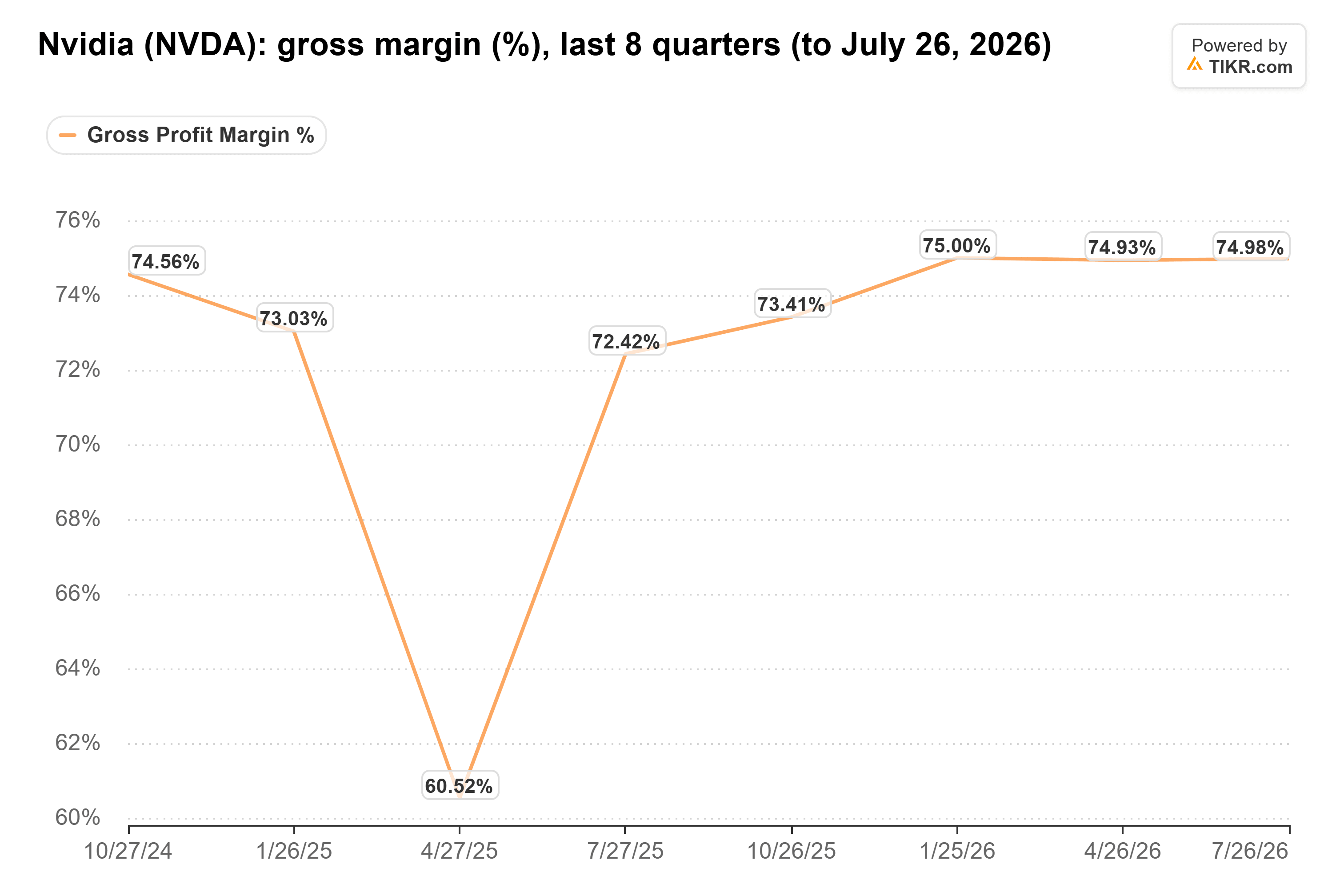
NVIDIA’s gross margin was 75.0% in the quarter to July 26, 2026, and it has been within a tenth of a point of that for three quarters. (The dip to 60.5% in the quarter to April 27, 2025 came from a charge of about $4.5 billion on H20 chips after U.S. export restrictions.) Margins like that depend on buyers who can’t get enough of what NVIDIA sells. If Niles is right that supply across semis is catching up, that’s the pricing at risk.
What Dell’s November 24 Report Will Settle
Dell’s stockpile says chips were there for anyone willing to pay, and Intel says PC buyers are starting to balk at the price. Together, they point to shortage pricing that’s closer to its end than its start. That makes me more cautious on the chipmakers still priced as if everything is sold out than on the companies buying from them.
The other side is that Dell’s $95 billion backlog uses up every part on that shelf. Dell’s third-quarter report on November 24 will show which read is right. If inventory starts falling as AI racks ship, the stockpile was a bet on demand that paid off. If it keeps climbing past $21.3 billion, Niles’ read gets a lot harder to argue with.
So what is Dell stock actually worth?
TIKR lets you forecast the future price of any stock in less than a minute. Just enter a few assumptions into TIKR’s valuation model and see what Dell could be worth. Start from Wall Street consensus estimates, or adjust the inputs to reflect your own view of the business. It’s free to use.
Disclaimer:
Please note that the articles on TIKR are not intended to serve as investment or financial advice from TIKR or our content team, nor are they recommendations to buy or sell any stocks. We create our content based on TIKR Terminal’s investment data and analysts’ estimates. Our analysis might not include recent company news or important updates. TIKR has no position in any of the stocks mentioned. Thank you for reading, and happy investing!