
Key Takeaways
- Lockheed Martin (LMT) raised its quarterly dividend to $3.60 a share on Oct. 9, and General Dynamics (GD) raised its 2026 earnings forecast again on Oct. 30.
- Both companies grew their dividends 6.4% a year from fiscal 2020 to fiscal 2025, but Lockheed yields 2.4% against General Dynamics’s 1.7%.
- General Dynamics pays out 29% of its free cash flow over the trailing 12 months, against Lockheed’s 38%, so its dividend has more room.
- Lockheed’s 10-year F-35 framework with the Pentagon still needs approval and funding from Congress, and Lockheed is putting up at least $7 billion of its own money to support it.
Lockheed Martin raised its quarterly dividend to $3.60 a share on Oct. 9, up from $3.45. On its Q3 call, it called the raise “our 24th consecutive year of dividend increases.”
Eight days after that call, General Dynamics raised its full-year 2026 earnings forecast again, to $17.20-$17.30 a share. Over the five years to fiscal 2025, the two grew their dividends at exactly the same pace: 6.4% a year.
So if both keep that pace, which one pays you more over the next 10 years?
| Metric | Lockheed Martin (LMT) | General Dynamics (GD) |
|---|---|---|
| Dividend yield | 2.5% | 1.8% |
| Dividend growth, fiscal 2020-2025 | 6.4% a year | 6.4% a year |
| Cash dividend payout ratio, TTM | 38% | 29% |
| Cash dividend payout ratio, fiscal 2026 consensus | 43% | 33% |
| Net debt/EBITDA | 1.4x | 0.6x |
| Interest coverage | 7.9x | 18.7x |
Source: TIKR, Nov. 9, 2026. TTM is the twelve months to Sept. 27, 2026, for Lockheed and to Oct. 4, 2026, for General Dynamics.
6 safe dividend stocks paying retirees 6%+ yields
There are over 100 stocks paying 6%+ annual dividends today.
But after an extensive investment review leveraging TIKR’s proprietary data, we now believe only six of them are truly safe for retirees.
They’re all yours for free as part of our new investment report, which you can access right here.
Lockheed has $292 billion of work lined up
Lockheed’s Q3 sales rose 11% from a year earlier to $20.7 billion, and backlog reached a record $292.0 billion as of Sept. 27. On Oct. 22, Lockheed and the Pentagon announced a 10-year framework for at least 850 F-35s.
Lockheed says it invests in the business first, and “Second, we return cash to shareholders.” Over the twelve months to Sept. 27, 2026, the dividend took a comfortable 38% of free cash flow.
The fiscal 2026 consensus puts that at 43%, and Lockheed’s own guidance of $7.8-$8.0 billion in 2026 free cash flow is slightly above that consensus.
Free cash flow has covered the dividend in every fiscal year since 2019, and dividends paid reached $3.13 billion in fiscal 2025:
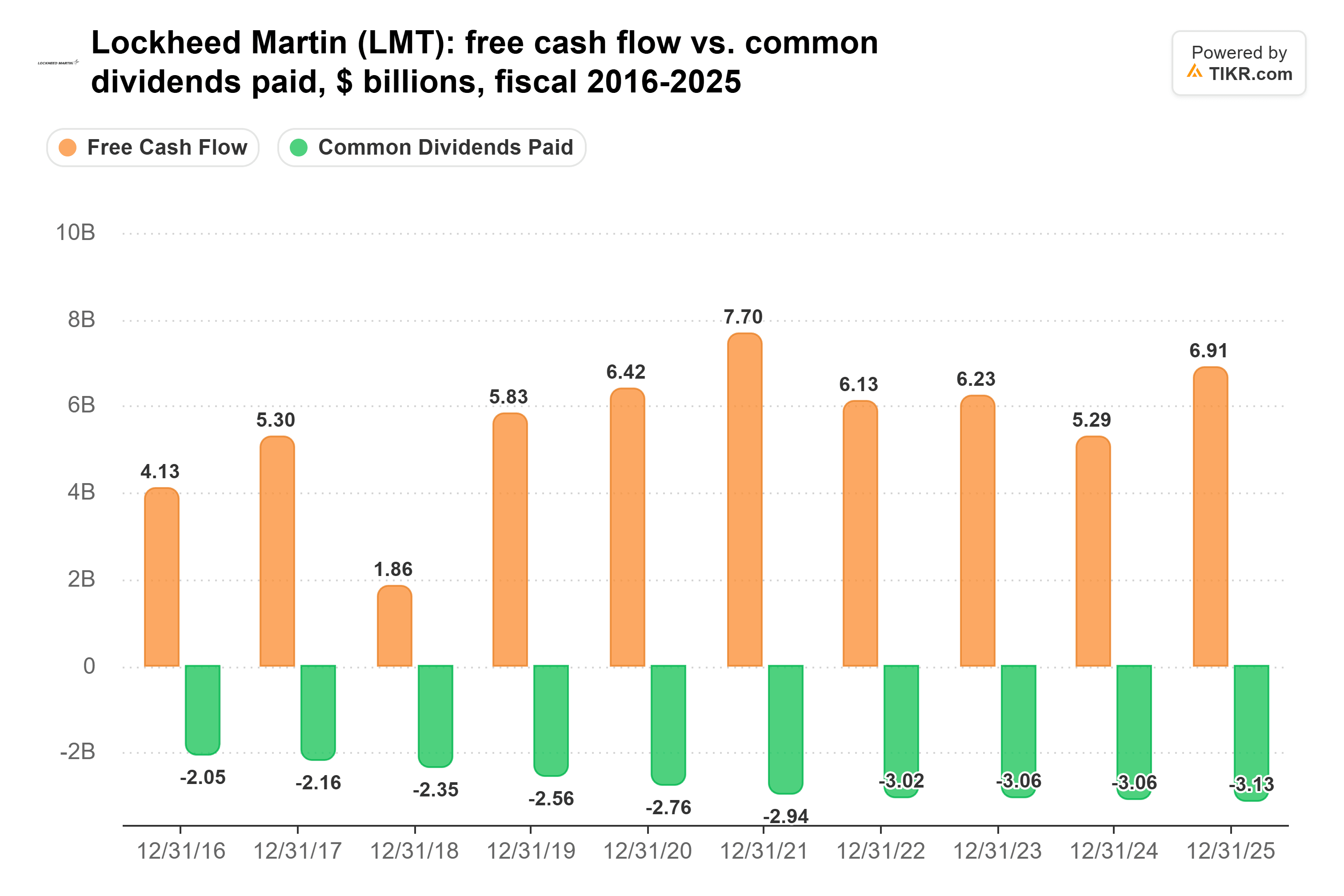
At a 2.5% yield, $10,000 pays $250 a year today. If the dividend grows 6.4% a year, that becomes about $436 in year 10, a 4.4% yield on the original $10,000, and about $3,354 in total over the decade.
The main risk is the F-35 framework, since Lockheed is self-funding at least $7 billion of supporting work for it.
General Dynamics has more room to spare
General Dynamics raised its dividend at that same pace, from $4.40 to $6.00 a share, but it starts from a lower 1.8% yield.
Its Q3 was just as strong: revenue rose 12.9% from a year earlier to $14.6 billion, and backlog reached a record $220 billion.
Its dividend has more cushion than Lockheed’s, taking 29% of free cash flow over the twelve months to Oct. 4, 2026, and 33% on the fiscal 2026 consensus.
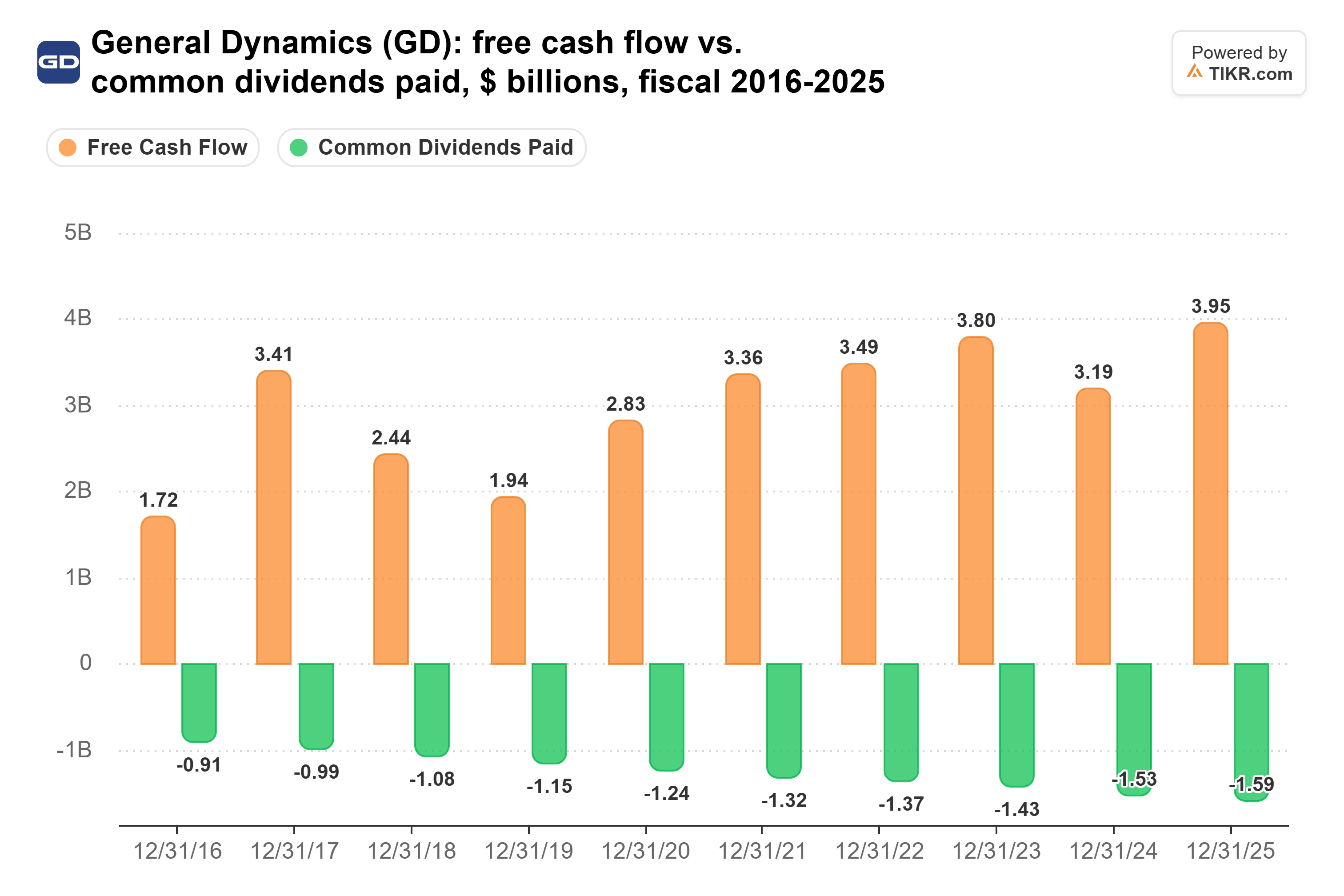
That consensus has free cash flow rising 28%, from fiscal 2025’s $3.95 billion to $5.06 billion, which looks reachable, since trailing free cash flow is already $5.77 billion.
Free cash flow covered the dividend in every fiscal year from 2016 to 2025, while dividends paid rose from $910 million to $1.59 billion:
On the Q3 call, CFO Kimberly Kuryea said, “We continue to support the dividend as it relates to share repurchase,” with buybacks only offsetting dilution for now.
On Oct. 7, General Dynamics named its president, Danny Deep, to succeed CEO Phebe Novakovic from January.
At a 1.8% yield, $10,000 pays $180 a year today. If the dividend grows 6.4% a year, that becomes about $315 in year 10, a 3.1% yield on the original $10,000, and about $2,418 in total over the decade.
So which dividend wins?
Lockheed Martin pays you more over the next 10 years, and I’d take it. With both dividends growing 6.4% a year, $10,000 in Lockheed pays about $3,354 over the decade, against about $2,418 for General Dynamics.
At those rates, General Dynamics’s yearly income wouldn’t catch Lockheed’s for more than 30 years.
The real question is whether Lockheed can keep raising at that pace. Analysts expect its free cash flow to stay well above what the dividend needs:
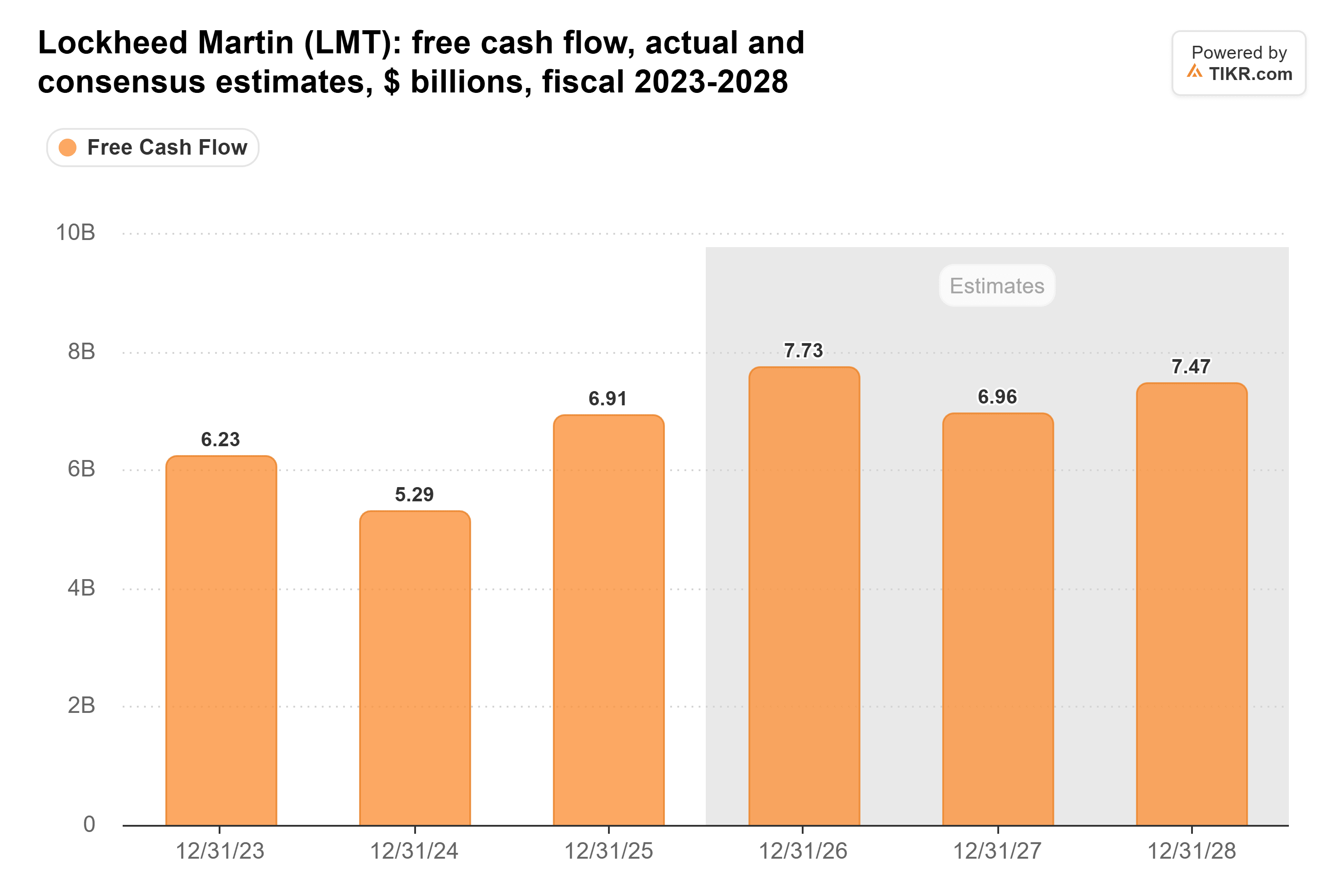
Consensus dips to $6.96 billion in fiscal 2027 before rising to $7.47 billion in fiscal 2028. Even the dip is more than twice the $3.13 billion Lockheed paid in dividends in fiscal 2025.
General Dynamics’ dividend is the better covered of the two, with a smaller payout and less debt.
But it would have to make up a lot of ground from a 1.8% yield in 10 years, and at 38% of free cash flow, Lockheed has plenty of room to keep raising too.
Of course, the F-35 framework still needs Congress to authorize and fund it before it becomes a contract. If Congress stalls it, or Lockheed’s spending on it pushes free cash flow below those estimates, Lockheed’s raises could slow.
Forget Lockheed Martin: 6 safe 6%+ dividend yields you can buy right now
Dividends can hold the key to enormous wealth. But only if you buy the right ones.
Picking the right high-yield dividend stock can be the difference between a dream retirement…and scraping by every month, waiting for the next Social Security check to clear.
We’ve identified six stocks yielding 6%+ that we believe every retiree should know about right now. (And Lockheed Martin isn’t one of them.)
Disclaimer:
Please note that the articles on TIKR are not intended to serve as investment or financial advice from TIKR or our content team, nor are they recommendations to buy or sell any stocks. We create our content based on TIKR Terminal’s investment data and analysts’ estimates. Our analysis might not include recent company news or important updates. TIKR has no position in any of the stocks mentioned. Thank you for reading, and happy investing!