Key Takeaways
- Kraft Heinz yields 7.3% and Mondelez yields 3.6%, and Mondelez raised its quarterly dividend 4% in July.
- Kraft Heinz’s dividend has held at $1.60 a share since fiscal 2020, while Mondelez’s grew 10.1% a year from fiscal 2020 to fiscal 2025.
- Over the trailing 12 months, Kraft Heinz paid out 50% of its free cash flow as dividends, against 82% for Mondelez.
- Analysts expect Kraft Heinz’s free cash flow to fall in 2026 as it spends more on its brands, which would lift its payout ratio to 69%.
Mondelez International (MDLZ) raised its quarterly dividend 4% on July 28. It announced the raise alongside second-quarter results that showed organic net revenue up 2.2% from a year earlier.
Kraft Heinz (KHC) had a rougher quarter. On Aug. 5, it reported second-quarter organic net sales down 1.3% and a $7.4 billion non-cash impairment. Yet Kraft Heinz still pays the far bigger yield, 7.3% against 3.6%, on a dividend that’s sat at $1.60 a share since fiscal 2020.
So if you’re buying a food stock for income, which one actually pays you more over the next 10 years?
| Metric | Kraft Heinz (KHC) | Mondelez (MDLZ) |
|---|---|---|
| Dividend yield | 7.3% | 3.6% |
| Annual dividend | $1.60 | $2.08 |
| Dividend growth, fiscal 2020–2025 | 0.0% a year | 10.1% a year |
| Cash dividend payout ratio (TTM) | 50% | 82% |
| Cash dividend payout ratio (fiscal 2026 consensus) | 69% | 80% |
| Net debt/EBITDA (LTM) | 2.71x | 2.95x |
| Interest coverage (LTM) | 4.93x | 7.97x |
Kraft Heinz: the big check holds
Kraft Heinz’s sales are slipping at home. North America organic net sales fell 2.7% in the second quarter of 2026, while emerging markets grew 8.5%. For the full year, the company expects organic net sales down 0.5% to 2.0%.
The dividend is on firmer ground. Over the 12 months to June 27, 2026, it took a comfortable 50% of free cash flow. The company lists sustaining the dividend among its priorities, alongside investing in the business and paying down debt.
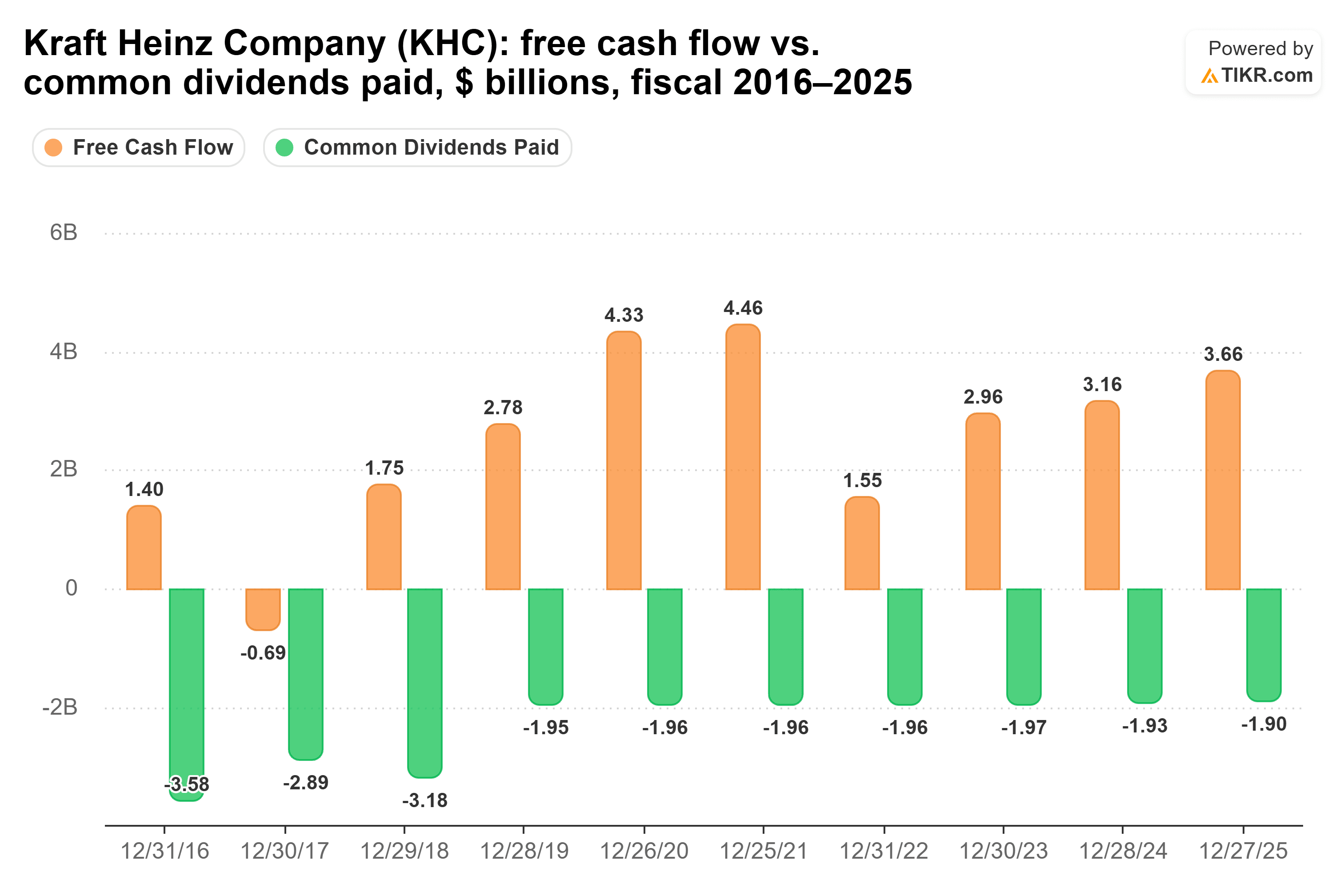
Dividends paid fell from $3.18 billion in fiscal 2018 to $1.95 billion in fiscal 2019. Since then, free cash flow has covered them every year but fiscal 2022.
Consensus has fiscal 2026 free cash flow 25% below fiscal 2025’s, which would lift the ratio to 69%. Management expects adjusted operating income to fall 16% to 18% this year as it puts about $700 million of incremental investment behind its brands. As Kraft Heinz CEO Steve Cahillane put it: “We have seen that our brands respond well when we invest behind them.”
Five analysts make that estimate, and last year’s consensus came within 4% of the actual. Even at 69%, the dividend is well-covered. The main risk is one the company names itself: retailers widening price gaps with private label.
Mondelez: a smaller check that keeps climbing
Where Kraft Heinz’s sales are slipping, Mondelez’s are growing. Net revenues rose 4.1% in the second quarter of 2026 on distribution gains in emerging markets, even with Europe down 3.5% organically. The company now expects at least 2% organic revenue growth for the year.
Its dividend is the tighter fit. It took 82% of free cash flow over the 12 months to June 30, 2026, and consensus puts fiscal 2026 at 80%.

Dividends paid rose from $1.83 billion in fiscal 2021 to $2.49 billion in fiscal 2025. Over the same years, free cash flow barely moved, from $3.18 billion to $3.24 billion, which pushed the payout from 58% to 77%.
For 2026, management expects about $3 billion of free cash flow and adjusted EPS flat to up 5% at constant currency. That leaves less room for raises at the old pace, and July’s 4% raise was well below the 10.1% a year it averaged from fiscal 2020 to fiscal 2025. The main risk is volatile cocoa and other commodity costs, which the company names itself.
So which dividend wins?
Kraft Heinz pays you more over the next 10 years. Put $10,000 into each stock at today’s yields. Hold Kraft Heinz’s dividend flat, at its five-year rate, and grow Mondelez’s 10.1% a year. Kraft Heinz pays about $7,300 in all, against about $5,761 for Mondelez: roughly $1,539 more.
That math asks very little of Kraft Heinz. It just has to keep paying $1.60 a share, from a 50% payout today and 69% forecast for fiscal 2026. It asks a lot of Mondelez, which would need to keep raising 10.1% a year from an 82% payout, right after a 4% raise. And even at that pace, Mondelez’s income only passes Kraft Heinz’s in about 2034, too late to close the gap by year 10.
Mondelez still has a real case. Its business is growing, and its interest coverage is the stronger of the two at 7.97x. At its five-year rate, its $360 a year becomes about $855 by year 10, an 8.5% yield on your original $10,000. From around 2034 on, it would pay the bigger check every year. It’s just that over this decade, Kraft Heinz’s head start is too big, and its dividend is the better covered of the two.
Of course, Kraft Heinz still has to make its investment year pay off. If North America keeps sliding into 2027, that 69% forecast payout is the number to watch.
So what is Kraft Heinz stock actually worth?
TIKR lets you forecast the future price of any stock in less than a minute. Just enter a few assumptions into TIKR’s valuation model and see what Kraft Heinz could be worth. Start from Wall Street consensus estimates, or adjust the inputs to reflect your own view of the business. It’s free to use.
Disclaimer:
Please note that the articles on TIKR are not intended to serve as investment or financial advice from TIKR or our content team, nor are they recommendations to buy or sell any stocks. We create our content based on TIKR Terminal’s investment data and analysts’ estimates. Our analysis might not include recent company news or important updates. TIKR has no position in any of the stocks mentioned. Thank you for reading, and happy investing!