


Key Takeaways
- Clorox yields 6.2% and Kimberly-Clark 5.4%, and Clorox’s CFO says shareholders should expect its dividend raises to continue.
- Over the twelve months to June 30, 2026, Kimberly-Clark’s dividend used 92% of its free cash flow, and Clorox’s used 149%.
- Clorox’s net debt rose to 4.3x EBITDA in fiscal 2026, from 1.8x in fiscal 2025, after its GOJO acquisition.
- The next test is whether Clorox’s free cash flow climbs back above its $602 million dividend bill in fiscal 2027, the year to June 2027.
A 6.2% yield is hard to ignore, and on its Aug. 3 earnings call, Clorox (CLX) told investors to count on it. “Dividend has increased annually for a decade,” said CFO Luc Bellet. “And for now, you should expect this to continue.”
That promise has a catch. Over the twelve months to June 30, 2026, Clorox paid $602 million in dividends out of $405 million of free cash flow.
That’s why anyone hunting for 5%+ income should look at Kimberly-Clark (KMB) right alongside it. Its 5.4% yield is smaller, but over the same twelve months, its $1.68 billion of dividends came out of $1.82 billion of free cash flow. So which one actually pays you more over the next 10 years?
| Metric | Kimberly-Clark (KMB) | Clorox (CLX) |
|---|---|---|
| Dividend yield | 5.4% | 6.2% |
| Annual dividend | $5.12 | $5.00 |
| Dividend growth, 5 years | 3.3% a year (fiscal 2020–2025) | 2.0% a year (fiscal 2021–2026) |
| Cash dividend payout ratio (TTM to June 30, 2026) | 92% | 149% |
| Net debt/EBITDA (LTM) | 1.49x | 4.29x |
| Interest coverage (LTM) | 12.2x | 6.8x |
Kimberly-Clark: tight, but covered
Kimberly-Clark’s second quarter of 2026 was quiet at the top line. Net sales rose 0.6% from the second quarter of 2025 to $4.2 billion, and adjusted EPS rose 10.4% to $1.80.
Its dividend used 92% of free cash flow over the twelve months to June 30, 2026. That’s tight but covered, and the record shows how rarely it has run short.
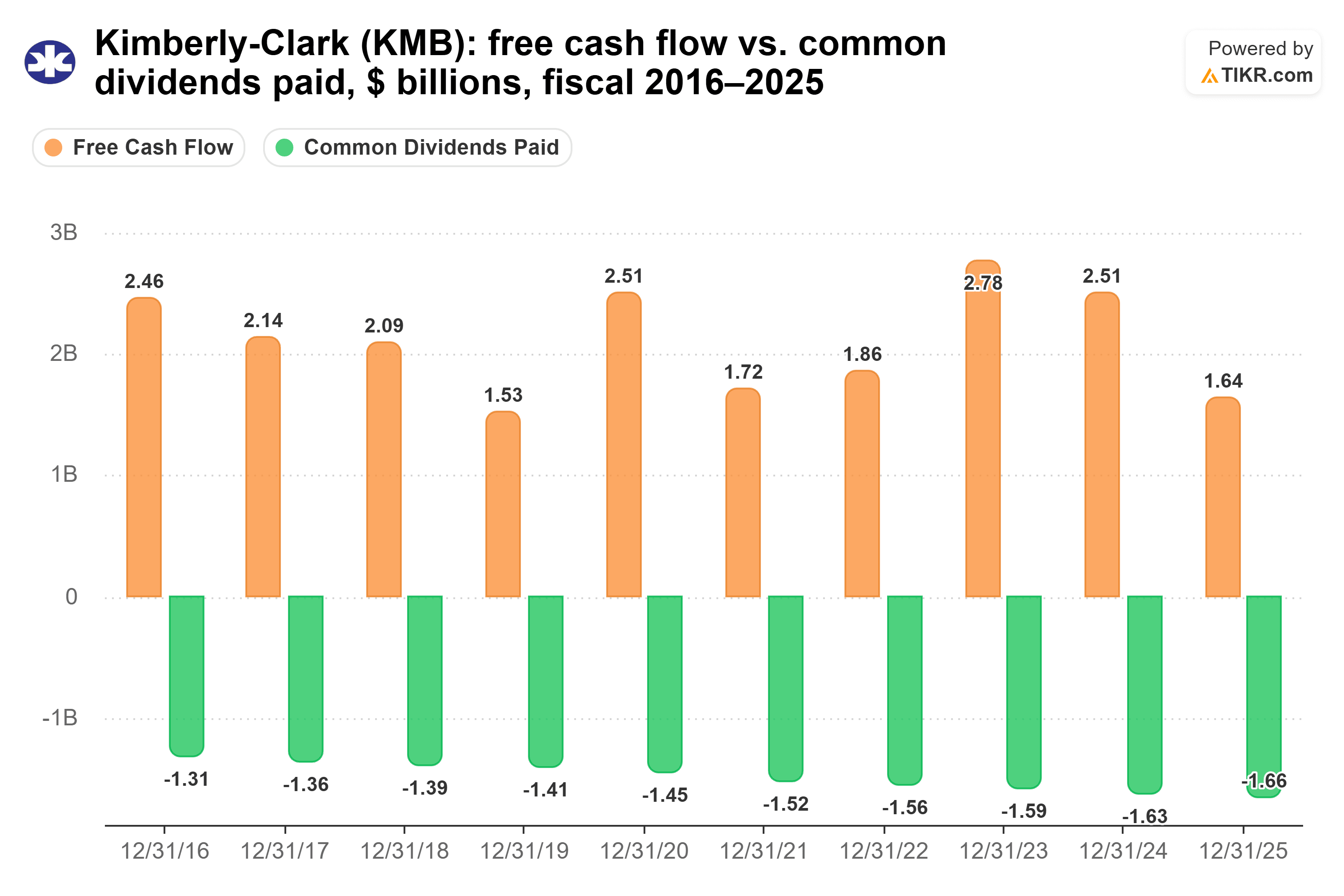
Free cash flow swung between $1.53 billion in fiscal 2019 and $2.78 billion in fiscal 2023, Dividends paid rose every year, from $1.31 billion in fiscal 2016 to $1.66 billion in fiscal 2025. Fiscal 2025 was the only year of the ten when free cash flow, at $1.64 billion, came in just below the dividend.
The first half of 2026 looks better: cash from operations was $1.7 billion, against $1.1 billion a year earlier.
The main risk is China, where false claims about its diapers spread online and are still hurting sales. Management expects adjusted EPS to decline at a low-single-digit rate in 2026, on a constant-currency basis.
Clorox: a bigger check on thinner cash
Clorox’s business is in a harder spot. In fiscal 2026, the year to June 30, net sales fell 5% to $6.72 billion, and adjusted EPS fell 28% to $5.53, from $7.72. Cash from operations fell 38%, to $612 million from $981 million.
Management calls the payout “a bit elevated, but we see this as something more transitory as we rebuild our gross margin and not something structural.” The chart shows it has happened before.

Dividends paid rose from $412 million in fiscal 2017 to $602 million in fiscal 2025 and stayed there in fiscal 2026. Free cash flow fell short of them in three of the last five years: fiscal 2022, 2024 and 2026.
There’s a recovery plan. For fiscal 2027, Clorox guides to adjusted EPS of $5.70 to $6.00 and a gross margin of about 42%. It also expects net sales up 13% to 14%, including about 9.5 points from GOJO.
So which dividend wins?
I’d count on Kimberly-Clark to pay you more over the next 10 years.
At each stock’s 5-year growth rate, $10,000 in Clorox pays about $6,792 over the decade, against about $6,283 from Kimberly-Clark. That’s about $509 more for Clorox, but the edge depends on Clorox raising its dividend every year. If Clorox simply held its dividend, that $10,000 would pay $620 a year, or $6,200 over 10 years. That’s less than Kimberly-Clark.
Holding is a real possibility. Clorox is already paying more than it generates in free cash flow, and its leverage just jumped.

Bellet said the GOJO debt is structured “to ensure that we would actually repay those with the free cash flow that we’ll generate over the next 12 to 18 months.” The dividend has to come out of that same cash. Meanwhile, Kimberly-Clark’s 3.3% pace is backed by a covered payout and light leverage. At these rates, its yearly income would pass Clorox’s around 2037.
That isn’t to say Clorox’s dividend is in danger. Management says its commitment to the dividend “has not changed,” and earnings are guided higher for fiscal 2027. It’s just that Kimberly-Clark gets you its income without needing a recovery first.
Of course, if Clorox gets its gross margin to about 42% in fiscal 2027 and free cash flow climbs back above $602 million, that extra $509 looks a lot more solid. Its next quarterly report is the first place to check.
So what is Kimberly-Clark stock actually worth?
TIKR lets you forecast the future price of any stock in less than a minute. Just enter a few assumptions into TIKR’s valuation model and see what Kimberly-Clark could be worth. Start from Wall Street consensus estimates, or adjust the inputs to reflect your own view of the business. It’s free to use.
Disclaimer:
Please note that the articles on TIKR are not intended to serve as investment or financial advice from TIKR or our content team, nor are they recommendations to buy or sell any stocks. We create our content based on TIKR Terminal’s investment data and analysts’ estimates. Our analysis might not include recent company news or important updates. TIKR has no position in any of the stocks mentioned. Thank you for reading, and happy investing!


