Key Takeaways
- Of the 460 big funds that have filed 13Fs for the quarter ended Sept. 30, 18 bought Sandisk and 20 sold, with Stanley Druckenmiller’s Duquesne Family Office and Leopold Aschenbrenner’s Situational Awareness among the sellers.
- Situational Awareness sold a stake worth $5.67 billion at June 30, far more than any buy, the biggest of which was Jericho Capital’s new $682 million position.
- Sandisk trades at 3.2x forward earnings, the low of its past year, while Dell Technologies, which GQG Partners added to alongside a new Sandisk stake, trades at about 11x.
- At that multiple, investors are already paying for a steep fall in earnings, which gives the buyers the better case as long as Sandisk’s multiyear contracts hold up.
Sandisk (SNDK) is down 66% since June 30, and the big funds that own it can’t agree on what comes next.
Their 13Fs for the quarter ended Sept. 30 split almost evenly. Of the 460 big funds that have filed for the quarter (the ones readers know, or with $1 billion or more of US stocks in their 13Fs, quant and index funds left out), 18 bought Sandisk, either starting a position or adding 20% or more, and 20 sold out or cut 20% or more. Forty of them held it at the quarter’s end.
TIKR tracks 26 analysts on Sandisk. How many say “Buy”?
See the full breakdown of Buy, Hold, and Sell ratings on Sandisk, along with Wall Street’s revenue and earnings estimates, all in one place. More than 500,000 investors use TIKR to research stocks like this one. See Sandisk’s Analyst Ratings
Jericho made the biggest bet
Jericho Capital Asset Management, a $12 billion fund, led the buyers with a new position of 391,880 shares, worth $682 million at Sept. 30 and 5.8% of its 13F stocks. Brad Gerstner’s Altimeter Capital started smaller, with 25,170 shares worth $44 million, 0.4% of its 13F stocks.
GQG Partners, a $164 billion fund, opened a $210 million Sandisk position and more than doubled its stake in Dell Technologies (DELL), to 2.84 million shares worth $1.53 billion, 2.9% of its 13F stocks. That puts GQG on both sides of the flash trade: the company that makes it and one of the companies paying more for it. Dell raised its prices as memory costs climbed, and its product gross margin rose to 17.3% in its quarter ended July 31, from 12.1% a year earlier. Dell trades at about 11x forward earnings, in line with its average since 2019.
Ken Fisher’s Fisher Investments added too, but barely. Its 13F, filed Nov. 6, shows 2,505 shares, up from 2,032, an add worth about $823,000 at quarter-end prices. For a firm that manages $386.67 billion, that’s a rounding error.
Aschenbrenner’s exit dwarfs every buy
Leopold Aschenbrenner’s Situational Awareness sold all 2.5 million of its shares, a stake worth $5.67 billion at June 30, when Sandisk was 28.1% of its 13F stocks. Its 13F, filed Nov. 16, still lists call options on Sandisk with a notional value of $183 million. Sandisk was one of three stocks Aschenbrenner dumped last quarter.
Whale Rock Capital, a $13 billion hedge fund, cut its stake 65%, a sale worth about $673 million, and the 209,621 shares it kept are still 3.2% of its 13F stocks. Amanah Holdings Trust sold all 250,000 of its shares, a $568 million stake at June 30. Stanley Druckenmiller’s Duquesne Family Office sold all 34,900 of its shares, worth $79 million at June 30, or 1.8% of its 13F stocks.
Sandisk trades like the boom is over
On price alone, the sellers look right so far. Sandisk is down 66% since June 30, the last date the sold-out funds’ 13Fs show them holding it, and 55% since Sept. 30. That isn’t any fund’s return, since a 13F doesn’t show when in the quarter a fund traded or what it paid.
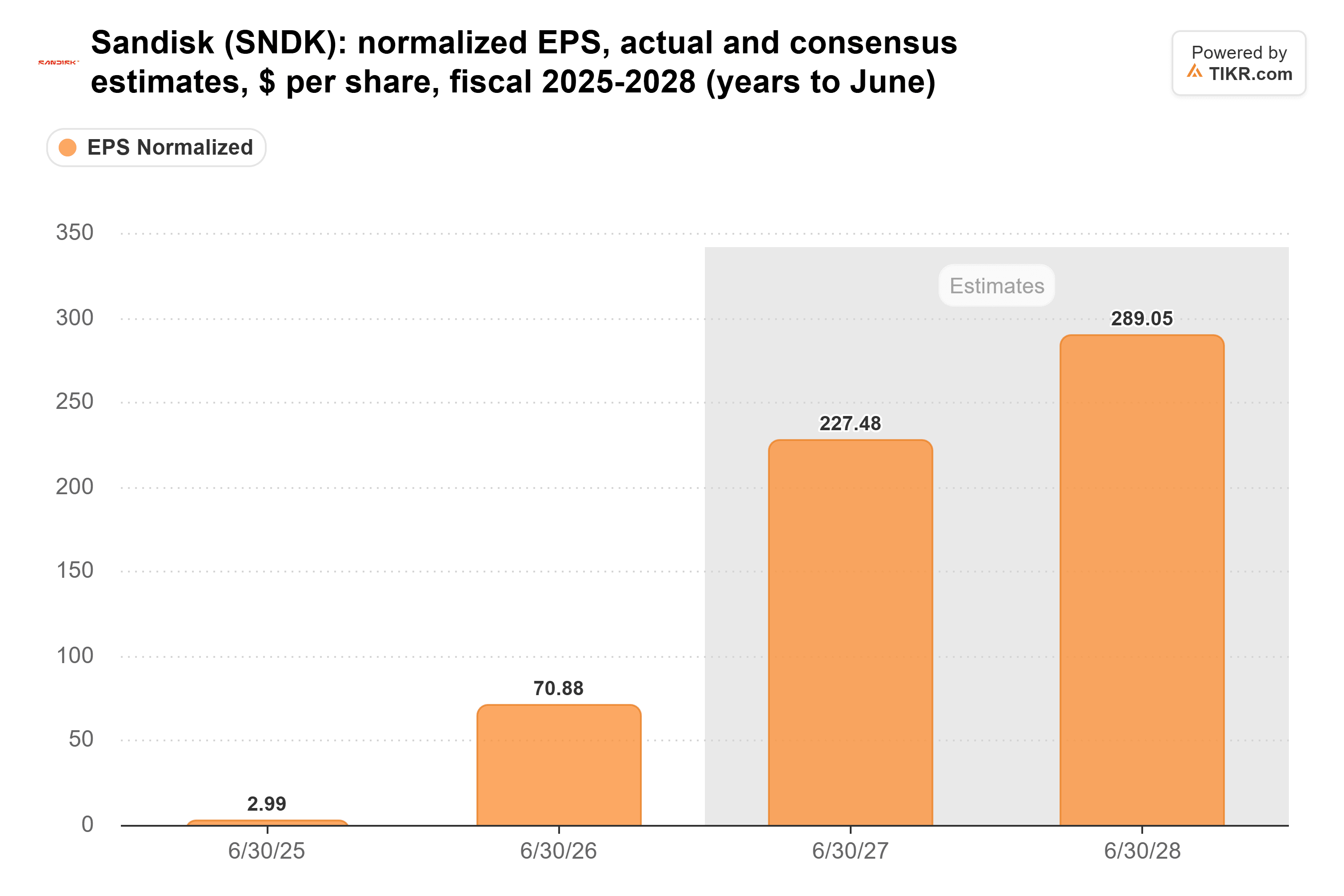
The business has gone the other way. Sandisk earned normalized EPS of $70.88 in fiscal 2026, up from $2.99 the year before, and analysts expect $227.48 in fiscal 2027 and $289.05 in fiscal 2028:
Yet Sandisk trades at 3.2x forward earnings, the low of its past year, against an average of 10x and a high of 27x in January:
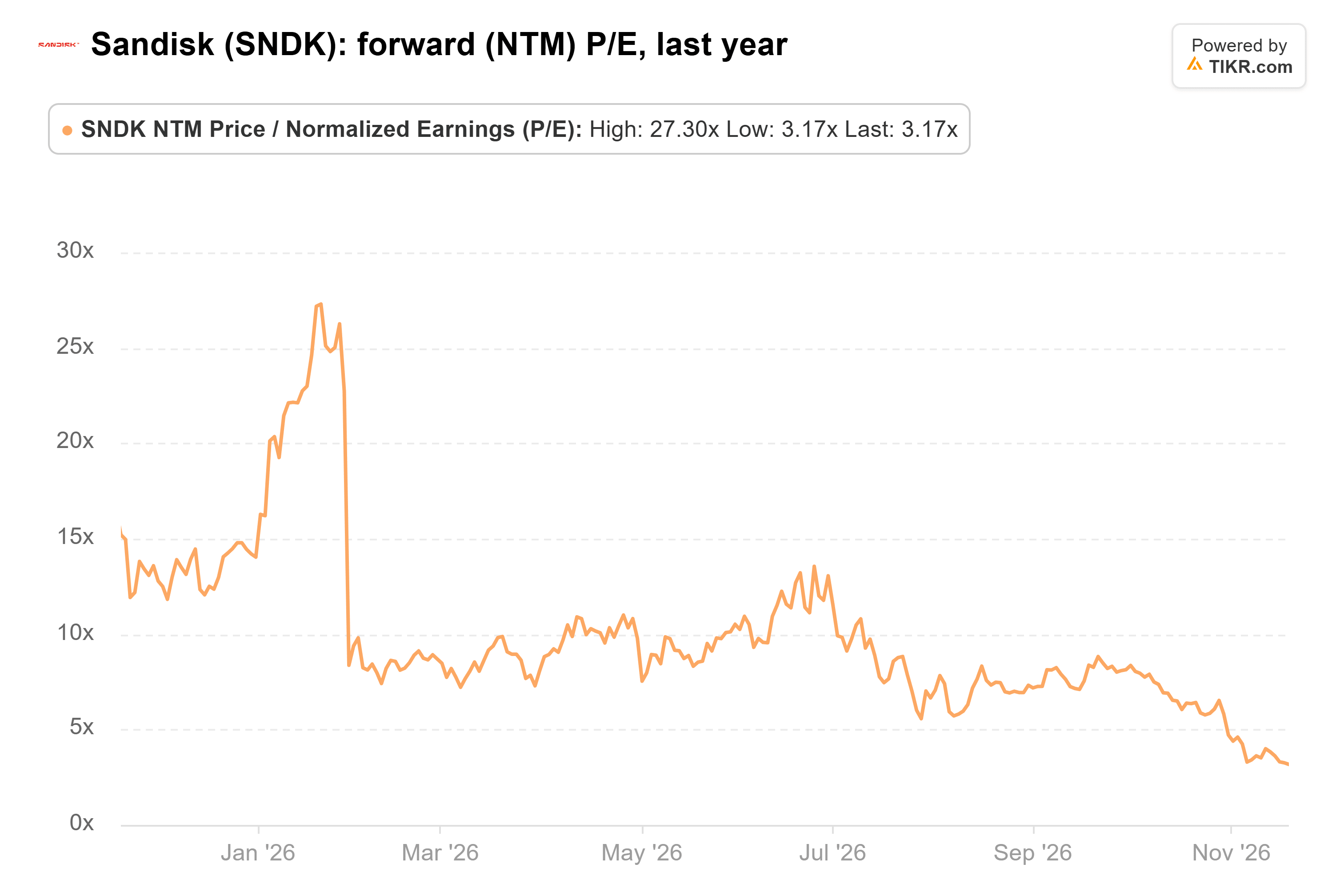
At that multiple, investors are paying for a bust. The three analysts who model fiscal 2030 expect EPS of $155.11, 49% below the fiscal 2029 estimate, and Kioxia’s NAND price gains cooled to the mid-20s percent in the September quarter, from about 70%.
Sandisk’s answer is its multiyear contracts: $88.9 billion of remaining performance obligations at Oct. 2, valued at floor prices that management says still yield a gross margin of about 80%. Its non-GAAP gross margin was 85.1% in its latest quarter, against 29.9% a year earlier.
The consensus target is $2,047, up from $256 a year ago, and even the lowest of the 25 analysts’ targets, $870, sits above the last close of $776:
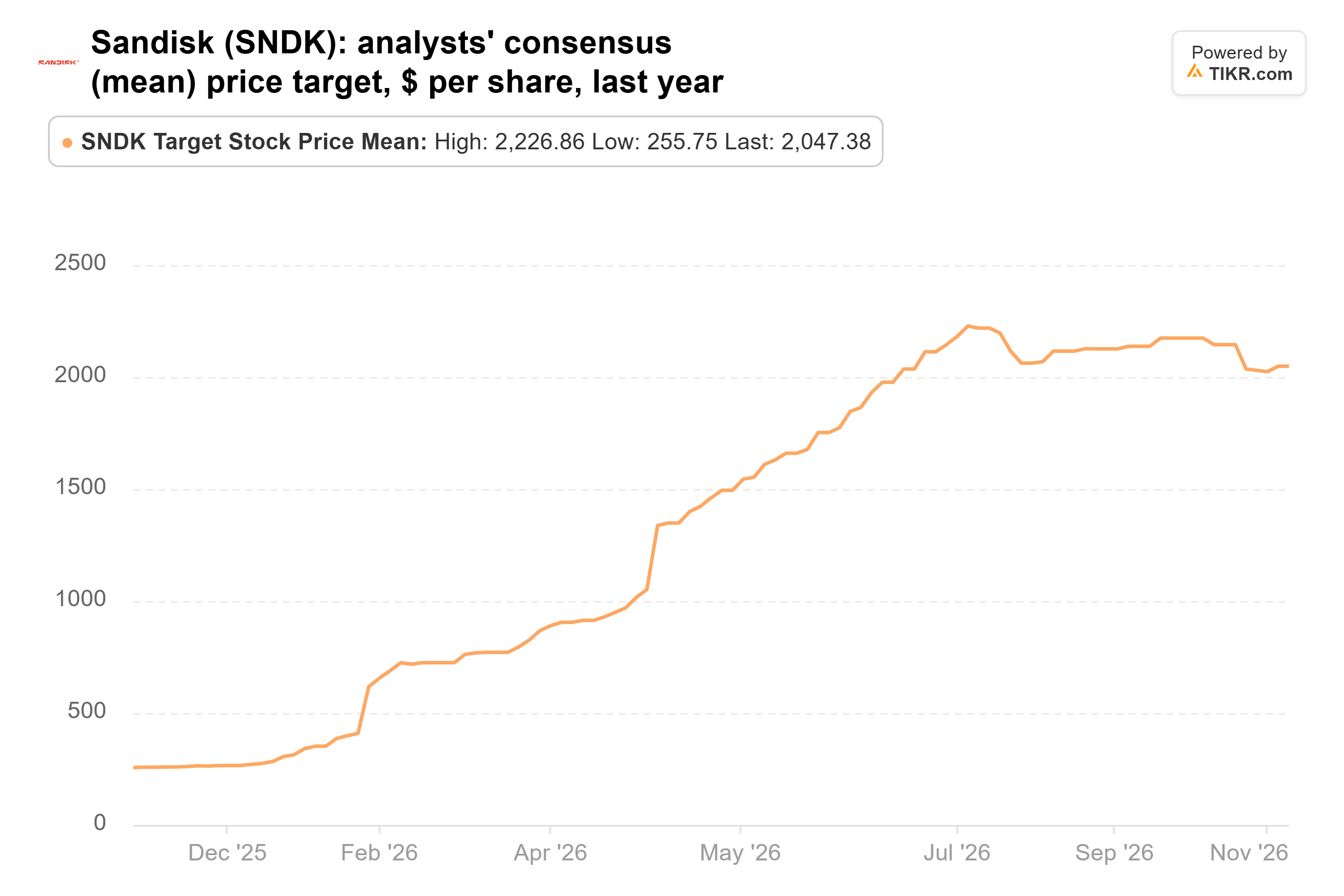
(Those are pre-split prices: Sandisk’s 8-for-1 split takes effect when trading opens Nov. 20.)
I side with the buyers
At 3.2x forward earnings, I’d rather be with the buyers from here. Even if earnings fall by half on the path those few fiscal 2030 estimates sketch, Sandisk wouldn’t be an expensive stock at today’s price. The risk is that its contracts are young: the oldest was signed in January, and the $16.5 billion of guarantees management cited in August cover only part of what they’re worth.
Dell reports next week, and its margins will show whether buyers are still absorbing higher memory prices. Sandisk reports its December quarter in late January. Revenue at or above the top of its $12.2 billion to $12.6 billion guide, with remaining performance obligations above $88.9 billion, would back the buyers. The next round of 13Fs, due in mid-February, will show which funds stuck with their side.
So what is Sandisk stock actually worth?
TIKR lets you forecast the future price of any stock in less than a minute. Just enter a few assumptions into TIKR’s valuation model and see what Sandisk could be worth. Start from Wall Street consensus estimates, or adjust the inputs to reflect your own view of the business. It’s free to use.
Disclaimer:
Please note that the articles on TIKR are not intended to serve as investment or financial advice from TIKR or our content team, nor are they recommendations to buy or sell any stocks. We create our content based on TIKR Terminal’s investment data and analysts’ estimates. Our analysis might not include recent company news or important updates. TIKR has no position in any of the stocks mentioned. Thank you for reading, and happy investing!