Key Takeaways
- Ken Fisher’s Fisher Investments and GQG Partners were among 16 big funds that bought Dell in the quarter ended Sept. 30, while 12 sold.
- GQG added about $931 million of Dell, more than all 12 sales put together, and six of the sellers added ExxonMobil in the same quarter.
- Dell has fallen 42% since Sept. 30, but it trades below its five-year average multiple while analysts keep raising their earnings estimates.
- TIKR’s numbers give the buyers the better case, and Dell’s third-quarter report in late November is the first test of it.
Big funds couldn’t agree on Dell Technologies (DELL) last quarter.
Of the 460 big funds that have filed 13Fs for the quarter ended Sept. 30, 16 bought Dell, either opening a position or adding 20% or more to their shares. (That’s funds readers know, or ones with $1 billion or more of US stocks in their 13Fs, leaving out quant and index funds.) Twelve sold out or cut 20% or more, and 33 held it at the quarter’s end.
Half of the sellers had something in common: six of them added ExxonMobil (XOM) in the same quarter. So did Fisher, and its ExxonMobil buy was far bigger than its Dell buy.
GQG made the biggest bet by far
GQG Partners, which manages $164 billion, raised its Dell stake 156%, to 2.84 million shares from 1.11 million. That’s about $931 million of stock at quarter-end prices, and it made Dell GQG’s 13th-largest holding, at 2.9% of its 13F stocks. WT Asset Management, whose 13F holds $6.18 billion of US stocks, opened a new position of 144,544 shares, worth about $78 million. E20 Capital, with $1.21 billion of US stocks in its 13F, opened one of 54,533 shares and made Dell its 12th-largest holding. Fisher Investments, which manages $387 billion, raised its stake 268%, to 12,487 shares, but at $7 million that’s only its 446th-largest holding. Lee Ainslie’s Maverick Capital more than doubled its stake, to 6,808 shares.
TIKR tracks 30 analysts on Dell Technologies. How many say “Buy”?
See the full breakdown of Buy, Hold, and Sell ratings on Dell Technologies, along with Wall Street’s revenue and earnings estimates, all in one place. More than 500,000 investors use TIKR to research stocks like this one. See Dell Technologies’ Analyst Ratings
The sellers were mostly smaller funds
The biggest sales came from funds managing $2 billion to $3 billion. MANE Global Capital Management, which manages $2.9 billion, sold all 80,225 of its shares, about $35 million, after Dell had made up 3% of its 13F stocks the quarter before. Meridiem Capital Partners, a $2.4 billion fund, sold all 70,074 of its shares, about $30 million. Ardmore Road Asset Management, which manages $2.8 billion, cut its stake 66%, to 20,699 shares. The best-known seller is Jeremy Grantham’s GMO, which sold all 17,118 of its shares, about $7 million.
The ExxonMobil buys stand out on the numbers. ExxonMobil trades at about 11x forward earnings, the same as Dell. But analysts expect its normalized EPS to fall from $13.69 in 2026 to $10.32 in 2028 as the war-year lift to oil and refining fades. Their average target is 16% above ExxonMobil’s price, against 85% for Dell. Fisher’s new ExxonMobil stake of 31.93 million shares, worth $5.20 billion at Sept. 30, dwarfs its Dell position.
The sellers are ahead on price, for now
Dell is down 42% from its Sept. 30 price, which is the price every stake above is valued at. That isn’t any fund’s return, since a 13F doesn’t show what a fund paid or whether it has traded since. Barclays downgraded Dell to Equal Weight on Oct. 14 and cut its target to $574 from $603. Since then, investors have sold on fears of a Texas freeze on data center permits and on the Fed’s Nov. 13 warning about circular financing in AI.
But analysts keep raising what they expect Dell to earn.
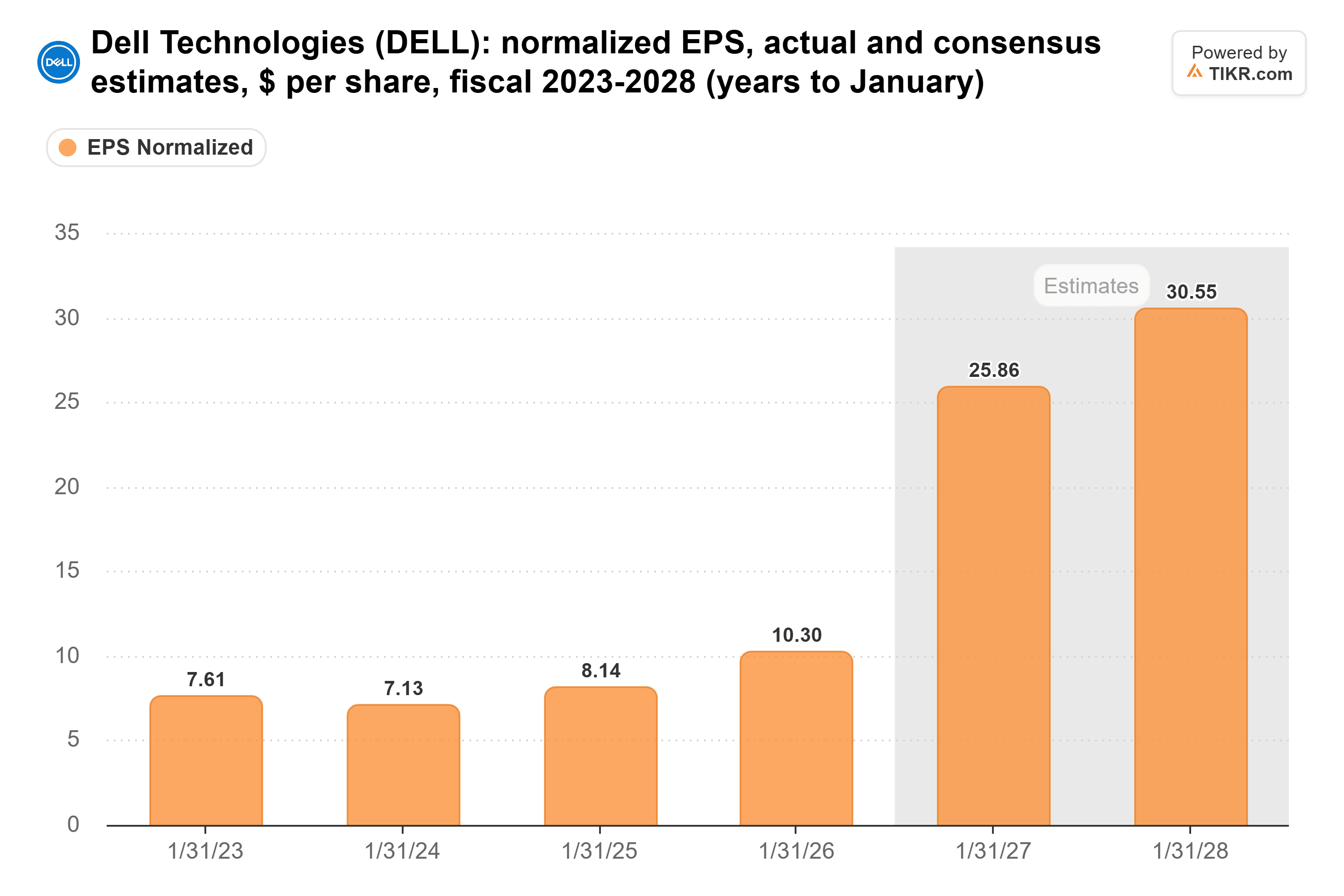
Consensus normalized EPS is $25.86 for the year ending January 2027, up from $10.30 the year before, and $35.63 for the year ending January 2029. The estimate for the year ending January 2028 was $21.40 at the end of June. It’s $30.55 now. All of these estimates predate the third-quarter report, for which Dell guided to non-GAAP EPS of $6.50, below the second quarter’s $7.04.
The stock also trades below its usual multiple.
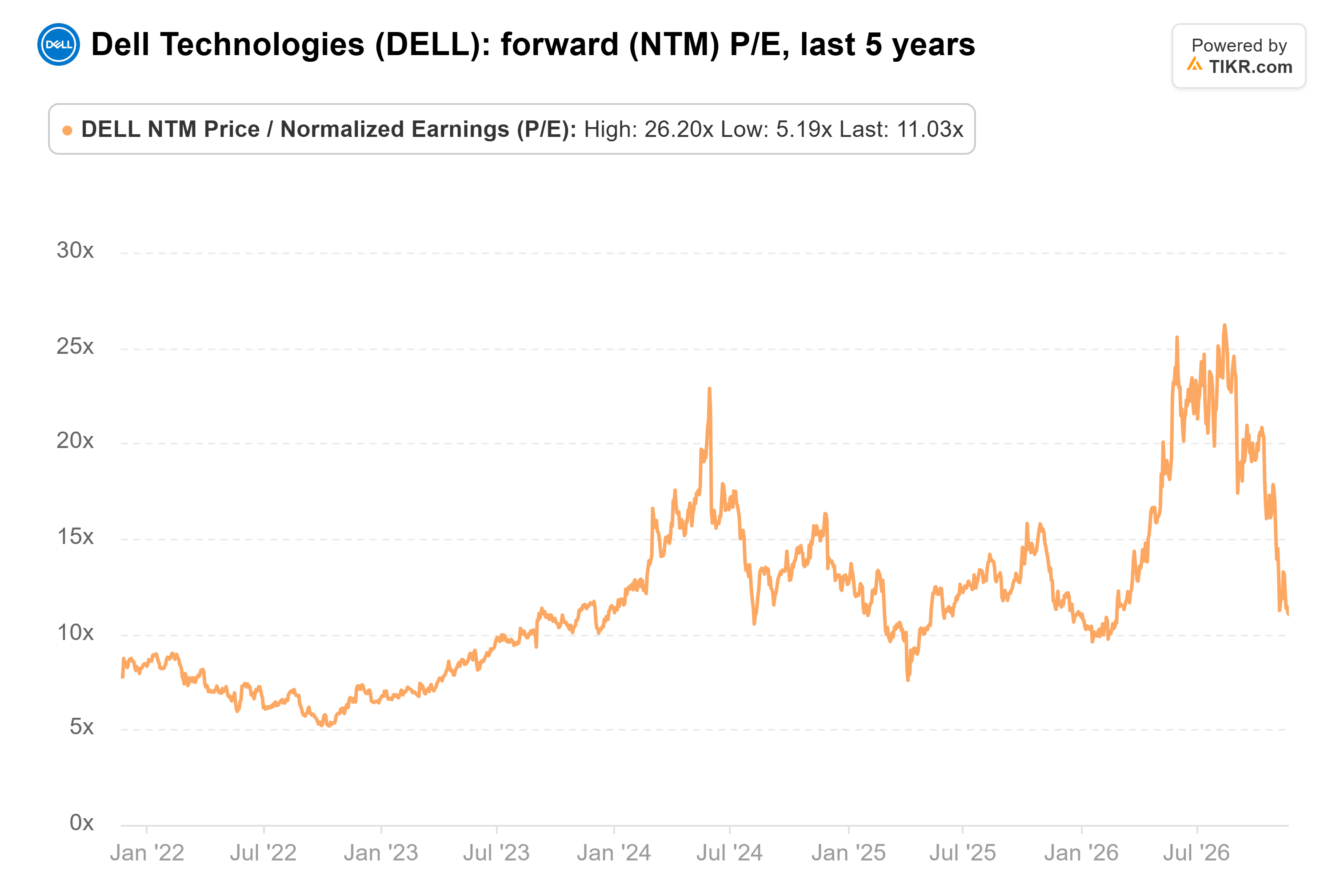
Dell’s forward P/E is 11x, under its five-year average of 12x and far below the 26x it reached in August.
The Street’s average target has climbed along with the estimates.
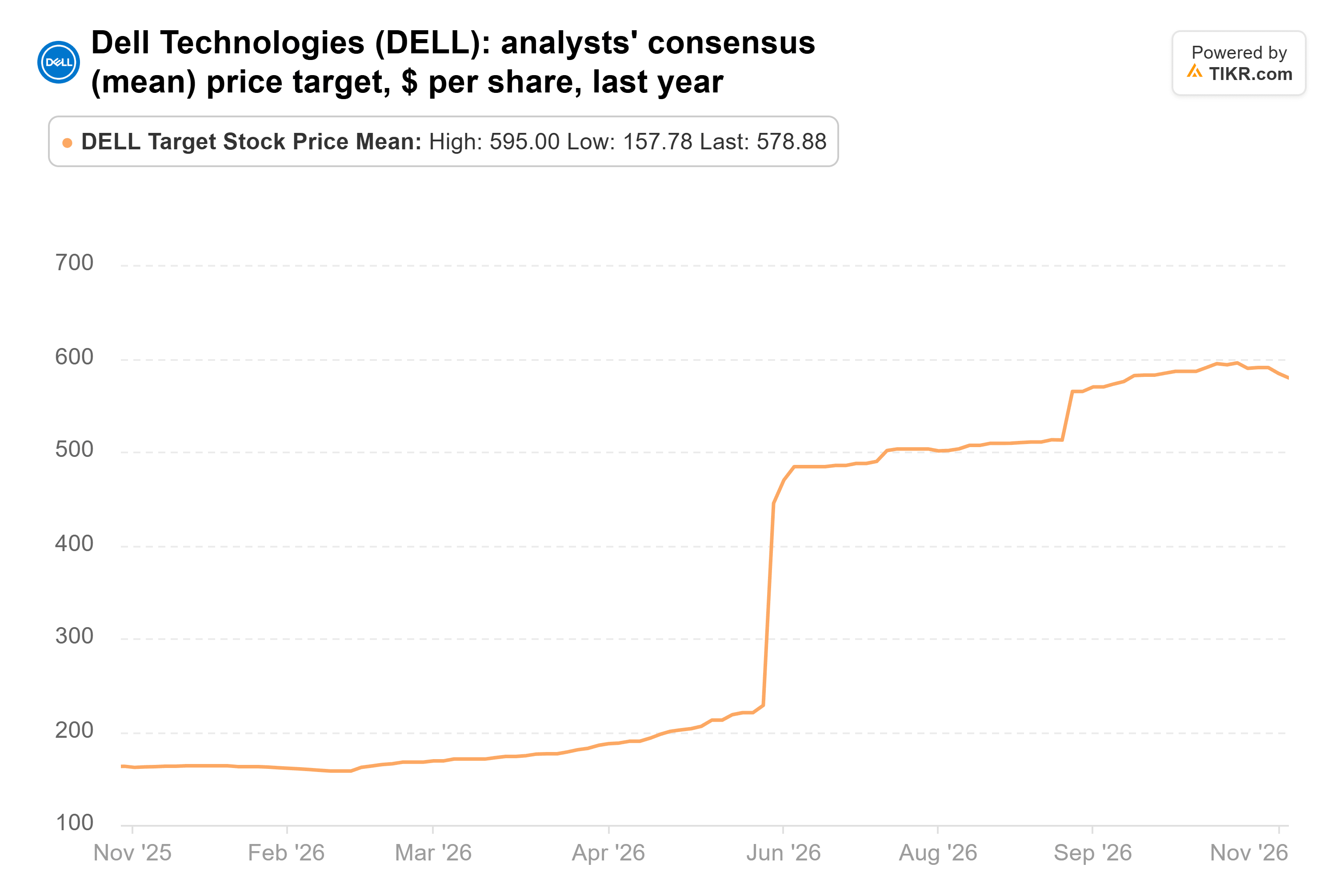
The average target is now $579, up from $163 a year ago. On our math, $579 is about 16x the $35.63 analysts expect for the year ending January 2029, which is what the market will be pricing a year from now. That’s well above Dell’s usual 12x, so the target needs a higher multiple as well as estimates that hold.
The buyers have the better case
Cash is the sellers’ strongest point. In the first half of Dell’s fiscal year, through July 31, free cash flow was $4.1 billion, the same as a year earlier, while GAAP net income rose to $7.6 billion from $2.1 billion. Over the same six months, Dell’s lower-grade customer financing receivables rose to $4.4 billion from $1.8 billion.
Still, I side with the buyers. Estimates are still rising, and the stock already prices in a lot of this year’s AI and memory boom fading.
Dell’s third-quarter report, expected in late November, is the first test. If AI server revenue reaches the $19 billion guide and the backlog holds near $95 billion, the buyers look right. If financing receivables jump by billions again, the sellers do.
So what is Dell stock actually worth?
TIKR lets you forecast the future price of any stock in less than a minute. Just enter a few assumptions into TIKR’s valuation model and see what Dell could be worth. Start from Wall Street consensus estimates, or adjust the inputs to reflect your own view of the business. It’s free to use.
Disclaimer:
Please note that the articles on TIKR are not intended to serve as investment or financial advice from TIKR or our content team, nor are they recommendations to buy or sell any stocks. We create our content based on TIKR Terminal’s investment data and analysts’ estimates. Our analysis might not include recent company news or important updates. TIKR has no position in any of the stocks mentioned. Thank you for reading, and happy investing!