
Key Takeaways
- Of the 460 big funds that have filed 13Fs for the quarter ended Sept. 30, 16 bought Walmart and 16 sold it. The biggest moves were a $177 million new stake and a $168 million exit.
- Walmart stock is up 21% since Sept. 30. Its Nov. 19 report beat its own profit guidance and raised its outlook for the year.
- At 42x forward earnings, Walmart trades well above its five-year average of about 30x and Target’s roughly 17x, though below Costco’s roughly 48x.
- The sellers have the stronger case from here, since analysts’ consensus target is only about 5% above the stock’s last close.
Walmart drew as many big sellers as big buyers last quarter. Walmart (WMT) was bought by 16 of the 460 big funds that have filed 13Fs for the quarter ended Sept. 30, and 16 others sold out or cut their stakes by 20% or more. “Big funds” here means funds readers know or ones with $1 billion or more of US stocks, with quant and index funds left out. A buy means a new position or 20% or more added, and 53 funds held the stock at the quarter’s end.
So far, the buyers have done better. The stock is up 21% since Sept. 30, and Walmart’s Nov. 19 report beat its own profit guidance. But at 42x forward earnings, Walmart costs more than twice as much as Target (TGT) and not much less than Costco (COST).
The buyers went big on new positions
The Wellcome Trust made the biggest buy. Its 13F, filed Nov. 12, shows a new position of 1.70 million shares worth $177 million at Sept. 30. That’s 1.9% of the $9.16 billion of US stocks its 13F holds. MKP Capital Management, which manages $12.85 billion, opened a $61 million position. Mane Global Capital Management took its stake from 3,170 shares to 432,596, worth $45 million. Two well-known managers bought too, in small size: Lee Ainslie’s Maverick Capital opened a position worth about $994,000, and Bill Nygren’s Harris Associates nearly tripled its stake.
TIKR tracks 45 analysts on Walmart. How many say “Buy”?
See the full breakdown of Buy, Hold, and Sell ratings on Walmart, along with Wall Street’s revenue and earnings estimates, all in one place. More than 500,000 investors use TIKR to research stocks like this one. See Walmart’s Analyst Ratings
The sellers walked away from almost as much
Junto Capital Management, which manages $10.52 billion, sold all 1.49 million of its shares, according to its 13F filed Nov. 16. On June 30 that stake was worth $168 million and made up 3.1% of its 13F stocks. Anomaly Capital Management sold out of a stake worth $51 million on June 30. Blue Sparrow, whose 13F holds $8.31 billion of US stocks, cut its stake 64% to 355,000 shares. In the same quarter it nearly doubled its Costco stake, to 41,000 shares, and each of those two stakes was worth $37 million at Sept. 30.
The filings show only what each fund held at the end of June and the end of September. We can’t tell when anyone traded, at what price, or why. The 21% gain is the stock’s own move from its Sept. 30 price, since no filing shows what a fund paid or whether it still holds the shares.
Walmart handed the buyers a good quarter
Walmart’s adjusted EPS came in at $0.65 for the quarter ended Oct. 31, above its $0.62-$0.64 guide. Adjusted operating income rose 5.5% in constant currency, against a 2%-4% guide. Walmart U.S. comparable sales excluding fuel grew 2.9%, up from 2.6% in the second quarter, and 3.6% excluding health and wellness. Its advertising sales rose 37%. Walmart raised its adjusted EPS outlook for the year ending January 2027 to $2.84-$2.89 from $2.80-$2.87.
Analysts already expected a bit more than that: $2.90 for this fiscal year, rising to $3.63 for the year ending January 2029.
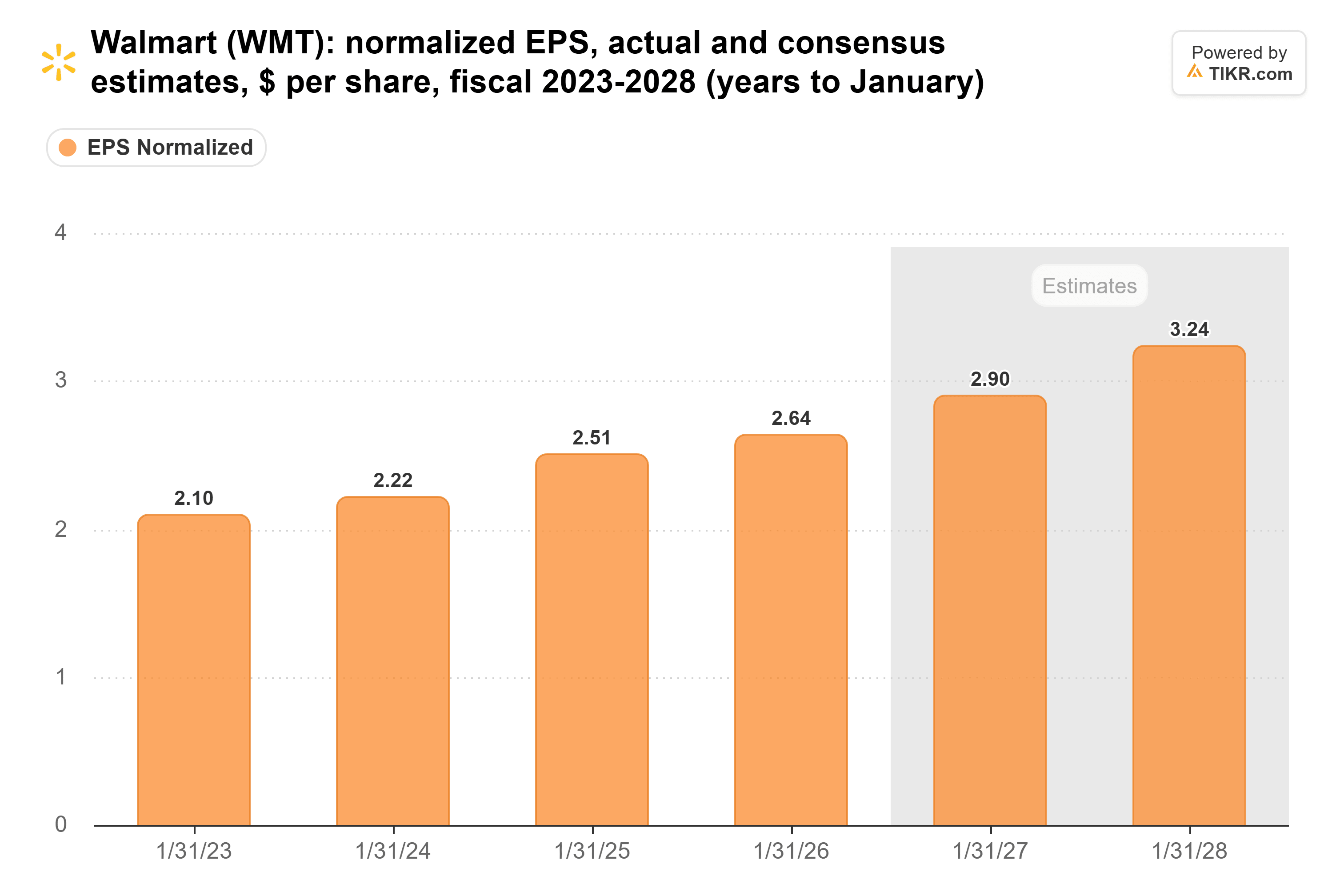
The raised guidance gives analysts little reason to lift their numbers, and the stock slipped 1% on the day of the report.
At 42x, the sellers have the numbers
Walmart trades at 42x forward earnings, against a five-year average of 29.7x:
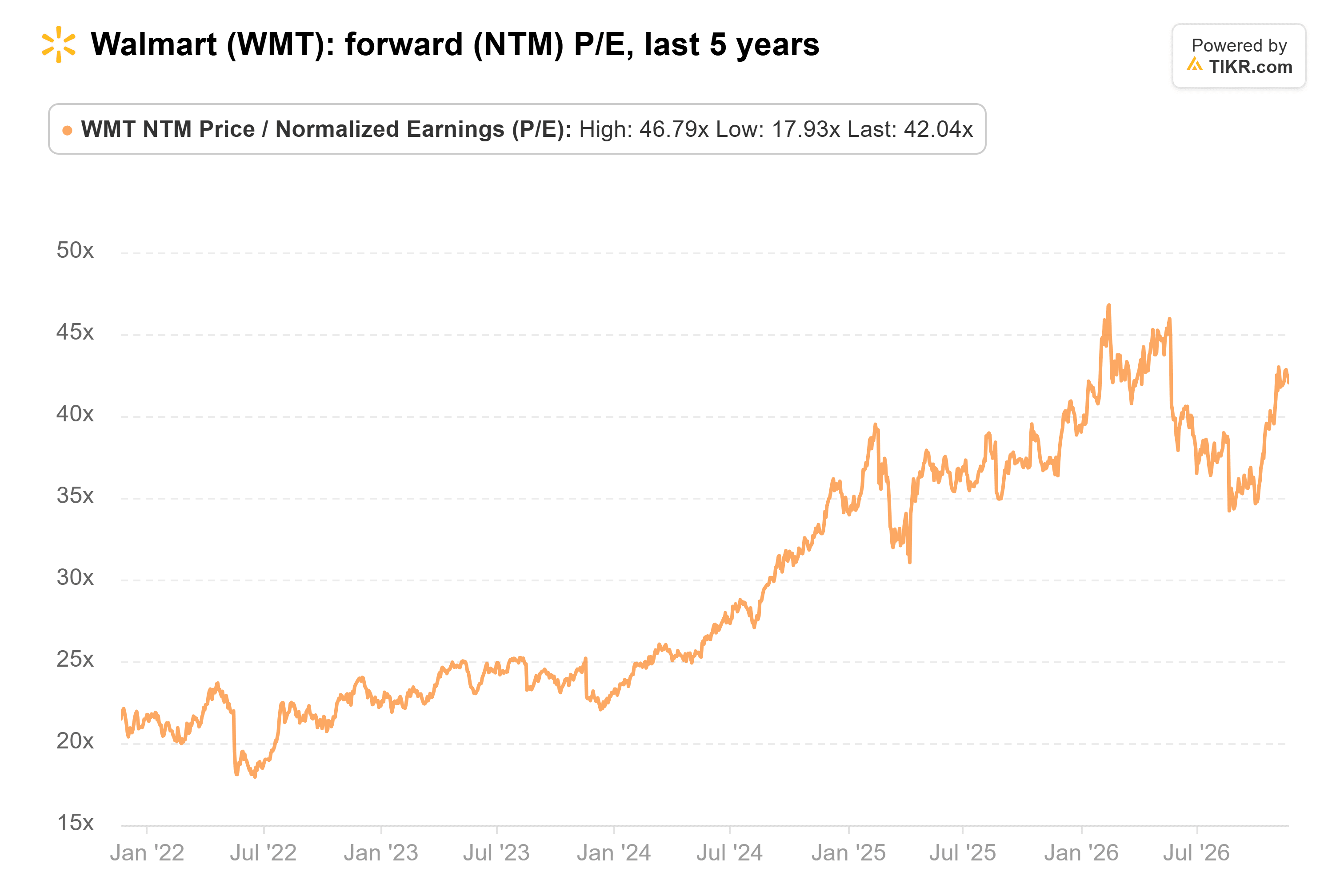
That’s not far from its 46.8x peak in February. At its five-year average multiple, analysts’ estimate for the year ending January 2029 would be worth about $107 a share. Target trades at about 17x, after its third-quarter comparable sales grew 5.6% on 5.0% more traffic. Costco is even pricier at about 48x, and its consensus target sits 0.8% below its last close.
Walmart’s consensus target has slipped since June:
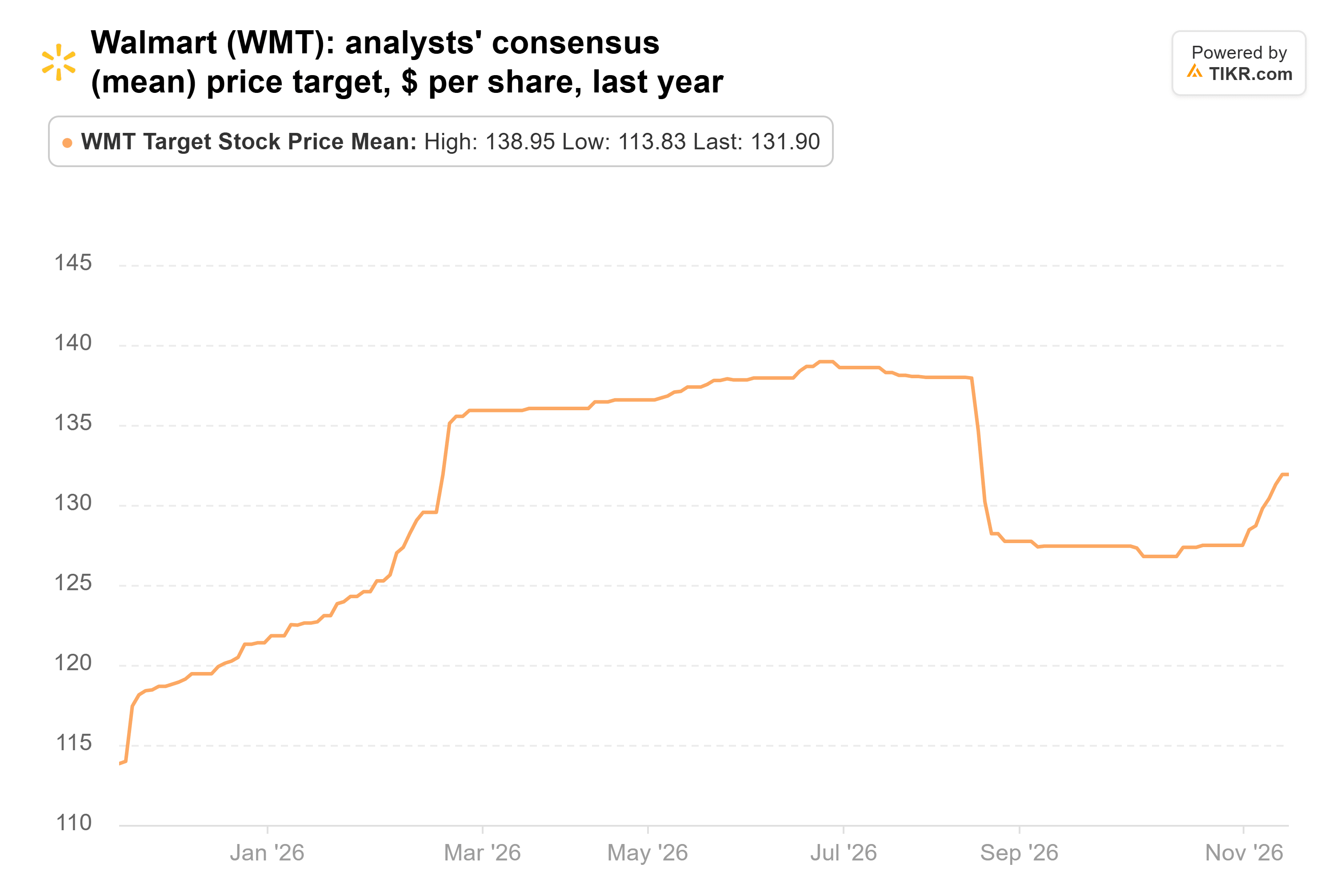
At $131.90, down from June’s $138.95, the target sits about 5% above the last close, with individual targets running from $81 to $155. Those targets were set before the Nov. 19 report.
The sellers have the better case from here
I side with the sellers. The buyers have been right so far, and Walmart’s business is holding up. But at 42x, investors are already paying for margin gains Walmart has only started to show, and analysts see only about 5% upside even after a good report. The risk to that view is advertising: if Walmart keeps growing it at this quarter’s pace and profit keeps outrunning sales, today’s multiple won’t look as rich.
The next test comes in February, with Walmart’s fourth-quarter report and its outlook for the year ending January 2028. If Walmart guides EPS at or above the $3.24 analysts expect, with capex back under 4% of net sales, I’d change my mind. The funds’ next 13Fs, due in mid-February, will show which side kept going.
So what is Walmart stock actually worth?
TIKR lets you forecast the future price of any stock in less than a minute. Just enter a few assumptions into TIKR’s valuation model and see what Walmart could be worth. Start from Wall Street consensus estimates, or adjust the inputs to reflect your own view of the business. It’s free to use.
Disclaimer:
Please note that the articles on TIKR are not intended to serve as investment or financial advice from TIKR or our content team, nor are they recommendations to buy or sell any stocks. We create our content based on TIKR Terminal’s investment data and analysts’ estimates. Our analysis might not include recent company news or important updates. TIKR has no position in any of the stocks mentioned. Thank you for reading, and happy investing!