


Key Takeawayst
- The Fed flagged “circular financing,” where chip suppliers help back buyers of their own hardware.
- Dell’s financing receivables jumped to $20.4 billion at July 31, 2026, from $14.3 billion in January.
- Lower-grade receivables more than doubled to $4.4 billion as free cash flow stalled.
- The loss provision is still small next to Dell’s profits, but its lowest-grade receivables are growing fastest.
The Federal Reserve just put a name on one of the AI trade’s biggest worries, and Dell Technologies (DELL) is more exposed than its server numbers suggest.
In its Nov. 13 Financial Stability Report, the Fed described a “circular financing” dynamic: hyperscalers and GPU designers tied to smaller AI firms through debt and equity, with GPU makers often guaranteeing the chips’ future value. Their exposure in a downturn, the Fed said, may be substantially larger than their balance sheets show.
NVIDIA (NVDA) sits at the center of that and reports Nov. 17, its first under interim CEO Colette Kress. Dell builds AI racks on NVIDIA systems, and its exposure is simpler: it lends customers the money to buy them.
Bill Dudley, a Bloomberg Opinion columnist and former New York Fed president, asked on Bloomberg Surveillance on Nov. 9: “NVIDIA is guaranteeing the value of their chips. So what happens if the value of their chips goes down?”
Dell Is Now a Lender to the AI Boom
Dell’s net financing receivables rose to $20.4 billion at July 31 from $14.3 billion at Jan. 30, growth its 10-Q ties mainly to demand for its infrastructure offerings. Sales-type lease revenue, booked up front while customers pay over time, hit $3.7 billion in the quarter, 7.9% of revenue, up from $181 million a year earlier.
Receivables in Dell’s lowest credit grade more than doubled to $4.4 billion from $1.8 billion in six months, about a fifth of the book. And Dell targets only a mid-single-digit operating margin on AI servers, so a few bad loans can erase the profit on a lot of racks.
TIKR Tracks 30 Analysts on Dell Technologies. How Many Say “Buy”?
See the full breakdown of Buy, Hold, and Sell ratings on Dell Technologies, along with Wall Street’s revenue and earnings estimates, all in one place. More than 500,000 investors use TIKR to research stocks like this one. See Dell Technologies’ Analyst Ratings
Follow the Cash
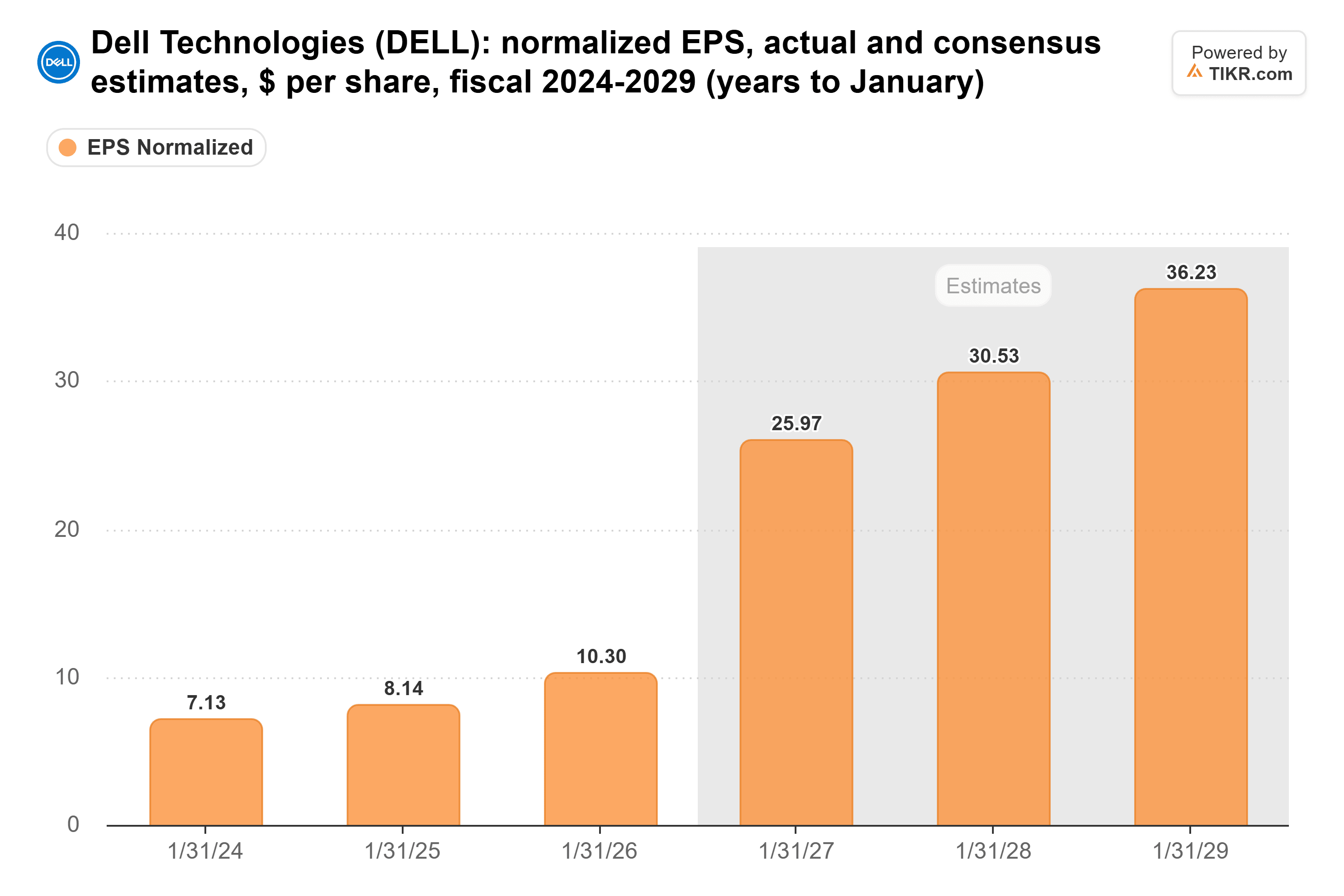
Analysts expect normalized EPS of $25.97 in fiscal 2027 (the year ending January 2027) and $30.53 the year after, up from $10.30 in fiscal 2026.
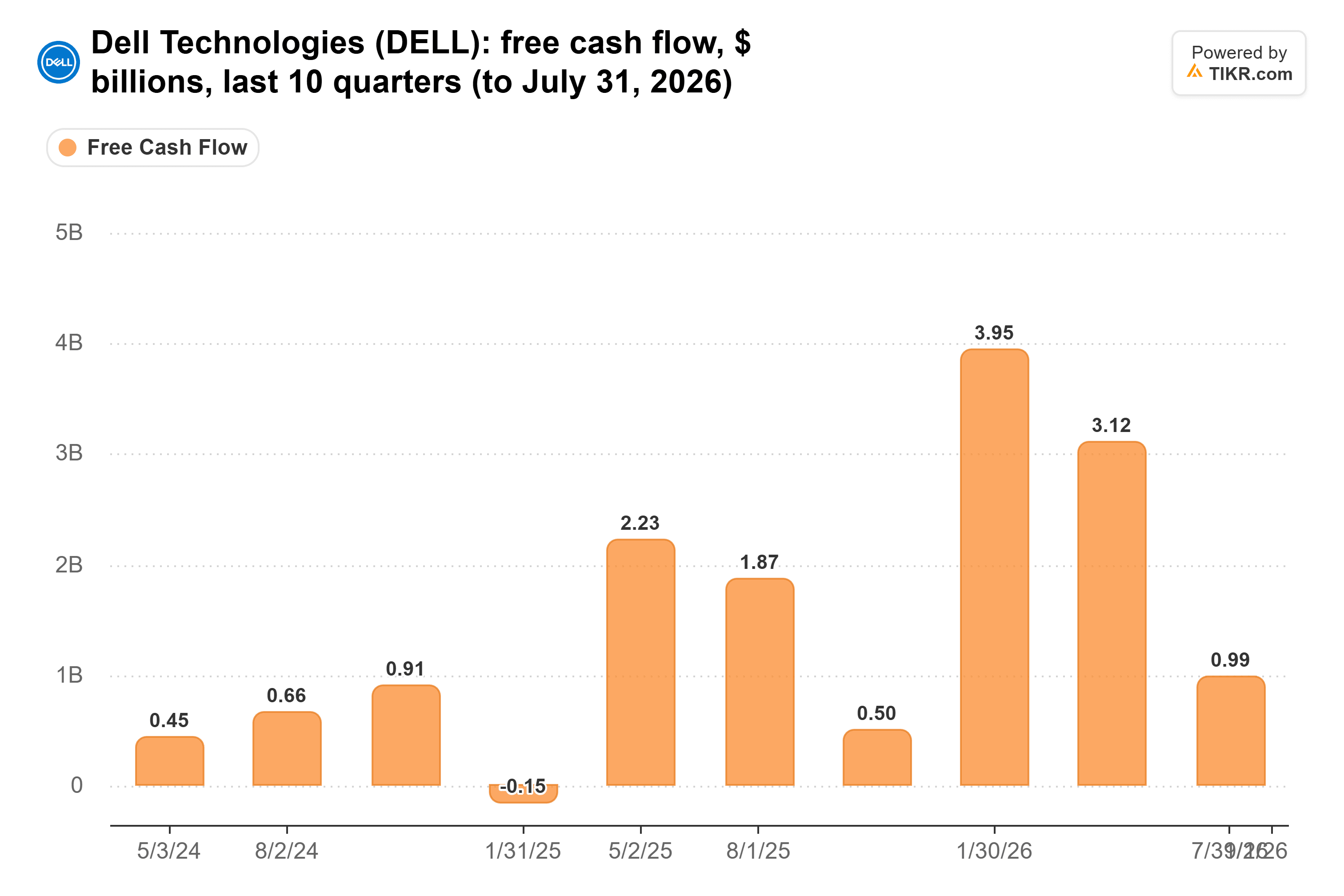
First-half net income more than tripled to $7.6 billion, yet free cash flow was flat at $4.1 billion as financing receivables used $6.4 billion of operating cash. July-quarter free cash flow fell to $986 million, from $3.12 billion in the previous quarter and $1.87 billion a year earlier.
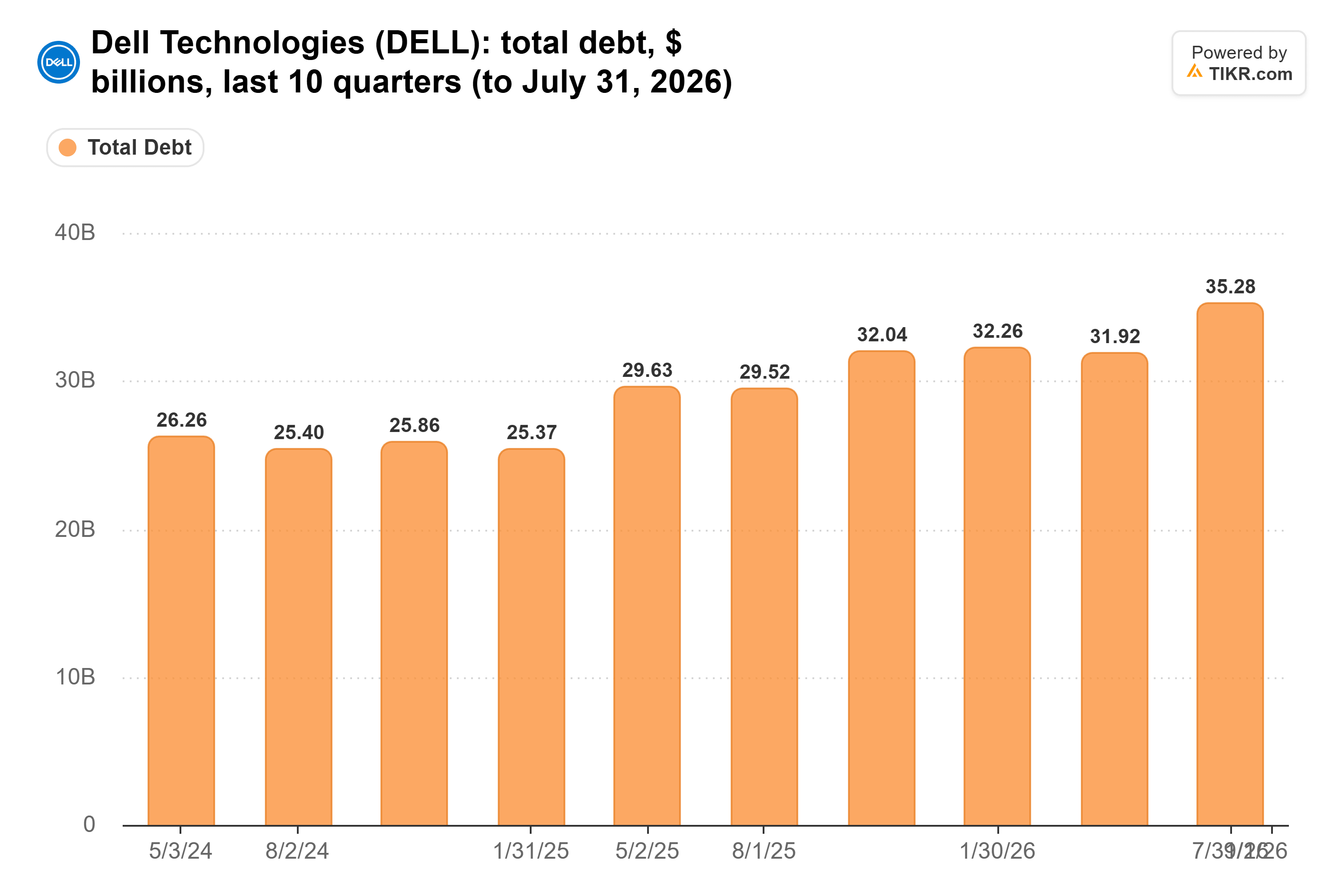
Dell says debt tied to its financing arm largely replaces what it lends. The arm’s own debt, mostly non-recourse securitizations, rose only $479 million in the first half, while net financing receivables grew $6.2 billion. Dell counts the rest as funded by corporate debt, which it assigns using a 7:1 debt-to-equity ratio, and that allocated amount rose $5.5 billion. Senior notes rose $2.5 billion, and Dell sold another $5 billion of notes in September. Total debt principal reached $34.7 billion at July 31, from $31.8 billion in January.
What Dell’s Nov. 24 Report Needs to Show
None of this threatens Dell yet. The second-quarter loss provision of $122 million is small against $4.1 billion of quarterly net income. But it was $11 million a year earlier. If customers fall behind just as used AI servers lose value, Dell would take the credit losses and recover less from the equipment, the same kind of double hit Dudley described for NVIDIA.
When Dell reports on Nov. 24, I want three things: the lower-grade share stops climbing, the provision comes in below $122 million, and free cash flow catches up with net income. A strong NVIDIA outlook on Nov. 17 would make those borrowers look safer.
So What Is Dell Stock Actually Worth?
TIKR lets you forecast the future price of any stock in less than a minute. Just enter a few assumptions into TIKR’s valuation model and see what Dell could be worth. Start from Wall Street consensus estimates, or adjust the inputs to reflect your own view of the business. It’s free to use.
Disclaimer:
Please note that the articles on TIKR are not intended to serve as investment or financial advice from TIKR or our content team, nor are they recommendations to buy or sell any stocks. We create our content based on TIKR Terminal’s investment data and analysts’ estimates. Our analysis might not include recent company news or important updates. TIKR has no position in any of the stocks mentioned. Thank you for reading, and happy investing!


