
Key Takeaways
- Johnson & Johnson stock is up 15% in the past month to a new 52-week high, as investors moved out of tech and into healthcare stocks like Eli Lilly.
- J&J’s pipeline gave those investors reasons to pick it, from Phase 3 psoriatic arthritis data for its Icotyde pill to an FDA approval for Rybrevant Faspro in head and neck cancer.
- Analysts expect J&J’s earnings to grow less than 4% a year through 2027, so the stock’s gains have come from a higher multiple.
- The stock looks like a hold for now, with J&J’s Dec. 8 outlook for 2027 set to show if earnings can match the price.
Johnson & Johnson (JNJ) stock is up 15% in the past month to a new 52-week high, while the S&P 500 fell 3% and the Nasdaq 100 fell 9%. Eli Lilly (LLY) did even better, up 24%.
Most of that came from money leaving tech for healthcare. But J&J gave those buyers plenty of reasons to pick it, and the question now is how much is left in the tank.
Healthcare became the place to hide
The month’s biggest gains came on days when investors dumped tech. On Oct. 22, the Nasdaq 100 fell 3%, and money moved into healthcare and consumer staples after Procter & Gamble beat estimates that morning. J&J had no news of its own big enough to explain its jump that day. Then on Nov. 4, stocks surged after Democrats won both houses of Congress in the midterms, and healthcare rose with the market.
Lilly’s bigger gain shows the whole group moved: investors wanted big drugmakers as a place to hide from tech.
TIKR tracks 23 analysts on Johnson & Johnson. How many say “Buy”?
See the full breakdown of Buy, Hold, and Sell ratings on Johnson & Johnson, along with Wall Street’s revenue and earnings estimates, all in one place. More than 500,000 investors use TIKR to research stocks like this one. See Johnson & Johnson’s Analyst Ratings
The pipeline gave buyers a reason
J&J came into the month on a down note. Its stock fell 6% on Oct. 13, the day it raised its 2026 guidance but reported MedTech sales growth of just 2.5%. That evening, Chairman and CEO Joaquin Duato told Jim Cramer on Mad Money that Tremfya’s momentum reinforces “our belief that it can grow into a $10 billion franchise.” That’s nearly double its 2025 sales of $5.2 billion, and its third-quarter sales jumped 68% to $2.40 billion.
The good news kept coming. On Nov. 5, the FDA gave Rybrevant Faspro accelerated approval in head and neck cancer. Two days later, J&J reported Phase 3 psoriatic arthritis data for Icotyde, the psoriasis pill Britain approved on Oct. 23. It got 58% of biologic-naive patients to an ACR20 response, which means at least a 20% improvement in key symptoms. And on Nov. 10, Caplyta won a second Phase 3 trial in bipolar mania, which sets up a planned FDA filing.
Investors are already paying for 2028
The earnings haven’t kept up with the stock. J&J’s Firefly Bio and Sail Biomedicines deals cut adjusted EPS by $0.64 this year and $1.36 in 2027. Consensus has normalized EPS rising under 4% a year from 2025 to 2027, then jumping 20% in 2028:
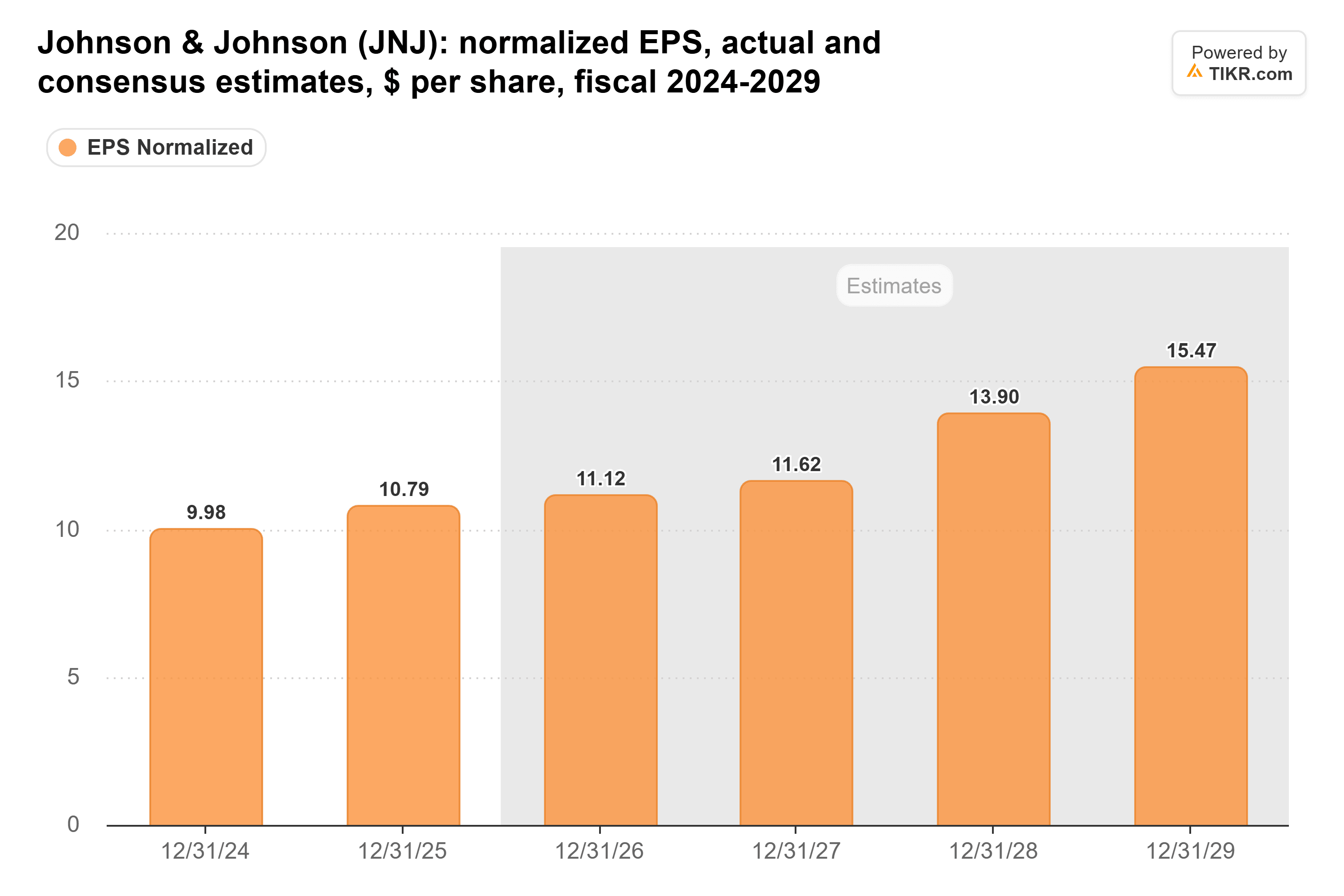
The multiple did the climbing instead. J&J’s forward P/E was already far above its history in late October. It has since reached about 26x, its highest in five years and well above its 17x average:
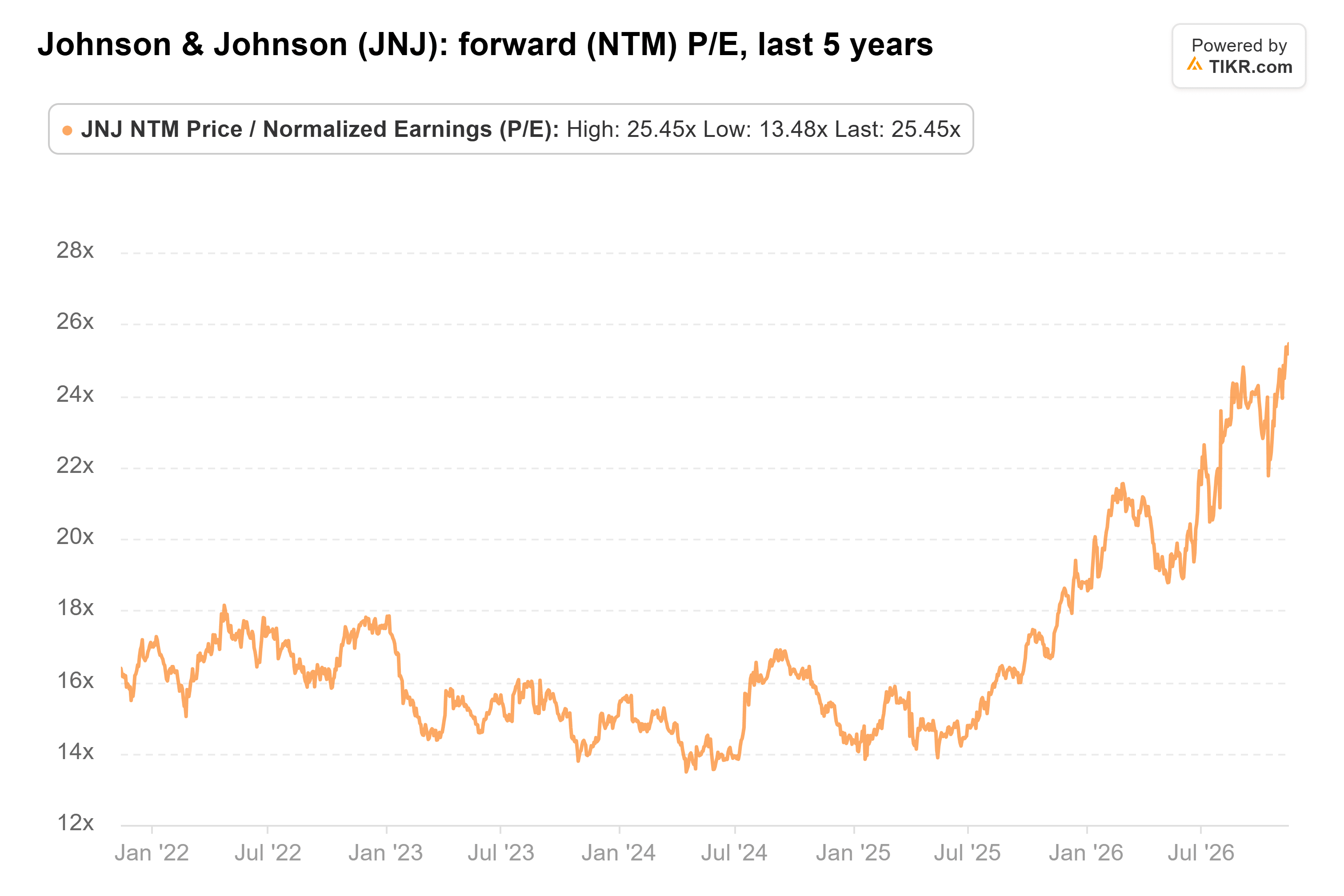
Even on 2028’s $13.90 estimate, the stock trades at about 21x.
Wall Street has chased it. The average price target climbed from $201 to $279 over the past year, and the stock now trades a little above it:
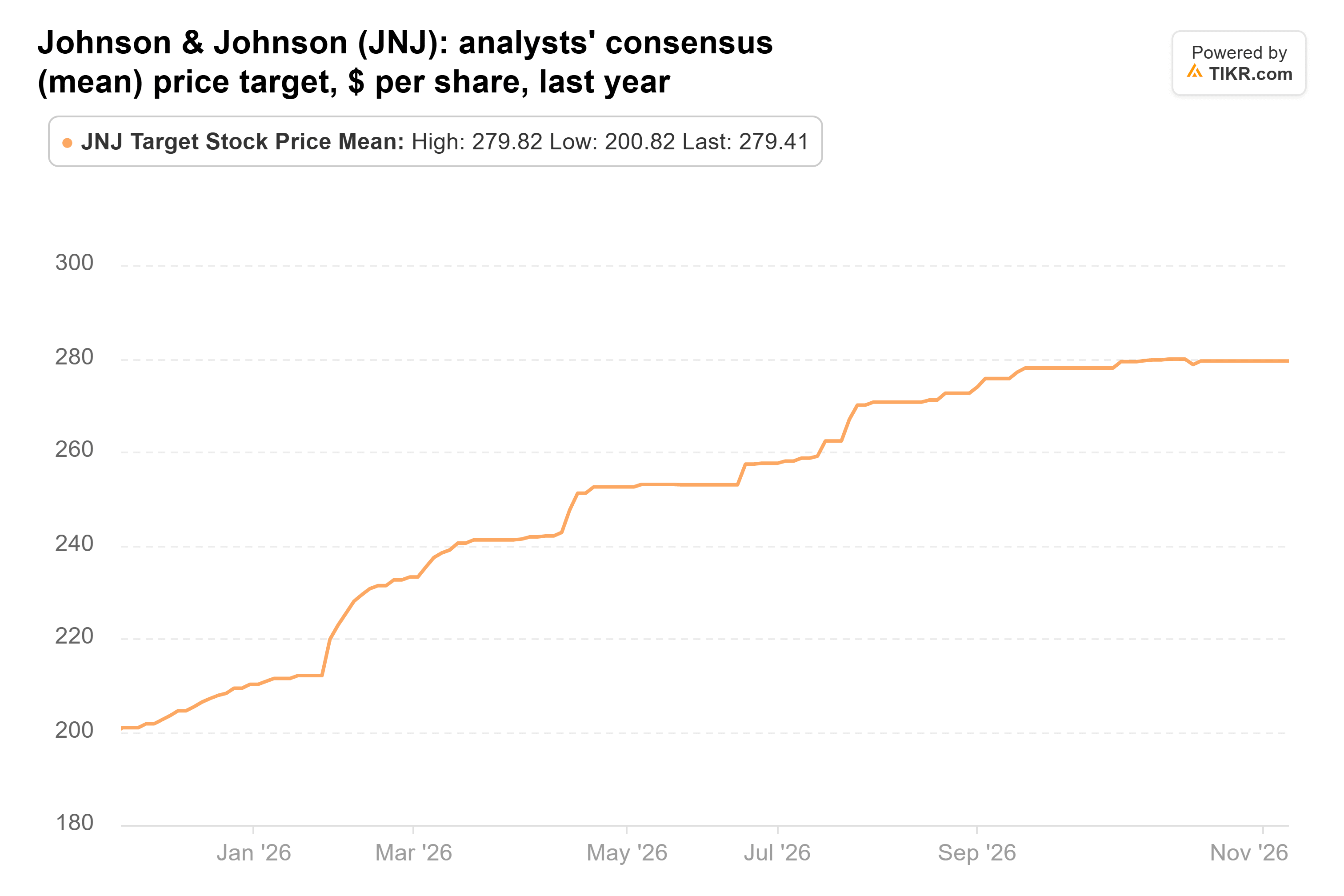
UBS rates it a Buy with the Street’s high target of $320. Bank of America has a Hold and a $275 target, which is below where the stock trades.
Wait for Dec. 8
J&J gives its 2027 outlook at an Enterprise Business Review on Dec. 8. CFO Joe Wolk said in September that products with $4 billion to $4.5 billion of sales lose exclusivity in 2027. Guidance at or above the $11.62 EPS consensus would help defend this multiple. The talc settlement also still needs 95% of the remaining ovarian claims to sign on.
I’d hold J&J here and wait for Dec. 8 before buying more. The business is in better shape than it was a year ago. But at a five-year-high multiple and a little above the average target, the price already reflects much of that. Of course, if money keeps fleeing tech, J&J could keep climbing before Dec. 8.
So what is Johnson & Johnson stock actually worth?
TIKR lets you forecast the future price of any stock in less than a minute. Just enter a few assumptions into TIKR’s valuation model and see what Johnson & Johnson could be worth. Start from Wall Street consensus estimates, or adjust the inputs to reflect your own view of the business. It’s free to use.
Value Johnson & Johnson for free
Disclaimer:
Please note that the articles on TIKR are not intended to serve as investment or financial advice from TIKR or our content team, nor are they recommendations to buy or sell any stocks. We create our content based on TIKR Terminal’s investment data and analysts’ estimates. Our analysis might not include recent company news or important updates. TIKR has no position in any of the stocks mentioned. Thank you for reading, and happy investing!