Key Takeaways
- Johnson & Johnson stock is up 42% in the past year. Over that stretch it moved to settle its ovarian talc claims, and its newer drugs made up for Stelara’s decline.
- Drug sales grew 7.7% in the third quarter, while MedTech grew 2.5% and missed estimates for a second straight quarter.
- The forward P/E has climbed to 24x against a five-year average of 17x, while deal costs hold expected earnings growth under 4% a year through 2027.
- The stock is a hold until J&J’s 2027 outlook on Dec. 8 shows whether growth can survive $4 billion-plus of lost exclusivity.
Johnson & Johnson (JNJ) is up 42% in the past year, and it fixed a lot along the way.
It moved to settle its ovarian talc suits, its newer drugs are making up for Stelara’s slide, and its OTTAVA surgical robot won U.S. authorization. But investors have already paid for much of that. So is it time to take profits, or buy more?
Talc finally has a price
On July 27, J&J proposed a $5.5 billion resolution of its remaining 76,000 or so ovarian talc claims. Five days earlier, the federal judge overseeing those claims had ordered plaintiffs to show why they shouldn’t be dismissed.
The deal needs at least 95% of those claims to sign on, and CFO Joe Wolk has said participation is trending toward that bar. Mesothelioma suits aren’t part of it, so talc isn’t completely behind J&J.
Drugs did the heavy lifting
Innovative Medicine sales grew 7.7% to $16.76 billion in the third quarter. Tremfya led the way at $2.40 billion, up 68%. Over the first nine months of 2026, Tremfya added $2.48 billion of sales, almost covering the $2.74 billion Stelara lost to biosimilars.
More than 20,000 U.S. patients have started Icotyde, the psoriasis pill J&J launched this year, and Britain approved it on Oct. 23.
Chairman and CEO Joaquin Duato sounded confident in the third-quarter release: “This progress, together with strategic investments in high-growth areas, gives us clearer line of sight to double-digit growth by the end of the decade.”
TIKR tracks 23 analysts on Johnson & Johnson. How many say “Buy”?
See the full breakdown of Buy, Hold, and Sell ratings on Johnson & Johnson, along with Wall Street’s revenue and earnings estimates, all in one place. More than 500,000 investors use TIKR to research stocks like this one. See Johnson & Johnson’s Analyst Ratings
Devices are still the weak half
MedTech is the drag. Its sales grew just 2.5% to $8.64 billion in the third quarter, missing Wall Street’s estimate for a second straight quarter. Its operational growth has slowed from 4.6% in the first quarter.
The stock fell 6% on Oct. 13, the day J&J reported, even though the company raised its 2026 adjusted EPS guidance to $11.10 at the midpoint.
Investors are paying ahead of the earnings
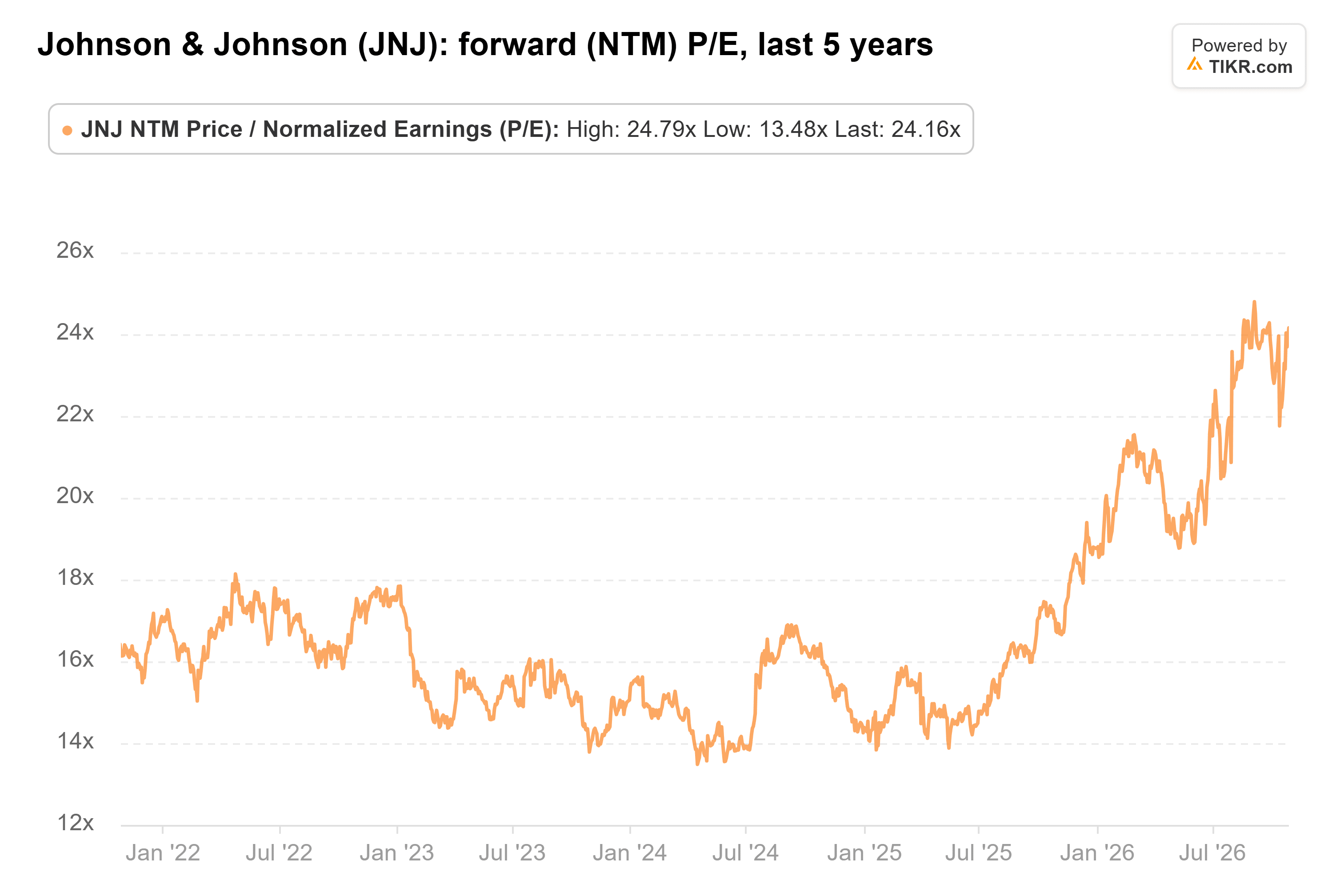
Part of the year’s gain came with the whole group: Merck gained [60%] and Eli Lilly [56%] over the same stretch. Still, J&J’s forward P/E has climbed to 24x, far above its five-year average of 17x and just below its 25x peak in early September:
Earnings haven’t kept pace. In July, J&J cut its 2026 adjusted EPS guidance to $10.96-$11.11 from $11.60-$11.75 because of its Firefly Bio and Sail Biomedicines deals. It says those deals take $0.64 a share from 2026 and $1.36 from 2027. Analysts have cut their 2027 estimate 9% since the end of June, and they now expect normalized EPS to grow less than 4% a year from 2025 to 2027:
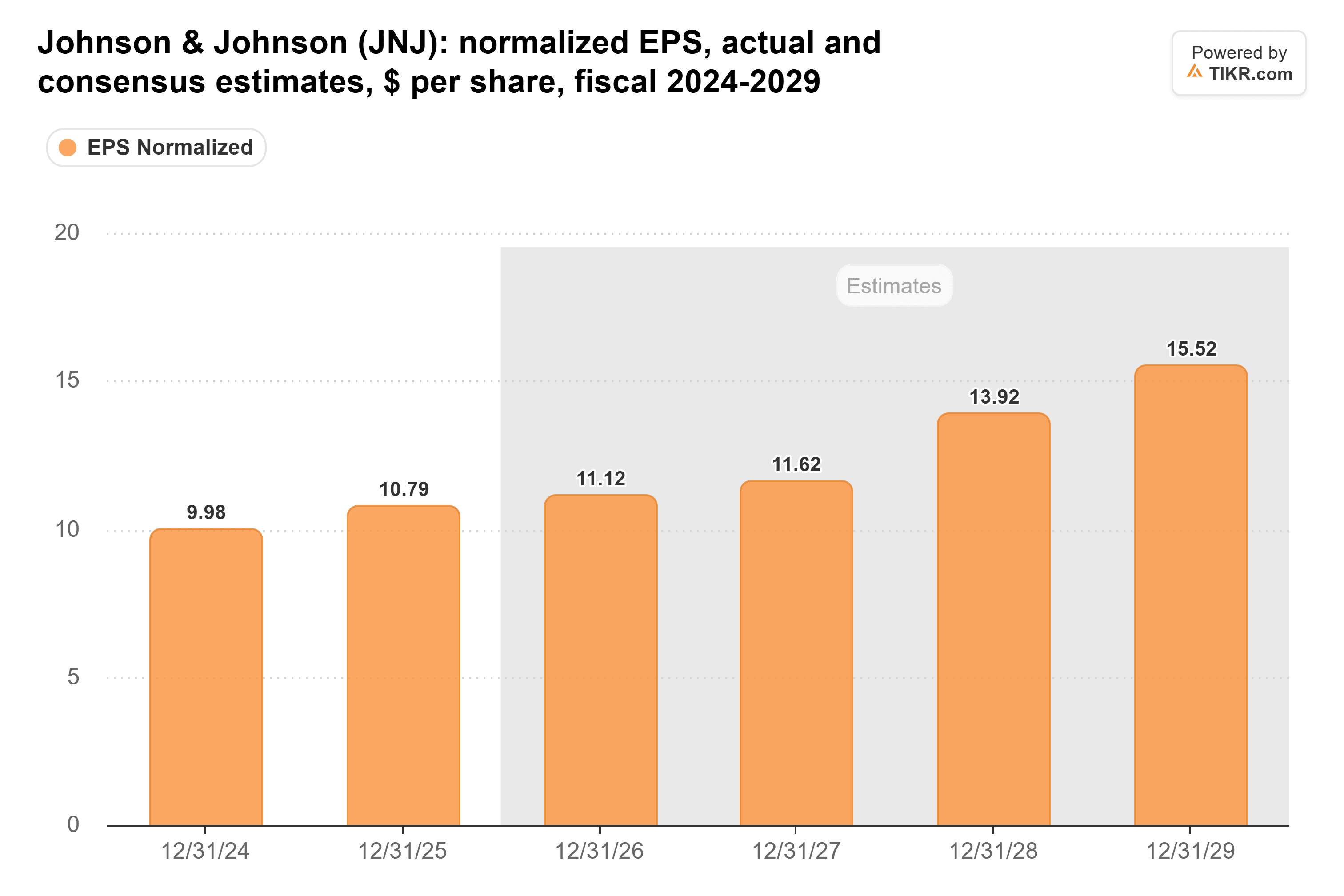
So investors are paying 24x for earnings that barely grow until 2028, when analysts expect a jump to $13.92.
Dec. 8 is the real test
J&J lays out its 2027 outlook on Dec. 8. In September, Wolk said $4 billion to $4.5 billion of products lose exclusivity in 2027. He also said 2027 can still match this year’s reported growth. Analysts mostly agree and expect revenue to reach $108 billion in 2027, up about 7%:
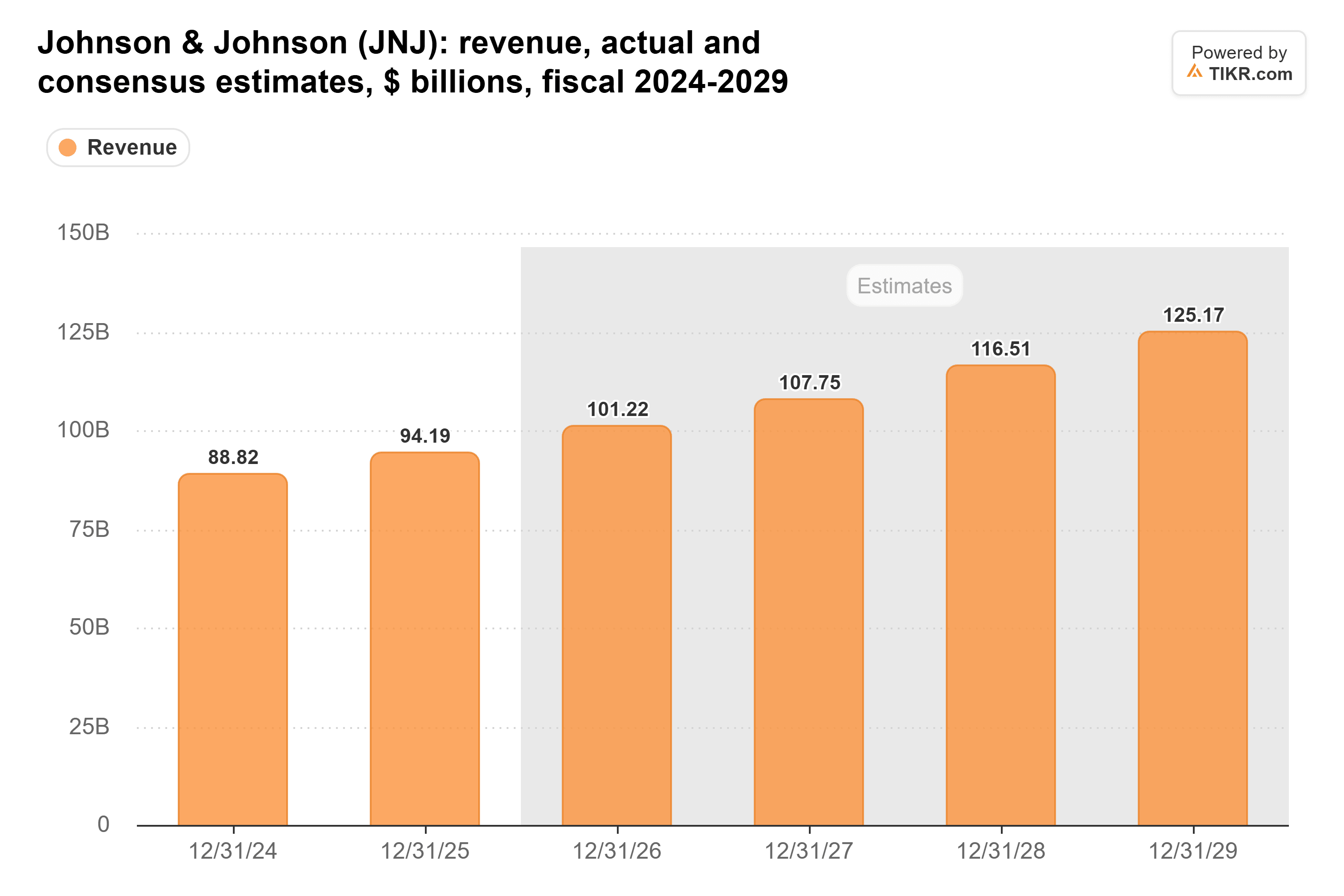
They stop short of Duato’s double digits, though, at 7% to 8% a year through 2030.
Hold, and wait for Dec. 8
So, take profits or buy more? Neither, for now. J&J’s fixes are real. But at 24x forward earnings, with Wall Street’s average target of $279 only a little above the stock, the price already reflects them. I’d hold what I own and wait before buying more.
My take: a 2027 outlook at or above the $11.62 consensus, with the deal dilution included, would make that multiple much easier to defend. Of course, Icotyde’s psoriatic arthritis data and Inlexzo’s bladder cancer data, both due later this year, could move the stock first.
So what is Johnson & Johnson stock actually worth?
TIKR lets you forecast the future price of any stock in less than a minute. Just enter a few assumptions into TIKR’s valuation model and see what Johnson & Johnson could be worth. Start from Wall Street consensus estimates, or adjust the inputs to reflect your own view of the business. It’s free to use.
Value Johnson & Johnson for free
Disclaimer:
Please note that the articles on TIKR are not intended to serve as investment or financial advice from TIKR or our content team, nor are they recommendations to buy or sell any stocks. We create our content based on TIKR Terminal’s investment data and analysts’ estimates. Our analysis might not include recent company news or important updates. TIKR has no position in any of the stocks mentioned. Thank you for reading, and happy investing!