Key Takeaways
- Elon Musk says many of NVIDIA’s supply deals rested on a handshake with Jensen Huang, and that some will be lost now that Huang has resigned as CEO.
- Dylan Patel says Google is already asking NVIDIA’s small suppliers for capacity, and Alphabet has the cash to back that up, with its TPU chips built by Broadcom.
- NVIDIA’s biggest supply lines are signed, with $279 billion of supply and capacity commitments as of July 26, 2026.
- Lost handshake deals are more likely to raise NVIDIA’s costs than cut its shipments, so the margin guide in its Nov. 17 report is the number to watch.
NVIDIA (NVDA) reports on Nov. 17 for the first time without Jensen Huang as CEO. Some of the supply he locked up may never have been written down.
SemiAnalysis founder Dylan Patel told CNBC on Nov. 13 that Huang personally went to the heads of NVIDIA’s suppliers, “even of tiny companies where they only generate a few hundred million dollars of revenue but they have an important subcomponent,” and talked them into selling NVIDIA their output. Now, he says, “Google’s begging for more capacity from the whole supply chain.”
That puts two other companies in the story. Google’s parent, Alphabet (GOOG), designs its own AI chips, called TPUs, with Broadcom (AVGO), so any capacity NVIDIA loses could flow to both.
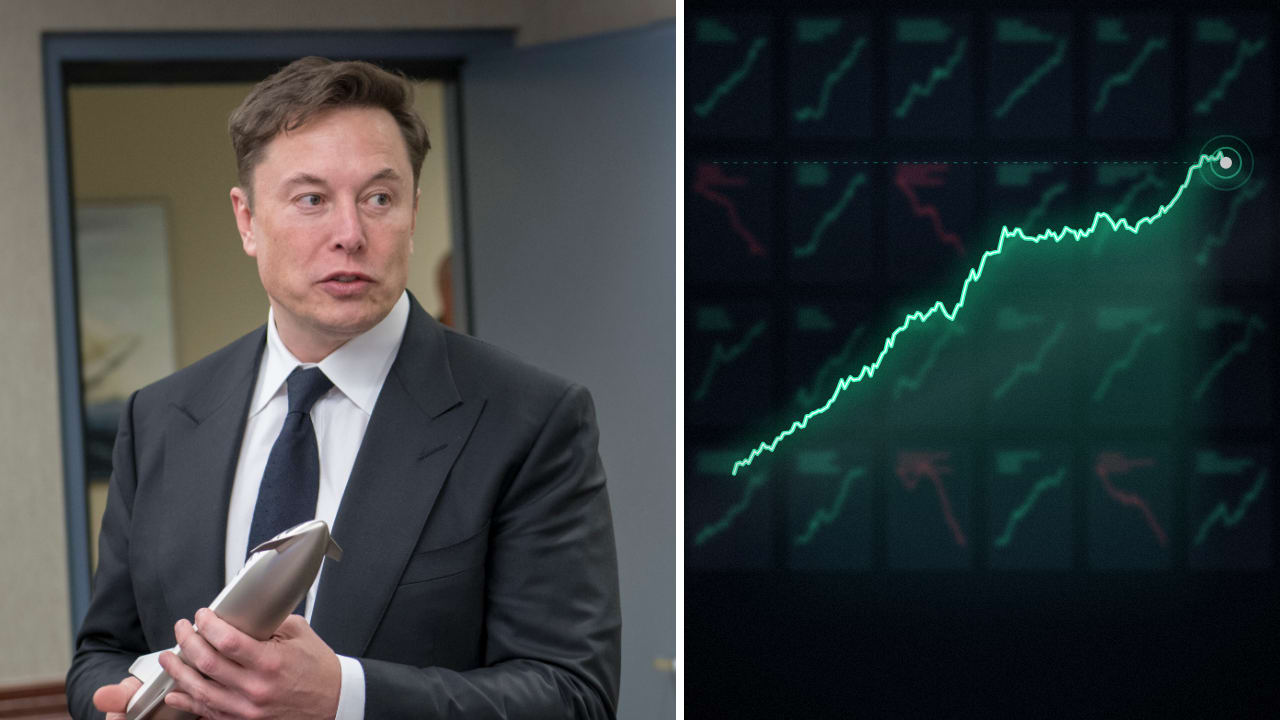
Elon Musk’s response on Nov. 14? Huang “drove supply chain brilliantly at Nvidia, but many of those deals were a handshake with Jensen, not a written contract.”
“Without Jensen, at least some of those critical deals will be lost.”
That’s a real problem for a company that says supply is what limits its growth.
TIKR tracks 62 analysts on Nvidia. How many say “Buy”?
See the full breakdown of Buy, Hold, and Sell ratings on Nvidia, along with Wall Street’s revenue and earnings estimates, all in one place. More than 500,000 investors use TIKR to research stocks like this one. See Nvidia’s Analyst Ratings
A small part can hold up a big rack
A rack can’t ship until every part is in it, so a supplier with a few hundred million dollars of revenue can hold up billions of dollars of NVIDIA systems. Lock that supplier up early, and the racks ship on time. Management expects revenue to grow about 70% in the year to January 2028, and on the Aug. 26 call Huang said demand runs well above that, with supply setting the limit.
Analysts expect earnings to grow at about the same pace. Consensus has normalized EPS going from $9.33 for the fiscal year ending January 2027 to $15.85 for the year after:
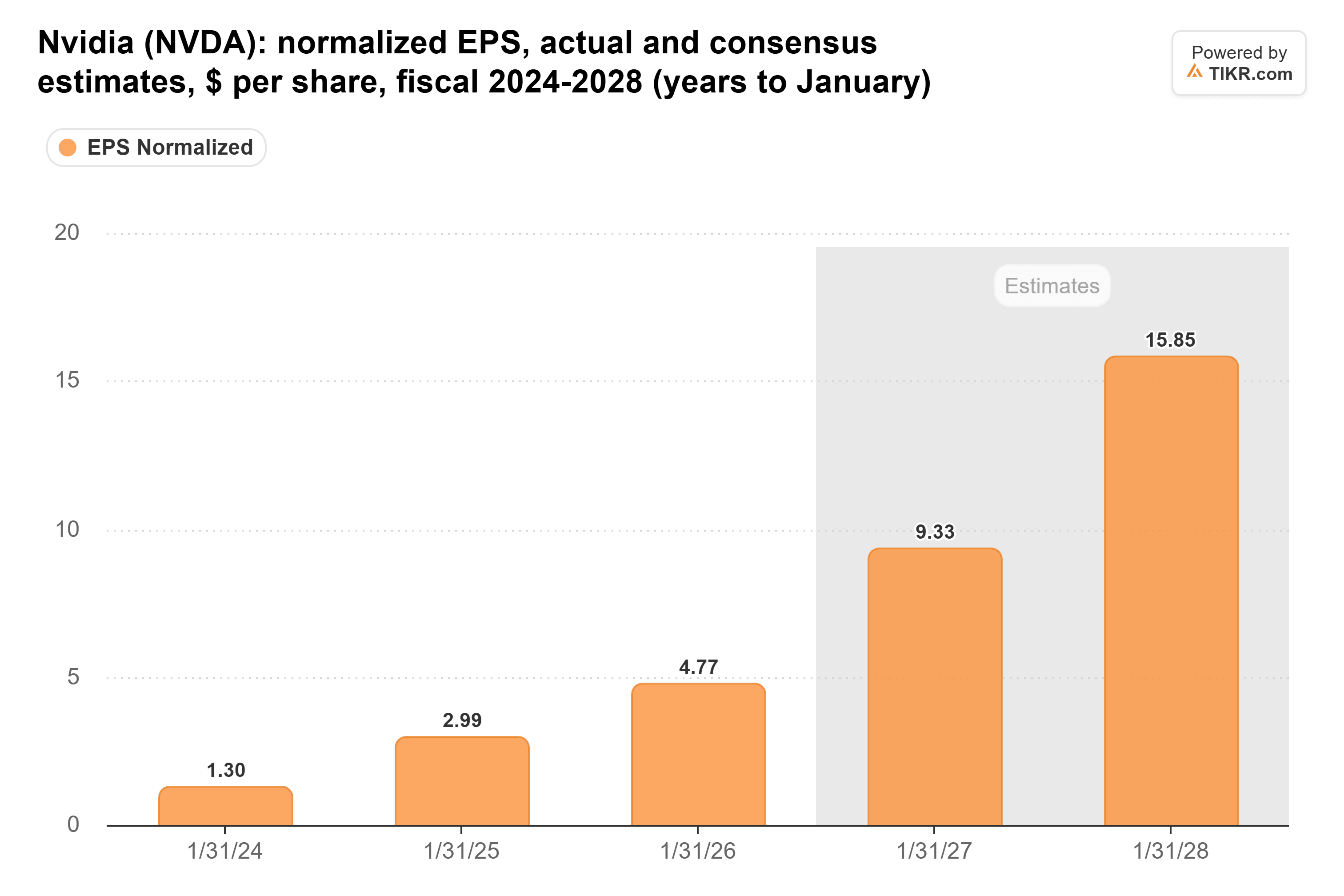
Those estimates have barely moved in the past month. The year-to-January-2028 figure was $15.92 in late October. Nobody can put a number on a handshake yet, but those estimates take for granted that NVIDIA keeps getting its parts.
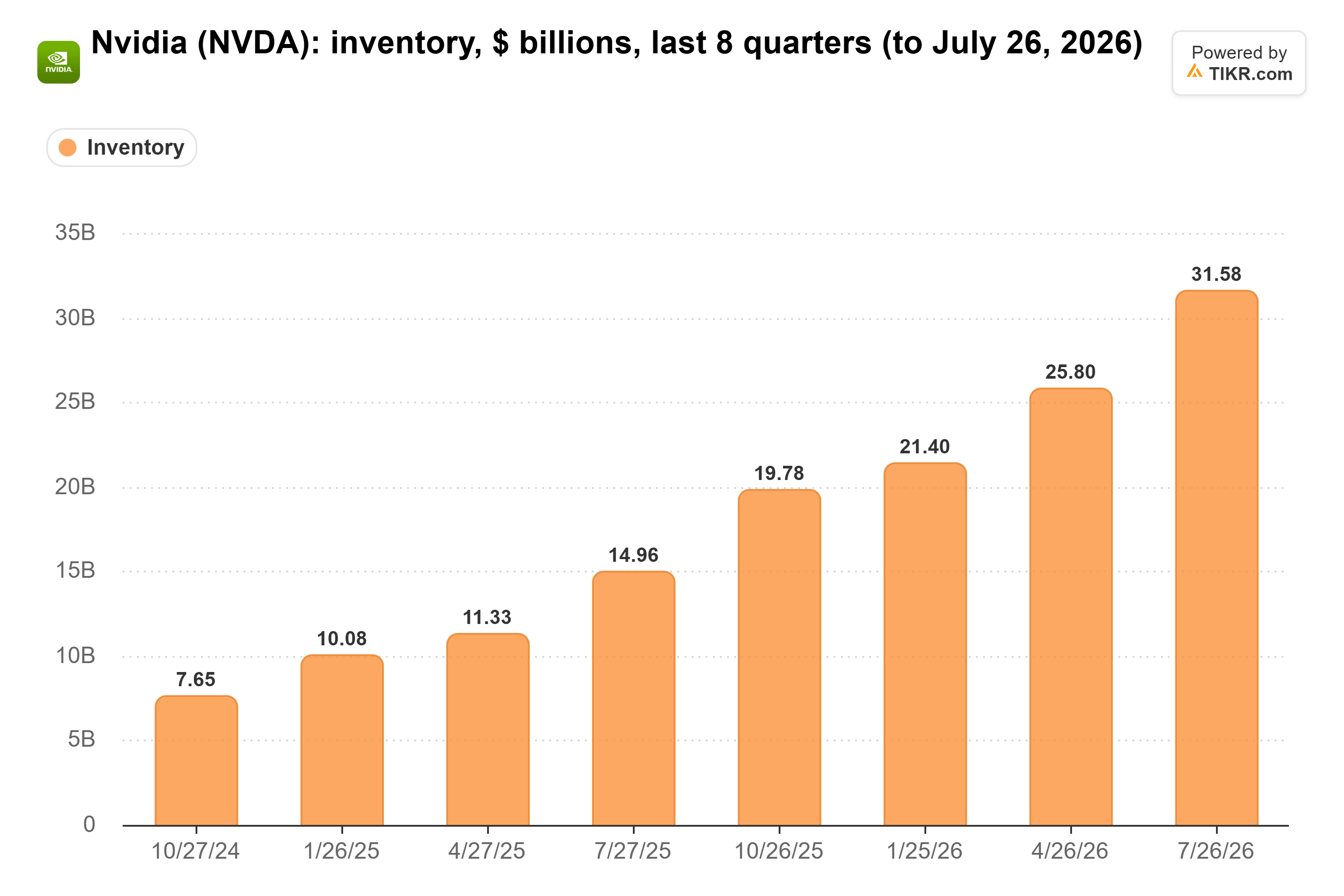
NVIDIA’s balance sheet shows the same lock-up. Inventory has more than quadrupled in under two years, to $31.6 billion as of July 26, 2026:
Google has the cash to bid
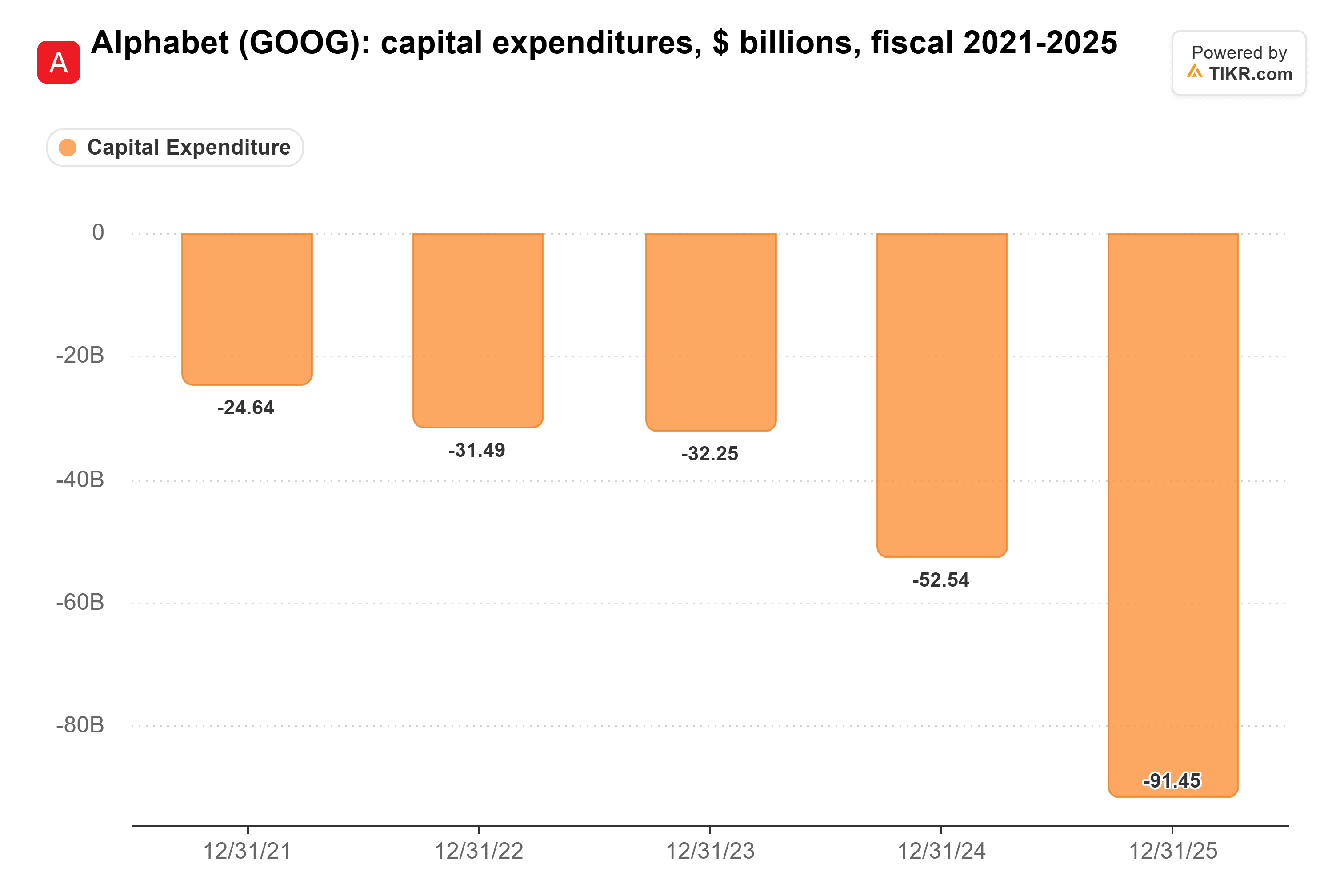
If any capacity comes loose, Google is the obvious buyer. Alphabet spent $91.5 billion on capital expenditures in 2025, up from $52.5 billion in 2024 and $24.6 billion in 2021:
Google also sells its TPU chips to outside buyers now. Morgan Stanley estimates Alphabet’s direct TPU system sales at $84 billion in 2027, up from about $8 billion in 2026. Broadcom builds those chips. It has a long-term agreement to develop and supply Google’s future TPUs, plus a deal to supply networking and other components for Google’s AI racks through 2031. Broadcom closed 5.5% higher on Nov. 12, the day Huang’s exit was announced, as rival chipmakers rallied.
Patel also thinks the parts matter more because NVIDIA’s lead is thin. He calls NVIDIA “only a year ahead of their biggest competitors,” and adds, “It’s not like the gap is massive.”
The big contracts are in writing
Still, NVIDIA’s largest supply lines run on signed commitments. According to its latest quarterly report, its supply and capacity commitments, mostly for memory, reached $279 billion on July 26, 2026, up from $119 billion a quarter earlier. Computer scientist Alexander Wissner-Gross described one possible outcome on the Moonshots podcast: with Huang out for good, NVIDIA “coasts for a while based on their TSMC relationships and based on their stranglehold on silicon output.”
That makes a few lost handshakes more likely to raise NVIDIA’s costs than to cut its shipments. A small supplier with Google on the phone can keep selling to NVIDIA and simply charge more. That would hit a gross margin that’s already heading lower: management expects it to bottom at 71%-72% in the January 2027 quarter as memory prices climb, down from 75.0% in the July quarter.
Where to look on Nov. 17
Musk is probably right that some of those deals slip, and NVIDIA can live with that. Suppliers with a few hundred million dollars of revenue are small next to $279 billion of signed commitments. The trouble is that each of those parts costs more once Google starts bidding, and NVIDIA’s margin has little room to spare. On Nov. 17, the numbers to check are whether inventory and supply commitments keep climbing and whether management holds its 71%-72% margin guide for the January quarter. Colette Kress, now interim CEO as well as CFO, will be the one delivering both.
Whoever runs NVIDIA next can call the same suppliers Huang did, and that could even be Huang himself: the Financial Times reported on Nov. 15 that he has discussed a possible return with confidants, though that report is unconfirmed. Either way, it may take a few quarters to learn which handshakes held.
So what is NVIDIA stock actually worth?
TIKR lets you forecast the future price of any stock in less than a minute. Just enter a few assumptions into TIKR’s valuation model and see what NVIDIA could be worth. Start from Wall Street consensus estimates, or adjust the inputs to reflect your own view of the business. It’s free to use.
Disclaimer:
Please note that the articles on TIKR are not intended to serve as investment or financial advice from TIKR or our content team, nor are they recommendations to buy or sell any stocks. We create our content based on TIKR Terminal’s investment data and analysts’ estimates. Our analysis might not include recent company news or important updates. TIKR has no position in any of the stocks mentioned. Thank you for reading, and happy investing!