Key Takeaways
- AMD fell 20% in two days, starting with an 8% drop after short seller Hunterbrook reported that a blacklisted Chinese server maker kept using newer AMD firmware.
- The firmware is for EPYC server CPUs, and Hunterbrook says its findings don’t prove an export violation.
- The bigger risk is Washington, with a pause on a tighter blacklist rule ending Jan. 10.
- Analysts kept raising AMD’s revenue estimates up to the report.
Advanced Micro Devices (AMD) fell 8% on Thursday after Hunterbrook Media published “AMD Has Its Own China Problem.” Its affiliate Hunterbrook Capital is short the stock. It fell 13% more on Friday, to $424.39, as tech sold off.
The title points to a real gap with NVIDIA (NVDA): AMD billed 22.4% of its 2025 revenue to China and Hong Kong, against 9.1% for NVIDIA, though NVIDIA’s figure counts customers by headquarters.
Jim Cramer called it a “hitjob” on X and said he’d buy and “thank the shortseller for a discount back to where it was before that amazing quarter.” I think he’s right. The report is about EPYC server firmware, and two big AMD server builders, Dell Technologies (DELL) and Hewlett Packard Enterprise (HPE), are growing their server sales fast.
AMD’s China Problem Is a Server CPU Story
The Commerce Department blacklisted the Chinese server maker IEIT Systems in March 2025. Hunterbrook found that IEIT has since built at least six newer versions of AMD’s startup firmware into its server updates, the latest posted Oct. 19 for EPYC Turin servers. It also found that three companies tied to IEIT sell AMD-based servers whose firmware is 99.94% identical to IEIT’s: Maginfra in China, Kaytus in Singapore and Aivres in California.
But Hunterbrook says it doesn’t know how IEIT got AMD’s code or whether anyone held a license to supply it, and that its findings don’t establish an export-law violation. AMD said the claims “misrepresent AMD’s business practices and relationships.”
The business at stake is narrow, too. CNBC’s John Fort said on Power Lunch that, by his read of AMD’s 10-K, the export-restricted part is about $1 billion, mostly MI308 GPUs.
AMD’s Estimates Kept Climbing
Cramer’s “amazing quarter” was AMD’s third, reported Nov. 3, when revenue rose 45% to a record $13.4 billion and Data Center revenue jumped 97%. Analysts expect revenue to nearly triple, from $34.6 billion in 2025 to $95.9 billion in 2027:

That 2027 estimate was $89.2 billion in late October. I don’t see much in the report that should move it, since the 2027 jump rests on Helios GPU racks for OpenAI and other big AI labs, and on a boom in server CPUs for AI agents.
TIKR Tracks 54 Analysts on AMD. How Many Say “Buy”?
See the full breakdown of Buy, Hold, and Sell ratings on AMD, along with Wall Street’s revenue and earnings estimates, all in one place. More than 500,000 investors use TIKR to research stocks like this one. See AMD’s Analyst Ratings
Dell and HPE will give the next read on that CPU demand. In the quarter ended July 31, 2026, Dell’s traditional servers and networking revenue rose 122% to $10.5 billion, and HPE’s server revenue rose 35.3% to $6.8 billion. Neither breaks out AMD, but both build servers on its chips. Dell reports on Nov. 24, and HPE is expected to report the same week.
Meanwhile, the stock trades well below its usual multiple. It was at 32.5x forward earnings at Thursday’s close, against a three-year average of 38.7x and a peak of 66.6x at the end of June:
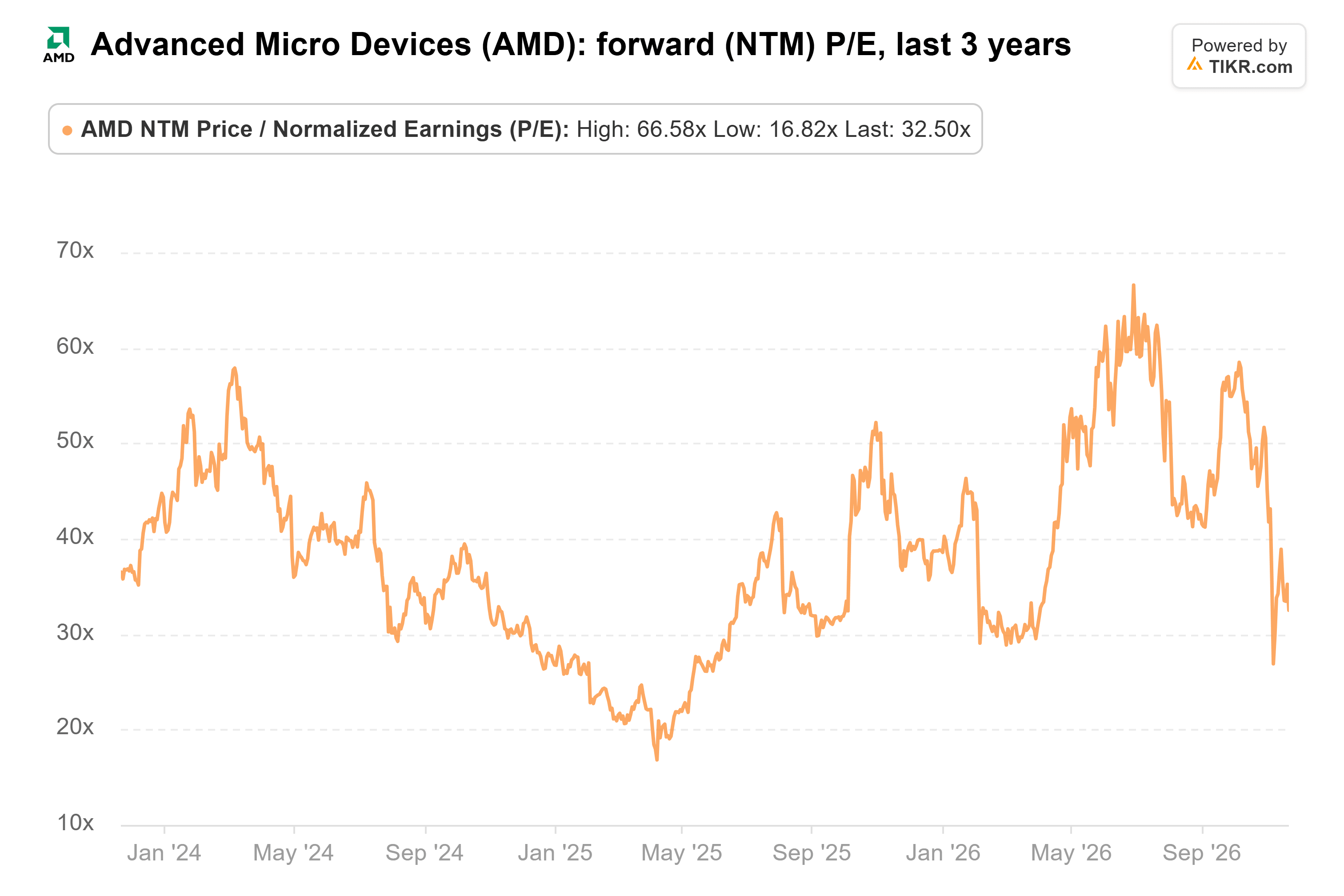
At Friday’s $424.39, the same estimates put it near 28x.
Washington Is the Bigger Risk for AMD
Washington keeps tightening the rules. A Commerce Department rule effective Nov. 19 adds license requirements for advanced US AI chips shipped to Singapore, Malaysia, Thailand, Indonesia and Brazil, which covers AMD’s Instinct GPUs. And on Jan. 10, a pause ends on a rule that extends blacklist limits to companies at least 50% owned by blacklisted ones. Hunterbrook says Kaytus’s audited accounts name IEIT as its parent.
I’d Take the Discount on AMD
For AMD’s growth, I think the China risk is overblown. If IEIT’s affiliates were cut off, AMD would lose server sales to a few brands tied to China, including Aivres, which AMD lists as a maker of Instinct GPU servers, while analysts’ 2027 numbers rest on GPU racks for big AI labs. After a 20% two-day drop, Cramer’s discount looks real to me, with Jan. 10 as the date to watch.
AMD’s fourth-quarter results are the next test. AMD guided to about $17 billion of revenue, plus or minus 3%, and hitting that would show the growth case is intact.
So What Is AMD Stock Actually Worth?
TIKR lets you forecast the future price of any stock in less than a minute. Just enter a few assumptions into TIKR’s valuation model and see what AMD could be worth. Start from Wall Street consensus estimates, or adjust the inputs to reflect your own view of the business. It’s free to use.
Disclaimer:
Please note that the articles on TIKR are not intended to serve as investment or financial advice from TIKR or our content team, nor are they recommendations to buy or sell any stocks. We create our content based on TIKR Terminal’s investment data and analysts’ estimates. Our analysis might not include recent company news or important updates. TIKR has no position in any of the stocks mentioned. Thank you for reading, and happy investing!